Geopolitical Mining · Geopolitical Milestones
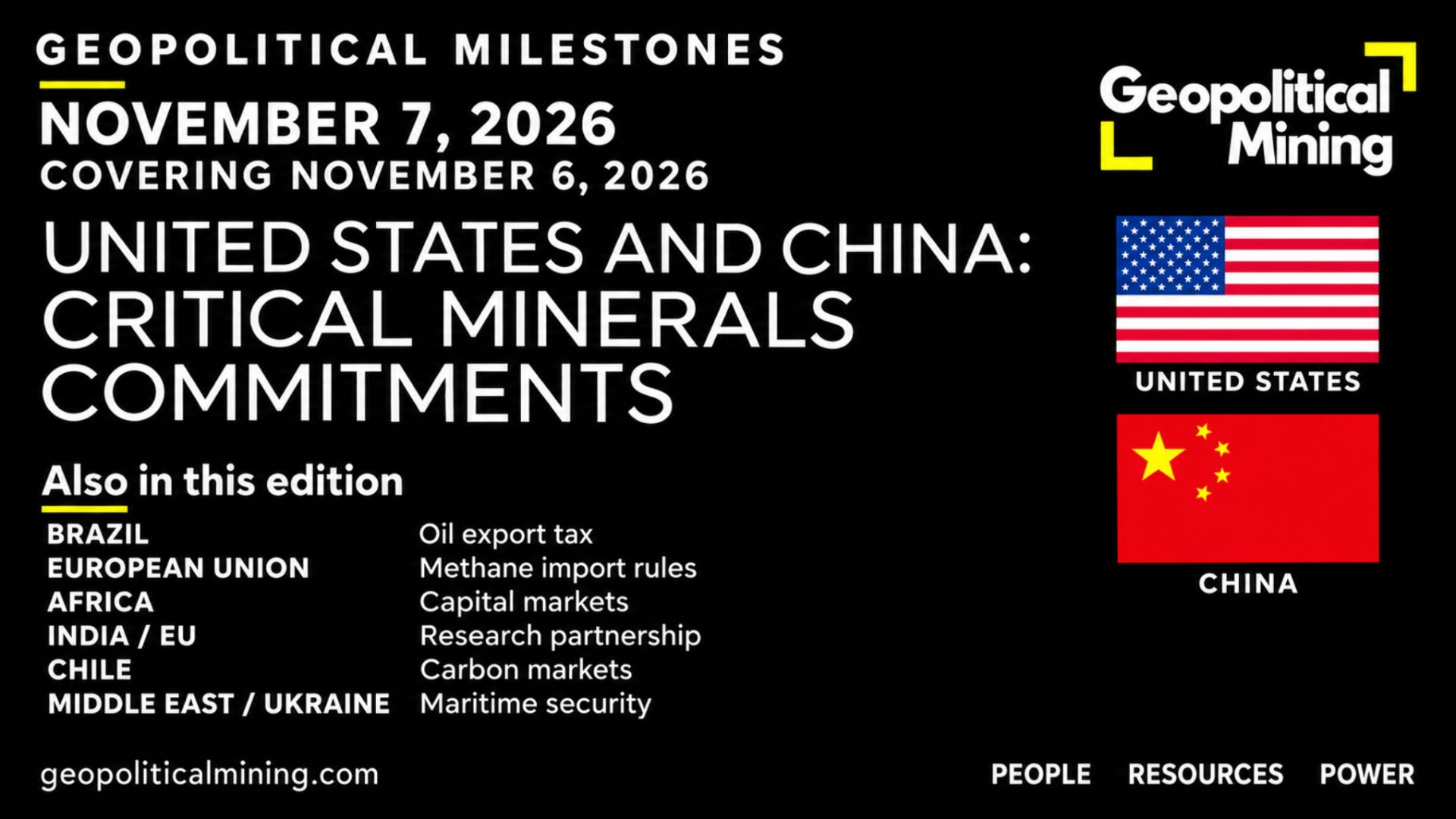
United States Presses China on Rare Earths and Critical Minerals Commitments
Washington’s call for China to deliver on mineral commitments leads seven developments affecting supply, finance and industrial capacity. Brazil’s oil export tax, European energy rules, African capital markets, research cooperation with India, Chile’s carbon market and maritime security reveal the different conditions shaping international investment.
Geopolitical Milestones is a daily briefing for senior executives, investors and policymakers. Each edition examines significant international developments and their implications for investment, business strategy and public policy.
Also in this edition: Brazil’s oil export tax; European methane rules; African capital markets; India’s research partnership with Europe; Chile’s carbon market; and shipping security in the Middle East and Black Sea.
Milestone 01
United States Presses China on Rare Earths and Critical Minerals Commitments
On November 6, U.S. Trade Representative Jamieson Greer and Treasury Secretary Scott Bessent spoke with Chinese Vice Premier He Lifeng. Greer called for concrete action on earlier commitments covering agricultural purchases, rare earths and other critical minerals.
Treasury linked the discussion to implementation of the Busan arrangement. Bessent raised concerns about recent Chinese actions and said further progress depended on concrete results. Neither readout announced new tariffs or a new mineral export restriction.
Geopolitical Mining reading:
The call places mineral supply within the wider trade relationship between the two countries. For manufacturers, an agreement matters when it becomes reliable access to the materials required for production. That makes implementation as consequential as the original negotiation.
At the same time, the diplomatic channel remains active. The commercial issue is how commitments translate into supply while the two governments manage other trade disputes. This leaves room for cooperation, but keeps strategic inputs closely connected to decisions made beyond the purchasing contract.
Milestone 02
Brazil Extends 12% Oil Export Tax Through December
Brazil’s foreign trade committee approved an extension of the 12% tax on crude oil exports through December 31. The decision was taken on November 5 and announced by the Ministry of Development, Industry, Trade and Services on November 6.
The tax has applied since March, when conflict in the Middle East disrupted energy markets. The government links its continuation to maintaining domestic supply. This is an extension of an existing measure, rather than a new tax introduced this week.
Geopolitical Mining reading:
Brazil is using the terms of oil exports to influence the balance between selling abroad and supplying its domestic market. The measure connects the revenue of producers to the availability of feedstock for refining and fuel supply at home.
For an oil exporting economy, higher international prices can improve export earnings while increasing pressure on domestic energy costs. Keeping the tax through December shows how that tension is being managed through trade policy, with direct implications for the commercial value of each route to market.
Milestone 03
European Union Council Backs Delay to Methane Import Rules
The Council of the European Union agreed on November 6 to seek a one year delay to selected methane rules. It cited pressure on energy supply from the Middle East conflict. The proposal covers monitoring obligations for imported oil, gas and coal, alongside later methane intensity requirements.
Under the Council’s position, import monitoring would start on January 1, 2028. Methane intensity reporting would move to August 2029 and maximum intensity levels to August 2031. Agreement with the European Parliament is still required; the existing legal timetable has not yet changed.
Geopolitical Mining reading:
The proposed delay connects Europe’s environmental requirements to the practical availability of energy imports. Compliance depends on information and verification extending beyond European borders, where producers and supply systems operate under different rules.
Allowing more time could ease the adjustment for suppliers while preserving the direction of the regulation. The wider significance is how energy security influences the pace of implementation. That timetable affects both market access for exporters and the energy options available to European industry.
Milestone 04
Africa’s Capital Markets Show Resilience but Financing Gaps Remain
The OECD’s Africa Capital Markets Report 2026, published on November 6, finds that governments and businesses generally retained market access through recent global shocks. However, outcomes varied substantially across countries, and activity remains concentrated in South Africa, Egypt, Nigeria and Morocco.
Corporate debt outstanding stood at US$211 billion at the end of 2025, with syndicated loans accounting for 81%. Only 17% of corporate debt issuance in 2025 was in local currency. These figures describe the financing structure, rather than new investment announced on the publication date.
Geopolitical Mining reading:
The findings bring the financing of productive capacity into focus. Mineral resources and industrial ambitions need funding that can support construction, equipment and years of operation. The depth of local markets influences how much of that capital can be raised domestically.
A wider investor base and stronger institutions can expand those options. Meanwhile, reliance on foreign currency finance connects project economics to exchange rates as well as operating performance. Differences between African markets therefore matter to the terms on which investment becomes possible.
Milestone 05
India and European Union Conclude Horizon Europe Association Talks
The European Commission and India announced on November 6 that negotiations on India’s association to Horizon Europe had concluded. Association is envisaged for January 2027, subject to signature and completion of the required procedures.
The arrangement covers Pillar II, which supports collaborative research in areas including industry, digital technologies, space, climate and energy. Indian organisations would be able to receive funding directly and coordinate projects. India would contribute financially, while awards would remain competitive. The programme’s €93.5 billion budget is not an allocation to India.
Geopolitical Mining reading:
The agreement would deepen the relationship through shared research funding and project leadership. This matters for industrial development because technological capability is built through networks of companies, laboratories and specialists, as well as through investment in physical production.
For European and Indian organisations, common access to funding can make joint work easier to organise. The resulting links could support new technologies and industrial partnerships over time. Their commercial value will emerge from the projects selected and the capacity to bring research into use.
Milestone 06
Chile Advances Carbon Market Rules and International Project Cooperation
Chile’s Environment Ministry reported on November 6 that it had recognised three carbon certification programmes for its international carbon market framework: Verra’s Verified Carbon Standard, Gold Standard and ART TREES. Recognition does not automatically authorise individual projects or emission reductions.
The ministry also reported progress on three programmes with Switzerland covering biomass boilers, electric mobility and energy storage, and eight projects with Japan. The national committee’s endorsement allows final ministerial procedures to proceed. The separate agreement on implementing rules with Japan was reached on October 5.
Geopolitical Mining reading:
Chile is building the rules through which verified emission reductions can support international investment. Certification, national authorisation and bilateral cooperation each have a role in connecting a project to potential buyers and financing.
The technologies involved also link carbon markets to changes in energy use and infrastructure. Their importance extends beyond the certificate itself: credible rules can help turn an environmental outcome into an additional source of project value. Final approvals will determine which activities can use that route.
Milestone 07
Middle East and Ukraine Shipping Attacks Prompt Renewed IMO Warning
The International Maritime Organization’s Council renewed its call for safe shipping routes on November 6. It condemned attacks on merchant shipping in the Red Sea and on vessels and maritime infrastructure supporting Ukraine’s Black Sea corridor.
IMO also reported at least 130 verified attacks on commercial vessels in the Middle East region and 25 seafarer deaths since the conflict began. Its Secretary General said further measures would be examined. The statement did not announce the reopening of a route or a new protection arrangement.
Geopolitical Mining reading:
Maritime security is part of the operating capacity of the global economy. Ships require safe passage, functioning ports and crews able to work and return home. Disruption across several routes makes those conditions relevant to energy, food and industrial supply at the same time.
The Council’s intervention brings the human and commercial dimensions together. Protecting seafarers supports the continuity of trade itself. For commodity supply chains, agreements on production and purchasing remain dependent on the transport systems that connect them.
Continue reading Geopolitical Mining. Explore our daily mining coverage, weekly reviews and country analysis.