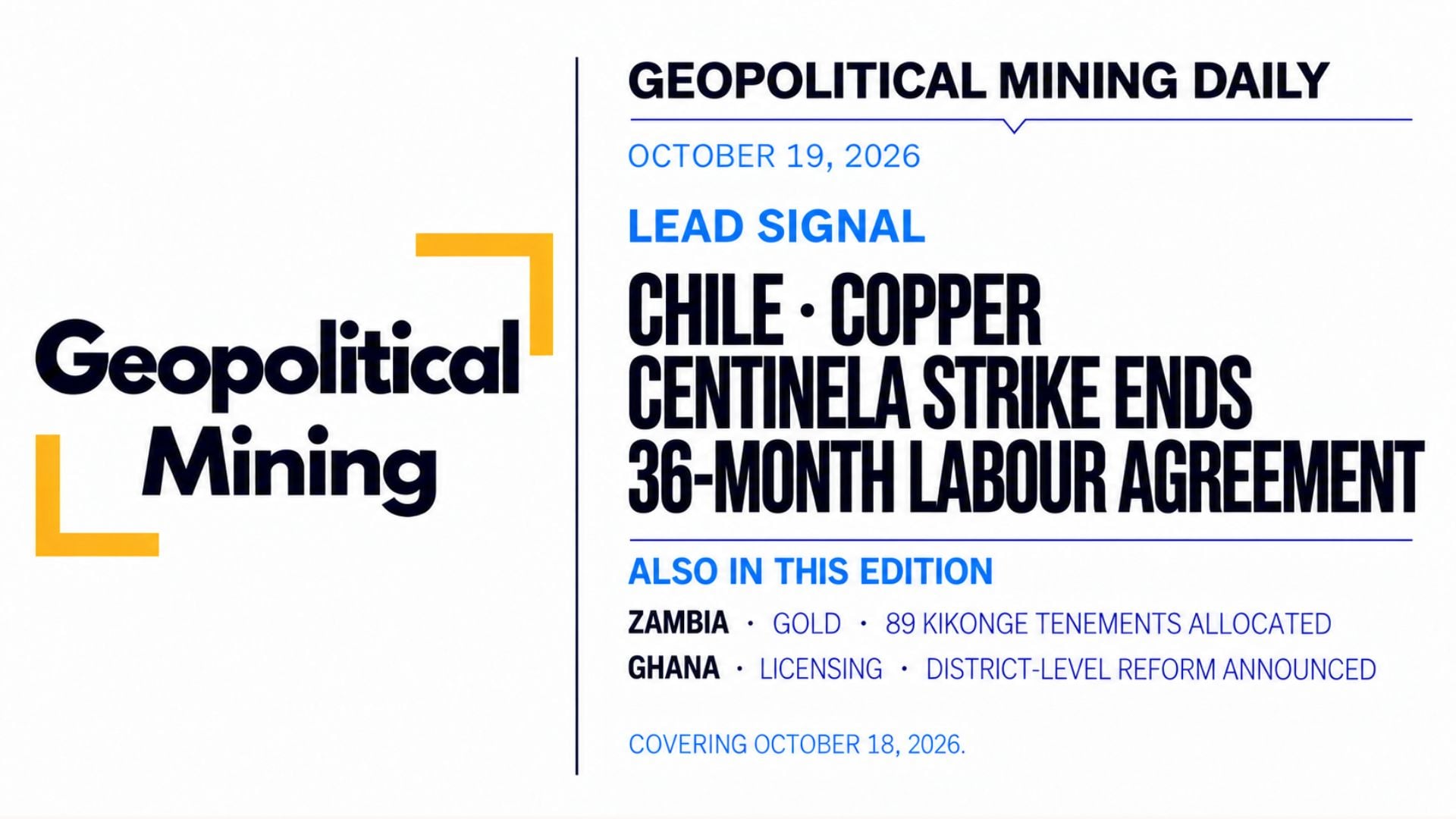

Geopolitical Mining Daily · October 19, 2026
Centinela Strike Ends with a 36-Month Labour Agreement
The Centinela strike ends with a new collective agreement, leading this Geopolitical Mining Daily for senior executives, investors and policymakers. Three developments show how labour settlements, mining rights and local institutions shape the conditions for mineral production.
A copper labour agreement in Chile, gold mining allocations in Zambia and licensing plans in Ghana put institutions at the centre of this edition.
Chile’s labour settlement resolves a specific dispute. Meanwhile, Zambia moves from formalisation plans to allocated mining areas, while Ghana outlines a more local licensing model. These are different stages of change: an agreement concluded, an allocation completed and a reform direction announced. None should be confused with additional mineral output.
The GM observation framework
The ten Signals
Each Daily uses the same ten strategic lenses. The highlighted dimensions classify the developments in this edition.
Chile · Copper and labour relations
Centinela Strike Ends with a 36-Month Labour Agreement
What happened
Minera Centinela and the Esperanza and Distrito Centinela unions announced an agreement on October 18. It ends the strike that began on October 7. The two unions represent 709 workers, or 22% of the company’s own workforce. The new collective agreement runs for 36 months.
Voluntary mediation by Chile’s labour authority brought the parties back to talks on October 13. The settlement includes a CLP24 million bonus for concluding negotiations and renewing shift arrangements, alongside improvements in pay and benefits. However, Centinela says it maintained operational continuity and met its results during the strike. The agreement therefore does not mark a restart of suspended copper production.
The Centinela strike agreement adds contractual certainty to an operating mine. It shows how labour relations and public mediation can shape business conditions without adding reserves or plant capacity. For management, the next task is to deliver the agreed terms. For investors, the change is reduced exposure to this specific dispute, rather than evidence of additional copper supply.
Zambia · Gold mining formalisation
Zambia Allocates 89 Kikonge Mining Tenements to Cooperatives
What happened
Zambia completed the allocation of 89 mining tenements to 89 gold mining cooperatives in Kikonge, Mufumbwe, on October 18, according to ZNBC. The state broadcaster reported directly from officials involved in the process. The allocation advances the administrative organisation of the gold mining area in North-Western Province.
The next steps include operating procedures, identification and controlled access. Each cooperative is to receive 15 access cards, giving a total of 1,335. However, cooperative representatives still seek finance, machinery and technical support. Allocated ground and access arrangements therefore do not establish that equipped operations have started producing gold.
For the state, formalisation requires more than assigning areas on a map. Operators also need workable rules, funding and supervision. Clear boundaries can support accountability, but their value depends on enforcement in the field. This makes the transition from allocation to safe, funded operations the next important test.
First-hand reporting
ZNBC · Ministry completes Kikonge allocation · October 18, 2026Ghana · Mining governance
Ghana Sets Out District Licensing and Community Agreement Plans
What happened
Ghana’s lands and natural resources minister, Emmanuel Armah-Kofi Buah, outlined plans for district-level mining licensing on October 18. Speaking at the launch of mining cooperatives in Ellembelle, he said applications would begin locally rather than require travel to Accra. Ghana News Agency reported the statement from Nkroful.
The minister also described community development agreements under the planned mining framework. Meanwhile, the Minerals Commission urged cooperatives to reserve part of their proceeds for reclamation and community development. These statements connect access to mining rights with responsibilities toward land, water and host communities. They describe the reform direction, rather than a dated notice bringing new district powers into force.
Local administration may reduce the distance between applicants and regulators. However, proximity alone does not guarantee effective oversight. Clear legal powers, trained staff and consistent enforcement will determine whether licensing reform supports responsible operations. The practical test is whether simpler access to formal mining also produces stronger accountability.
First-hand reporting
Ghana News Agency · Minister’s remarks in Nkroful · October 18, 2026The Daily records verified changes. The Signals provide the classification map. The Weekly brings the developments together for the deeper system reading.