Geopolitical Mining · Geopolitical Milestones
EU Opens Accession Clusters with Ukraine and Moldova
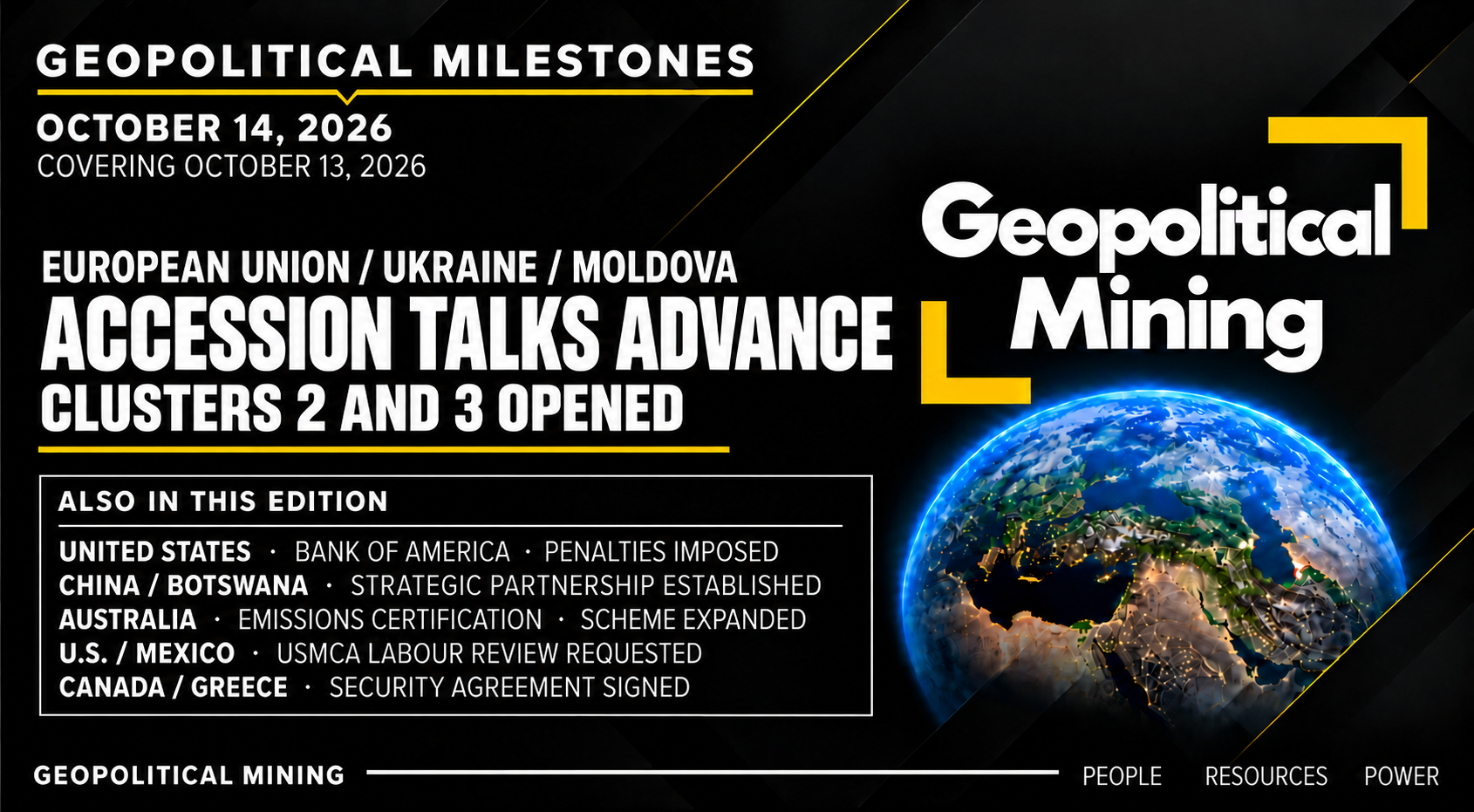
EU accession talks with Ukraine and Moldova advanced on October 13 as both countries opened two economic clusters. The new negotiations cover the internal market, competitiveness and inclusive growth. Meanwhile, this edition tracks bank enforcement, China’s ties with Botswana, Australian emissions certification, USMCA labour rules and defence information security.
Geopolitical Milestones is a daily briefing for senior executives, investors and policymakers. Each edition examines significant international developments and their implications for investment, business strategy and public policy.
Also in this edition: US authorities impose more than $1.21 billion in Bank of America penalties; China and Botswana deepen their partnership; Australia expands emissions certification; the US invokes a labour review in Mexico; Canada and Greece sign an information security agreement.
European integration, market rules and investment
EU accession talks expand to two economic clusters for Ukraine and Moldova
The European Union opened two accession negotiating clusters with both Ukraine and Moldova on October 13. Cluster 2 covers the internal market, while cluster 3 addresses competitiveness and inclusive growth. Together, they comprise 17 chapters for each country. These include rules on goods, workers, services and capital, as well as company law, taxation, financial services and customs. The EU also set benchmarks for the future provisional closure of those chapters.
For executives and investors, the talks identify the next areas of regulatory alignment to track in each market. For example, changes to competition rules and financial services can affect how firms operate and raise capital. However, opening negotiations does not grant EU membership or change tariffs by itself. Progress still depends on reforms and their implementation. Meanwhile, the EU will continue to monitor both countries against its standards. The decisions follow the opening of external relations talks in July.
Council of the European Union
Financial integrity, sanctions compliance and bank controls
US authorities impose more than $1.21 billion in Bank of America penalties
US authorities announced more than $1.21 billion in penalties against Bank of America on October 13. FinCEN assessed $1.2 billion, while the OCC imposed $750 million and OFAC announced an $11.6 million settlement. However, FinCEN credits the OCC penalty against its own assessment. The combined amount therefore excludes double counting that $750 million. The OFAC settlement covers 475 apparent sanctions violations. Meanwhile, Treasury said the bank failed to report more than $5 billion in suspicious transactions on time.
The action also requires independent reviews and a review of earlier transactions. For banks and international businesses, it highlights the need to connect customer checks, transaction monitoring and sanctions screening. In particular, correspondent banking can expose institutions to payments linked to restricted parties across several jurisdictions. The case spans multiple sanctions programmes, including those concerning Russia and Iran. However, the announcements establish the penalties and required corrective work; they do not confirm that the bank has completed payment.
US Treasury · Office of the Comptroller of the Currency
US Treasury · coordinated Bank of America enforcement, October 13
Diplomacy, infrastructure and economic cooperation
China and Botswana deepen strategic ties and formalise Belt and Road cooperation
On October 13, China and Botswana elevated their relationship to a comprehensive strategic cooperative partnership. During President Duma Boko’s state visit to Beijing, the two sides also formalised cooperation documents. These include a Belt and Road cooperation plan and a memorandum listing priorities for that initiative. Their joint statement addresses infrastructure, energy, agriculture, logistics and the digital economy. In addition, it calls for implementation of their cooperation memorandum on green minerals.
For companies and investors, the package defines areas where the two governments intend to support closer economic ties. However, the official accounts do not quantify new financing or confirm completed investment payments. The announcements therefore leave project funding and commercial terms unspecified. Meanwhile, wider access for Botswana’s agricultural exports and an initial trade arrangement still require further work. The milestone is a stronger diplomatic and cooperation framework. It does not establish a new free trade agreement or immediate tariff changes.
Ministry of Foreign Affairs of China
Chinese foreign ministry · joint statement with Botswana, October 13
Chinese foreign ministry · leaders’ meeting and document signatures
Emissions data, industrial exports and product transparency
Australia expands Guarantee of Origin coverage for industrial products and fuels
Australia announced an expansion of its Guarantee of Origin scheme on October 13. The new coverage includes aluminium, iron ore, biogas and biomethane. It also adds hydrogen production routes such as gas reforming, solid gasification and pyrolysis. These join renewable hydrogen, which was eligible from 2025. The voluntary framework records product origin and emissions, while a separate component certifies renewable electricity. It therefore provides evidence about production rather than automatically labelling every eligible product as green.
For producers and buyers, more consistent emissions records can support comparisons across supply chains and export markets. In particular, the scheme can help document the attributes on which purchase and investment decisions depend. However, expanded certification does not by itself confer foreign market access or new subsidies. The government is also consulting on coverage for liquid fuels with low carbon emissions, iron, alumina and ammonia. Those categories remain prospective, while the October 13 announcement confirms the stated expansion.
Australian Department of Climate Change, Energy, the Environment and Water
Australian government · expanded emissions certification, October 13
Trade enforcement, labour rights and automotive supply chains
US invokes USMCA labour mechanism at Mexican automotive textile supplier
The United States requested a Mexican review of Carolina Performance Fabrics on October 13 under the USMCA Rapid Response Labor Mechanism. The facility in Salvatierra, Guanajuato, makes specialised textiles for the automotive industry. US authorities cited alleged violations of freedom of association and collective bargaining rights. They also directed the suspension of customs liquidation for unsettled entries of goods from the facility. This pauses the final assessment of those entries, rather than banning imports.
Mexico has ten days to agree to the review. If it agrees, it has 45 days from the request to complete that review. For buyers and logistics teams, the immediate issue is the customs treatment of goods from this specific plant. Meanwhile, the bilateral process will examine the alleged labour violations. The original union petition dates from September 10, but the new milestone is the October 13 enforcement step. However, initiating the process does not establish a final finding against the facility.
Office of the United States Trade Representative
USTR · Carolina Performance Fabrics review request, October 13
Defence cooperation, information security and industrial partnerships
Canada and Greece sign agreement to protect classified information
In Athens on October 13, Canada and Greece signed a General Security of Information Agreement. The framework covers the secure exchange of classified information between government bodies and authorised contractors. For example, its scope includes defence intelligence and technical data on weapons systems. Both countries are NATO allies.
For defence suppliers, the agreement can help establish the security conditions needed for sensitive industrial cooperation. The Canadian announcement also identifies advanced technology, maritime awareness and infrastructure protection as areas for collaboration. However, it describes those effects as applying once the agreement enters into force. The verified milestone is therefore the signature. It does not confirm new procurement awards or specify a contract value. Meanwhile, businesses considering joint work will need to track implementation and the applicable security requirements.
Government of Canada · Public Services and Procurement Canada
Government of Canada · information security agreement, October 13
Continue reading Geopolitical Mining. Explore our daily mining coverage, weekly reviews and country analysis.