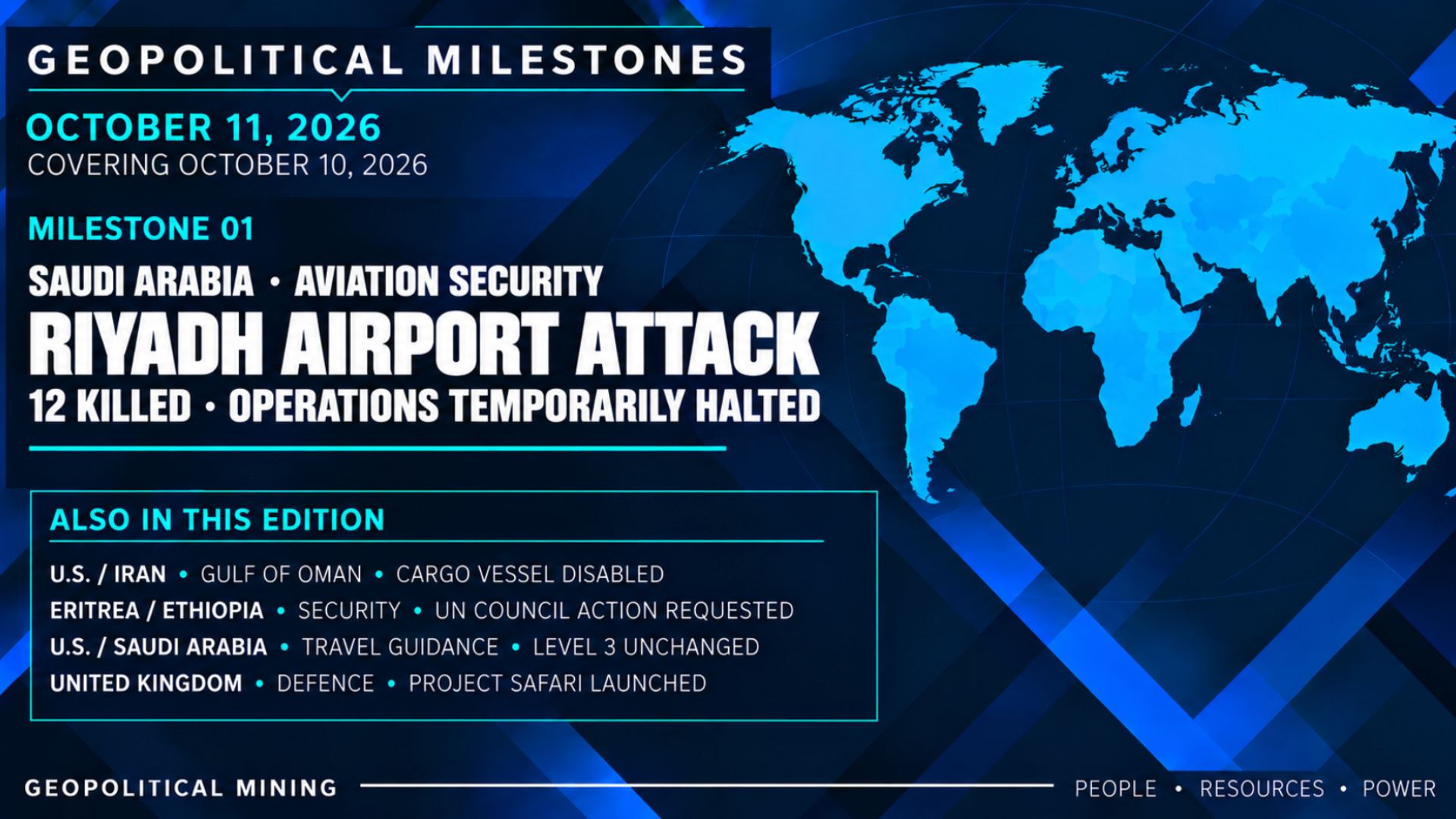

Geopolitical Mining · Geopolitical Milestones
Riyadh Airport Attack Kills 12 and Temporarily Halts Operations
An October 10 attack on King Khalid International Airport killed 12 people and prompted a temporary suspension of operations, Saudi Gazette reported the following day, citing Saudi aviation authorities. This edition also covers a U.S. strike on a cargo vessel in the Gulf of Oman, Eritrea’s appeal to the UN Security Council, updated U.S. travel guidance for Saudi Arabia, and a new British defence testing programme.
Geopolitical Milestones is a daily briefing for senior executives, investors and policymakers. Each edition examines significant international developments and their implications for investment, business strategy and public policy.
Also in this edition: U.S. forces disable a cargo vessel in the Gulf of Oman; Eritrea requests Security Council action; the United States updates Saudi Arabia travel guidance without changing the Level 3 advisory; the United Kingdom launches Project Safari.
Civil aviation, airport security and regional transport infrastructure
Riyadh airport attack kills 12 and temporarily suspends operations
An attack on King Khalid International Airport in Riyadh on Saturday, October 10, killed 12 people and injured 309. According to Saudi Gazette’s early October 11 report, those figures came from Saudi Arabia’s General Authority of Civil Aviation (GACA). Among the fatalities were four Saudi citizens, two Bangladeshi citizens and six other foreign nationals. GACA also said it had temporarily suspended airport operations while emergency teams assessed damage and checked the safety of airport facilities. In addition, Bahrain’s Foreign Ministry condemned what it described as an attack by Yemen’s Houthi movement, in a statement carried by the Saudi Press Agency.
Meanwhile, Riyadh was preparing to host meetings of senior energy officials as the suspension affected one of Saudi Arabia’s principal international airports. The schedule placed the International Energy Forum’s seventeenth ministerial meeting on October 11, followed by the WPC Energy Congress welcome reception that evening. After that, the schedule listed the congress’s formal inaugural session on October 12. The attack thus placed airport access and security alongside energy diplomacy during an unusually important week for the capital.
Sources: Saudi Gazette citing GACA · Saudi Press Agency · WPC Energy
Saudi Gazette · October 11 report citing GACA on casualties and temporary airport suspensionSaudi Press Agency · Bahrain Foreign Ministry condemns what it calls a Houthi attack
WPC Energy · official October 11 reception and October 12 congress opening schedule
Maritime enforcement, military operations and Gulf trade routes
U.S. forces disable cargo vessel in Gulf of Oman blockade
U.S. Central Command (CENTCOM) said its forces disabled a commercial cargo ship in the Gulf of Oman on October 10 after it disregarded repeated warnings and attempted to cross the continuing U.S. blockade against Iran. According to the command, a U.S. fighter jet struck the stern of the M/V Ocean Molica, also known as the Arika Sun, a vessel sailing under Panama’s flag. CENTCOM also reported that the strike disabled the ship’s propulsion without injuring the crew.
The command also said the ship had earlier departed an Iranian port. Specifically, it described the operation as enforcement of a blockade that U.S. forces resumed on July 14. According to CENTCOM, its forces had disabled four commercial vessels and turned around 135 ships during that period. In addition, the command advised crews navigating the Gulf of Oman and the approaches to the Strait of Hormuz to follow maritime warnings. It also urged them to maintain communication with U.S. naval forces. CENTCOM is the source for those operational figures and the account of the strike.
U.S. Central Command · official press URL and reproduced release
U.S. Central Command · October 10 official press releaseForth · text of CENTCOM’s October 10 release reproduced from the command
Horn of Africa security, diplomacy and United Nations procedures
Eritrea asks UN Security Council for deterrent measures against Ethiopia
In a letter dated October 10, Eritrean Foreign Minister Osman Saleh asked the United Nations Security Council to condemn what Eritrea described as Ethiopia’s threatened aggression and to take deterrent measures under Chapter VII of the UN Charter. In response to Ethiopian communications of October 9, the letter also rejects Ethiopia’s claim that its military actions were defensive. The document has two pages and bears Saleh’s signature and the Eritrean Foreign Ministry’s seal.
The letter places Eritrea’s request for Security Council intervention alongside competing accounts of military operations and renewed fighting in northern Ethiopia. Claims concerning responsibility for the escalation reflect the respective governments’ positions rather than independent Council findings. The document carries an October 10 date, while the Eritrean Center for Strategic Studies published it on October 11.
Eritrea Ministry of Foreign Affairs · published document; United Nations
Eritrea Ministry of Foreign Affairs · October 10 signed letter to UN Security Council (PDF)Eritrean Center for Strategic Studies · publication of the letter on October 11
United Nations · Secretary-General statement on renewed hostilities, published October 10
Travel guidance, aviation risk and government personnel security
U.S. updates Saudi Arabia travel guidance, maintaining Level 3
The U.S. Department of State updated the summary of its Saudi Arabia travel advisory on October 10 while maintaining Level 3, which recommends reconsidering travel. Its terrorism and other risk indicators also remained unchanged. Specifically, the notice warns about missile and drone threats, armed conflict and terrorism. In addition, it states that U.S. government employees working in Saudi Arabia require special authorization to use King Khalid International Airport in Riyadh. The department also prohibits those employees from traveling within 20 miles of the Yemen border.
However, those restrictions on U.S. government personnel are distinct from the broader advisory to private travelers. The State Department says commercial flights remain operational in Saudi Arabia, although significant disruptions have sometimes occurred. For employers, carriers and other organizations arranging international movements, the update provides government travel guidance rather than a general order closing Saudi airspace.
U.S. Department of State
U.S. Department of State · Saudi Arabia Level 3 travel advisory and October 10 update historyDefence industry, advanced weapons testing and innovation
UK launches Project Safari and signs Hebrides range design agreement
The United Kingdom’s Ministry of Defence and QinetiQ announced Project Safari on October 10 to simplify access to the country’s military test and evaluation facilities for small and medium enterprises in the defence sector. To this end, the programme aims to give firms a single point of contact and streamline approvals for technology trials. For example, these include tests of hypersonic weapons, directed energy systems and autonomous equipment. In this way, it addresses practical barriers that can delay testing before new capabilities enter service.
The same announcement also reported that Defence Readiness and Industry Minister Luke Pollard signed an agreement with QinetiQ. In particular, this covers the first design stage of a programme worth millions of pounds to develop the MOD Hebrides weapons testing range. The planned improvements aim to enable tests of hypersonic missiles and other advanced systems. At this stage, the signed step concerns initial design work, while the broader Project Safari programme concerns access and approvals across sovereign testing facilities.
Continue reading Geopolitical Mining. Explore our daily mining coverage, weekly reviews and country analysis.