
Geopolitical Mining · Geopolitical Milestones
Africa Credit Rating Agency Launches in Mauritius
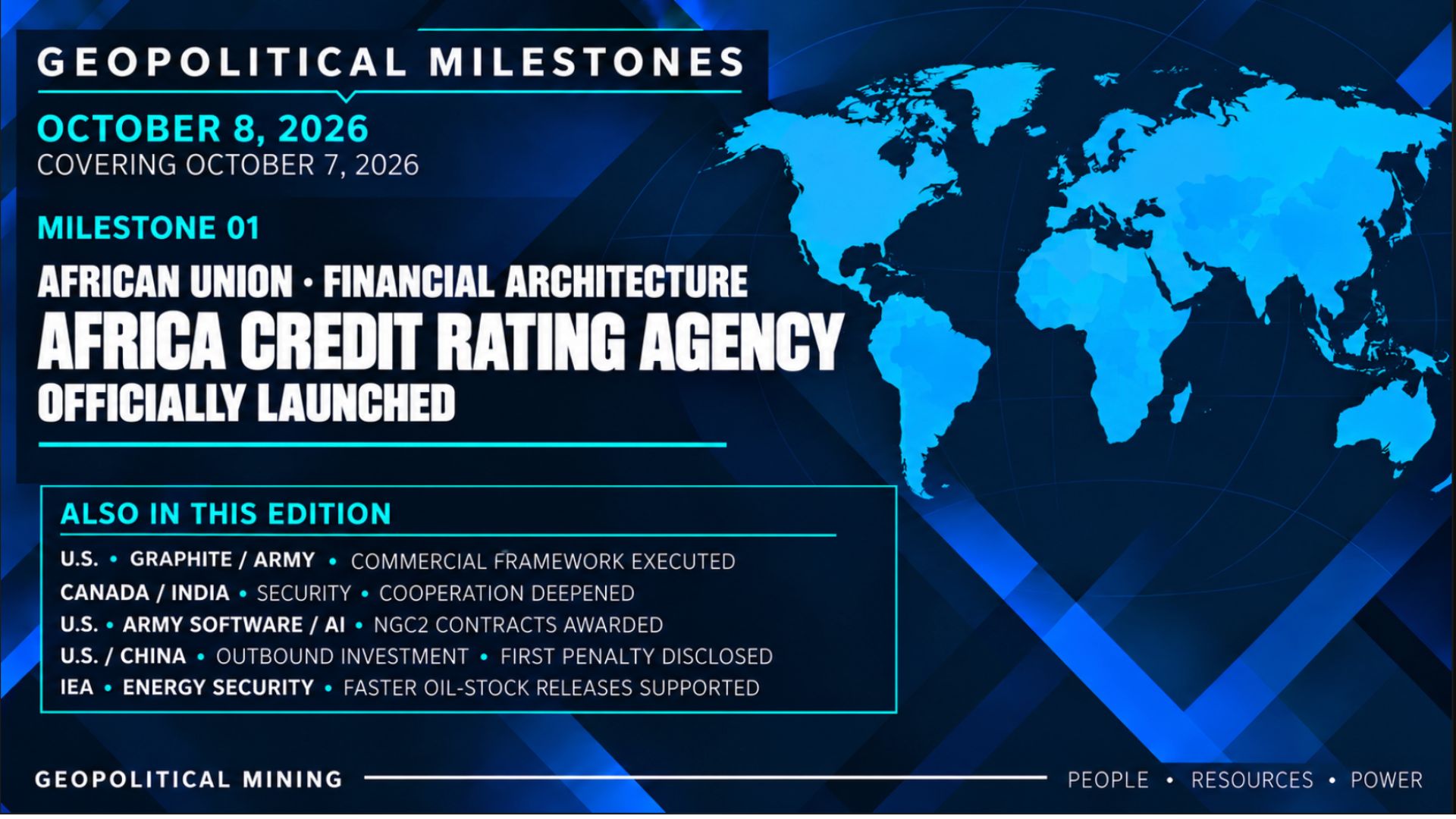
The Africa Credit Rating Agency was officially launched on October 7 as an African Union-mandated, private-sector-driven institution designed to add an independent African credit opinion to global financial markets. Also in this edition: Titan Mining announced an executed commercial framework with the U.S. Army for graphite processing at Anniston Army Depot, while a Canadian readout detailed commitments to deepen security cooperation with India. The U.S. Army issued initial Next Generation Command and Control software awards, and Treasury disclosed the first civil penalty under its outbound investment regime. IEA member governments backed faster oil-stock releases while prioritising diesel.
Also in this edition: faster IEA oil-stock releases, a U.S. Army graphite-processing framework, deeper Canada-India security cooperation, initial U.S. Army NGC2 software awards and the first publicly disclosed U.S. outbound-investment penalty.
Financial architecture, sovereign risk and access to capital
Africa Credit Rating Agency officially launches in Mauritius
The African Union officially launched the Africa Credit Rating Agency, or AfCRA, in Port Louis, Mauritius, on October 7. The AU describes AfCRA as an African Union-mandated institution created to provide independent, evidence-based credit assessments of African sovereigns, sub-sovereigns, companies and institutions, using African data, expertise and context alongside international standards.
The launch marks the formal establishment of an AU-backed credit-rating institution. The AU says AfCRA is private-sector-driven, self-funded and independent: governments cannot own shares, while the African Peer Review Mechanism oversaw its establishment before the agency moved to autonomous operation. The agency is intended to complement rather than replace existing global rating firms and to expand coverage in African capital markets.
African Union · African Peer Review Mechanism
The Launch of Africa Credit Rating Agency · October 7, 2026AU Commission Chairperson helps officially launch AfCRA · October 7, 2026
Critical minerals, defence infrastructure and domestic processing
Titan Mining and U.S. Army set commercial framework for graphite processing
Titan Mining announced on October 7 that its subsidiary Empire State Mines and the U.S. Department of the Army had executed a term sheet establishing principal commercial terms for an Enhanced Use Lease at Anniston Army Depot in Alabama. The proposed project would use approximately 97 acres of Army property to develop downstream graphite-processing capacity within an existing defence installation.
Under the proposed structure, Empire State Mines would finance, build, own and operate the facility. Titan says the initial phase would produce purified micronized graphite, with a later phase planned for coated spherical purified graphite following customer qualification. The framework provides a potential path to site tenure of up to 100 years and is designed to connect U.S. natural-flake graphite production with domestic value-added processing.
Titan Mining Corporation · U.S. Army commercial framework
Titan Mining and U.S. Army agree to commercial framework for graphite processing facility · October 7, 2026Bilateral reset, security cooperation and economic-security dialogue
Canada and India deepen security cooperation and open new channels
An October 7 Canadian government readout described a senior security dialogue in New Delhi during Canadian Prime Ministerial adviser David Morrison’s October 5–7 visit at the invitation of India’s National Security Adviser Ajit Doval. The two sides reviewed implementation of the shared Security Work Plan formalized in February 2026 and agreed to deepen cooperation on transnational organised crime, terrorism, violent extremism, trafficking, cybercrime, extortion and extradition.
The readout also records agreement to strengthen existing institutional mechanisms and establish new channels where appropriate for faster information-sharing. Canada and India will explore structured dialogues on cyber security and economic security, while also welcoming progress toward a Comprehensive Economic Partnership Agreement and discussing the potential for a more substantive bilateral defence relationship.
Government of Canada · Privy Council Office
Canada-India senior security dialogue readout · October 7, 2026Military software, artificial intelligence and command-and-control modernization
U.S. Army issues initial NGC2 software awards for I Corps
The U.S. Army announced on October 7 that it had issued several initial contract awards for Next Generation Command and Control warfighting applications. The awards move NGC2 from division-level prototyping toward product delivery and scaling across I Corps, with a modular software ecosystem intended to integrate information and mission execution across command and control, fires, intelligence, movement and manoeuvre, sustainment and protection.
The Army awarded commercial applications to multiple vendors for an initial collective one-year value of approximately US$93.6 million. Those applications add to software already provided by Anduril, Palantir, Raft and Striveworks for the NGC2 data layer and core artificial-intelligence capabilities. The Army says the open architecture is intended to allow new technologies to be incorporated as the system scales.
United States Army · Army Public Affairs
New contract awards support NGC2 software delivery to I Corps · October 7, 2026Economic security, China exposure and outbound technology investment controls
U.S. Treasury discloses first civil penalty under outbound investment rules
The U.S. Treasury announced on October 7 that it had issued the first civil penalty under the Outbound Investment Security Program. Treasury said it penalized Amidi, LLC US$200,000 for failing to notify an investment by a controlled foreign entity into Shanghai Qiongche Intelligent Technology Company, or Noematrix, a Chinese company developing artificial intelligence, robotics and embodied intelligence.
The program, in force since January 2025, requires notification for certain U.S.-linked investments and prohibits others involving entities connected to China, Hong Kong or Macau in quantum computing, artificial intelligence and semiconductors. Treasury said the underlying investment occurred in April 2025 and the penalty itself was issued in July 2026; the October 7 action is the public disclosure of that first enforcement case.
U.S. Department of the Treasury · Investment Security
Treasury announces enforcement penalty for violation of outbound program · October 7, 2026Energy security, strategic reserves and Strait of Hormuz disruption
IEA members back faster oil-stock releases and prioritise diesel
IEA member governments expressed support on October 7 for accelerating the emergency oil-stock releases announced under the March 2026 Collective Action, with the aim of completing the outstanding releases as soon as possible. Members also supported prioritising diesel stocks where possible because of tight diesel-market conditions.
The IEA said approximately 325 million barrels had already been released under the March action. Completing all stocks previously pledged but not yet released would bring about 100 million additional barrels to market. Member governments still hold roughly 1.1 billion barrels of publicly held emergency oil stocks, including more than 200 million barrels of diesel, and the IEA said it remains ready to release more if required.
International Energy Agency · Member governments
Statement by IEA Executive Director on meeting of IEA Member governments · October 7, 2026Continue reading Geopolitical Mining. Explore our daily mining coverage, weekly reviews and country analysis.