
Geopolitical Mining · Geopolitical Milestones
Pacific Link Listed as National Interest Project, Project Star and Indonesia Downstreaming Ministry
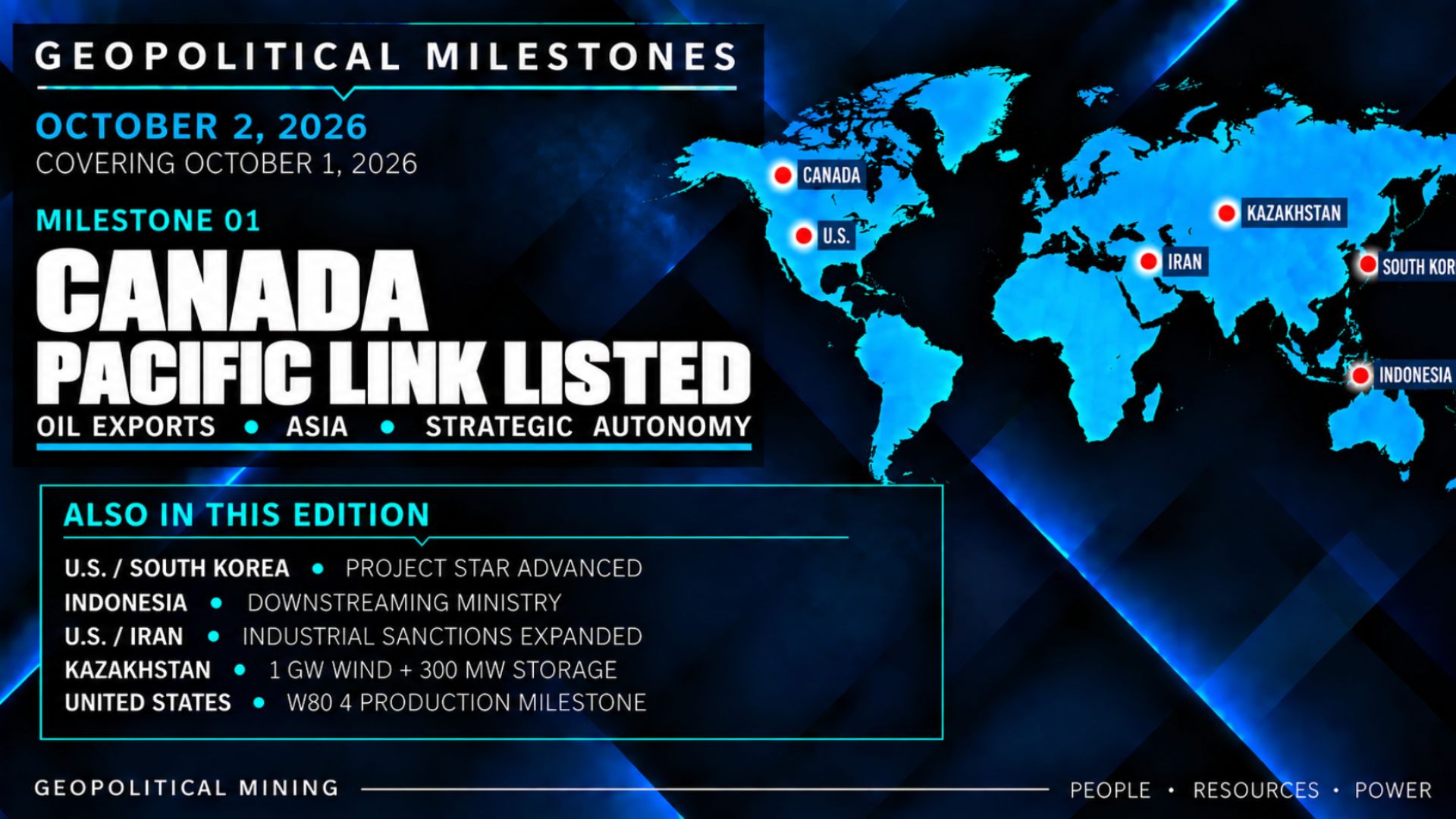
October 1 brought a formal national interest listing for Canada’s Pacific Link oil pipeline, the advancement of Project Star as the first strategic investment project under the United States and South Korea investment framework, and a new Indonesian coordinating structure joining downstreaming with energy transition. Also in this edition: expanded U.S. sanctions on Iran’s industrial base, authorisation of a major wind and storage agreement in Kazakhstan and a production milestone in the U.S. W80 4 nuclear warhead programme.
Also in this edition: Project Star for AI data centre power, Indonesia’s downstreaming and energy transition structure, U.S. sanctions on Iranian industry, Kazakhstan wind and storage infrastructure and the W80 4 production milestone.
Energy security, infrastructure and trade diversification
Canada lists Pacific Link as a project of national interest
The Government of Canada formally listed Pacific Link, the proposed West Coast oil pipeline, as a project of national interest on October 1 under the Building Canada Act. Canada and Alberta are to share equal ownership, Indigenous communities will be offered a minimum 10% ownership interest supported by federal and provincial loan guarantee programmes, and project development is being led by Trans Mountain with Pembina participating as a private sector investor.
The federal government says the proposed pipeline is intended to add capacity for roughly one million barrels per day of Canadian oil exports to Asian markets and reduce dependence on the United States. Over the next year, the Major Projects Office, supported by the Canada Energy Regulator, will lead the federal review and consultations while proponents develop the final concept, including route, environmental work, costs, procurement and workforce planning.
Prime Minister of Canada · Project of national interest
Pacific Link listed as a project of national interest · October 1, 2026Economic security, AI power and strategic investment
United States and South Korea formally advance US$22.3 billion Project Star
The governments of South Korea and the United States announced implementation plans on October 1 for three strategic investment tracks under their bilateral investment framework. Project Star, a US$22.3 billion combined cycle gas power project in Encinal, Texas, is being advanced as the first formal strategic investment project under that structure.
The planned 6,472 MW plant is designed to supply electricity directly to nearby AI data centres. Related Companies and NextEra Energy are expected to lead the project, with Lewis Energy Group providing land, natural gas, water and related infrastructure. The first phase is targeted for commercial operation in 2029, with full operation planned for 2032. The two governments present the project as a model linking AI infrastructure, energy investment and economic security cooperation.
Republic of Korea Ministry of Trade, Industry and Resources · Strategic investment plan
United States and South Korea strategic investment project plan · October 1, 2026Mineral downstreaming and energy transition governance
Indonesia brings downstreaming and energy transition under one coordinating ministry
President Prabowo Subianto inaugurated Energy and Mineral Resources Minister Bahlil Lahadalia on October 1 as Coordinating Minister for Downstreaming and Energy Transition. The appointment places two policy agendas that had been managed through separate tracks under one coordinating structure while Bahlil continues to serve as Energy and Mineral Resources Minister.
Indonesia’s Energy Ministry said the new structure is intended to increase domestic value addition from natural resources while strengthening national energy resilience and independence. The ministry also linked the change to geopolitical uncertainty, changes in the global economy and pressure to accelerate cleaner energy, bringing mineral and resource downstreaming into the same coordinating architecture as the energy transition.
Indonesia Ministry of Energy and Mineral Resources · Institutional policy
Downstreaming and energy transition placed under one coordinating structure · October 1, 2026Sanctions, industrial capacity and strategic supply chains
United States expands Iran sanctions to automotive and rail sectors
The U.S. Treasury expanded its sanctions architecture toward Iran on October 1 by issuing two additional sectoral determinations under Executive Order 13902 covering the automotive and rail sectors. The determinations allow the Office of Foreign Assets Control to sanction individuals or entities operating in those sectors and were accompanied by multiple designations involving Iranian manufacturers, rail operators, steel interests and foreign suppliers.
The action reaches beyond Iran through suppliers and facilitators in several jurisdictions and also uses existing authorities covering iron, steel, aluminium and copper. Treasury describes the measures as part of Operation Economic Outcast and says the objective is to increase pressure on remaining industrial sources of revenue and logistics while expanding sanctions exposure for foreign firms supporting targeted networks.
U.S. Department of the Treasury · Office of Foreign Assets Control
Operation Economic Outcast targets Iran’s industrial sectors · October 1, 2026Renewable infrastructure and energy diversification
Kazakhstan authorises agreement for 1 GW wind and 300 MW storage project
Kazakhstan’s government approved the signing of an agreement on October 1 between the Ministry of Energy and Turan Wind Energy for a 1,000 MW wind power plant with a 300 MW electricity storage system in the Kostanay region. Prime Minister Olzhas Bektenov signed the corresponding government resolution.
The project is expected to involve roughly 380 billion tenge of investment. Construction is planned to begin in spring 2027, with completion and commissioning targeted by the end of 2029. The government presents the project as part of its effort to diversify the national energy balance and increase renewable generation.
Government of Kazakhstan · Renewable energy infrastructure
Government authorises agreement for Kostanay wind and storage project · October 1, 2026Nuclear deterrence and defence production
United States completes FY2026 component milestone for W80 4 warhead programme
The National Nuclear Security Administration announced on October 1 that the Kansas City National Security Campus had completed all W80 4 components planned for fiscal year 2026, with several finished ahead of schedule. The milestone advances the programme toward delivery of its first complete production unit, which remains targeted before the end of fiscal year 2027.
The W80 4 programme modernises the legacy W80 1 warhead and is intended for the U.S. Air Force’s future LRSO cruise missile. NNSA said the remaining components are expected to enter production in early 2027 while manufacturing, qualification and integration work continues across the nuclear security enterprise.
U.S. National Nuclear Security Administration · Nuclear production
NNSA completes planned FY2026 W80 4 components · October 1, 2026Continue reading Geopolitical Mining. Explore our daily mining coverage, weekly reviews and country analysis.