Geopolitical Mining · Geopolitical Milestones
White House Super Intelligence Order, LNG Canada Phase 2 and Iran Procurement Sanctions
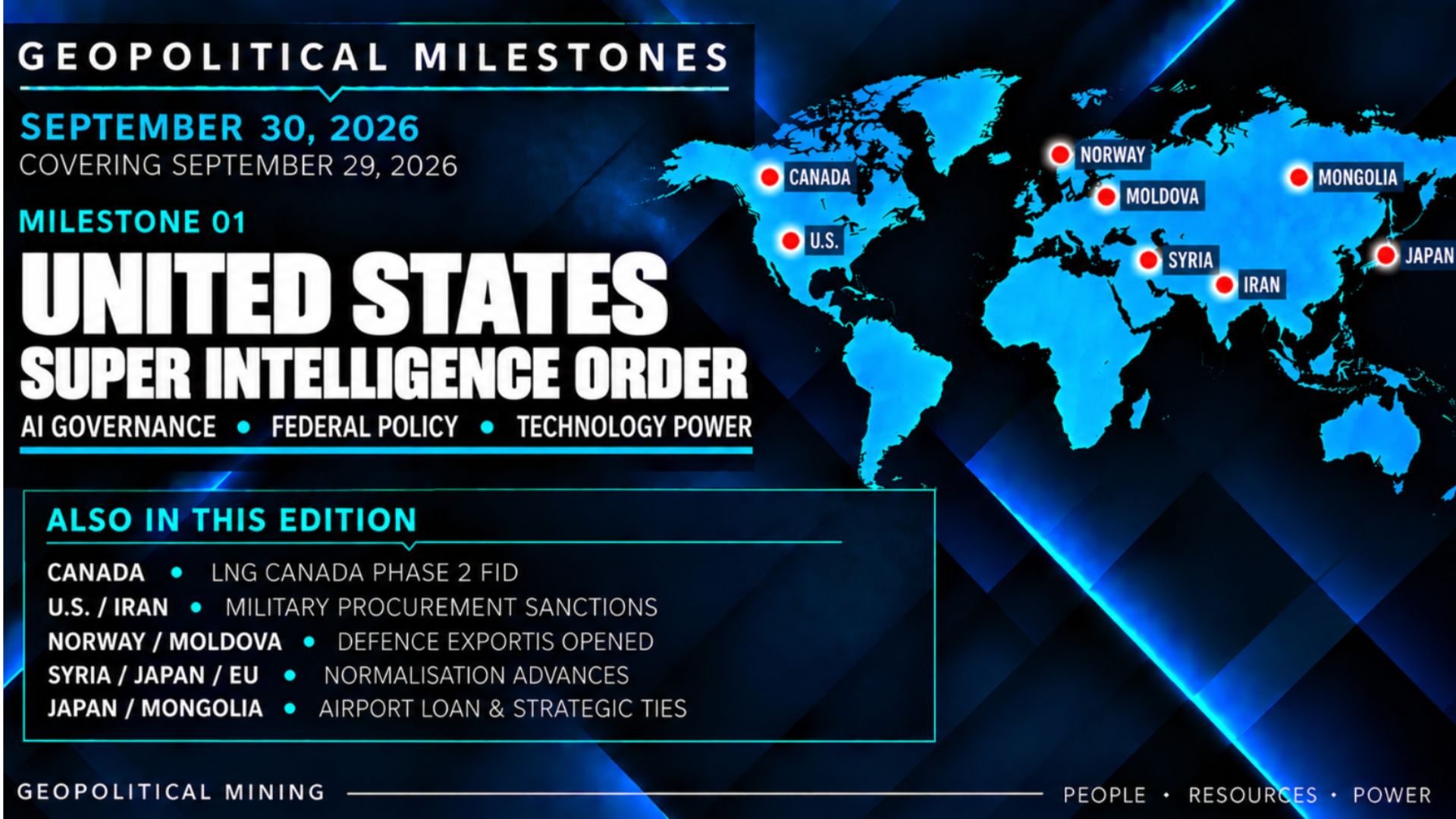
September 29 brought a U.S. executive order establishing “Super Intelligence” as the terminology of the federal executive branch, a C$33 billion final investment decision for LNG Canada Phase 2, new U.S. sanctions on Iran-linked military procurement networks, Norway’s decision to open defence exports to Moldova, further steps in Syria’s international normalisation and a Japan-Mongolia package linking strategic partnership, infrastructure, energy and regional resilience.
Also in this edition: LNG Canada Phase 2, U.S. sanctions on Iranian military procurement networks, Norway-Moldova defence exports, Syria normalisation and Japan-Mongolia strategic cooperation.
Technology governance and strategic competition
U.S. orders executive branch to adopt “Super Intelligence” terminology
The White House issued an executive order on September 29 directing executive departments and agencies, to the maximum extent permitted by law, to use the terms “Super Intelligence” and “SI” in place of “Artificial Intelligence” and “AI” in official correspondence, public communications, websites, reports, policy documents and other non-statutory materials. The order presents the terminology change as part of a broader federal framing of advanced computing capabilities and American technological leadership.
The order also gives the Assistant to the President for Science and Technology 60 days to submit proposed legislative language for a federal definition of Super Intelligence, including an assessment of whether that definition should modify, expand upon or supersede the existing statutory definition of artificial intelligence and whether conforming amendments to federal law should be proposed.
The White House · Executive Order
Inaugurating the Era of Super Intelligence · September 29, 2026Energy security, trade diversification and major infrastructure
LNG Canada Phase 2 reaches C$33 billion final investment decision
LNG Canada reached a final investment decision on September 29 for its Phase 2 expansion in Kitimat, British Columbia, unlocking a C$33 billion private-sector investment. The expansion is expected to double the terminal’s capacity to 28 million tonnes of LNG annually and strengthen Canada’s ability to supply markets in Asia and Europe from its Pacific coast.
The decision also triggered a final investment decision on Coastal GasLink Phase 2, which will double the pipeline’s existing capacity through additional compressor stations and upgrades along the 670-kilometre route linking the Western Canada Sedimentary Basin to Kitimat. The federal government framed the projects around trade diversification, Indo-Pacific market access and global energy security.
Prime Minister of Canada · Major projects and energy security
Prime Minister Carney welcomes LNG Canada Phase 2 · September 29, 2026Military supply chains and economic statecraft
U.S. sanctions Iran-linked military procurement networks across multiple jurisdictions
The U.S. Treasury’s Office of Foreign Assets Control sanctioned 10 individuals and entities on September 29 under Operation Economic Outcast for procurement activity linked to Iran’s Ministry of Defense and Armed Forces Logistics. Treasury said the networks supported the acquisition of weapons, weapons components and dual-use technology connected to Iranian military programmes, including ballistic missiles and unmanned aerial vehicles.
The designations reach across several jurisdictions, including China and Hong Kong, Pakistan, Saudi Arabia, Türkiye and Iran. Treasury identified procurement relationships involving electronics suppliers, intermediaries and defence companies and said the action is intended to increase the cost of rebuilding and sustaining Iranian weapons programmes while exposing foreign actors to U.S. sanctions risk.
U.S. Department of the Treasury · OFAC sanctions
Operation Economic Outcast Takes Down Iranian Military Procurement Networks · September 29, 2026European security and defence support
Norway opens defence-materiel exports to Moldova
The Norwegian government decided on September 29 to allow exports of Norwegian defence materiel to the Republic of Moldova. Moldova had not previously been authorised as a recipient under Norway’s export-control regime, and the decision opens the possibility of military support alongside the civilian assistance Norway has provided since 2022.
Norway linked the policy change to Moldova’s exposure to the consequences of Russia’s war against Ukraine and to the wider security environment. Norwegian companies can now apply for export licences, while the government said any military support will be funded through the ordinary defence budget rather than the Nansen Support Programme.
Norwegian Ministry of Foreign Affairs · Export-control decision
Norway authorises defence exports to Moldova · September 29, 2026Sanctions relief and diplomatic normalisation
Japan eases Syria asset freezes as EU deepens engagement in Damascus
Japan partially lifted Assad-era asset-freezing measures on September 29 by removing 16 Syrian entities from its sanctions list. The entities include the Commercial Bank of Syria, petroleum companies and state bodies including the Ministries of Defence and Interior. Japan said the measures remain in place against 59 individuals and 15 entities.
On the same day in Damascus, EU High Representative Kaja Kallas said the European Union was using political and economic tools to support Syria’s transition. She pointed to the earlier lifting of EU economic sanctions, restoration of the full application of the EU-Syria Cooperation Agreement and the first High-Level Political Dialogue, while describing the September 29 visit as part of turning closer relations into concrete cooperation on institutions, reconstruction and regional security.
Japan Ministry of Foreign Affairs / European External Action Service · Syria policy
Japan · Partial lifting of asset-freezing measures · September 29, 2026EU · Joint press conference in Damascus · September 29, 2026
Strategic partnership and infrastructure diplomacy
Japan and Mongolia deepen strategic partnership with airport financing and energy cooperation
Japanese Prime Minister Sanae Takaichi and Mongolian Prime Minister Nyam-Osor Uchral met in Tokyo on September 29 and agreed to deepen their Special Strategic Partnership for Peace and Prosperity. Japan described Mongolia as its most important “Third Neighbor” and linked the relationship to strengthening Mongolia’s freedom to decide for itself and resilience under the updated Free and Open Indo-Pacific framework.
During the visit, officials signed and exchanged notes for a ¥158.284 billion yen loan to expand Chinggis Khaan International Airport, a major bilateral infrastructure project operated through a joint venture involving Japanese companies. The leaders also agreed to cooperate in oil reserves and renewable energy under POWERR Asia and to strengthen economic and regional-security cooperation.
Japan Ministry of Foreign Affairs · Summit and Exchange of Notes
Japan-Mongolia Summit and Working Dinner · September 29, 2026Exchange of Notes for the Chinggis Khaan International Airport expansion loan · September 29, 2026
Continue reading Geopolitical Mining. Explore our daily mining coverage, weekly reviews and country analysis.