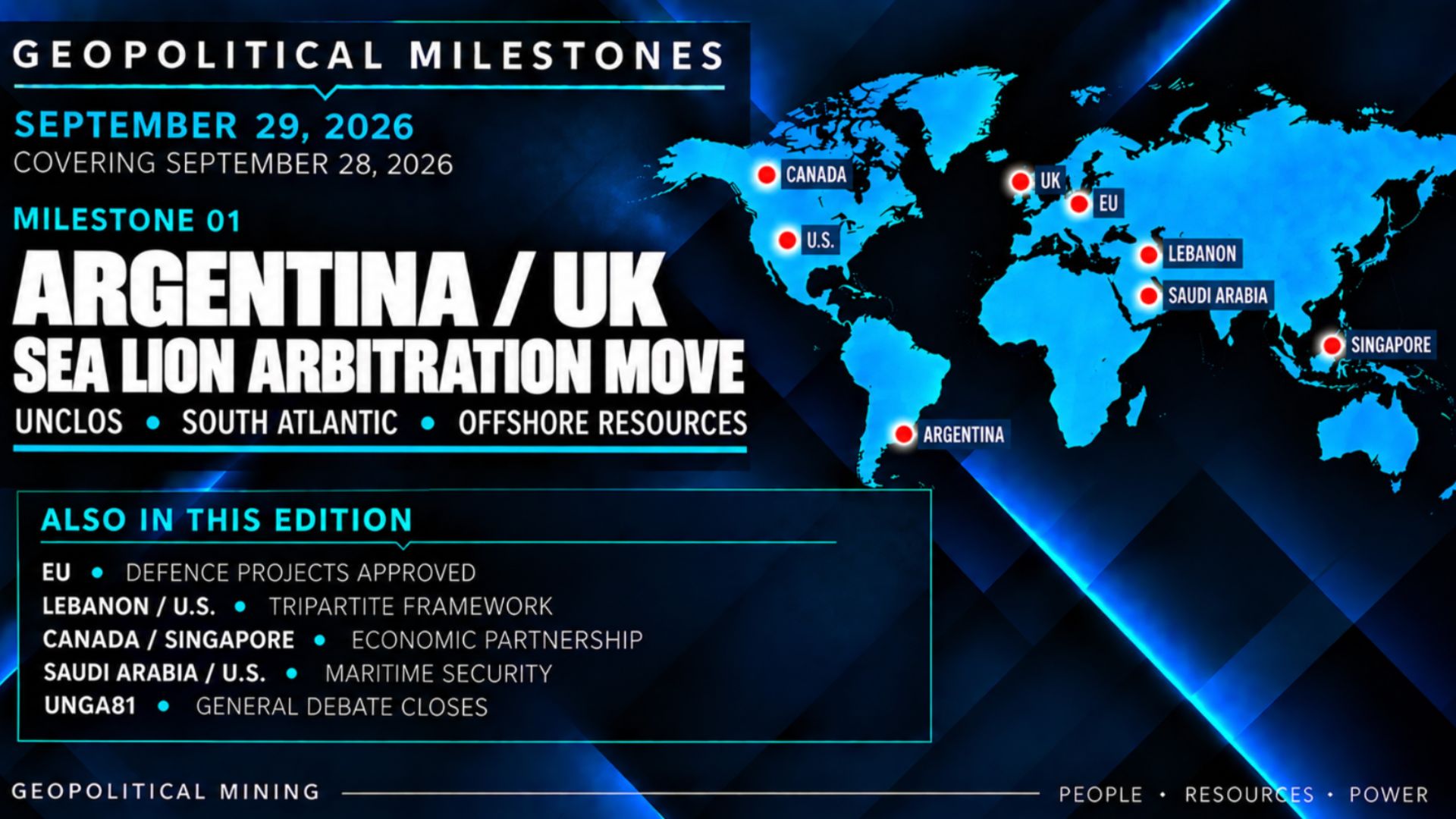

Geopolitical Mining · Geopolitical Milestones
Argentina Moves Sea Lion Dispute to UNCLOS Arbitration, EU Defence Projects and Lebanon-U.S. Framework Talks
September 28 brought Argentina’s move to initiate Annex VII UNCLOS arbitration over the Sea Lion offshore oil project, approval of the European Union’s first Defence Projects of Common Interest, Lebanon-U.S. talks on implementing a regional security framework, Canada-Singapore economic-partnership discussions, Saudi-U.S. maritime-security coordination and the close of the UN General Assembly’s General Debate.
Also in this edition: the EU’s first Defence Projects of Common Interest, Lebanon-U.S. framework implementation talks, Canada-Singapore economic cooperation, Saudi-U.S. maritime security and the close of the UNGA81 General Debate.
South Atlantic sovereignty and offshore resources
Argentina moves Sea Lion dispute toward Annex VII UNCLOS arbitration
Argentina’s Office of the President announced on September 28 that President Javier Milei had instructed the Foreign Ministry and government legal teams to initiate the arbitration procedure provided for in Annex VII of the United Nations Convention on the Law of the Sea in connection with the Sea Lion offshore oil project. Argentina also said it had formally called on the United Kingdom to take measures within two weeks to prevent the start or continuation of hydrocarbon exploitation activities that Argentina contests.
The move places offshore resources inside the broader sovereignty dispute over the Falkland Islands (Malvinas) and surrounding maritime areas. Argentina presents the planned arbitration as a means of protecting what it considers its sovereign rights over the continental shelf. The United Kingdom’s stated position is different: on September 18, the UK government said the Falkland Islands are British and that the Islanders have the right to develop their natural resources, including hydrocarbons, as part of their right of self-determination.
Argentina Presidency / UK Foreign, Commonwealth & Development Office · Official statements
Argentina · Comunicado Oficial Número 166 · September 28, 2026United Kingdom · Minister for Overseas Territories statement on the Falkland Islands · September 18, 2026
European defence industrial policy
EU approves first five European Defence Projects of Common Interest
The Council of the European Union approved the first five European Defence Projects of Common Interest on September 28 under the European Defence Industry Programme. The projects are collaborative industrial initiatives intended to develop military capabilities considered critical to the security and defence interests of the Union.
The five projects cover drones and counter-drone systems, integrated maritime and seabed defence, space capabilities, federated air and missile defence including early warning, and Eastern Flank Watch. Following the Council decision, the projects are eligible to receive EU funding through the European Defence Industry Programme.
Council of the European Union · European defence industry
European defence industry: Council identifies the first five projects of common interest · September 28, 2026Levant security and state sovereignty
Lebanon presses for timetable and verification in U.S. talks on tripartite framework
Lebanese Prime Minister Nawaf Salam met U.S. Secretary of State Marco Rubio in Washington on September 28 and called for moving the tripartite framework into an implementation phase. According to the Lebanese government’s account, Salam argued for reciprocal and phased steps intended to produce an Israeli withdrawal from Lebanese territory alongside the extension of Lebanese state authority and exclusive state control over weapons.
Salam also called for a clear timetable and a credible verification mechanism to monitor implementation. The Lebanese readout said Rubio reaffirmed U.S. support for Lebanon and its legitimate institutions, continued support for the Lebanese Armed Forces and the importance of continuing implementation of the framework.
Presidency of the Council of Ministers, Lebanon · Meeting readout
Prime Minister Nawaf Salam meeting with U.S. Secretary of State Marco Rubio · September 28, 2026Trade diversification and Indo-Pacific economic ties
Canada and Singapore prioritize economic-partnership talks and Canada-ASEAN FTA
Canadian Prime Minister Mark Carney spoke with Singapore Prime Minister Lawrence Wong on September 28 about strengthening the bilateral relationship in a rapidly changing international environment. The leaders discussed the recently announced negotiations for a Canada-Singapore Economic Partnership Framework and opportunities to expand bilateral trade.
They also discussed redoubling efforts to conclude negotiations for a Canada-ASEAN Free Trade Agreement. Carney highlighted potential Singaporean investment in Canada’s artificial-intelligence ecosystem and energy sector, and the leaders agreed to remain in close contact ahead of a planned visit by Wong to Canada later in 2026.
Prime Minister of Canada · Leaders’ readout
Prime Minister Carney speaks with Prime Minister of Singapore Lawrence Wong · September 28, 2026Gulf and Red Sea maritime security
Saudi Arabia and United States discuss Hormuz, Bab al-Mandab and Yemen
Saudi Foreign Minister Prince Faisal bin Farhan met U.S. Secretary of State Marco Rubio in Washington on September 28. The meeting reviewed Saudi-U.S. strategic relations and regional developments, including the situation in Yemen and wider security conditions affecting the region.
Saudi official reporting on the talks said the ministers stressed the importance of protecting maritime security and freedom of navigation through international waterways, particularly the Strait of Hormuz and Bab al-Mandab, linking those routes to regional stability and the continued flow of trade and global supply chains.
Saudi Foreign Ministry / U.S. Department of State · Ministerial meeting
Saudi Foreign Ministry official account · September 28, 2026 meeting recordU.S. Department of State · Secretary Rubio meets Saudi Foreign Minister Prince Faisal bin Farhan Al Saud · September 28, 2026
Global governance and multilateral agenda
UNGA81 General Debate closes as AI moves to the centre of the multilateral agenda
The General Debate of the eighty-first session of the United Nations General Assembly closed on September 28 after six days of statements. The President of the General Assembly said 194 delegations had spoken, including 113 Heads of State and Government, one Crown Prince, 11 Vice-Presidents, seven Deputy Prime Ministers and 48 Ministers.
In his closing synthesis, the President highlighted the rapid rise of artificial intelligence in the multilateral agenda. He said only five delegations had raised AI four years earlier, compared with 128 delegations in 2026, and described artificial intelligence or artificial general intelligence as having moved from the margins of the debate to its centre.
United Nations General Assembly · Closing remarks
Remarks at the close of the General Debate of the eighty-first session · September 28, 2026Continue reading Geopolitical Mining. Explore our daily mining coverage, weekly reviews and country analysis.