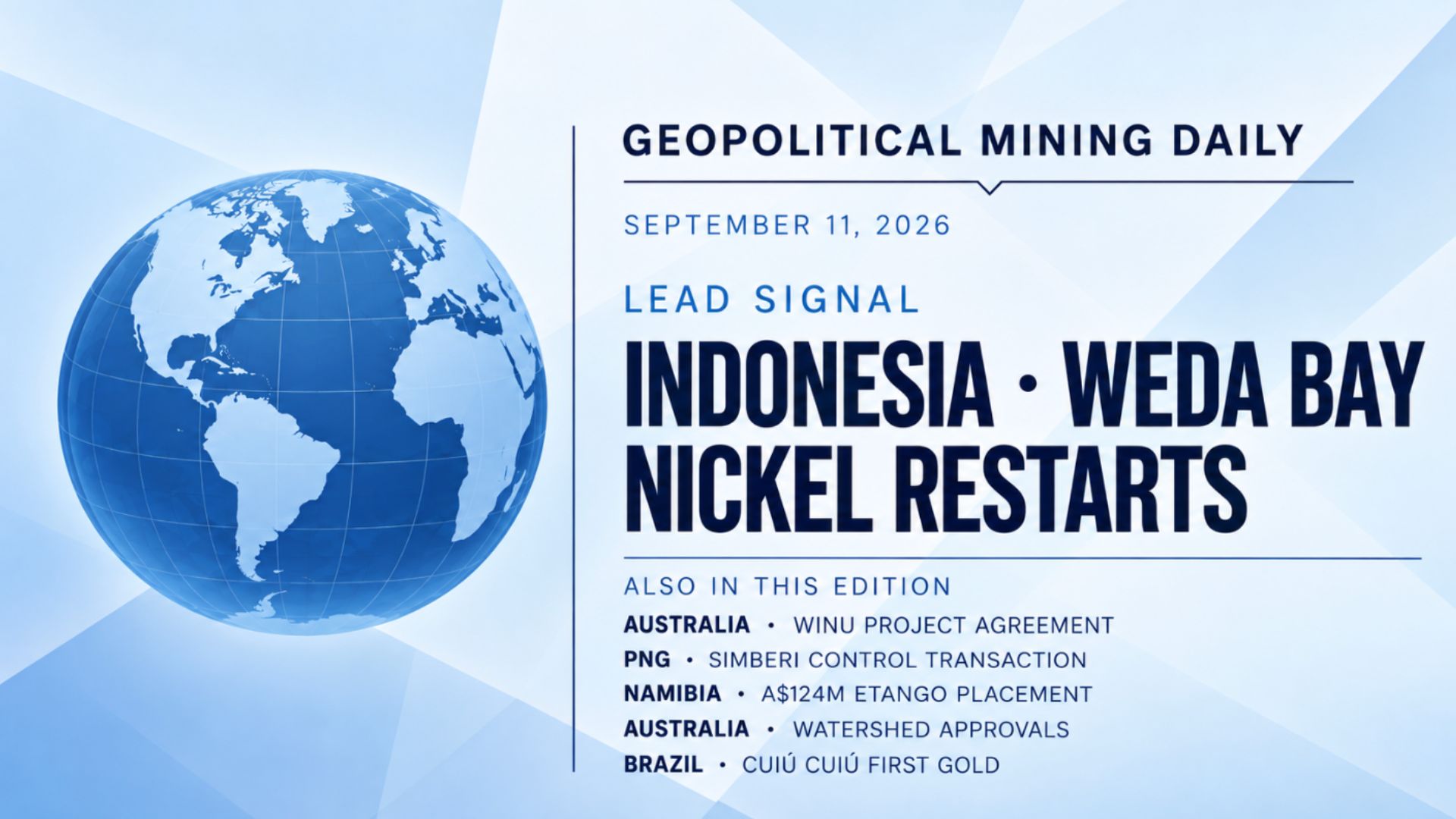

Geopolitical Mining Daily · September 11, 2026
Indonesia Authorizes Weda Bay Nickel Restart After Four Month Halt
PT Weda Bay Nickel is restarting after Indonesian authorities reopened the mine following four months of Care & Maintenance, restoring a strategic nickel supply pathway while 2026 volumes and grades remain uncertain. Traditional Owner consent, gold ownership, uranium finance, tungsten approvals and first gold production move through separate execution gates.
Eramet announced the progressive restart of PT Weda Bay Nickel after Indonesian authorization. Nyangumarta Warrarn Aboriginal Corporation and Rio Tinto signed a Project Agreement for Winu. St Barbara signed a binding agreement to sell its remaining Simberi interest to Lingbao. Bannerman completed the bookbuild for an A$124 million Etango placement. Tungsten Mining reported that Watershed had attained its primary project approvals and begun early works. Cabral Gold poured first gold at Cuiú Cuiú during commissioning.
The 2026 observation framework
The ten Signals for 2026
Every Daily edition is read against the same ten strategic lenses. Signals activated by today’s verified developments are highlighted below.
Today’s direction of travel
Control over mineral supply is being exercised through production authorization, consent, ownership and capital rather than policy statements alone. Indonesia has reopened Weda Bay after a regulatory halt. Winu has secured Nyangumarta consent but still needs statutory approvals and investment sanction. Chinese capital is moving deeper into Papua New Guinea gold and Namibian uranium, while Australian tungsten and Brazilian gold advance from approvals and construction toward physical output.
Lead development
Weda Bay Nickel restarts after Indonesian authorization
What happened
On September 10, Eramet announced that mining operations at PT Weda Bay Nickel in North Maluku were restarting after Indonesian authorities authorized activity following four months of Care & Maintenance. The restart is progressive and is being carried out with contractors while equipment and people are remobilized.
The interruption followed a sharp change in Indonesia’s annual production approval. In February, Eramet said PT Weda Bay Nickel had received an initial 2026 Work Plan and Budget pathway for 12 million wet metric tonnes of nickel ore, compared with an initial 32 million wet metric tonnes for 2025 that was later revised to 42 million. By April, the company expected the initial 2026 volume to be reached by mid May and was preparing the mine for Care & Maintenance while seeking an upward revision.
Eramet has not disclosed the production volume attached to the new authorization. It also says the timing of the ramp up depends on contractor and equipment remobilization, a redesigned annual mine plan and remaining administrative work. The company cannot yet provide a reliable estimate of production, sales volumes or ore grades for the rest of 2026 and plans to update its external sales guidance later.
Signal reading
The restart shows how directly sovereign production authorization can govern a strategic mineral supply node. Weda Bay is integrated with the Indonesia Weda Bay Industrial Park, where different ore grades feed pyrometallurgical and high pressure acid leach processing routes. Eramet describes Weda Bay as the world’s largest nickel mine by volume. Reopening the mine therefore restores an important supply pathway, while the absence of disclosed volumes means the scale of that restoration is still unknown.
Next proof point: publication of updated 2026 sales guidance, disclosure of the authorized mining volume if made public, completion of contractor and equipment remobilization, stable ore production and evidence that mine output is again supporting nearby processing at planned rates.
Major development
Nyangumarta and Rio Tinto sign Project Agreement for Winu
What happened
On September 10, the Nyangumarta Warrarn Aboriginal Corporation and Rio Tinto signed a Project Agreement for the proposed Winu copper and gold mine on Nyangumarta Country in Western Australia. The agreement builds on a 2023 planning arrangement and sets out how Nyangumarta knowledge, priorities and perspectives will inform continuing planning and future implementation.
Through the agreement, Nyangumarta People have given their consent for the proposed mine and associated infrastructure on Nyangumarta Country. The framework covers the avoidance and minimization of potential impacts on the environment and Aboriginal cultural heritage, as well as pathways for training, employment and business participation. Rio Tinto says Winu would be the first mine developed on Nyangumarta Country.
The agreement does not authorize construction. Winu remains subject to regulatory and other approvals and a final investment decision. Rio Tinto’s project page also states that the environmental review process remains active, with public comment on the Environmental Review Document open until October 22. Rio Tinto holds 70% of Winu and Sumitomo Metal Mining holds 30%, with Rio targeting first copper by 2030.
Signal reading
Winu makes legitimacy part of the project’s operating architecture before investment sanction. Consent has been negotiated through a long process and the agreement creates a continuing role for Nyangumarta People across the life of the project. Its strategic value will depend on implementation: cultural heritage protection, environmental commitments, participation and benefit pathways must function in practice while the project continues through formal approvals and capital decisions.
Next proof point: completion of the environmental review process, remaining Traditional Owner arrangements where required, regulatory decisions, a final investment decision, implementation of heritage and environmental commitments and measurable delivery of training, employment and business participation.
Major development
St Barbara signs A$453 million Simberi transaction with Lingbao
What happened
On September 10, St Barbara signed a binding agreement to sell its remaining interest in the New Simberi Gold Project and related Tabar Islands exploration interests to Lingbao Gold Group. On completion, St Barbara is to receive A$410 million in cash plus repayment of approximately A$43 million for its share of construction capital funded between April 2026 and signing.
Lingbao will also fund St Barbara’s share of New Simberi capital requirements from signing until completion. St Barbara would retain a 2.75% net smelter return royalty on future gold and silver production from New Simberi and a 1.5% royalty on future mineral production from the Tabar Islands exploration licences. The structure therefore moves St Barbara toward an ownership exit while preserving exposure to future production.
Completion is targeted for the March quarter of 2027 and remains subject to conditions precedent, including regulatory approvals in the People’s Republic of China and Papua New Guinea and shareholder approvals if required. The signing therefore establishes a binding transfer pathway but does not yet transfer ownership or consideration.
Signal reading
The transaction would deepen Lingbao’s control over a Papua New Guinea gold development while redirecting St Barbara’s balance sheet toward its Nova Scotia portfolio and retained royalties. The strategic change occurs through ownership and capital responsibility: Lingbao is taking over the development funding burden from signing, but legal control still depends on cross border approvals and closing.
Next proof point: Chinese and Papua New Guinean regulatory approvals, any required shareholder votes, continued construction funding through the interim period, completion in the March quarter of 2027 and settlement of the cash consideration.
Major development
Bannerman completes bookbuild for A$124 million Etango placement
What happened
On September 10, Bannerman Energy completed the bookbuild for a fully underwritten institutional placement to raise A$124 million before costs at A$4.00 per share. Approximately 31 million new shares are expected to settle on September 15 and be allotted on September 16. The company is also pursuing a separate non underwritten Share Purchase Plan targeting up to A$10 million.
The placement follows confirmation that all conditions precedent to Bannerman’s strategic investment and joint venture with CNNC Overseas Limited have been satisfied or waived. Under the broader financing structure, CNOL can invest up to US$321.5 million and would hold an underlying 42.75% economic interest in Etango, while Bannerman would hold 52.25% and the One Economy Foundation 5%. CNOL is also to purchase 60% of future Etango production on market based terms.
Bannerman says the placement, existing cash, near term CNOL subscription and reimbursement payments and CNOL working capital contributions are expected to fully fund Etango through construction and ramp up. A final investment decision has not yet been made and remains targeted for the fourth quarter of 2026.
Signal reading
Etango is moving from a financing problem toward a financed construction proposition without conventional project debt. The capital stack also links a Namibian uranium project to a Chinese nuclear utility through ownership, funding and future offtake. The September 10 bookbuild reduces Bannerman’s residual funding gap, but settlement, CNOL completion and the final investment decision remain distinct steps before the company can treat the full construction pathway as sanctioned.
Next proof point: placement settlement and allotment, completion of the CNOL subscription and reimbursement flows, the fourth quarter final investment decision, conversion of early works into full scale construction and evidence that the combined funding package remains sufficient through ramp up.
Major development
Watershed secures primary approvals as early works advance
What happened
On September 10, Tungsten Mining announced that the Watershed tungsten project in Far North Queensland had attained its full set of primary project approvals. The company identifies Watershed as a granted mining lease project with an Environmental Authority and says its current approval package includes the Progressive Rehabilitation and Closure Plan required for development.
The company has also started early construction activities before a final investment decision. Access and approved clearing works are progressing, site facilities and accommodation are being expanded and the workforce is expected to increase materially as the project moves toward its next engineering and financing decisions.
Watershed still has important gates ahead. Tungsten Mining is targeting release of the Definitive Feasibility Study in October 2026, with a final investment decision to follow. First production is targeted for the first half of 2027. Those dates remain forward looking and depend on study results, capital, construction performance and commissioning.
Signal reading
Watershed moves the Australian tungsten story from permitting risk toward execution risk. Primary approvals allow the project to advance physical preparation, but they do not establish bankability or production. The next test is whether the updated engineering, financing and early works remain aligned tightly enough for an investment decision and a credible path to first concentrate.
Next proof point: release of the October Definitive Feasibility Study, a funded final investment decision, expansion of early works into full construction, delivery against the first half 2027 schedule and commissioning of a repeatable tungsten concentrate circuit.
Major development
Cabral pours first gold at Cuiú Cuiú during commissioning
What happened
On September 10, Cabral Gold announced the first gold pour from its 100% owned Phase 1 Cuiú Cuiú mine in Brazil. The pour produced approximately 1,130 ounces of gold and occurred as part of commissioning of the wet circuit.
Cabral completed commissioning of the dry circuit in July and says the wet circuit is now nearing completion. The Phase 1 operation is based on mining and heap leach processing of near surface oxide material. The company previously secured a US$45 million gold loan to fund the starter operation and has been building the project through 2026.
The first pour is a physical production milestone, but the operation has not yet reached commercial production. Cabral is now focused on ramping up mining and ore stacking toward 3,000 tonnes a day, with commercial production targeted by the end of 2026. Formal 2027 production guidance is expected only after the ramp up phase.
Signal reading
Cuiú Cuiú has crossed the line from construction into first metal, but its more important operating test begins now. A commissioning pour confirms that ore, leaching and recovery systems can produce gold; it does not yet demonstrate sustained stacking rates, recoveries, costs or commercial availability. The project becomes durable supply only when those operating variables stabilize.
Next proof point: completion of wet circuit commissioning, sustained ore stacking near the 3,000 tonne per day target, reported recovery and operating performance, declaration of commercial production and formal 2027 guidance.
The system reading
What today’s evidence tells us
Today’s evidence is about control over the gates to production. Indonesia can restrict and restore mine output through annual authorization. Nyangumarta consent gives Winu a negotiated project governance architecture but does not replace environmental approvals or FID. Lingbao has signed for St Barbara’s remaining Simberi interest but the transaction still needs regulatory clearance and closing. Bannerman has completed the institutional bookbuild it expects to close the residual Etango funding gap, while settlement, CNOL completion and FID remain ahead. Watershed has crossed its primary permitting threshold and entered early works. Cuiú Cuiú has produced first gold while its wet circuit is still commissioning. Across all six developments, one gate has opened, but none should be confused with the entire delivery pathway.
Signals for 2026 gives the map. The Daily records new evidence against that map. Today’s lead shows how a state production authorization can stop and restart a globally important nickel mine, while the wider edition follows consent, ownership, finance, permitting and commissioning as separate conditions of mineral delivery.