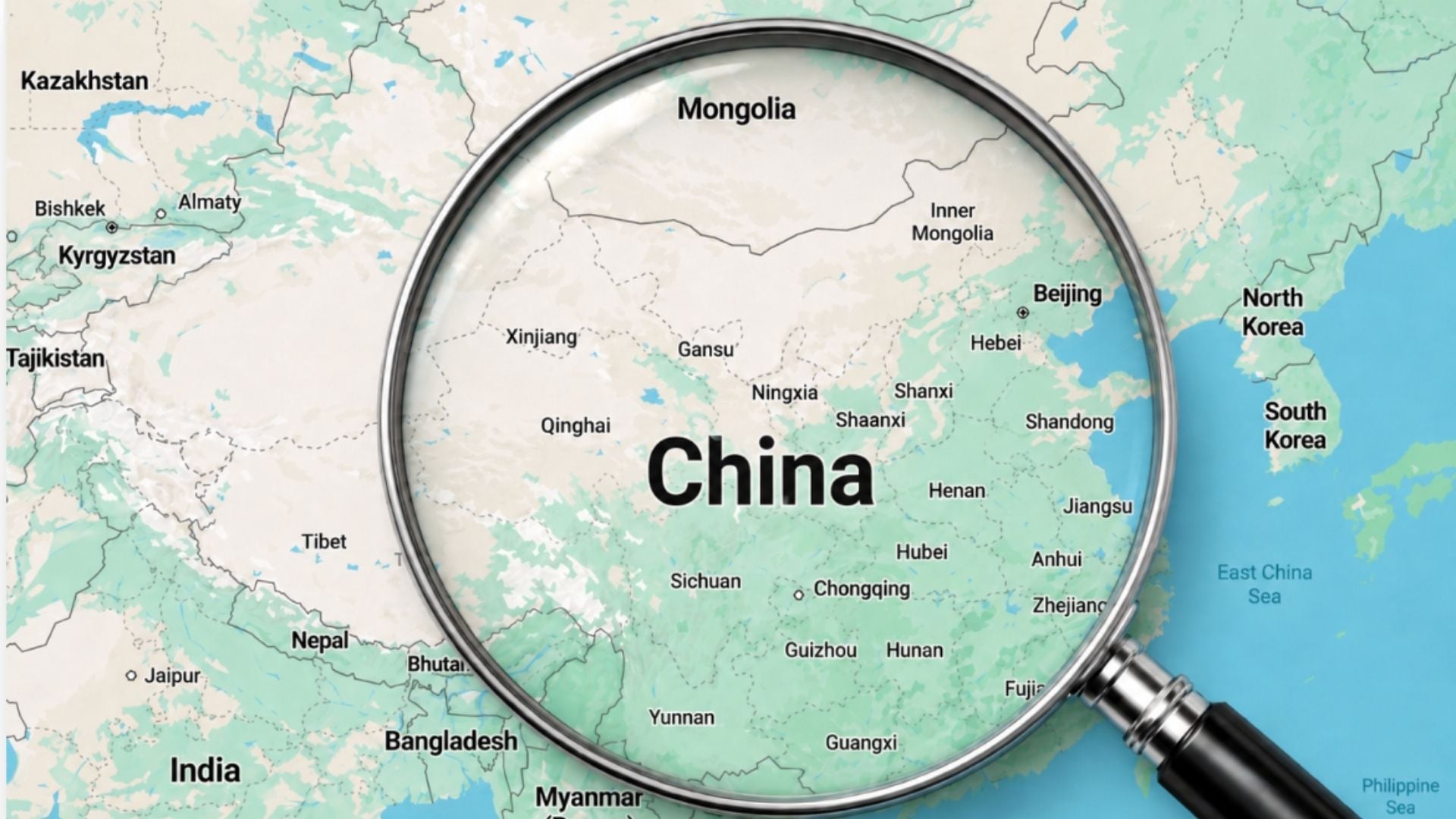

Geopolitical Mining · Country & Region Analysis
China’s Long View of Material Power
China’s revised defense mobilization law extends a decades long approach to national security in which resources, production capacity, infrastructure and supply are built before pressure makes them indispensable. Strategic minerals form the upstream foundation of that system.
By Marta Rivera Muñoz and Eduardo Zamanillo
September 3, 2026
On August 28, 2026, China adopted a comprehensive revision of its National Defense Mobilization Law. The legislation will enter into force on October 1 with 14 chapters and 82 articles covering national planning, statistical surveys of mobilization potential, strategic material reserves, military production, transportation, data, infrastructure and civilian resources.
At the center of the law is a definition with significance across the material economy. China describes defense mobilization as the activity through which the state prepares for a rapid transition between peacetime and wartime conditions and converts economic and social strength into defense strength when sovereignty, unity, territorial integrity, security or development interests face a threat. The law incorporates mobilization preparation into national economic and social development planning and creates systems for understanding the economic capabilities that may become available to the state.
That conversion depends upon the physical capabilities of the country. Materials must be available. Industrial facilities must be capable of continuing or expanding production. Technology, data, software and technical teams must sustain increasingly complex industrial systems. Warehousing, transportation and distribution must carry inputs toward priority users. The state must also possess enough information to understand what capacity exists, where it is located and how rapidly it can be activated.
The revised law organizes these functions through a strategic material reserve system led by government and supported by enterprises, public institutions and social organizations. Physical inventories are accompanied by technology reserves and production capacity reserves. Warehousing, transportation and distribution form part of the same system. Military authorities must assess the security of industrial and supply chains, while designated organizations must preserve equipment, materials, supporting products, technology, data, software, technical teams and implementation plans. Once mobilization measures are activated, suppliers of these inputs must give priority to military research, production conversion, expanded output and maintenance requirements.
China’s relationship with the material economy extends far beyond this legislation. Minerals, processing capacity, manufacturing, energy systems, infrastructure and access to resources have shaped its development strategy for decades. As examined in For China, Minerals Were, Are and Will Always Be Strategic, China built industrial depth by connecting the resource with the capabilities required to transform it, moving through mineral production, processing, technical knowledge, infrastructure, manufacturing and increasingly sophisticated downstream industries. That trajectory has given China central positions across several global material chains.
The revised law gives this material orientation a deeper place within national preparedness. Productive assets created during ordinary economic development are expected to remain visible, maintained, expandable and available across changing conditions. The material foundations of power are therefore built through development and preserved through institutions capable of carrying them into moments of pressure.
The timing gives the law particular significance. Since May 2025, China has placed important resources and strategic minerals within national security doctrine, organized mineral reserves and emergency supply through the 15th Five Year Plan, identified different priorities across scarce and advantageous minerals, and established a detailed operating framework for mineral rights, production, reserves, logistics and emergency allocation. The August 2026 law adds the wider national system through which strategic materials and industrial capacity can contribute to defense mobilization.
Read together, these developments show how China continues to deepen a principle that has guided its rise: material security is constructed before the moment in which its value becomes indispensable.
Security Is Built Before It Is Needed
The most consequential work envisaged by the revised law takes place during peacetime. Public authorities must incorporate mobilization preparation into national economic and social development plans. China will conduct statistical surveys of mobilization potential, maintain dynamically updated information, establish implementation plans and develop data systems supporting preparation and activation. Organizations and citizens are required to complete their assigned preparation responsibilities before mobilization occurs, while designated institutions must maintain plans, teams and regular exercises.
This approach gives time a central place in national security. Industrial capacity is assembled over years, well before the moment it becomes necessary. Mines, processing plants, power systems, ports, railways and storage facilities require planning, capital, engineering, construction and operating experience. Technical teams develop through education and sustained practice. Geological knowledge accumulates through surveying and exploration. Supply relationships depend upon contracts, infrastructure and political continuity.
The material capabilities required under pressure must therefore exist within the economy before pressure arrives. China’s strategic reserve architecture reflects this principle by combining resources available at different speeds. Physical inventories provide immediate material. Production capacity renews supply. Technology reserves preserve the knowledge required to operate or adapt industrial systems. Warehousing and transportation allow available material to become delivered supply.
Material preparedness
How Material Capacity Becomes National Preparedness
| Material layer | Capacity being prepared | Time horizon | Strategic function |
|---|---|---|---|
| Geological knowledge | Surveys, mineral data, identified deposits and resource assessments | Years to decades | Creates visibility over future material options |
| Access to resources | Mineral rights, operating permissions, contracts and overseas relationships | Years | Determines whether geological potential can enter production |
| Mining and processing | Operating assets, technical capability and expandable production | Years to decades | Converts resources into usable industrial materials |
| Physical inventories | Strategic material and mineral product reserves | Immediate to short term | Provides available supply during disruption |
| Production capacity reserves | Prepared capability to increase or redirect output | Short to medium term | Replenishes inventories and sustains industrial continuity |
| Technology, data and teams | Technical knowledge, software, operating data and professional capacity | Continuous | Preserves the ability to operate and adapt industrial systems |
| Storage and logistics | Warehousing, transportation and distribution | Immediate to medium term | Converts material availability into delivery |
| National coordination | Monitoring, planning, exercises and supply priorities | Continuous | Connects economic capacity with national requirements |
Geopolitical Mining analytical framework based on China’s revised National Defense Mobilization Law, the 15th Five Year Plan and the Implementation Regulation of the Mineral Resources Law. This Geopolitical Mining construction synthesizes the source documents into an analytical table.
The value of an industrial asset consequently extends across several time horizons. A deposit provides a future source of supply. An operating mine provides current output and the possibility of expansion. A processing facility carries technology, personnel and accumulated industrial knowledge. An inventory creates time for the rest of the system to respond. A transportation network connects each layer with the industrial user.
Each form of preparedness addresses a different delay within the material system. Product reserves absorb the interval before additional supply can arrive. Production capacity reserves shorten the time required to increase output. Deposits protected for future use preserve options beyond the life of current inventories. Technology reserves reduce the delay involved in reproducing or adapting industrial capability. Logistics determine how rapidly material can be moved from availability into use.
China’s long view emerges through these overlapping forms of preparation. The system preserves the conditions through which future decisions can remain executable, even when ordinary commercial access becomes more difficult.
A Long Material Trajectory
China’s current mobilization architecture builds upon the National Defense Mobilization Law adopted in 2010. The earlier legislation already established strategic material reserves, military production capacity reserves, conversion and expansion of production, priority provision of energy and materials, and access to civilian resources when mobilization requirements exceeded existing reserves. Designated organizations were expected to maintain equipment, materials, supporting products, technology, plans and technical teams.
The 2026 revision increases the institutional depth of that foundation. The strategic reserve system now expressly includes broader participation by enterprises, public institutions and social organizations. Technology reserves and production capacity reserves receive clearer recognition alongside physical inventories. Military industrial and supply chain assessments become a defined responsibility. Data and software join the capabilities that organizations must preserve. Statistical surveys, dynamic information systems, implementation plans and exercises strengthen the connection between economic capacity and operational readiness.
The law also places defense requirements within development itself. Construction projects and important products closely related to defense must incorporate relevant functions and technical requirements. Mobilization preparation enters economic and social development planning, while economic construction is expected to strengthen the country’s wider defense capacity. The relationship between development and preparedness is therefore established while projects, infrastructure and industrial systems are still being designed.
China’s national security doctrine had already given important resources a foundational position. The May 2025 white paper China’s National Security in the New Era describes economic security as the basis of the country’s wider national security concept and places energy, important resources, industrial supply chains, technology and overseas interests within the security of high quality development. It calls for diversified supply, a new round of mineral prospecting, larger strategic mineral reserves, greater recycling and sufficient, stable and sustainable access to important resources.
The white paper also calls for stronger coordination across the exploration, production, supply, reserves and sales of strategic mineral resources. This formulation follows the resource across its complete institutional and commercial life. Geological knowledge, production, circulation and reserves become connected functions within national security.
The 15th Five Year Plan gives this direction a more detailed planning structure. Within its chapter on national economic security, the Plan calls for stronger exploration, development and reserves of strategic minerals. It combines a new round of prospecting with product reserves, production capacity reserves and origin reserves. Commodity storage and transportation bases, supply risk monitoring, early warning, emergency provision, international cooperation in resource development and the protection of strategic corridors form part of the same resource security architecture.
The Plan also strengthens coordination between military and civilian planning, policies and resources. It calls for shared facilities and equipment, defense requirements within important infrastructure and stronger coordination between defense mobilization and emergency management. Strategic minerals, economic security and mobilization therefore develop inside a common national planning environment, with each institutional field contributing a different capability.
Institutional sequence
From Mineral Security to Material Preparedness
| Date | Institutional development | Material capability | Strategic meaning |
|---|---|---|---|
| May 2025 | China’s National Security in the New Era | Strategic mineral prospecting, reserves, diversified supply, recycling and stable access to important resources | Places resources and industrial continuity within the material foundations of national security |
| March 2026 | 15th Five Year Plan | Product reserves, production capacity reserves, origin reserves, storage, transport, monitoring, emergency supply and international resource cooperation | Organizes mineral security across several time horizons and connects it with economic resilience |
| April 2026 | Ministry of Natural Resources prospecting priorities | Stronger focus on copper, iron, lithium, cobalt and nickel, together with consolidation of rare earths, tungsten and tin | Differentiates minerals where China seeks stronger access from minerals carrying an established advantage |
| May and June 2026 | Implementation Regulation of the Mineral Resources Law | Full chain governance, strategic classifications, controlled access, reserves, emergency production, overseas cooperation and supply chain security | Converts mineral security into a permanent administrative and operating system |
| August and October 2026 | Revised National Defense Mobilization Law | Strategic material inventories, technology reserves, production capacity, logistics, industrial supply chain assessments, data and software | Connects the wider material economy with national preparedness and defense mobilization |
Geopolitical Mining chronology based on the cited official Chinese documents. The selection of milestones and the interpretation of their strategic meaning are Geopolitical Mining analysis.
The sequence reveals an accumulation of state capacity. National security doctrine defines the role of resources. Economic planning organizes reserves, logistics and emergency supply. Mineral policy identifies different resource conditions. Regulation establishes rights, responsibilities and operating mechanisms. Defense mobilization prepares the broader economic system through which strategic materials can be maintained, expanded and directed.
China is carrying a long standing material orientation into a deeper institutional stage. Geology, mineral rights, production, processing, inventories, technology, infrastructure and national coordination increasingly form parts of a continuous system.
For the full Geopolitical Mining framework behind this article, see our book Mining Is Dead. Long Live Geopolitical Mining.
Mineral Security Becomes an Operating System
The Implementation Regulation of the Mineral Resources Law, published in May 2026 and effective from June 15, gives the mineral component of this architecture its most detailed operating form. It establishes a full chain coordination system for strategic mineral exploration, production, supply, reserves and sales. Fiscal, financial, land, environmental, industrial and trade policies are expected to support exploration, mining, processing, commerce and stockpiling.
The strategic mineral list must be evaluated according to the importance of a mineral for the economy, society and national security, together with domestic availability, scarcity, external dependence and the resilience of relevant industrial and supply chains. These criteria position each mineral according to its role within the wider productive system and the vulnerabilities surrounding its supply.
The Regulation connects strategic classification with control over development. Particular minerals can receive planned production, total volume controls and restrictions on eligible operators. Scarce strategic deposits of sufficient scale can receive differentiated allocation procedures. When urgent resource security requirements arise, mining rights can be granted directly with State Council approval.
Its reserve architecture creates three forms of material availability. Product reserves hold mineral material capable of entering supply relatively quickly. Production capacity reserves require strategic mineral operators to plan output with mine capacity, external transportation and operating conditions in mind, preserving the ability to increase production during an emergency. Origin reserves protect identified deposits in the ground, maintain geological knowledge and improve their future capacity for emergency development.
These forms are designed to work together as a graduated supply system. Product inventories serve immediate requirements. Production capacity renews and expands supply. Protected deposits preserve longer term options. Their connection gives China several possible responses to disruption, each operating at a different stage of the mineral system.
The Regulation links those reserves with monitoring and action. Public authorities will track supply, demand, prices and security risks, share information across institutions and issue forecasts and warnings. During a mineral emergency, they may organize extraction, processing, transportation and supply, requisition mineral products, storage facilities and transportation equipment, and distribute material according to an established order of priority.
Time becomes an instrument of mineral strategy through this architecture. China can draw upon available material, expand current output and preserve future deposits while monitoring the conditions that may require one form of capacity to move into another. Mineral security becomes a standing administrative capability extending from geological knowledge to delivered supply.
China’s mineral policy also recognizes that different materials create different strategic positions. At its April 2026 press conference, the Ministry of Natural Resources said the next phase of prospecting would focus on scarce strategic minerals including copper, iron, lithium, cobalt and nickel. The Ministry also said China would consolidate the resource position of minerals where it holds an advantage, including rare earths, tungsten and tin.
Mineral priorities
Two Mineral Positions Within China’s Material Strategy
| Resource position | Minerals identified in April 2026 | Institutional direction | Material objective |
|---|---|---|---|
| Scarcity and external exposure | Copper, iron, lithium, cobalt and nickel | Exploration, domestic production, reserves, overseas cooperation, transport and diversified access | Increase the reliability and number of routes through which industrial demand can be supplied |
| Established advantage | Rare earths, tungsten and tin | Resource consolidation, planned development, production management, processing depth and protection of strategic capability | Preserve the durability of China’s position across resources, materials and downstream industry |
The mineral groupings are drawn directly from the Ministry of Natural Resources’ April 2026 statement. The categories describing China’s resource position, the institutional direction and the material objectives are Geopolitical Mining analysis.
The first position directs policy toward access and continuity. China’s industrial system requires large volumes of copper, iron, lithium, cobalt and nickel, while domestic resource conditions, ore quality, external dependence and future demand can create different forms of exposure. Exploration, production, overseas relationships, storage and emergency capacity increase the options available to the state.
The second position directs policy toward durability. Rare earths, tungsten and tin sit within mineral systems where China possesses significant geological, processing, technological or market capabilities. Their management supports the preservation of industrial depth and influence across downstream supply.
China is consequently organizing different mineral strategies within the same architecture. Materials associated with scarcity draw attention toward additional sources and secure routes. Materials associated with advantage draw attention toward consolidation, processing capability and the durability of China’s position. Both depend upon information, production, technology, logistics and state coordination.
From Minerals to National Capacity
The revised defense mobilization law operates through the broader category of strategic materials. China’s mineral laws and plans provide the upstream resource architecture through which many of those materials are produced.
A geological resource acquires strategic utility through conversion. Exploration establishes what exists. Mineral rights create access. Extraction produces ore or concentrate. Processing creates metals, chemicals, fuels and other industrial materials. Manufacturing turns those materials into components, machines, electrical systems, transport equipment, communications technologies and defense products. Energy, infrastructure and logistics sustain the movement from one stage to the next.
Minerals remain embedded throughout this sequence. Copper supports electricity networks, communications, transport and industrial equipment. Iron supports steel and the physical infrastructure of production. Lithium, nickel and cobalt enter energy storage and advanced industrial systems. Rare earths support permanent magnets, electronics, sensors and specialized equipment. Tungsten contributes properties required in high performance industrial and defense applications.
Their security value therefore develops through the chain that transforms them. Geological endowment creates a material possibility, while processing, energy, technology, infrastructure, human capability and public institutions determine whether that possibility becomes reliable supply.
China’s material strategy has consistently concentrated on these connections. The 2026 Mineral Resources Regulation formalizes full chain governance from exploration to sales. The revised mobilization law extends the same material logic into strategic reserves, industrial preparedness, transportation, information and priority supply.
Capability map
Where Mineral Security and Defense Mobilization Meet
| Capability | Mineral security architecture | Defense mobilization architecture | Combined function |
|---|---|---|---|
| Visibility | Geological surveys, reserve reporting and supply monitoring | Mobilization potential surveys, data systems and supply chain assessments | Creates knowledge of available resources and usable economic capacity |
| Physical material | Product reserves and mineral inventories | Strategic material reserves | Provides supply that can be accessed before additional production arrives |
| Expandable output | Production capacity reserves at strategic mineral operations | Production conversion and expansion capacity | Preserves the ability to replenish or redirect industrial output |
| Future supply | Protected origin reserves and continued exploration | Long term mobilization planning | Maintains options across immediate and future conditions |
| Technical capacity | Mining, processing, geological and operational knowledge | Technology reserves, data, software, teams and exercises | Keeps industrial assets operable and adaptable |
| Delivery | Storage bases, transport conditions and emergency mineral supply | Warehousing, transportation, distribution and priority provision | Moves available material toward designated users |
| Coordination | Monitoring, early warning and emergency allocation | National planning, implementation plans and mobilization priorities | Aligns material flows with national requirements |
Geopolitical Mining comparative analysis based on the Implementation Regulation of the Mineral Resources Law and the revised National Defense Mobilization Law. This Geopolitical Mining comparison maps functional relationships between two legally distinct systems.
The two systems meet through capacity. Mineral institutions create, preserve and monitor resource supply. Mobilization institutions organize the broader economy through which strategic materials can sustain industrial and defense output. Their relationship develops through the facilities, inventories, technologies, transportation systems and organizations that carry the resource into use.
Visibility is the first requirement. The state needs information about deposits, reserves, industrial facilities, transportation assets and supply conditions. Preparedness follows through maintained inventories, available production, protected technology, technical teams and operational plans. Convertibility completes the sequence by allowing existing economic capacity to expand, adapt or receive a different allocation priority.
The strategic value of the system lies in its ability to move from potential capacity to usable supply. A known deposit becomes more valuable when development can be accelerated. An operating mine gains depth when output can be increased. A processing facility gains resilience when knowledge, personnel, energy and inputs can sustain it. An inventory becomes useful when transportation can deliver it to the required user.
China’s mobilization architecture gives national significance to the complete material sequence. Resources, industrial capability and logistics become connected through institutions designed to preserve continuity across different conditions.
The External Geography of Material Security
China’s material economy extends beyond its domestic resource base. The 15th Five Year Plan calls for international cooperation in energy and resource development and for the protection of strategic corridors. The 2026 national development program also calls for stronger overseas mineral development cooperation and greater capacity to return resources to China.
The Mineral Resources Regulation places international investment, trade and technology cooperation within the national mineral system. Overseas mineral development must protect Chinese national and public interests, manage security risks, comply with the laws of the host jurisdiction and remain subject to the relevant Chinese administrative and diplomatic frameworks. The Regulation connects external cooperation with the stability of industrial and supply chains.
These provisions give China’s domestic material architecture an external geography. A mineral project abroad can contribute through ownership, financing, purchase rights, processing access or long term commercial supply. Infrastructure determines whether the resource can be developed and moved. Ports, railways, roads, electricity systems and storage facilities shape the reliability of the route. Political relations influence its durability. Contracts establish who receives production and under which conditions.
The resulting relationship extends from the deposit to the industrial user. Every stage contributes to continuity, and the reliability of the complete route becomes part of the strategic value of the resource.
This carries particular significance for copper, iron, lithium, cobalt and nickel, the group identified by China’s Ministry of Natural Resources as scarce strategic minerals. Countries producing these materials can occupy important positions within China’s search for diversified, dependable and politically sustainable access.
China’s domestic priorities can therefore influence the depth and structure of its relationships with resource countries. Investment, infrastructure, processing, purchase agreements, logistics and political cooperation become different parts of a material route expected to remain functional over a long period. A project can be evaluated through geology, cost and expected return alongside the reliability of the host jurisdiction, the location of processing, the security of transportation and the durability of contractual access.
For producing countries, these developments expand the meaning of a mineral relationship with China. Chinese participation can provide capital, construction capability, infrastructure, technical knowledge, processing access and long term demand. These capacities can help convert mineral potential into sustained production, particularly where development remains constrained by finance, electricity, transport or industrial capability.
The structure surrounding that participation will determine how the resulting capacities are distributed. Ownership affects control and exposure to value. Purchase agreements determine access to production. Processing location influences where technical knowledge and industrial capability accumulate. Infrastructure ownership affects the direction and flexibility of material flows. Financing terms shape future decisions, while data and technology determine how much operational knowledge remains within the producer country.
A producing country therefore enters a negotiation extending across the architecture built around its resource. Geological knowledge, project ownership, infrastructure, processing, market access, technical capability and contractual flexibility will determine the positions retained by each party over the life of the relationship.
This becomes especially important when the external partner organizes its mineral relationships around continuity under pressure. China’s long horizon can support projects and infrastructure capable of enduring across commodity cycles and political changes. Producer countries can strengthen their own position by bringing an equally long horizon to the negotiation.
Public geological knowledge, infrastructure planning, technical education, processing capability, diversified markets and strong institutions allow mineral relationships to expand national capacity alongside production. The strategic value of the resource grows when the resulting architecture creates durable options for both sides.
Material Power and National Preparedness
China’s latest institutional movement reinforces a principle that has shaped its development for decades. National power depends upon the ability to organize the material economy across time.
Resources provide future possibilities. Exploration creates knowledge. Mineral rights create access. Mines and processing facilities create output. Inventories create immediate availability. Production capacity renews supply. Technology and skilled teams preserve industrial operation. Infrastructure and logistics create delivery. Monitoring creates warning. National coordination connects these capabilities with public priorities.
The revised National Defense Mobilization Law brings these functions into a broader system of preparedness. It strengthens the state’s ability to understand its economic potential, preserve strategic materials, maintain production capacity and coordinate resources when national requirements intensify.
Its importance for mining appears through this complete material sequence. China’s mineral strength has developed through sustained investment in geological knowledge, processing, industrial capability, infrastructure and overseas access. The national security white paper, the 15th Five Year Plan and the Mineral Resources Regulation have given those capabilities a clearer institutional form. The mobilization law now places strategic materials and industrial continuity within the wider capacity to convert economic strength into national strength.
The current geopolitical environment gives this development its urgency. Access to resources depends upon mines, processing plants, contracts, infrastructure, transportation routes and political relationships that require years to construct. China is organizing those capabilities before pressure determines their value.
Its long view of material power lies in this capacity to carry resources across different moments. The state is building the ability to understand what exists, preserve material in several forms, increase output, sustain industrial systems, move supply and establish priorities.
Minerals sit at the beginning of that architecture because industrial and technological capability ultimately rests upon a physical foundation. Their strategic relevance extends through the systems that transform geology into material availability and material availability into national capacity.
For resource countries, the same movement changes the strategic meaning of their mineral relationships. Their deposits and production can enter systems designed around long term access, industrial continuity and national preparedness. The terms governing those connections will influence where infrastructure, knowledge, processing capability and future options accumulate.
China’s latest law therefore makes visible a wider reality of geopolitical mining. Material power grows through the institutions capable of carrying a resource across time, from geological possibility to industrial capacity and from industrial capacity to national resilience.
Material security is built through the capacities a country creates before pressure reveals their full value.
China’s long view connects resources, industry, infrastructure and national preparedness across the complete material system.
Resources
Defense Mobilization
National Defense Mobilization Law of the People’s Republic of China. 2010 text.
National Security and Planning
State Council Information Office. China’s National Security in the New Era. May 12, 2025.
Mineral Governance and Priorities
Ministry of Natural Resources. April 2026 Regular Press Conference. April 29, 2026.