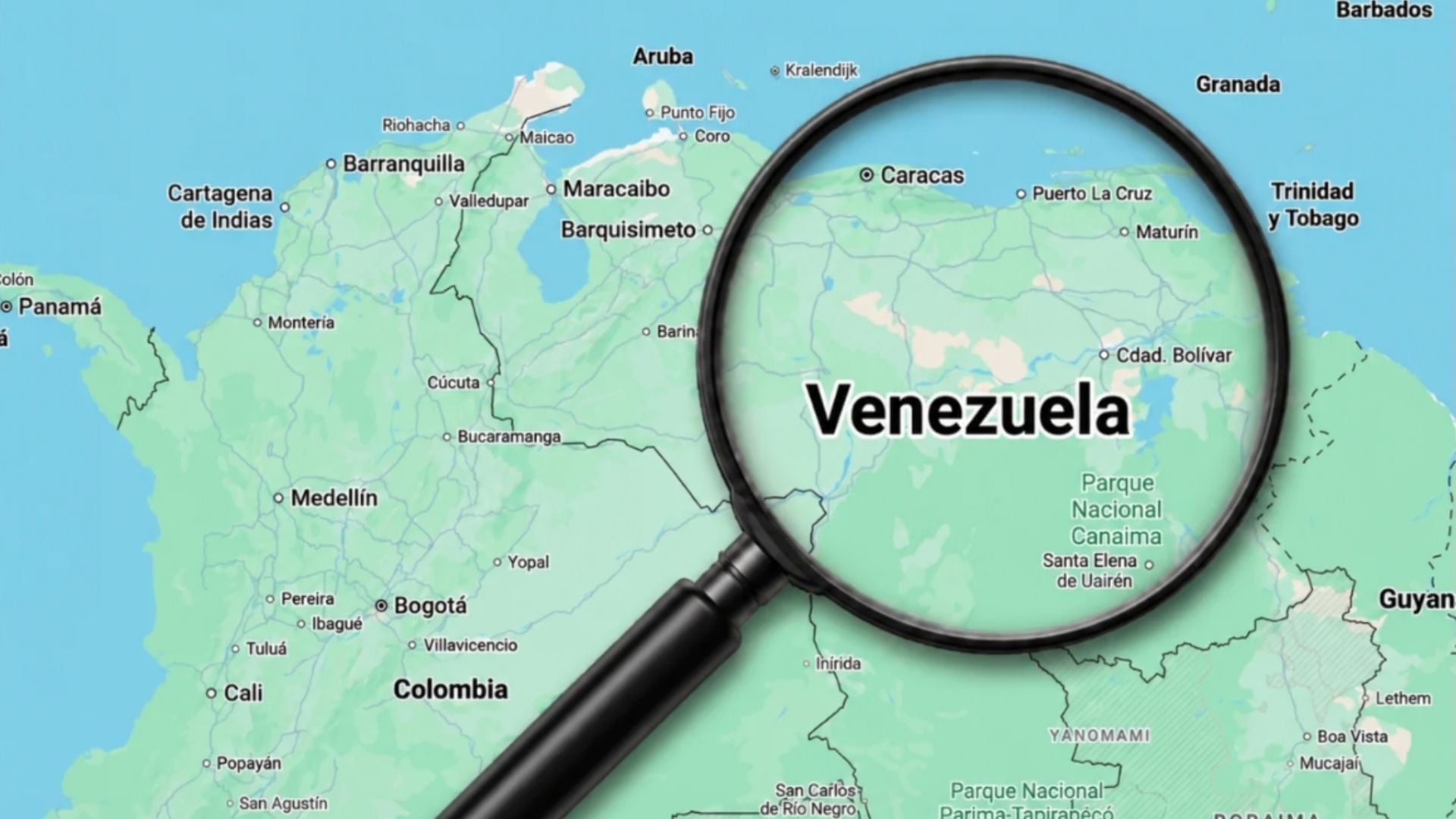
Geopolitical Mining · Country & Region Analysis
The System Around the Resource: What the Agreement Between Venezuela and the United States Really Means
The emerging relationship between Venezuela and the United States reaches from heavy crude and Gulf Coast refining into corporate governance, offtake, minerals, technology, traceability and future investment.
By Marta Rivera Muñoz and Eduardo Zamanillo
August 31, 2026 · Updated September 1, 2026
Updated September 1, 2026. This article now incorporates the White House fact sheet published on August 31, which disclosed the concession period and the United States government’s equity, governance and offtake rights in the structure around NABEP.
The emerging relationship between Venezuela and the United States is being interpreted primarily through oil. Oil provides the scale, the immediate geopolitical significance and the most visible economic connection between the two countries. Venezuela holds an immense petroleum endowment, while the United States possesses capital, technology, trading capacity and one of the most sophisticated refining systems in the world.
The wider significance becomes clearer when the arrangement is examined as a material system. The physical characteristics of Venezuelan crude determine how it can be transported and processed. Diluent is required to move much of the extra heavy production from the Orinoco Belt. Electricity is needed to operate fields, pumping systems, pipelines and terminals. Refineries must be capable of receiving the crude, while shipping, insurance, ports, contracts, payment channels and sanctions permissions must connect each part of the system.
Minerals are entering this same architecture. The United States regulatory framework now covers the commercial movement of Venezuelan minerals, the provision of technology and services for mining operations and the negotiation of future investment contracts. It also introduces chain of custody requirements, transaction reporting, restrictions on the location of processing and conditions regarding the companies and countries that may participate.
The August 31 White House fact sheet makes this system more concrete. It discloses an equity position for the United States government in NABEP’s corporate parent, rights over board appointments, guaranteed access to part of future production and first refusal over the remainder. Venezuela is therefore becoming a contemporary example of how resource security is organized around material compatibility, industrial capacity and the institutions that govern production, commercialization and value.
The Oil Project and Its Governance Structure
On August 29, the Venezuelan government described the agreement as a binational alliance for the joint development of oil fields and greenfield blocks in the Orinoco Belt. According to the official announcement, the binational project was signed for 25 years, covers 17 strategic fields, includes eight greenfield blocks and carries an objective of production above 1.5 million barrels per day. For the financial modelling underlying its revenue projection, the Venezuelan government used US$65 per barrel as the reference oil price. On that basis, it estimated that the project would generate US$209.335 billion in revenue for the Venezuelan state and stated that the contractual structure would preserve state ownership of the resources and Venezuela’s sovereignty over them.
On August 31, the White House published a more detailed account of the corporate and commercial structure. It stated that the Venezuelan interim authorities had granted North American Blue Energy Partners, known as NABEP, 100 year concessions for the same 17 fields, with approximately 65 billion barrels of proven reserves. The fact sheet says those concessions are governed by Venezuela’s new hydrocarbons law. According to the same document, NABEP plans to invest up to US$100 billion in new oil infrastructure and is expected to pay approximately US$200 billion in royalties and taxes over the first 25 years. The document also anticipates that new Venezuelan output will be processed through United States refineries and developed with American rigs and infrastructure.
The two official statements use different legal and financial horizons. The Venezuelan announcement describes a binational project signed for 25 years, while the White House describes 100 year field concessions and places its fiscal estimate within the first 25 years. The public documents currently available do not include the underlying concession, operating or shareholder agreements. The relationship between these periods, the precise rights attached to the concessions and the assumptions behind the two revenue estimates cannot yet be independently assessed.
The White House fact sheet also states that NABEP granted the United States Department of War’s Office of Strategic Capital a 35 per cent equity stake in its corporate parent. The Department of State received the right to purchase 20 per cent of production from NABEP’s current and future fields at production cost, together with a right of first refusal over the remaining 80 per cent. The United States government also received veto power over board appointments, while a majority of NABEP’s directors must be United States citizens. The agreement between the United States government and NABEP is governed by United States law and subject to the jurisdiction of United States courts. The fact sheet also refers to United States audit provisions, payment oversight and financial monitoring around tax and royalty flows.
These rights operate within the corporate governance, commercialization and legal architecture surrounding production. The Venezuelan statement continues to assert state ownership and sovereignty over the resources themselves. Read together, the documents show how formal resource ownership can coexist with substantial external influence over the company, capital, future production and the routes through which oil reaches the market.
The Venezuelan statement also contains one of the most important premises behind the agreement. It acknowledges that reserves underground are insufficient without investment, technology, infrastructure and productive capacity. Venezuela contributes the resource, the industrial history and the experience of its workforce, while the United States contributes capital and technology. The government explicitly connects this combination with the energy security of the Western Hemisphere.
The United States had already begun constructing the regulatory and financial framework for that relationship. In January, the Department of Energy stated that the United States would market Venezuelan crude through authorized channels, with the initial proceeds settling in accounts controlled by the United States. The same plan contemplated the sale of approximately 30 million to 50 million barrels, the return of United States origin diluents, the supply of oil field equipment and services, and work to improve an electricity system considered essential to restoring production.
On August 27, the Office of Foreign Assets Control expanded this structure through licenses covering Venezuelan oil, petrochemical products, diluents, technology, electricity, selected oil and gas operators, minerals, mining services and transactions involving PDVSA. The licenses create an operating perimeter around the reopening, defining the activities that may proceed, the entities that may participate, the information that must be reported and the payment and contractual conditions attached to authorized transactions.
The White House places the agreement within an explicitly hemispheric strategy. Its fact sheet states that many of the incremental fields assigned to NABEP had previously been controlled or operated by Russian and Chinese firms and presents the new structure as part of an effort to build strategic and defensible supply chains in the hemisphere.
A Barrel Is a Physical Material
Oil is frequently discussed through aggregate measures such as reserves, production, exports and prices. Those indicators remain essential, although they can obscure the physical differences between crude streams. Every barrel has a density, viscosity, sulfur content and chemical composition that determine how easily it can be transported, what equipment is required to process it and which products a refinery can obtain from it.
The United States produced a record 13.6 million barrels of crude oil per day in 2025, retaining its position as the largest producer in the world. Much of the crude produced in the United States is relatively light and sweet, while many domestic refineries, particularly complex facilities on the Gulf Coast, were designed or adapted to process heavier and more sulfurous grades. This helps explain why the country can produce enormous quantities of oil while continuing to import particular qualities that fit its refining system.
Venezuela produces the kind of heavy and sour crude that many Gulf Coast refineries are equipped to receive. The United States Energy Information Administration has identified Gulf Coast facilities as well suited to Venezuelan heavy crude and has noted that several refineries historically connected with Venezuela were specifically designed to process heavy oil. This creates a physical relationship between the quality of the Venezuelan resource and industrial assets that already exist in the United States.
The physical relationship begins before the crude reaches a refinery. Production from the Orinoco Belt is frequently extra heavy and highly viscous, which means that it requires lighter hydrocarbons to make it transportable. Diluent allows the crude to move through pipelines, enter storage systems and reach export terminals. Shortages of diluent have previously constrained Venezuelan production, demonstrating that access to a resource depends on the availability of the materials that make its movement possible.
General License 47B addresses this requirement directly. It authorizes the sale, storage, marketing, delivery and transportation of United States origin diluents to Venezuela. The authorization also includes payment processing, shipping, marine insurance, ports and terminal services, showing that the supply of diluent is treated as a complete logistical operation rather than as an isolated commodity transaction.
The geographical connection adds another layer. Venezuelan crude can travel through the Caribbean toward the Gulf Coast without passing through the Strait of Hormuz, the Suez Canal or other distant maritime corridors. Geography alone does not guarantee security, but it reduces one important category of exposure when the necessary ports, vessels, insurers, payment systems and refining capacity can be organized around the route.
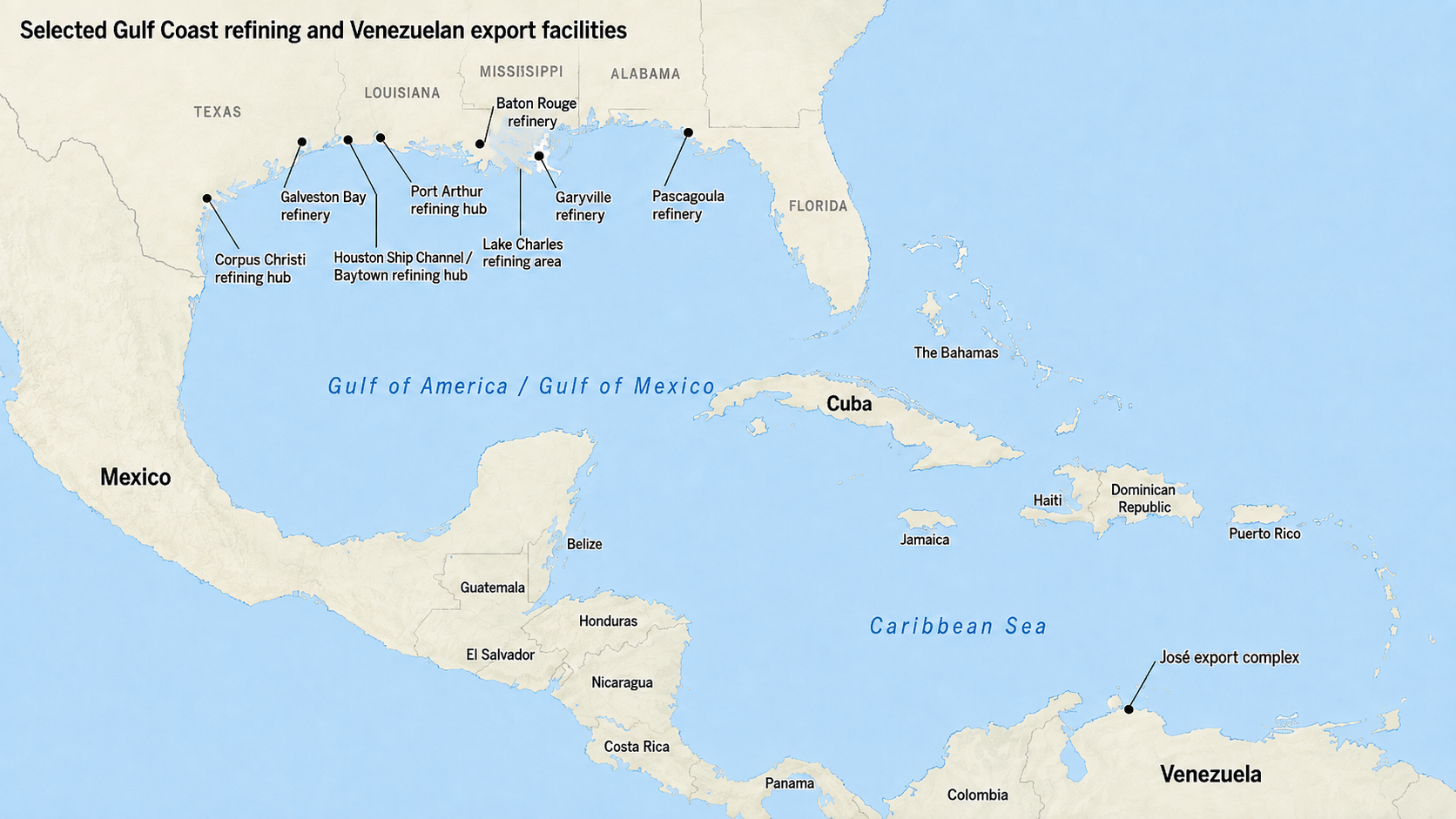
The strategic value of Venezuelan crude therefore arises from a combination of attributes. It has a physical quality that corresponds with part of the United States refining system, a relatively close geographical position and an established industrial history. The current opening is attempting to restore the institutional, technical and financial conditions required to reconnect those elements.
Proximity in a Constrained Oil Market
The timing of the opening increases its significance. In August, the International Energy Agency reported that global refinery throughput in July remained almost 5 million barrels per day below the level of the previous year. Atlantic Basin refining margins reached record levels as product markets tightened, while observed global oil inventories had declined by 410 million barrels between the end of February and the end of July.
The United States Energy Information Administration also expected United States commercial crude inventories to remain below the lowest level of the previous five years through the end of 2026. Refinery inputs during the first seven months of the year were the highest since 2019, supported by strong margins and constrained global product markets. The combination of high refinery activity, lower net imports and tighter international supply placed greater value on crude streams that could be integrated reliably into the domestic refining system.
Venezuela cannot rapidly replace all disrupted or constrained supply. Years of underinvestment, limited maintenance, deteriorated infrastructure and restricted access to capital have reduced productive capacity. Earlier assessments by the Energy Information Administration concluded that substantial new investment would be required for significant production growth, while the Venezuelan government’s own announcement now places capital, technology and infrastructure at the center of the recovery effort.
Its strategic contribution develops through optionality. Venezuela offers a nearby source of heavy crude that can be expanded over time and directed toward an industrial system already capable of processing it. In an oil market shaped by route disruption, depleted inventories, refinery bottlenecks and differences in crude quality, that optionality has value before the full production target is achieved.
Material Proximity
Material proximity describes the practical distance between a resource and the industrial system that can transform it into usable supply. Geographical distance forms one part of that relationship, alongside physical compatibility, infrastructure, processing capacity, institutional access and the ability to document the material throughout its movement.
Physical proximity concerns the relationship between the qualities of a resource and the technical requirements of the system receiving it. Venezuelan heavy crude and complex Gulf Coast refining capacity offer a clear example. A resource may be abundant, but its industrial relevance depends on whether the receiving system can process its density, impurities, composition and form.
Geographical proximity concerns transport distance, ports, borders, corridors and exposure to interruption. A nearby resource can reduce shipping time and route risk, although those advantages become meaningful only when vessels, terminals, insurance and commercial access are available. Venezuela’s position in the Caribbean gives it geographical proximity to the United States, while the licenses and logistics arrangements seek to make that position operational.
Industrial proximity depends on the presence of the connected assets required to move and transform the resource. In petroleum, the system includes fields, wells, diluents, electricity, pipelines, storage, terminals, tankers, refineries and product markets. In mining, it includes exploration capability, equipment, energy, water, roads, ports, laboratories, processing plants, refineries and qualified customers.
Institutional proximity determines whether companies can legally and commercially participate. Sanctions, licenses, payment systems, eligible counterparties, contractual jurisdictions, reporting obligations and investment authorizations establish the rules through which the physical relationship can function. Venezuela’s resources have remained geographically close to the United States throughout the sanctions period, while the institutional distance between those resources and the United States market changed considerably.
Informational proximity becomes particularly important for minerals. Buyers, investors, regulators and financial institutions need credible information about origin, ownership, quantities, prices, taxes, counterparties and chain of custody. A material whose history cannot be verified may remain commercially distant even when it is physically available.
Material proximity therefore measures the organization surrounding a resource. It helps explain why geological abundance and strategic supply can diverge for long periods, and why a change in permissions, infrastructure, processing access or traceability can alter the strategic relevance of a country without changing the geology beneath it.
The Architecture of Access
The United States framework now addresses commercial movement, operating capacity, corporate ownership, board governance, offtake, future investment and institutional control. The August 31 disclosure adds the corporate vehicle and future production to the licensing architecture that had already been established around Venezuelan oil, energy and minerals.
Material access
How the United States Framework Reaches Across Oil, Energy and Minerals
| Layer of access | Oil and energy | Minerals | Strategic function |
|---|---|---|---|
| Commercial circulation | General License 46D | General License 51C | Allows authorized entities to purchase, sell, store, transport, market and process material that has already been produced |
| Operating capacity | General Licenses 47B and 48C | General License 54B | Opens access to diluents, equipment, technology, software, services, maintenance, electricity, logistics, insurance and ports |
| Corporate and project development | General License 50C, NABEP’s 100 year concessions, the 35 per cent United States government equity position and board appointment rights | General License 55 | Defines operating participants, ownership and governance rights, and pathways for project expansion and future investment |
| Production and processing orientation | Guaranteed 20 per cent offtake at production cost and first refusal over the remaining production | Processing restrictions and participant exclusions under General Licenses 51C and 54B | Influences where material moves, who receives priority access and where industrial value can be created |
| Governance of access | Payment accounts, reporting, audit provisions, payment oversight and United States law and jurisdiction for the United States government agreement with NABEP | Chain of custody, transaction reporting, contractual jurisdictions and participant restrictions | Determines how transactions are documented, how payments are handled and where selected disputes are resolved |
The licenses separate existing commercial flows from operational recovery and future investment. The August 31 fact sheet adds equity, board governance and offtake rights, bringing the corporate and commercial organization of production into the same material system.
The August 31 fact sheet places NABEP at the center of the oil structure. The 35 per cent equity position, board appointment rights, guaranteed 20 per cent offtake and first refusal over the remaining production reach beyond permission to trade oil. They place the United States government within the ownership structure, governance and commercialization of the operator that holds the concessions.
General License 46D authorizes established United States entities to lift, purchase, transport, store, market, sell and refine Venezuelan origin oil and specified petrochemical products. It also covers vessel chartering, marine insurance, ports and commercial swaps involving crude, diluent and refined products. General License 47B supplies the diluent required by extra heavy crude, while General License 48C authorizes goods, technology, software and services for oil, gas, petrochemical and electricity operations.
General License 50C defines another part of the corporate perimeter. Its annex names BP, Chevron, Eni, Maurel & Prom, Repsol and Shell as entities whose oil and gas operations in Venezuela can proceed within the authorization. The license also establishes payment and dispute resolution conditions around their activities.
The architecture now reaches from material already produced to the inputs required for recovery, the governance of the operating company, future capital and priority access to output. It governs several stages through which the resource becomes industrial supply.
For the full Geopolitical Mining framework behind this article, see our book Mining Is Dead. Long Live Geopolitical Mining.
Minerals Enter the Same Architecture
The mineral licenses reveal the wider direction of the opening. General License 51C authorizes established United States entities to purchase, sell, store, deliver and transport Venezuelan origin minerals, including gold. The authorization also extends to commercial, legal, technical, safety and environmental due diligence, as well as shipping, security, marine insurance, ports and the processing or refining of the material outside Venezuela, subject to the limitations contained in the license.
The boundaries of the license are as important as the activities it permits. General License 51C does not authorize exploration, development, extraction or production inside Venezuela. It also withholds authorization for the creation of new joint ventures or other entities that would undertake those activities. Its immediate purpose is therefore the circulation and treatment of Venezuelan minerals that have already been produced through authorized commercial channels.
The reporting requirements place traceability at the center of that access. Participating entities must identify the parties involved, describe their supply chain due diligence and chain of custody procedures, report the quantities and descriptions of the minerals, disclose purchase prices and transaction dates, and identify taxes, fees and other payments made to the Venezuelan government. The first report is required shortly after the initial transaction, followed by reports every 30 days while the activity continues.
These requirements carry particular significance in the Venezuelan gold sector. The OECD has documented risks of corruption, conflict financing, money laundering and adverse human rights impacts across gold flows from Venezuela. Traceability requirements can create a formal route for eligible production, although their credibility will ultimately depend on the ability to verify origin and custody within the producing territory.
General License 54B addresses the operating system behind production. It authorizes goods, technology, software and services from the United States for mineral exploration, development, mining, extraction, processing, refining and production in Venezuela. The authorization includes payment services, logistics, marine insurance, ports, maintenance, refurbishment and the repair of equipment used across mineral operations.
This opens a pathway for technical and operational capacity to enter a mining system that has faced equipment deterioration, weak infrastructure, limited maintenance and restricted access to capital. Machinery, spare parts, software, engineering, laboratories, processing systems and technical services can affect the productive capacity of an operation long before a new mine is constructed. General License 54B does not authorize the formation of new joint ventures, which means that it can support existing or authorized activity while leaving the creation of new corporate structures to another stage of approval.
General License 55 provides that additional stage. Issued in March, it allows companies to negotiate and enter into contingent contracts for future investment in Venezuela’s mineral sector, including gold. Those contracts may cover new exploration, mine development, extraction, processing, refining, production, expansion of existing operations and the formation of new joint ventures. Their execution remains expressly dependent on a separate authorization from OFAC.
Read together, the three mineral licenses create a staged pathway. General License 51C allows eligible material already produced to enter authorized commercial and processing channels. General License 54B allows equipment, technology and services to support the physical system that produces and treats the material. General License 55 enables companies to prepare future investments and contractual structures while preserving a further regulatory decision before capital can be deployed.
This structure gives the United States visibility across several moments of the mineral chain. It can observe who purchases the material, how origin is documented, what price is paid, which services and technologies enter Venezuela, which projects are being prepared and which counterparties are expected to participate.
Processing and the Geography of Value
One of the most consequential elements appears in the treatment of mineral processing. General License 51C withholds authorization for Venezuelan minerals to be processed or refined in China, Russia, Iran, North Korea or Cuba. The precise exclusions vary across the wider group of licenses, but the mineral framework consistently limits participation by designated actors connected to those countries.
This means that the opening governs more than access to material at the point of sale. It begins to influence where that material can be transformed into a commercially and industrially usable product. For many minerals, the greatest strategic leverage emerges after extraction through concentration, separation, refining, chemical conversion, metal production or manufacturing to specification.
The distinction matters because mine supply and industrial capacity are distributed differently across the world. A country may possess an orebody while depending on another country for the technical processes that turn the ore into a qualified industrial input. Processing determines purity, consistency, recoveries, commercial acceptance and, in many cases, the location where a substantial part of the economic value is created.
The mineral licenses therefore introduce a form of downstream orientation. Venezuelan origin material entering the authorized system would need to move toward processing jurisdictions that fit the conditions established by the United States. This could encourage new relationships with refiners and processors in the United States or aligned markets, although the documents currently provide no list of specific facilities, projects or mineral products expected to receive that material.
For mining countries, this is a significant signal. The strategic negotiation surrounding a resource increasingly includes the destination of concentrates, the ownership of processing technology, the location of refining, the standards required by buyers and the countries that remain eligible to participate. Geological access begins the relationship, while the geography of transformation determines how much industrial value and strategic influence can be created from it.
Venezuela’s Wider Material Base
Gold is the only mineral named individually in the licenses, but the legal language covers minerals of Venezuelan origin more broadly. The wider wording creates space for other materials to enter the framework when traceable production, viable projects, eligible counterparties and commercially acceptable products can be established.
Our earlier analysis, Venezuela Mining Law and the Viability Question, examined the wider mineral endowment and industrial base behind Venezuela’s mining opening. The latest USGS country data available for that analysis showed that Venezuela produced an estimated 2.25 million metric tons of iron ore in 2022, along with 250,000 metric tons of bauxite, 47,000 metric tons of primary aluminium, 2.6 million metric tons of hydraulic cement, 15,000 metric tons of phosphate rock, 200,000 metric tons of bituminous coal and a smaller volume of diamonds. The same USGS assessment ranked Venezuela as the second largest producer of direct reduced iron in Latin America and the Caribbean during that year, with approximately 18 per cent of regional output.
These figures document a real, although weakened, mineral and industrial base. They do not establish that all operations are currently ready for investment or capable of expanding production. They show that Venezuela’s material economy extends across mining, metals, construction inputs, energy and chemicals, with each material depending on a different combination of infrastructure and industrial capacity.
Iron ore and direct reduced iron connect mining with steelmaking. Recovering that chain requires mines, beneficiation, transport, natural gas or another reduction input, electricity, maintenance and functioning steel related industrial facilities. Its strategic value depends on whether those assets can be organized into a reliable production system and connected with customers capable of absorbing the resulting products.
Bauxite and aluminium reveal the importance of electricity. Aluminium production requires continuous power, stable operations and substantial industrial discipline. The inclusion of electricity generation, transmission, storage and distribution within General License 48C could therefore have consequences beyond the oil fields, particularly if improved power reliability eventually supports energy intensive mineral and metal production. The current licenses create a permission structure, while project specific investment and operating plans would still be required to translate that permission into production.
Phosphate introduces another material chain. The annexes to General Licenses 46D and 48C include phosphate rock, sulfur, sulfuric acid, phosphoric acid, ammonia, urea and a range of fertilizer products and precursors. The regulatory opening therefore reaches materials positioned between mining, hydrocarbons, chemical processing, agriculture and food security.
This connection deserves particular attention. Natural gas can support ammonia production, while phosphate rock and sulfur related products can enter the production of phosphatic fertilizers. Electricity, chemical plants, storage and ports support the chain. An agreement introduced through petroleum can therefore influence the availability of agricultural inputs and the material foundations of regional food production.
Gold presents a different operating challenge. Its high value relative to weight allows it to move through fragmented and opaque networks. Commercial access therefore depends heavily on territorial control, formal operators, verified origin, secure transport, transparent payments and credible refining routes. The reporting obligations in General License 51C recognize that the governance of the material is inseparable from its commercial value.
The wider wording of the licenses may eventually be applied to other Venezuelan minerals. Legal coverage alone does not demonstrate the existence of an economic deposit, a compliant resource estimate, a viable project or a qualified product. Each opportunity will require geological data, ownership clarity, technical studies, infrastructure analysis, environmental and social assessment, traceability and a realistic path to market.
From Mineral Endowment to Mining Viability
In May, Geopolitical Mining examined Venezuela’s new mining law through three tests of mining viability: territory, governance, and energy and infrastructure. The emerging United States framework engages directly with parts of the governance and operating capacity tests, while the territorial test remains largely dependent on institutions inside Venezuela.
On governance, the licenses introduce chain of custody, supply chain due diligence, transaction reporting, price disclosure, payment records and identified contractual forums. OFAC requires relevant contracts with the Venezuelan government, PDVSA or Minerven to provide for dispute resolution proceedings in the United States, the United Kingdom, France or Singapore. These conditions create a more legible external framework around authorized commercial relationships.
On energy and infrastructure, the permissions cover diluents, oil field equipment, mining technology, software, maintenance, electricity, shipping, insurance, ports and terminal services. These are components of the productive system that can help restore existing capacity and support the preparation of future projects. Their presence also demonstrates how closely mining viability depends on systems that extend beyond the mine itself.
Territorial governance remains the most difficult layer. Reporting can document a transaction once material enters a formal channel, but credible chain of custody begins at the place of extraction. It requires identifiable operations, clear mineral rights, secure transport, environmental oversight, community relationships, public authority and the ability to separate authorized production from illicit or informal flows.
External licenses can construct institutional scaffolding around transactions and investment. They cannot independently establish state authority across a mining district or guarantee that production entering the system has been governed consistently from the point of origin. That responsibility remains central to Venezuela’s ability to convert legal access into traceable and legitimate supply.
This is where the concept of mining viability remains essential. A project becomes strategically meaningful when geology, institutions, infrastructure, energy, territory, capital and legitimacy can operate together over time. Venezuela’s opening addresses several of those conditions, while the durability of the system will depend on execution inside the country and confidence among companies, lenders, workers, communities and international counterparties.
Sovereignty Within a Governed Material System
The Venezuelan government has emphasized that the state retains ownership and sovereignty over its resources. The United States framework formally recognizes that Venezuelan natural resource revenues held in the designated Treasury structure remain the sovereign property of Venezuela. At the same time, those funds are held in United States custody and may be transferred or disbursed only through the mechanisms established by the executive order and related authorizations.
This arrangement illustrates the multiple dimensions through which sovereignty operates in a contemporary resource economy. Geological sovereignty concerns ownership of the resource. Operational sovereignty concerns the authority to determine who develops it, under which conditions and with what technology. Commercial and industrial sovereignty concern buyers, destinations, processing and the location of value creation. Financial and informational sovereignty concern payments, revenues, production data, prices and knowledge of the material’s movement.
The August 31 disclosure adds a corporate and commercial layer to this distribution of authority. Formal ownership of the petroleum underground continues to be described as Venezuelan, and the White House says the concessions themselves are governed by Venezuela’s new hydrocarbons law. At the corporate and commercial level, the United States government holds a 35 per cent equity position in NABEP’s corporate parent, veto power over board appointments, a requirement that most directors be United States citizens, guaranteed access to 20 per cent of production at cost and first refusal over the remainder. The separate agreement between the United States government and NABEP is governed by United States law and subject to United States courts.
The licenses add further influence over eligibility, payments, dispute resolution, reporting and processing geography. Venezuela contributes the resource and domestic authority, while access to capital, technology and selected international markets is organized through a framework in which the United States occupies defined positions across the company, its production and the institutional channels surrounding both.
The durability of this distribution of authority will depend on whether the interests of the participants can remain aligned. Venezuela seeks production, investment, public revenue, industrial recovery and recognition of sovereign ownership. The United States seeks secure and governable access to nearby resources while limiting the role of strategic competitors. NABEP and other participating companies require enforceable contracts, reliable payments, operating continuity and returns capable of supporting capital over many years.
The resulting bargain encompasses far more than royalties or equity ownership. It influences how the resource is financed, produced, governed, documented, transported, processed and sold. It also determines which jurisdictions, companies and technologies become embedded within the productive system.
The Wider Material Bargain
The Venezuelan case provides a framework for considering how future resource agreements may develop across the material economy. Governments and companies are increasingly negotiating systems of production rather than isolated deposits or commodity volumes. Infrastructure, energy, processing, technology, payment channels, traceability and geopolitical eligibility are becoming integral parts of the commercial relationship.
A copper agreement can connect the mine with electricity, water, transmission, roads, rail, ports, concentrate sales and smelting capacity. A lithium agreement can include extraction technology, chemical conversion, product qualification, water management, intellectual property and the location of battery manufacturing. A rare earth agreement can extend from mining through separation, metal production, alloy production and magnet manufacturing.
Gold requires a different configuration centered on territorial authority, formalization, chain of custody, refining standards and financial controls. Fertilizers connect natural gas, phosphate, sulfur, ammonia, acids, chemical facilities, ports and agricultural policy. Each resource follows its own physical pathway, but each depends on an organized system that converts geological or industrial inputs into usable supply.
For governments, this expands the scope of resource policy. Mining and energy ministries remain central, while the strategic outcome also depends on finance, trade, foreign affairs, infrastructure, industry, environment, territorial governance and public legitimacy. The quality of coordination across those institutions can influence whether a country captures durable value or provides raw material within a system largely organized elsewhere.
For companies and investors, country risk analysis must extend beyond the legal title to the resource. Boards need to understand the exact material being produced, the industrial assets capable of using it, the infrastructure standing between the resource and the customer, the jurisdictions governing contracts and payments, the technologies required for processing and the geopolitical relationships embedded in market access.
This is the wider implication of material proximity. A nearby resource can remain strategically distant when infrastructure, institutional permission or reliable information is absent. A resource can move closer when capital, technology, processing, logistics and governance are deliberately organized around it.
Strategic Reading
The opening between Venezuela and the United States is one of the clearest current examples of resource strategy returning to the physical reality of materials. Heavy crude provides the initial industrial fit. Venezuela holds a type of oil that corresponds with complex United States refining capacity, while its Caribbean location provides geographical proximity. Diluent, electricity, equipment, logistics and investment are required to restore the productive system, and the licenses provide the institutional channels through which those capabilities can enter.
The August 31 White House disclosure makes the system around the resource more visible. Equity, board, offtake and legal rights give the United States government a defined position within the operator and the pathway through which future production can reach the market, while Venezuela continues to assert sovereign ownership of the resources. Strategic influence is being built through the institutions that convert the petroleum endowment into production, revenue and supply.
The mineral permissions extend this logic into a broader material relationship. Commercial access requires chain of custody and transaction visibility. Operating recovery requires technology, equipment and services. Future expansion requires additional investment authorization. Restrictions on participants and processing locations influence where the material can move and where value can be created.
The outcome remains uncertain. The underlying contracts have not been published, the relationship between the 25 year project horizon and the 100 year concessions requires clarification, and the production objectives depend on sustained execution across infrastructure, capital, operations and institutions. Territorial governance, political legitimacy and the balance between external influence and domestic authority will continue to shape the investment environment.
The strategic signal is nevertheless substantial. Resource security is being organized through quality, distance, infrastructure, corporate governance, processing, traceability and institutional alignment. Venezuela possesses geographical and geological proximity to the United States. The emerging framework is attempting to create the industrial, commercial, institutional and informational proximity required to transform that position into dependable supply.
Geology establishes the possibility of production, while the system surrounding the resource determines its strategic contribution.
Venezuela’s significance will ultimately depend on whether this new material architecture can convert its petroleum and mineral endowment into production that is reliable, traceable, financeable and durable.
Resources
Venezuelan and United States Framework
Oil, Energy and Mineral Licenses
Oil Market and Physical Context
United States Energy Information Administration. Short Term Energy Outlook, August 2026.
International Energy Agency. Oil Market Report, August 2026.
Mineral Governance and Related Analysis
OECD. Gold Flows from Venezuela: Supporting Due Diligence on the Production and Trade of Gold.
Rivera Muñoz, Marta, and Eduardo Zamanillo. Venezuela Mining Law and the Viability Question.
Rivera Muñoz, Marta, and Eduardo Zamanillo. Mining Viability.