
Geopolitical Mining · Weekly
Geopolitical Mining Weekly
Week of July 6–12, 2026
Authors: Marta Rivera | Eduardo Zamanillo
July 12, 2026
What this week really tells us
What stood out this week is that mineral security is moving from policy intent into execution discipline. The signals were not only about naming minerals as strategic, announcing partnerships or presenting new investment vehicles. They were about the instruments and conditions that determine whether supply can actually move: structured capital, permitting decisions, research capacity, local processing, mining technology, operating reliability and the ability to convert industrial ambition into real production.
In Canada, the launch of the Canada Critical Minerals Accelerator moved policy into a project level commercial framework around Teck’s Trail Operations in British Columbia. The agreement connects public investment, private capital, processing expansion and possible offtake rights for germanium, antimony and gallium. That matters because mineral security is not only about owning resources. It is also about securing access to processed strategic metals.
In the United States, the Forest Service issued the final record of decision for South32’s Hermosa Critical Minerals Project in Arizona. The signal is important because zinc and manganese supply still has to pass through financial assurance, final mine-plan authorization and project execution before it becomes operating capacity. Permitting is not outside the supply chain. It is part of the supply chain.
Europe sent a different signal through the RAMP partnership, putting long-term research and innovation behind raw materials resilience across the value chain. China and Namibia placed critical minerals inside a broader agenda of local processing, beneficiation, technology transfer, skills and logistics. Canada backed mining technologies aimed at more precise extraction and better mine restoration monitoring. Ivanhoe’s Kamoa-Kakula update showed the operating side of the same question: copper supply depends on mining rates, smelting, inventories, power and by-product markets, not only on resource size.
The week’s message is direct: mineral security is not advancing through one instrument. It is advancing through a portfolio of instruments. Public capital, permits, research, beneficiation, mining technology, processing, logistics and operating reliability are becoming part of the same supply question. The signal is that countries and companies are no longer only asking where the minerals are. They are asking whether the system around those minerals can move from intention to execution.
For the full Geopolitical Mining framework behind this note, read our book Mining Is Dead. Long Live Geopolitical Mining.
Signals of the week
Signal 1: Canada is turning critical minerals policy into strategic investment and offtake architecture
What happened
On July 7, Natural Resources Canada launched the Canada Critical Minerals Accelerator and announced a Strategic Investment Agreement signed by the CCMA, the Canada Growth Fund and Teck Resources Limited. The agreement supports the expansion of production capacity at Teck’s Trail Operations in British Columbia, described by Canada as one of the world’s largest fully integrated polymetallic smelting and refining complexes.
The potential total investment by Teck could reach up to C$850 million. The expansion could double Trail’s existing production capacity for germanium and antimony and potentially add new gallium production capacity. The agreement also establishes the commercial framework for an equity like investment by the Canada Growth Fund of up to C$400 million directly into the facility. Through the CCMA, Canada may also negotiate an offtake structure, including rights for a portion of future germanium, antimony and gallium produced at Trail. The arrangements are not final. Canada said realization of the commercial arrangements remains subject to conditions, including definitive documentation and applicable approvals.
Why it matters
This matters because Canada is moving from critical minerals strategy into commercial architecture. The signal is not just that Canada wants more critical minerals production. It is that the state is trying to shape the financing and access structure around processed strategic metals.
Germanium, antimony and gallium matter because they sit closer to high value industrial and defence supply chains than to traditional bulk mineral markets. They are not only mined. They must be recovered, refined, qualified and connected to users that need secure supply. The Trail signal is also important because it focuses on an existing smelting and refining complex. Mineral security does not always require starting from zero. Sometimes the strategic opportunity is to expand and repurpose industrial capacity that already exists. The qualification matters. This is a strategic investment agreement and commercial framework, not completed production expansion. The real test will be whether the agreement moves into definitive documentation, investment, construction and reliable output.
Implications for capital and strategy
For capital, the signal is that strategic metals processing assets may attract more structured public private capital, especially when they can offer processed material rather than only upstream resource exposure. For strategy, the deeper message is that offtake is becoming part of statecraft. Countries are not only asking who can produce the material. They are asking how access to that material can be structured before markets tighten.
Signal 2: Hermosa shows that permitting is part of the critical minerals supply chain
What happened
On July 7, the U.S. Department of Agriculture’s Forest Service issued the final record of decision for South32’s Hermosa Critical Minerals Project in Santa Cruz County, Arizona. South32 Hermosa is proposing a US$3.3 billion mining and processing operation in a historic mining district near the U.S.–Mexico border. USDA said the project includes one of the world’s largest undeveloped zinc resources and minerals such as zinc and manganese.
The Forest Service said the issuance of the record of decision signals the conclusion of the NEPA process. The next steps for South32 Hermosa include submitting financial assurance and the final Mine Plan of Operations. Final authorization is scheduled for September 4, 2026.
Why it matters
This matters because a critical minerals project does not become supply when it enters the political narrative. It becomes supply only when it moves through the legal, environmental, technical and financial gates that allow it to be built. Hermosa is important because zinc and manganese are connected to industrial systems, steel, batteries and infrastructure. But the strategic relevance of the project does not remove the need for permitting discipline.
The final record of decision is a major milestone, but it is not the same as operating capacity. Financial assurance, the final Mine Plan of Operations, construction, commissioning and execution still matter. This is where mineral security often becomes difficult. Governments may want faster supply. Companies may want project certainty. Communities and regulators still need credible environmental and operating conditions.
Implications for capital and strategy
For capital, the signal is that permitting milestones can materially change project risk, but they do not eliminate execution risk. Investors still need to understand the next legal and technical gates. For strategy, the deeper message is that permitting capacity is supply chain capacity. A country cannot build mineral security if its projects cannot move through review in a credible and durable way.
Signal 3: Europe’s RAMP partnership shows that raw materials security also depends on research capacity
What happened
On July 7, the European Health and Digital Executive Agency published details on RAMP, the Raw Materials Partnership for the Green and Digital Transition. RAMP is a long term cofunded partnership under Horizon Europe. It brings together 56 partners from 33 countries and has a total budget of approximately €300 million, including a €90 million contribution from the European Union. The partnership will launch seven transnational funding calls between 2025 and 2037. Its first joint transnational call is open, offering nearly €40 million for research and innovation projects across the raw materials value chain. The partnership covers sustainable primary supply, product design, manufacturing, reuse, recycling and recovery, as well as policy, regulation, sustainability and skills.
Why it matters
This matters because raw materials security is not built only through mines and financing. It also depends on knowledge. Exploration technologies, processing methods, recycling systems, product design, recovery techniques, skills and regulatory capacity all shape whether Europe can reduce dependence and build more resilient supply chains.
The RAMP signal is important because it recognizes that mineral security is a long-term capability problem. A project pipeline may depend on geology and capital, but a supply chain depends on technical knowledge, industrial adoption and the ability to solve problems across the value chain. Research and innovation are sometimes treated as secondary to production. In critical raw materials, they are part of production capacity over time.
Implications for capital and strategy
For capital, the signal is that technologies connected to processing, recovery, recycling and raw materials efficiency may become more strategically relevant if they can move from research into industrial use. For strategy, the deeper message is that supply resilience must be learned and built. Countries that invest only in extraction but not in knowledge, skills and industrial adaptation may remain dependent at the most important parts of the chain.
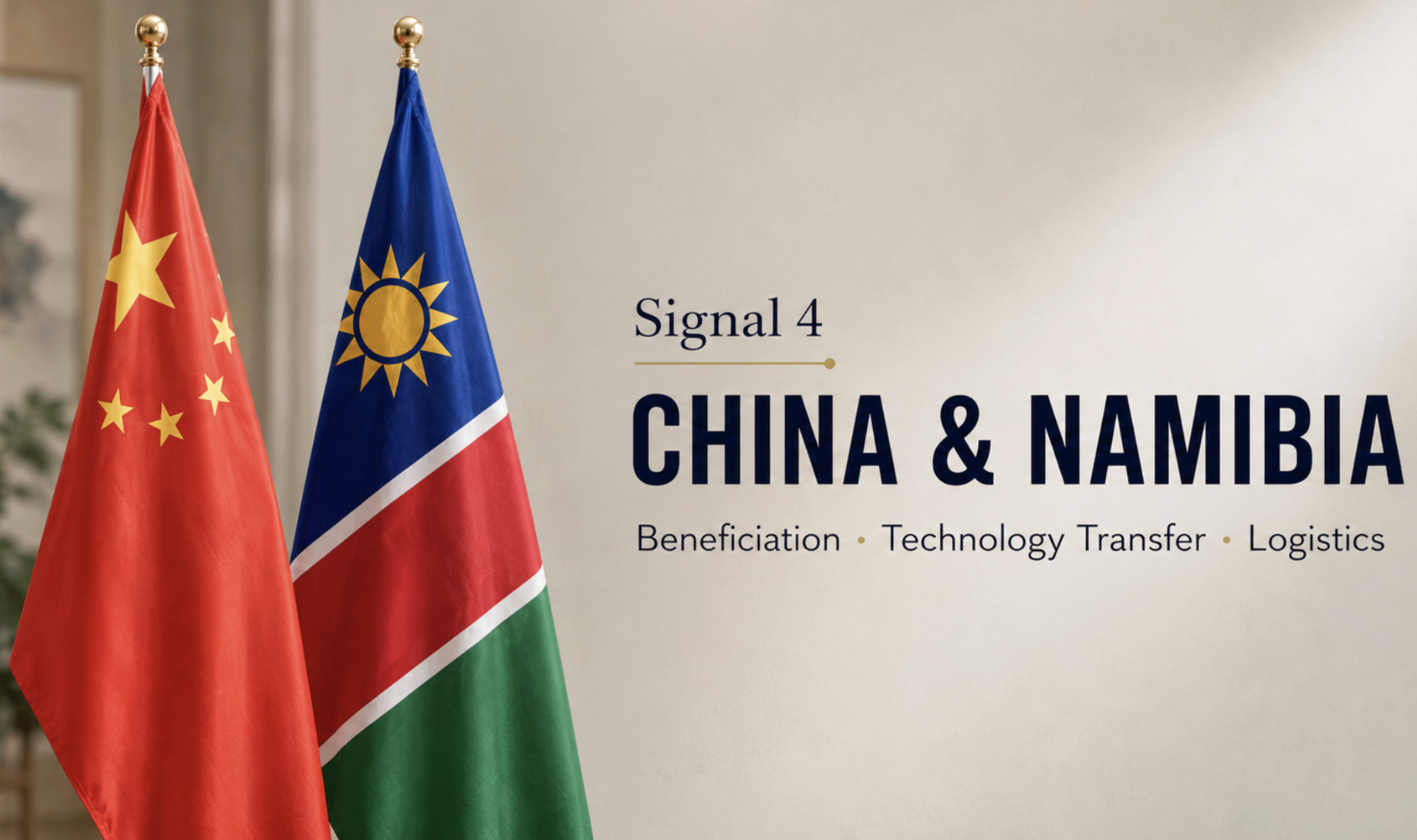
Signal 4: China and Namibia are putting critical minerals into beneficiation, technology transfer and logistics
What happened
On July 10, China’s Ministry of Foreign Affairs published a joint statement between China and Namibia following President Netumbo Nandi Ndaitwah’s state visit to China. The statement recognized the strategic importance of critical minerals and said the two sides agreed to strengthen cooperation in sustainable development, local processing, beneficiation and value addition of Namibia’s mineral resources, including uranium, lithium, rare earth elements and other strategic minerals.
The statement also mentioned technology transfer, local skills development and industrial capacity building. It separately identified logistics, maritime transport and trade facilitation, including the development of the Port of Walvis Bay as an important gateway connecting Southern Africa to regional and global markets.
Why it matters
This matters because mineral diplomacy is moving beyond access to deposits. For resource rich countries, the question is increasingly whether mineral development can support local processing, industrial capacity, skills and infrastructure. For external partners, the question is how to secure long term mineral relationships while responding to host country demands for more value capture. Namibia is important because it sits in several mineral conversations at once: uranium, lithium, rare earths, logistics and Southern African trade corridors. The mention of Walvis Bay also matters because ports and transport routes are part of mineral strategy.
The signal is not only about China. It is about a wider pattern. Resource holding countries are pushing mineral relationships toward beneficiation and industrial development, while major industrial powers are trying to secure supply through broader packages of investment, infrastructure and cooperation.
Implications for capital and strategy
For capital, the signal is that investors in Namibia and similar jurisdictions should expect local processing, skills development, logistics and value addition to remain central to project discussions. For strategy, the deeper message is that mineral security is becoming negotiated through development models, not only through mining licences or offtake contracts.
Signal 5: Canada’s mining innovation funding shows that technology is becoming part of supply credibility
What happened
On July 9, Innovation, Science and Economic Development Canada announced C$6.7 million in federal support for two Canadian led mining innovation projects valued at C$19.8 million. The projects are led by Novamera Inc. and Koonkie Canada Inc. Novamera will receive C$3.8 million toward a C$10.9 million project to advance Surgical Mining technology, which combines subsurface imaging, artificial intelligence, robotics and conventional drilling equipment to access critical mineral deposits with greater precision.
Koonkie will receive C$2.9 million toward an C$8.9 million project to develop an AI-powered platform using environmental DNA analysis, soil health data, remote sensing and Indigenous ecological knowledge to support ecological restoration and biodiversity monitoring at mine sites.
Why it matters
This matters because technology is becoming part of mining credibility. Critical minerals supply is not only a question of whether a deposit exists. It is also a question of whether the project can be mined with enough precision, environmental control, monitoring capacity and social confidence to move forward. The Novamera signal points to selective extraction and reduced disturbance. The Koonkie signal points to monitoring, restoration and environmental accountability after mining activity begins.
That matters because the barrier to supply is often not only capital. It is the trust deficit around mining. Technologies that improve precision, monitoring and restoration may help projects move through the practical and social conditions required for development. This does not mean technology replaces governance. It means technology can strengthen the operating basis for governance.
Implications for capital and strategy
For capital, the signal is that mining technologies that reduce disturbance, improve monitoring or support restoration may become more relevant to project risk and financing. For strategy, the deeper message is that mineral security depends on the quality of extraction, not only the quantity of extraction. How a project is mined can determine whether it can be built.
Signal 6: Kamoa-Kakula shows that copper security depends on operating recovery, smelting and power
What happened
On July 8, Ivanhoe Mines reported that Kamoa-Kakula produced 64,328 tonnes of copper in the second quarter of 2026. The company said Africa’s largest copper smelter produced 112,307 tonnes of high strength sulphuric acid during the quarter. It also said copper production is expected to increase in the second half of 2026, driven by a 30% increase in the Kamoa mining rate to 8.5 million tonnes per annum. Ivanhoe also reported that Project 95 is complete, that concentrator recovery rates are expected to improve from the third quarter of 2026, and that commissioning of a 60 MW solar facility with battery backup is underway. The company said the Lualaba Copper Smelter resumed normal operations on July 1 after a 56 day shutdown.
Why it matters
This matters because copper security is not only about finding copper. It is about keeping complex operating systems working. A large copper operation depends on mining rates, concentrator performance, smelter availability, power supply, inventory management, by product markets and logistics. If any of those pieces breaks down, supply is affected even when the resource remains in the ground.
Kamoa-Kakula is useful as a signal because it shows the operational side of mineral security. Production recovery, smelting and power are not secondary details. They are part of the copper supply chain. The sulphuric acid output is also relevant. Large copper smelters do not only produce copper. They also interact with regional chemical and industrial markets. That makes operational reliability even more important.
Implications for capital and strategy
For capital, the signal is that copper valuation must account for operating reliability, processing recovery, power systems, inventory and by product economics, not only reserves and headline production capacity. For strategy, the deeper message is that supply security depends on the ability to operate. A country or company can have world class resources, but production still depends on the discipline of the system inside and around the mine.
Signals to watch
- Whether the Canada Critical Minerals Accelerator, Canada Growth Fund and Teck convert the Trail strategic investment agreement into definitive documentation, approvals and clear offtake arrangements for germanium, antimony and gallium.
- Whether South32 Hermosa submits financial assurance and the final Mine Plan of Operations in time for the scheduled September 4 final authorization.
- Whether Europe’s RAMP partnership funds projects that move beyond research into industrial applications in processing, recycling, recovery and raw materials substitution.
- Whether China and Namibia’s critical minerals language translates into specific beneficiation, logistics or industrial capacity projects, especially around uranium, lithium, rare earths and Walvis Bay.
- Whether Canada’s mining innovation investments move Novamera and Koonkie from development into field deployment and measurable project level impact.
- Whether Kamoa-Kakula delivers the expected second half production increase, improved recovery rates, inventory destocking and progress on solar and battery commissioning.
- Whether Canada-Saudi commercial agreements signed during Prime Minister Carney’s visit to Jeddah lead to concrete mining, critical minerals, infrastructure or clean energy projects. Canada said the visit produced 13 commercial agreements and MOUs worth over C$1 billion across sectors including mining, infrastructure and defence.
- Whether the European Commission’s Raw Materials Mechanism moves from offtaker aggregation into supplier submissions and creates useful matches between European demand and external supply.
Three strategic questions for this week
- Which creates supply faster: public capital, permitting decisions, mining technology, processing capacity or operational recovery?
- Are governments building enough capacity around processed strategic metals, or are they still too focused on upstream resource announcements?
- How should investors value projects when the decisive risk sits in permitting, processing, technology or operating reliability rather than resource size?
Resources
Signal 1
Signal 2
Signal 3
Signal 4
Signal 5
Signal 6
Signals to watch