
Geopolitical Mining · Critical Minerals
Rare Earths Are Becoming a Talent War
Why mineral security now depends on engineers, processing knowledge and institutional competence
By Marta Rivera Muñoz and Eduardo Zamanillo
Rare earths are usually discussed through reserves, export controls, processing capacity and geopolitical dependence. That language is valid. These minerals sit inside permanent magnets, electric motors, defence systems, wind turbines, robotics, medical technologies, electronics, data centres and advanced manufacturing. Their strategic relevance is now widely understood.
The harder question is how mineral potential becomes reliable supply. A rare earth deposit creates possibility. It does not create supply. Between geology and supply lies a demanding sequence of technical, chemical, environmental, financial and commercial decisions. The orebody must be understood. The mineralogy must be characterized. The processing route must be tested. Separation circuits must be designed, stabilized and scaled. Residues must be managed. Product specifications must be reached consistently. Customers must qualify the material. Regulators must understand the project. Investors must understand the risk. Operators must run the system without losing control of cost, recovery, quality or compliance.
That is why rare earths are becoming a talent war. This is a competition for accumulated technical memory: engineers, geologists, metallurgists, chemists, mineral processors, environmental specialists, project financiers, permitting professionals, industrial strategists, laboratory networks, universities, public agencies and companies capable of learning together over time. In rare earths, capability is cumulative. It cannot be built through an announcement, a subsidy or an offtake agreement alone. It must be trained, practiced, retained and transferred across the value chain.
For the full Geopolitical Mining framework developed by Marta Rivera Muñoz and Eduardo Zamanillo behind this article, see our book Mining Is Dead. Long Live Geopolitical Mining.
The numbers behind the rare earths problem
The rare earths debate is often framed as a question of who has the resources. The numbers show a more complex picture. In 2025, global rare earth mine production reached an estimated 390,000 tonnes of rare earth oxide equivalent. China accounted for 270,000 tonnes, or roughly 69% of world mine output. The United States produced 51,000 tonnes of REO in mineral concentrates, but only 8,900 tonnes of rare earth compounds and metals. That gap matters. It shows that upstream production does not automatically translate into integrated supply.
The U.S. Geological Survey also estimated U.S. net import reliance for rare-earth compounds and metals at 67% in 2025. Between 2021 and 2024, China accounted for 71% of U.S. imports of rare earth compounds and metals. In 2025, U.S. imports of rare earth compounds and metals increased by 169%, even as the estimated value of those imports declined slightly, reflecting a shift toward lower value imported products.
| Indicator | 2025 or latest available data | Strategic reading |
|---|---|---|
| Global rare earth mine production | 390,000 t REO | Small-volume market with high strategic relevance |
| China mine production | 270,000 t REO | Around 69% of global mine output |
| U.S. mine concentrate production | 51,000 t REO | Upstream capacity exists |
| U.S. rare-earth compounds and metals production | 8,900 t | Processing and conversion remain the harder gap |
| U.S. net import reliance, compounds and metals | 67% | Domestic mining has not removed import dependence |
| China share of U.S. import sources, 2021–2024 | 71% | Dependency is geographically concentrated |
| U.S. import growth, compounds and metals | +169% | Demand for processed material is rising sharply |
These figures explain why rare earth security cannot be measured only by mine production. The bottleneck sits in the ability to convert mineral potential into qualified industrial inputs.
Rare earths are a system, not a single commodity
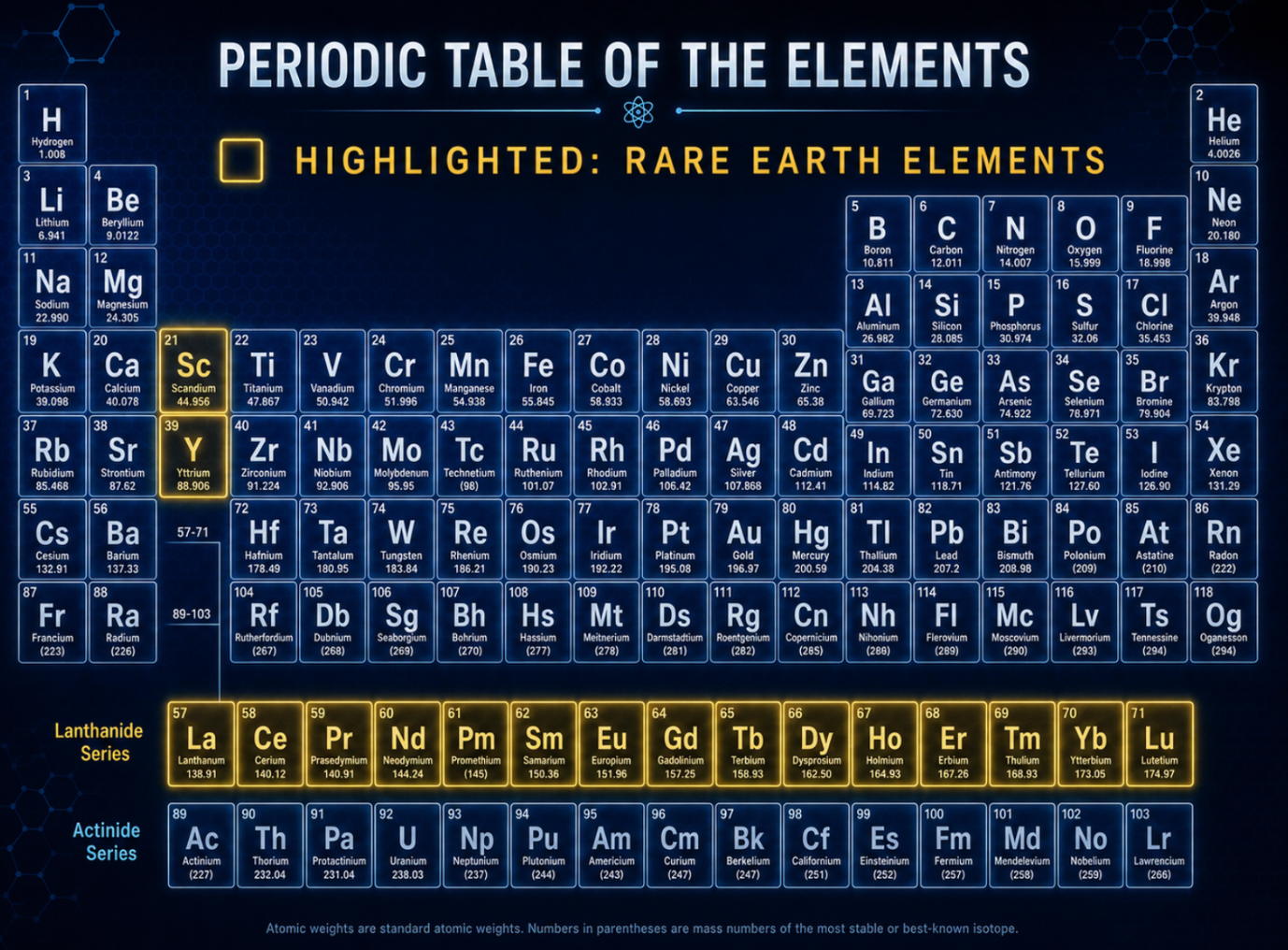
The term rare earths often creates the impression of one market. In practice, it refers to a family of elements with different uses, different processing challenges and different strategic implications. Some are essential for magnets. Others matter for catalysts, alloys, ceramics, electronics, defence systems or specialized industrial applications.
This matters because the rare earths challenge is rarely solved at the mine gate. Mining is only the first stage of a broader industrial system. The decisive bottlenecks often appear in beneficiation, cracking, leaching, solvent extraction, separation, oxide production, metal making, alloying, magnet manufacturing, recycling and customer qualification.
| Stage | Technical function | Strategic risk |
|---|---|---|
| Mining | Extract mineralized material | Geology alone does not create supply |
| Beneficiation | Upgrade ore into concentrate | Recovery depends on mineralogy and process control |
| Cracking and leaching | Break down mineral structure | Chemical complexity and environmental risk increase |
| Separation | Separate individual rare earth elements | One of the hardest midstream chokepoints |
| Oxide production | Produce saleable rare earth oxides | Requires consistency and purity |
| Metal and alloy making | Convert oxides into industrial inputs | Demands metallurgical and materials expertise |
| Magnet manufacturing | Produce permanent magnets | Downstream strategic leverage concentrates here |
| Qualification | Meet customer and sector requirements | Material without qualification remains commercially weak |
Rare earth security is built through a full chain of knowledge. This is one reason why rare earths have become difficult for Western countries to rebuild quickly. The minerals may exist in the ground. Projects may be announced. Governments may recognize the strategic importance. Capital may become available. The capacity to operate the midstream and downstream parts of the chain requires specialized expertise that takes years to form.
This is where the distinction between mineral potential and mineral viability becomes essential. A country may have resources and still lack supply. A project may have geological value and still remain commercially or technically fragile. A government may have ambition and still lack the institutional depth required to execute. Rare earths expose this gap with unusual clarity.
China’s advantage is educational, institutional and industrial
China’s position in rare earths is often explained through reserves, production and processing capacity. Those factors matter. The deeper advantage is educational, institutional and industrial. For decades, China has treated rare earths as a strategic field of knowledge. Universities, laboratories, companies and state agencies have worked around a common industrial priority. The result is an ecosystem of specialization. The International Energy Agency estimates that, for magnet rare earths, China accounted for around 60% of global mining output in 2024, about 91% of separation and refining, and 94% of rare earth containing permanent magnet production. In 2024, China exported 58,000 tonnes of rare earth magnets. These magnets are embedded in electric vehicles, wind turbines, industrial motors, defence systems, aerospace components and data centres.
| Layer of capability | China’s position | Why it matters |
|---|---|---|
| Magnet rare earth mining | Around 60% of global output, 2024 | Upstream scale |
| Separation and refining | Around 91% of global production, 2024 | Control of the hardest midstream stage |
| Permanent magnets | Around 94% of global production | Downstream industrial leverage |
| Rare earth magnet exports | 58,000 t, 2024 | Strategic reach into global manufacturing |
| U.S. import sources for compounds and metals | China 71%, 2021–2024 | Dependency enters through processed material |
Jiangxi University of Science and Technology’s Rare Earth College is a useful example of the hidden architecture behind this advantage. The college describes itself as an undergraduate talent training institution created to strengthen rare earth disciplines and serve the high quality development strategy of China’s rare earth industry. That framing matters. Rare earths are treated as a strategic knowledge domain, rather than a narrow mining subsector. A country that trains people across geology, metallurgy, materials science, chemistry, processing and industrial application creates an advantage that is difficult to replicate. When graduates enter companies already familiar with rare earth concepts, when laboratories work close to industrial problems, and when policy, education and industry move in the same direction, the system becomes faster at solving operational problems.
That speed matters in rare earths. Processing rare earths is technically complex. Product quality is sensitive. Separation is demanding. Environmental management is difficult. Scaling from laboratory work to stable commercial operation is rarely linear. A country with more people who have seen these problems before has a practical advantage over a country trying to rebuild the chain from a thin technical base. Mines and plants matter. The hidden infrastructure of expertise matters just as much.
The West is rebuilding capacity, but capability takes time
Western governments are moving more aggressively on critical minerals. Public capital is increasing. Strategic partnerships are multiplying. Rare earths have moved from industrial policy documents into national security planning. In December 2025, the U.S. Department of Energy announced up to US$134 million to enhance domestic rare earth supply chains. The funding supports projects that demonstrate the commercial viability of recovering and refining rare earths from unconventional feedstocks, including mine tailings, e-waste and other waste materials. The Rare Earth Elements Demonstration Facility program is designed to demonstrate the feasibility of a full-scale integrated extraction, separation and refinery facility. It also requires an academic partner and a cost share of at least 50% by the recipient. In May 2026, the White House authorized critical position pay for up to 400 positions supporting national security investment programs, with basic pay of up to US$400,000. The memorandum explicitly refers to the need to recruit investment, engineering, financial and legal professionals required to expand U.S. capacity in critical minerals, advanced materials and strategic supply chains.
Also in May 2026, the Quad partners (the United States, Japan, Australia and India) announced a Critical Minerals Initiative Framework with the intention to mobilize up to US$20 billion in government and private-sector support for mining, processing and recycling.
| Recent policy signal | Amount / scale | Strategic meaning |
|---|---|---|
| DOE rare earth supply chain funding | Up to US$134 million | Public capital is moving toward recovery, refining and demonstration-scale capacity |
| DOE Rare Earth Demonstration Facility | Integrated extraction, separation and refinery | The bottleneck is being treated as a full industrial system |
| White House critical position pay authority | Up to 400 positions; up to US$400,000 basic pay | Talent is now national security infrastructure |
| Quad Critical Minerals Initiative | Up to US$20 billion | Alliances are moving from diplomacy toward financing execution |
These signals are important. They show that mineral security is being understood as an execution problem. It requires engineers, financiers, legal specialists, investment professionals and public officials who can evaluate projects, structure capital, manage risk and move strategic programs from policy language into operational reality.
Capital can accelerate projects, but it cannot replace technical judgment. Alliances can create diplomatic alignment, but they do not automatically create processing competence. Industrial policy can create incentives, but incentives still need operators, engineers, environmental professionals, regulators and customers capable of converting funding into qualified supply. The West can identify projects. It can support companies. It can build funding vehicles. It can create strategic partnerships. The harder task is to rebuild the human infrastructure that allows these projects to move through technical uncertainty, permitting complexity, financing discipline, construction risk, commissioning challenges and market qualification. Rare earths make this particularly visible because the value chain is technical at every stage.
The talent gap is a viability risk
In mining, project risk is often discussed through geology, jurisdiction, permitting, capital cost, commodity price, infrastructure and social licence. These variables remain essential. In rare earths, talent itself becomes a viability risk. The United States has a measurable mining education gap. The National Academies report that U.S. mining engineering enrollment fell from 1,449 undergraduate students in 2015 to 590 in 2023. Bachelor’s degrees awarded fell from 371 to 162 over the same period. The same report notes that China has 45 mining engineering programs, about 12,000 students enrolled, and approximately 3,000 graduates per year.
| Workforce indicator | United States | China / comparison |
|---|---|---|
| Mining engineering programs | 14 | 45 |
| Undergraduate mining engineering enrollment | 590 in 2023 | About 12,000 |
| Mining engineering BSc degrees | 162 in 2023 | About 3,000 per year |
| Change in U.S. enrollment | -60% from 2015 to 2023 | China graduates about 16 times more mining engineers |
| Average U.S. BSc graduates per school | 12 in 2023 | Larger national pipeline |
This matters for rare earths because the required capabilities extend beyond conventional mining engineering. Rare earths need geologists, mineral processors, metallurgists, chemists, materials scientists, environmental specialists, process engineers, pilot plant teams, product qualification experts, commercial specialists, permitting officials and public-sector professionals who understand the technical chain.
A weak technical team can misread mineralogy. A weak processing base can overestimate recoveries. A thin regulatory team can struggle to assess environmental controls. A financing team without sector knowledge can misprice risk. A government agency without specialized personnel can slow down approvals or misunderstand the real bottlenecks. A project without customer qualification expertise can produce material that is technically impressive but commercially unusable. For investors, this matters. The question is whether the project has the people, partners and institutions required to move from resource to product. The same logic applies to governments. A national rare earth strategy is credible when it is supported by universities, laboratories, industrial partners, permitting expertise, environmental standards, financing tools and a workforce pipeline.
Rare earths sit at the convergence of mining, chemistry, materials science, manufacturing, defence, energy, trade policy and industrial strategy. The countries that understand this system will move faster.
From mine to market to knowledge to supply
The phrase mine to market is useful, but rare earths require a broader lens: knowledge to supply. That means mapping capability as carefully as resources. Where are the geologists who understand rare earth deposits? Where are the metallurgists who understand separation? Where are the laboratories that can test and validate flowsheets? Where are the engineers who can scale processing circuits? Where are the environmental specialists who can manage waste, residues and radioactive by products? Where are the public officials who can evaluate projects with technical competence? Where are the downstream manufacturers that can qualify the material? Where are the investors who understand that rare earth projects are mining, chemical processing and industrial supply chain projects at the same time?
These questions are now strategic. A rare earth supply chain is only as strong as its weakest knowledge link. A country may have geology but lack processing. It may have processing ambitions but lack operators. It may have capital but lack qualified projects. It may have government support but lack regulatory capacity. It may have diplomatic partnerships but lack the industrial base required to absorb the material. This is the real bottleneck behind many critical minerals strategies.
What this means for governments
For governments, the rare earths talent war creates a clear policy implication: mineral security must include education, technical training and institutional capacity as core strategic infrastructure. This means building stronger links between universities, laboratories, mining companies, chemical processors, manufacturers and public agencies. It means supporting applied research. It means funding pilot plants and demonstration facilities. It means creating internship pathways and industry exposure for students. It means rebuilding the reputation of mining and mineral processing among younger generations. It means attracting people into a field that has often been presented too narrowly.
It also means developing public-sector expertise. Permitting agencies, investment agencies, defence departments, energy departments and trade authorities all need people who understand the mineral system. Without that knowledge, governments may announce ambitious strategies while lacking the internal capacity to evaluate what is technically viable, commercially realistic and strategically urgent. Rare earths require a state that can coordinate, understand and enable. This is the role of a strategic enabling state: working with the private sector, universities and allied governments to build the competence required to operate at the speed and depth that mineral security now demands.
What this means for companies and investors
For companies, technical credibility will become more valuable. Projects that can demonstrate strong teams, validated flowsheets, credible processing partners, environmental discipline and realistic qualification pathways will stand out.
For investors, due diligence must go deeper than resource size and jurisdictional narrative. In rare earths, the technical chain matters. The team matters. The processing route matters. The relationship with downstream customers matters. The ability to manage scale-up matters. The regulatory path matters. The product specification matters.
A rare earth company should be evaluated as part mining project, part chemical processing project, part industrial supply chain project and part strategic asset. That is a different investment lens. It requires asking more precise questions.
What is the mineralogy? What processing route has been tested? At what scale? What recoveries are realistic? What impurities are present? What environmental constraints exist? What products will be sold? Who will qualify them? What is the pathway from concentrate to oxide, metal, alloy or magnet? What technical expertise does the team actually have? Which parts of the chain are internal, partnered or still undefined? These are not secondary questions. They are the project.
Rare earths and the return of the material economy
The rare earths talent war is part of a broader return of the material economy. Modern societies are rediscovering that digital systems, defence technologies, electrification, robotics, AI infrastructure and advanced manufacturing all depend on physical inputs. Minerals are the material base of modern life. Mineral supply depends on people who know how to find, extract, process, permit, finance, govern and transform those materials into usable industrial inputs.
This is where rare earths become a signal for the entire critical minerals agenda. The next phase of geopolitical mining will be shaped by countries that can connect resources with execution. Deposits will remain important. Capital will remain important. Diplomacy will remain important. The decisive advantage will belong to the countries that can train and coordinate the people who understand the material system.
Rare earths are becoming a test of national competence. The countries that build supply will be those capable of combining geology, engineering, metallurgy, chemistry, environmental governance, industrial policy, finance and manufacturing into one coherent system. The rare earths race is becoming a talent war for the material economy.
Resources
U.S. Geological Survey. (2026). Mineral Commodity Summaries 2026: Rare Earths.
International Energy Agency. (2025). Global Critical Minerals Outlook 2025.
U.S. Department of Energy. (2026). Rare Earth Elements Demonstration Facility.
Jiangxi University of Science and Technology. Rare Earth College.