
Geopolitical Mining · Weekly
Geopolitical Mining Weekly
Week of April 6–12, 2026
Authors: Marta Rivera | Eduardo Zamanillo
What this week really tells us
This week, seven developments showed that critical mineral security is moving deeper into project selection, processing capacity, public capital support, regulatory recalibration, allied financing corridors, and logistics infrastructure. The U.S. Department of Energy launched a new accelerator for critical minerals and materials processing. Canada Growth Fund backed Nouveau Monde Graphite’s Matawinie mine as the project moved closer to final investment decision. Rock Tech and BMI Group anchored a converter strategy in Ontario. Argentina advanced and completed a politically contentious glacier law reform with direct implications for mining. Australia and the United States signaled a larger and more operational critical-minerals support package, formally detailed the next day in an official communiqué. In Québec, construction began on the Contrecœur terminal expansion, reinforcing that supply security also depends on logistics corridors. And Zambia added a different kind of signal this week, not a new mine or processing plant, but a financing proposal that tries to connect mining value more directly with community outcomes, infrastructure, and regional execution.
The common pattern is clear. This was not a week of abstract ambition. It was a week about which projects, technologies, and financing structures are being pulled into the lanes that matter: pilot-scale processing, FID stage mine finance, conversion capacity, legal and permitting recalibration, allied funding structures, trade enabling infrastructure, and new efforts to widen mining finance beyond extraction alone. The system is becoming more selective about what gets supported, how it gets structured, and on what terms.
A second shift matters just as much. Mineral security is no longer only about geology. It is increasingly about whether a project can qualify for the legal, financial, and industrial frameworks that turn a resource into usable supply. That is why this week’s signals matter: they show how governments and companies are trying to derisk the processing step, anchor capital, and widen the execution lane for strategic projects.
A third shift is also beginning to appear. Mining finance itself may be starting to broaden beyond the asset and the balance sheet toward the wider regional conditions that shape whether a project can operate with stability over time. Zambia’s stakeholder-linked bond proposal matters in that context because it suggests an effort to bring infrastructure, artisanal formalization, community outcomes, and project execution into the same financial logic. If that direction develops further, one of the next important distinctions in mining may not be only which projects secure capital, but which projects can secure capital in ways that also strengthen the system around them.
For boards and investors, the question is increasingly about placement: which assets are inside the emerging lanes of domestic processing, mine-to-midstream integration, legal permissibility, allied financial backing, corridor capacity, and more integrated regional execution frameworks, and which are still outside them.

For private decision support on project, jurisdiction or capital questions, Geopolitical Mining Advisory applies a Systemic Mining Viability lens to assess whether a mining opportunity can become credible, legitimate and financeable before full due diligence begins.
Signals of the week
Signal 1: The U.S. launched a new accelerator for critical minerals processing
a) What happened
On April 7, DOE’s Office of Critical Minerals and Energy Innovation and Hydrocarbons and Geothermal Energy Office announced a new funding opportunity of up to US$69 million through the Critical Minerals and Materials Accelerator Program. DOE said the program is meant to bridge the gap between bench scale innovation and commercially viable technologies, and to support projects that advance domestic production and refining of critical materials.
b) Why it matters
This is important because it pushes U.S. critical minerals policy further into the midstream technology bottleneck. The signal is not simply that Washington wants more supply. It is that Washington is now trying to derisk the processing and refining technologies that often determine whether domestic supply chains become commercially real. That makes this a delivery signal, not just a research signal.
c) Implications for capital and strategy
For boards and investors, this implies that technical readiness and pilot to commercial scaling are becoming more important value drivers in U.S. critical minerals projects. In this environment, projects with credible process validation may start to matter more than early-stage resource narratives alone.
Signal 2: Canada Growth Fund moved Matawinie closer to FID
a) What happened
On April 9, Canada’s finance ministry said Canada Growth Fund would invest approximately US$82 million in Nouveau Monde Graphite as part of a broader US$297 million financing package alongside Eni, Investissement Québec, and public equity financing. NMG said the package, together with previously announced US$335 million in project debt commitments, is expected to fully fund the Phase 2 Matawinie Mine and advance it toward final investment decision. The company also linked the financing to the phased buildout of an integrated mine to anode material value chain in Québec.
b) Why it matters
This is a strong signal because it shows public capital moving beyond strategy statements and into FID-stage project assembly. Graphite is central to battery anodes, but the critical question is not just whether the resource exists. It is whether an integrated chain can be financed and built. Matawinie matters because it connects upstream mining to a broader mine-to-anode logic backed by a mix of state, provincial, industrial, and market financing.
c) Implications for capital and strategy
For investors and boards, this implies that graphite projects tied to integrated value chains and backed by state aligned capital may enjoy a stronger route to execution than standalone resource stories. Financing architecture is becoming part of strategic value.
Signal 3: Rock Tech anchored a lithium conversion play in Ontario
a) What happened
On April 8, Rock Tech announced a strategic partnership with BMI Group to advance the Red Rock lithium converter in Ontario. Rock Tech said BMI intends to invest CAD$200 million as anchor capital in the project’s broader equity structure, while the parties intend to launch a non dilutive funding program of up to CAD$30 million to support engineering, environmental and permitting work, and early site development in preparation for an end 2026 FID target. The company also framed the project as part of a North American and European critical raw materials cooperation logic.
b) Why it matters
This matters because it is not another mine signal. It is a conversion and infrastructure signal. Lithium strategy in North America is increasingly about who can build refining and conversion capacity close to industrial demand, with credible infrastructure, financing, and permitting pathways. That is what makes Red Rock more than a regional project announcement. It is part of a larger effort to build local processing capacity rather than remain dependent on conversion elsewhere.
c) Implications for capital and strategy
For boards and investors, this implies that conversion assets may increasingly deserve to be treated as strategic infrastructure, not just as technical add-ons to upstream mining. In lithium, the converter is becoming one of the key gateways to value.
Signal 4: Argentina reopened the glacier law question in favor of execution
a) What happened
On April 7, Argentina’s Subsecretariat of Environment publicly backed the reform of the glacier law, arguing that the change would provide greater legal clarity and predictability while strengthening provincial authority over natural resources. On April 9, the Presidency celebrated final congressional approval, saying the reform would allow technically assessed mining in areas previously classified too broadly, while maintaining protection for glaciers and periglacial landforms with hydrological functions. Reuters reported that the lower house approved the reform the same day, easing protections in ways the government says will support mining investment.
b) Why it matters
This is a significant mining governance signal because it shows a producing country trying to redraw the legal boundary between protection and development. Whether one agrees with the reform or not, it is clearly aimed at widening the execution lane for mining projects in high altitude regions. In geopolitical-mining terms, this is a reminder that resource rich countries are also competing through legal frameworks that determine whether copper and lithium projects can move forward.
c) Implications for capital and strategy
For investors and boards, this implies that Argentine mining exposure should be read through both opportunity and contestation. Legal reforms can widen the project pipeline, but they can also intensify litigation, scrutiny, and social conflict. That means governance durability still matters as much as regulatory opening.
Signal 5: Australia and the U.S. moved from framework language to a larger project-support lane
a) What happened
Reuters reported on April 12 that Australia and the United States had committed more than A$5 billion to support Australian critical minerals projects, nearly doubling the amount pledged when the bilateral framework was signed six months earlier. The following day, Australia’s Department of Industry published the ministerial communiqué, confirming that within six months both governments had each taken measures to provide at least US$1 billion in financing to key projects, established a Critical Minerals Supply Security Response Group, and listed supported projects across gallium, rare earths, nickel, graphite, tungsten, magnesium, vanadium, and scandium.
b) Why it matters
This matters because it shows allied mineral security policy becoming more operational. The key signal is not only the headline amount. It is the combination of project lists, financing measures, interagency coordination, and a formal response group focused on supply chain vulnerabilities and delivery of processed minerals. That is a much harder form of alliance building than strategic rhetoric alone.
c) Implications for capital and strategy
For boards and investors, this implies that Australian projects inside these U.S.-aligned lanes may gain stronger financing visibility and geopolitical relevance than comparable projects outside them. It also reinforces a broader point: allied mineral security is increasingly being built project by project, through selected financing and processing corridors, rather than through general statements of intent.
Signal 6: Contrecœur shows that mineral security also depends on trade corridors
a) What happened
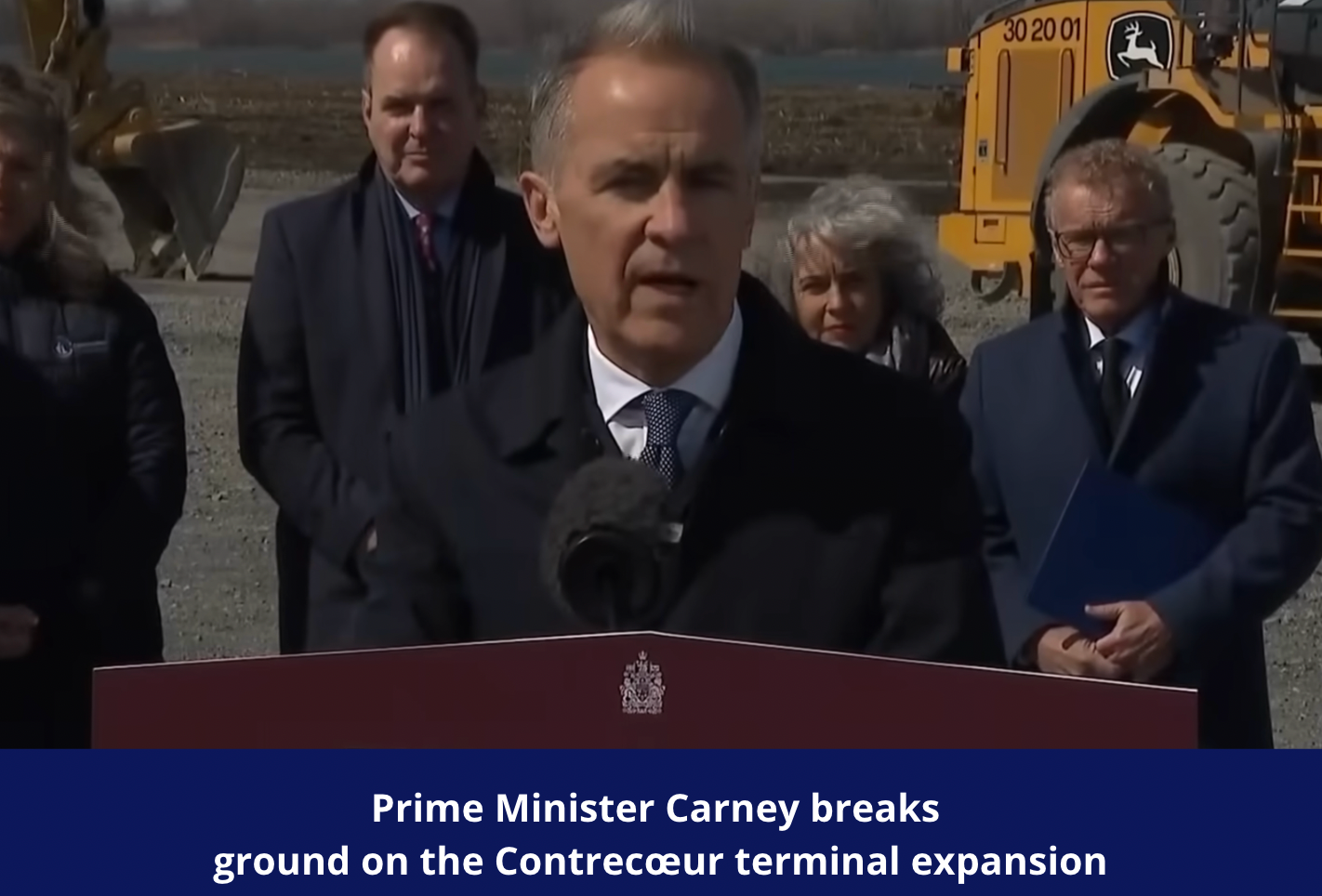
On April 9, Prime Minister Carney announced the start of construction of the Contrecœur terminal expansion at the Port of Montréal. The government said the project will expand the port’s capacity by approximately 60%, add up to 1.15 million TEUs of annual container handling capacity, and build a modern terminal with integrated rail, road, and marine infrastructure. The Prime Minister’s office also said the federal government is supporting the project with C$1.16 billion in financing through the Canada Infrastructure Bank.
b) Why it matters
This matters because critical-minerals strategy is not only about mines, refineries, and processing plants. It also depends on whether a country has the corridors to move inputs, equipment, and output reliably. Contrecœur is therefore a logistics signal, not just a port signal. It strengthens one of Eastern Canada’s main trade gateways and gives more substance to the idea that Québec, Ontario, and northern projects need enabling infrastructure if they are going to scale.
c) Implications for capital and strategy
For boards and investors, this implies that corridor infrastructure deserves more attention in mining analysis. In some jurisdictions, the difference between a strategic resource and a deliverable project will increasingly depend on whether ports, rail, roads, and financing structures are moving in parallel with the mine itself.
Signal 7: Zambia’s stakeholder linked bond widened the financing lens around mining
a) What happened
On April 7, Metalex Commodities and Veridicor announced a new stakeholder linked financing model for mining corridors, initially focused on Metalex’s copper and cobalt activities in Zambia’s North Western Province. At the center of the proposal is a Stakeholder Prosperity Bond, described as a capital instrument that links infrastructure investment and community level economic outcomes to execution stability and financial performance. Reuters reported the first issuance is expected to target between $100 million and $200 million by year end, with returns linked to predefined social and environmental outcomes rather than production volume alone.
b) Why it matters
This is a notable signal because it suggests a more integrated approach to mining finance. Rather than treating community conditions, artisanal mining, infrastructure gaps, and execution risk as separate issues, the proposal tries to bring them into the same financial structure. According to the announcement, the model is intended to support infrastructure such as energy, water, logistics, and housing; expand local participation and workforce pathways; reduce supply chain and access disruptions; and create a measurable link between stakeholder outcomes and project level performance. That makes the proposal interesting not only as a financing story, but as a signal that some actors are beginning to treat the wider regional system around a mine as part of value creation itself.
c) Implications for capital and strategy
For investors, boards, and policymakers, this implies that mining finance may begin to move beyond the narrow funding of extraction toward structures that also try to stabilize the conditions around extraction. In this case, Reuters reported the pilot is intended in part to formalize artisanal and small scale mining through regulated offtake agreements, shared infrastructure, and equipment investment, while industrial mines such as Metalex would act as anchors inside the bond structure. Strategically, that matters because it points toward a model in which execution risk, regional development, and project finance are treated as more closely connected than they have traditionally been in mining.
Signals to watch
- Whether DOE’s new accelerator begins to generate a visible pipeline of process technologies that can move from pilot stage toward commercial deployment, especially in refining and extraction bottlenecks.
- Whether NMG closes its equity package and declares FID for Phase 2 Matawinie on schedule, and whether that in turn strengthens the mine to anode logic in Québec.
- Whether Rock Tech can convert its BMI partnership into a bankable converter pathway, with permitting, engineering, and funding milestones intact through 2026.
- Whether Argentina’s glacier law reform expands real project optionality or instead triggers stronger legal and social resistance that slows execution.
- Whether the Australia–U.S. framework begins to concentrate financing and political support around a clearer shortlist of projects, especially in refining and processing rather than upstream extraction alone.
- Whether the Contrecœur terminal expansion begins to materially strengthen the logistics case for scaling mining and processing projects across Québec, Ontario, and northern corridors.
- Zambia introduced a stakeholder linked bond proposal that aims to connect mining finance more directly with infrastructure, artisanal formalization, and community level outcomes.
Three strategic questions for this week
- As governments become more selective about which projects to finance, process, or legally enable, are we still treating mineral security as a geology story rather than a qualification story?
- Which assets in our portfolio are actually positioned inside the emerging lanes of domestic processing, public capital support, allied industrial coordination, and corridor capacity, and which are still outside them?
- In producer countries such as Argentina, are we distinguishing clearly between regulatory opening and durable execution, including litigation, permitting, infrastructure, and social legitimacy risk?
For the full Geopolitical Mining framework behind this article, see our book Mining Is Dead. Long Live Geopolitical Mining.
Sources for this week’s note
- U.S. Department of Energy, Energy Department Issues Funding Opportunity to Strengthen American Critical Minerals and Materials Supply Chain, April 7, 2026.
https://www.energy.gov/cmei/articles/energy-department-issues-funding-opportunity-strengthen-american-critical-minerals - Department of Finance Canada, Minister Champagne welcomes Canada Growth Fund investment to support the construction of Nouveau Monde Graphite’s flagship Matawinie Mine, April 9, 2026.
https://www.canada.ca/en/department-finance/news/2026/04/minister-champagne-welcomes-canada-growth-fund-investment-support-construction-nouveau-monde-graphites-flagship-matawinie.html - Nouveau Monde Graphite, NMG Announces US$297 Million Equity Financing Package including US$213 Million Private Placement and US$84 Million Bought Deal Public Offering, Advancing Phase-2 Matawinie Mine toward FID, April 9, 2026.
https://nmg.com/nmg-announces-equity-financing-package/ - Rock Tech Lithium, Rock Tech Lithium and BMI Group Establish CAD $200 Million Anchor Partnership to Advance Red Rock Lithium Converter in Canada, April 8, 2026.
https://rocktechlithium.com/en/category/allgemein/ - Argentina.gob.ar, Reforma de la ley de glaciares: posicionamiento y respaldo de la Subsecretaría de Ambiente, April 7, 2026.
https://www.argentina.gob.ar/noticias/reforma-de-la-ley-de-glaciares-posicionamiento-y-respaldo-de-la-subsecretaria-de-ambiente - Argentina.gob.ar, Comunicado Oficial Número 145, April 9, 2026.
https://www.argentina.gob.ar/noticias/comunicado-oficial-numero-145 - Australian Department of Industry, Science and Resources, Australia and United States advance cooperation on critical minerals and rare earths supply chains, published April 13, 2026.
https://www.industry.gov.au/news/australia-and-united-states-advance-cooperation-critical-minerals-and-rare-earths-supply-chains - Prime Minister of Canada, Prime Minister Carney breaks ground on the Contrecœur terminal expansion, April 9, 2026.
https://www.pm.gc.ca/en/news/news-releases/2026/04/09/prime-minister-carney-breaks-ground-contrecoeur-terminal-expansion - Reuters, Africa to pilot bond aimed at formalising artisanal mining, April 8, 2026.
https://www.reuters.com/sustainability/boards-policy-regulation/africa-pilot-bond-aimed-formalising-artisanal-mining-2026-04-08/ - Metalex Commodities and Veridicor, Metalex Commodities and Veridicor Launch Stakeholder-Linked Financing Model for Mining Corridors., April 7, 2026.
https://veridicor.com/2026/04/07/metalex-commodities-and-veridicor-launch-stakeholder-linked-financing-model-for-mining-corridors/?utm_source=chatgpt.com