
Geopolitical Mining · Technical Intelligence for Decision-Makers
What Mining Operations Must Prove After Ramp-Up
Authors: Marta Rivera | Eduardo Zamanillo
Introduction
Ramp-up usually attracts the most attention in mining. It is visible, measurable and easy to communicate. A new plant starts operating, production rises, and each quarter is often read as proof that the asset is moving in the right direction. But from a technical and investment perspective, ramp-up is only the first threshold.
The more revealing test comes later. Once a mining operation has shown that it can reach higher production levels, the central question changes. The issue is no longer whether the plant or operating system can run. It is whether the operation can perform consistently under normal operating pressure.
That distinction matters because mining value is not created by capacity alone. It is created when an operation can sustain throughput, protect recoveries, manage mine sequence, absorb downtime and maintain cost discipline over time. Markets often reward visible progress during ramp-up. But the stronger signal of technical quality usually emerges afterward, when the operation must prove that performance can be repeated, defended and trusted.
This article looks at that post ramp-up phase through the operating variables that often matter most: throughput, recoveries, mine sequence, continuity and cost discipline. To make that logic more visible, it then contrasts two Chilean open pit copper operations that sit in different operating states. The examples used here come from copper in Chile, but the underlying logic is not unique to copper. Across mining, the specific procedures, processing routes and technical variables may differ depending on the commodity, the orebody and the scale of the project. Even so, many of the core challenges remain broadly similar: moving from visible growth to stable performance, managing operational variability, protecting continuity, and sustaining cost and process discipline over time.
This is the phase that deserves closer attention. Because once ramp-up has been achieved, the real question is not whether a mine can grow. It is whether it can become dependable.
1. Ramp-up proves capacity. It does not yet prove operating quality.
Ramp-up is often treated as a relatively straightforward stage in the life of a mining project, following engineering, construction and commissioning. In practice, it is far more important than that. It is the phase in which design assumptions begin to meet operating reality. For that reason, ramp-up often requires a dedicated and highly experienced commissioning and start up team capable of preparing the plant, systems and workforce for the transition into continuous operation.
A successful ramp-up shows that a plant can start, increase rates and move closer to design performance. That matters. It confirms that the asset is moving beyond commissioning and that the operating system is beginning to function at a different scale. But technically, it is still an early signal.
This is also the point at which many of the project’s real operating challenges begin to surface. Working conditions, equipment performance, control systems, ore variability, process stability and maintenance response all begin to matter in a more immediate way once the plant is running as an operating system rather than as a construction project. A mining operation can post a strong month or even a strong quarter while still carrying equipment sensitivity, recovery instability, maintenance risk or mine sequence pressure that only becomes visible over a longer operating period.
In other words, early production growth can confirm that the plant is capable of running. It does not yet confirm that the broader operation can sustain that performance with consistency.
That distinction is important because mining assets are not judged only by whether they can reach higher rates. They are judged by whether those rates can be repeated under less ideal conditions: changing feed, scheduled maintenance, workforce disruption, mechanical stress and the normal variability of mine operations. A plant may look stronger during the first visible growth phase than it will later, when the system has to operate with fewer transitional advantages and more operating pressure.
Ramp-up can validate the direction of an asset. It does not yet establish the durability of its operating quality. That is the harder test. It is also the more valuable one.
2. Throughput alone can be misleading.
More tonnes through the plant may appear to imply higher output, stronger performance and lower unit costs. But technically, throughput is only part of the picture. It shows how much material is being processed. It does not, on its own, show how much value is being created. In some cases, throughput can also be temporarily helped by more favourable feed conditions, blending flexibility or stockpile drawdowns that are not necessarily representative of longer term operating performance.
That matters because a plant can push more tonnes while processing lower grades, losing recoveries, or operating under conditions that are difficult to sustain over a full year. In those cases, high throughput may look strong in a presentation, while the economic quality of the operation remains less robust than the headline suggests. A temporary operating push can create the appearance of momentum even when the underlying system is still fragile.
This is particularly relevant in processing intensive mining operations, where throughput interacts directly with grade, recovery and continuity. A plant that runs harder but with weaker recoveries or more unstable downtime may generate a more ambiguous result than headline production figures suggest. Throughput, in other words, should not be read as a standalone sign of operating strength. It should be read in relation to the quality of feed, the efficiency of metal conversion and the stability of the operating calendar.
Throughput must also be read in relation to the mine’s ability to deliver material to the plant in the quantities and conditions assumed by the operating plan. In some cases, the plant may be capable of running at higher rates, while the constraint sits upstream: the mine may not be exposing, hauling or blending material at the pace or quality originally expected. In that situation, throughput is no longer only a plant performance issue. It becomes a mine-to-plant integration issue.
What matters is the relationship between throughput, grade, recovery and continuity. If throughput rises but recoveries weaken, or if a temporary operating push is followed by downtime and cost pressure, the apparent improvement may say less about operating strength than it first appears.
This is one of the most important distinctions to understand: a high operating rate is useful, but a dependable operating system is more valuable.
3. Recoveries are one of the clearest signals of technical quality.
If throughput tells you how much material is moving through the plant, recovery tells you how effectively the operation is converting that material into payable metal. That is why recoveries often say more about technical quality than production headlines do.
In mining, particularly where processing performance is central to value creation, a plant may continue running at high rates even as the economic quality of those tonnes changes quickly when recoveries become unstable. Lower recoveries can reflect metallurgical constraints, feed variability, blending issues, equipment performance or process instability. These signals do not always appear immediately in market commentary, but they matter materially to the value of the operation. For that reason, recoveries often provide a more demanding test of operating quality than throughput alone.
Production headlines tend to reward visible output. Recoveries, by contrast, reveal whether the plant is actually extracting metal efficiently from the material it is processing. An operation can continue producing significant tonnage while quietly losing part of its economic effectiveness if recoveries begin to drift. That kind of deterioration may look technical, but it has direct consequences for value, confidence and operating credibility.
Recoveries also matter because they often reveal the quality of the system behind the number. Stable recoveries usually suggest stronger process control, better understanding of ore behaviour, more disciplined blending and a more resilient plant. Unstable recoveries, by contrast, can indicate that the operation is still struggling to convert plant utilization into dependable metal output.
Production growth matters, but production growth supported by resilient recoveries is a much stronger signal of technical credibility and economic quality. That is the difference between an operation that is producing and one that is performing well.
4. Mine sequence matters more than many outsiders realize.
Mine sequence is one of the least understood variables in mining. It is also one of the most important. In simple terms, mine sequence refers to the order in which material is extracted and fed to the plant over time. That order affects grade, strip ratio, ore characteristics, blending options and, ultimately, the consistency of the operation. It also helps explain why performance does not move in a straight line, even when installed plant capacity remains unchanged.
Mine sequence is one of the clearest examples of why mining cannot be understood through isolated numbers alone. Behind any production profile sits a planning logic that must constantly balance short term performance against long term value. In many operations, the formal objective is to maximize NPV, but in practice that objective has to be balanced against a wider set of constraints: maintaining an appropriate stripping ratio, sustaining the right sinking rate, advancing pre-stripping at the correct pace, preserving development rates in the case of underground operations, managing ore quality, and controlling the effects of deleterious minerals that may reduce metallurgical performance or raise downstream processing risk.
That is why sequence matters so much. A mine can appear healthy on a quarterly basis and still face a more demanding year ahead if the feed profile changes. Lower grades, harder ore, more variable material, reduced blending flexibility or rising levels of problematic minerals can all affect output, recoveries and cost performance, even if the plant itself is technically capable. In other words, a strong plant does not guarantee a strong year if the mine is feeding it under less favourable conditions.
This is also where the integration between teams becomes critical. Mine sequence sits at the intersection of geology, mine planning and process performance. Geology defines the resource and the expected ore characteristics. Mining determines how material is accessed and scheduled. Processing reveals how that material actually behaves once it reaches the plant. If those functions are not well aligned, the operation can begin to drift away from the assumptions embedded in its models.
That challenge often becomes especially visible during and after ramp-up. Some projects perform well on paper and even progress well through construction, only to discover during ramp-up that deposit characterization was less robust than expected. In those cases, the industrial results may not fully match the geological or metallurgical models used in project development. Ore variability may prove greater than expected. Mineralogical behaviour may differ from assumptions. Recovery performance may become more complex. What looked coherent at the project stage can become more difficult once the operation is tested under real industrial conditions.
Once a mine has ramped up, the operating trajectory does not necessarily continue improving in a straight line. The plant and the mine have to perform together. A concentrator may be ready to operate at higher rates, but if the sequence of material going into the plant becomes more challenging, the annual outcome can still weaken.
Mine sequence influences not only how much material reaches the plant, but also what kind of material arrives, how efficiently it can be processed, and how durable the operating result is likely to be. It is one of the clearest examples of why mining should be read as a system rather than as a set of isolated numbers.
Throughput, recoveries and costs may all look acceptable in a given period, while the sequence underneath is quietly making the next phase more difficult. When that happens, the deterioration often appears later, after the headline figures have already created a stronger impression than the underlying mine plan really supports.
That is why serious technical reading should always ask a deeper question: not only what is happening in the plant, but what is happening in the mine that feeds it.
5. Downtime and labour events are not side stories. They are operating signals.
In many public discussions, downtime is treated as a temporary nuisance and labour disruption as a social issue separate from technical performance. In reality, both are part of the operating system. A shutdown affects more than lost tonnes. It affects rhythm, maintenance timing, sequencing discipline, workforce continuity and the reliability of the broader production plan. In a mining operation, timing matters almost as much as capacity. When one part of the system stops or slows unexpectedly, the effect can extend well beyond the immediate production loss.
The same applies to labour disruption. A strike is not important only because output falls for a period. It is important because it tests whether the operation can preserve continuity under stress. It can interrupt plant stability, alter maintenance windows, reduce operating flexibility and expose how resilient the broader system really is.
But continuity risk in mining does not come only from labour or equipment stoppages inside the plant. It can also come from the broader operating chain: shortages of critical supplies, delays in spare parts, limited equipment availability, unplanned maintenance events, or logistics constraints that disrupt the movement of material, consumables or product. In that sense, downtime should not be read only as an internal plant event. It can also be the result of weaknesses or bottlenecks elsewhere in the operating system.
Weather can also become a material operating constraint. In Arctic operations, high altitude mines, remote logistics corridors or port linked systems, environmental conditions may affect access, haulage, equipment performance, maintenance execution, safety, transport and shipment timing. These factors may sit outside the plant itself, but they can still shape operating continuity in ways that matter directly to production, inventory management and commercial performance.
A mine is not simply a deposit connected to a processing plant. It is a coordinated system of people, equipment, planning, process control, maintenance, logistics and timing. When one element is disrupted, the consequences are rarely confined to that single event. They often affect operating confidence more broadly.
This is particularly important in the period after ramp-up. At that stage, the operation is no longer only trying to prove that it can run. It is trying to prove that it can remain stable while normal pressures begin to accumulate. Downtime, labour events and continuity risks across the broader operating chain therefore become more revealing. They show whether the system is becoming manageable, not just technically possible.
That is why they should not be read as side stories. They are operating signals. They often provide some of the clearest clues about whether an operation is becoming dependable.
6. Cost improvement after ramp-up should be read carefully.
Lower unit costs after ramp-up are often presented as proof that an operation has entered a stronger phase. Sometimes that is true. Sometimes it is only partially true. Costs can improve for good reasons: better recoveries, stronger by product credits, higher throughput utilization, fixed cost dilution as volumes rise, or the disappearance of temporary commissioning inefficiencies. But costs can also remain exposed to changing grades, strip ratio, haul distances, reagent consumption, energy use, labour availability, equipment performance, maintenance intensity and operational interruptions. For that reason, lower costs after ramp-up should be treated as a useful signal, not as a final verdict on operating quality.
This is why cost discipline is a more useful concept than cost reduction. A technically strong operation is not simply one that reports lower costs in one period. It is one that can sustain a cost structure that still makes sense as the mine plan evolves, as maintenance normalizes, and as the operation absorbs the next phase of growth or integration.
Cost improvement can sometimes flatter a transition period. A mine may appear to be getting cheaper while still relying on conditions that are not fully stable or repeatable. Better costs in one quarter may reflect a favourable mix of grade, by product contribution, throughput dilution or plant conditions that do not necessarily define the next year.
That is why cost performance should always be read together with throughput, recoveries, mine sequence and continuity. Costs become more informative when they look durable across a broader operating cycle, not only attractive in a single reporting period. The better question is not simply whether costs are lower. It is whether those costs look durable enough to support long term confidence in the asset.
7. The next expansion phase often reveals more than the first one.
A mine that has completed an initial ramp-up phase often faces a second and more demanding challenge: integrating the next project phase without destabilizing the base operation.
This is where many operations become more interesting from a technical and strategic standpoint. The question is no longer whether they can build something new. The question is whether they can expand while preserving operating control. That is a different test. It requires not only capital and engineering, but also sequencing discipline, workforce continuity, maintenance planning, procurement reliability and the ability to keep the existing system stable while a new layer is being added.
A new project phase is often presented as an obvious positive: more throughput, more production, longer mine life, better economics. Those outcomes may well be achievable. But technically, the more revealing question is whether the operation can absorb that expansion without weakening the performance of the system already in place.
In many operations, phased development is not accidental. It is part of an engineered growth plan designed to manage capital intensity, control early execution risk and allow the asset to move into a larger operating configuration while already generating some cash flow. That makes strategic sense. But it also means that later phases should not be read as automatic upside. They are the point at which the operation must prove that staged growth can be integrated without weakening the base system.
In practice, that challenge often includes more than construction alone. It may involve plant tie-ins, shutdown coordination, new equipment integration, debottlenecking, revised mine sequencing, added infrastructure, changes in maintenance demand and the need to align multiple teams while the original operation continues to run. That is why second-phase growth can be more revealing than it first appears. It tests not only whether new capacity can be added, but whether the broader operating system can absorb that change without losing rhythm, reliability or technical discipline.
That is why second phase growth often tells decision makers more than the initial ramp-up did. The first phase proves that capacity can be added. The next phase tests whether management can integrate growth without losing control of reliability, recoveries, cost discipline and operating rhythm.
This is also where management quality becomes more visible. A mine can be expanded on paper, sanctioned in the market and supported by a strong technical case. But not every operation can move from one larger operating envelope to the next with the same degree of discipline. Some expansions strengthen the base asset. Others expose the limits of the operating system underneath. The technical question is not simply whether a mine can be expanded. It is whether it can be expanded well.
8. A recent technical contrast: Mantoverde and Caserones
Mantoverde and Caserones are both meaningful assets in Chile’s copper system, but they illustrate different technical moments in the life of a mine. That distinction matters because strong production numbers do not always mean the same thing.
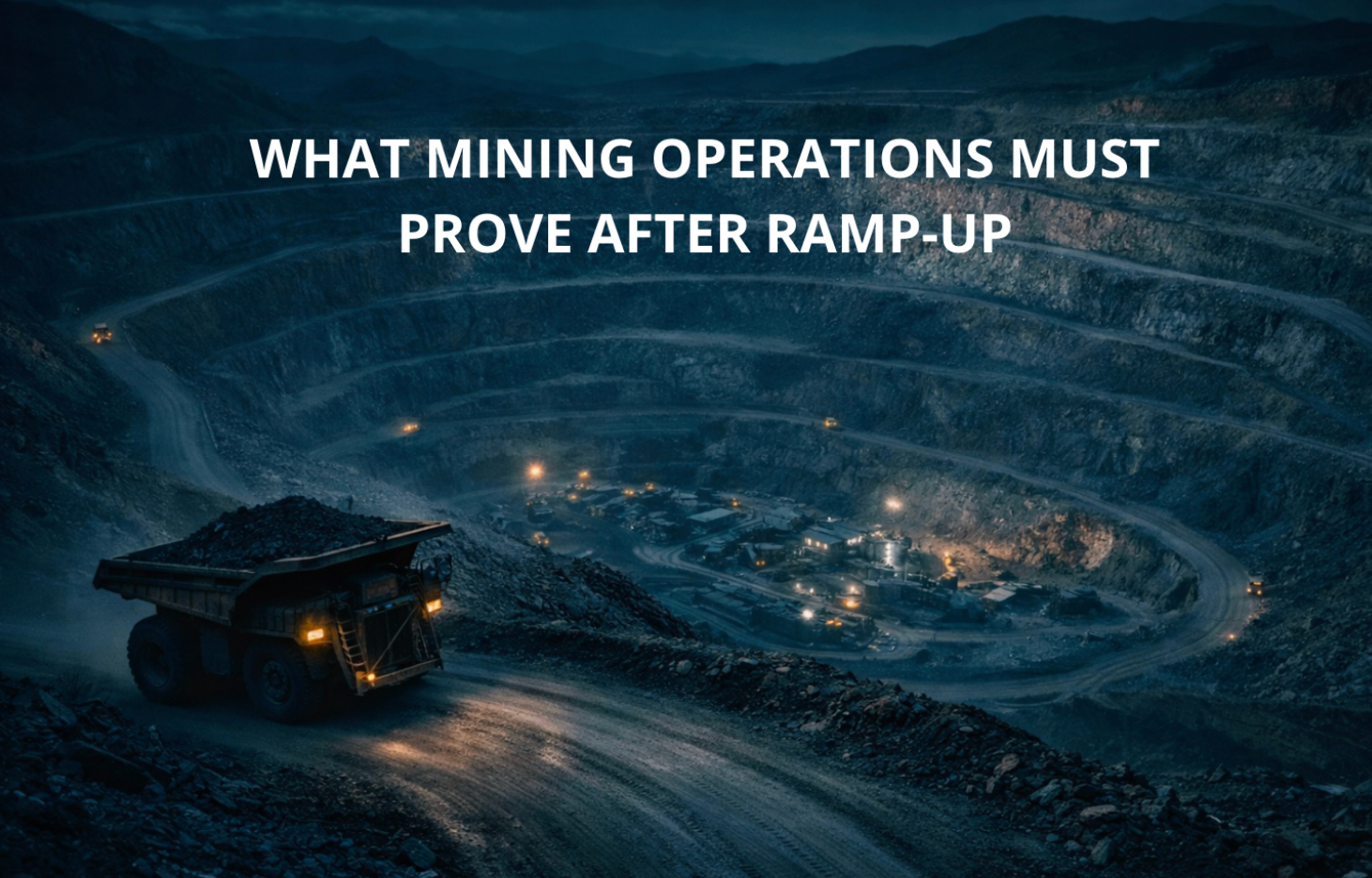
Mantoverde is an open-pit copper-gold mine in Chile’s Atacama Region, operated by Capstone Copper, which holds a 70% interest, with Mitsubishi Materials holding the remaining 30%. It is a useful example of an operation that appears to have moved beyond the initial ramp-up phase broadly in line with the company’s current operating plan, and is now entering the more demanding stage in which recent growth must be converted into stable and repeatable operating performance. Capstone’s 2026 guidance reflects exactly that kind of transition-year test: sulphide copper production of 64,000–74,000 tonnes, cathode production of 25,000–28,000 tonnes, labour disruption in January, planned shutdowns in Q2 and Q3, and the tie-in of MV Optimized before a further ramp-up in Q4. In that sense, Mantoverde is not simply a growth story. It is a test of whether recent operating progress can hold together under more normal operating pressure.
Caserones is useful for a different reason. It is not best understood as a mine that moved smoothly from construction into stable operations. Its analytical value lies in the opposite lesson: some assets take years to stabilize, and the reasons are not only financial or cyclical. Caserones came into operation during a weaker copper price environment, but its difficulties were also industrial. It faced a longer and more demanding path to stabilization, marked by ramp-up difficulties, operational underperformance and the challenge of aligning mine delivery, plant performance and process stability under real operating conditions.
That longer path is part of what makes the comparison useful. Caserones had to work through the kind of issues that often determine whether a project becomes dependable: throughput bottlenecks, recovery instability, mine underperformance, labour disruption and the challenge of operating a large, high-altitude system under harsh Andean conditions. In that sense, Caserones is not simply a mature mine now showing stronger numbers under Lundin. It is also a reminder that some assets require years of correction, adaptation and management change before a more credible operating base begins to emerge.
That is why the comparison matters. At Mantoverde, the central question is whether an operation that appears to be progressing beyond ramp-up broadly in line with plan can stabilize performance while managing labour disruption, planned shutdowns and a new phase of integration. At Caserones, the lesson is different: even a valuable asset can spend years underperforming before a more settled operating profile begins to appear. What now looks more stable operationally under Lundin should therefore be read not as proof that the asset was always solid, but as evidence of how long and difficult the road to stabilization can be.
Taken together, the contrast helps clarify the broader point of this article. Not all strong mining operations should be read in the same way. Some are only beginning to show whether recent growth can become dependable. Others are only now revealing what a more credible operating platform looks like after years of instability, operational strain and correction. That distinction helps separate visible production improvement from operating maturity, and momentum from technical credibility.
9. What decision makers should really watch
After ramp-up, four questions are especially useful when assessing whether operating progress is becoming technically credible.
- First, is throughput becoming repeatable, or is performance still being driven by temporary peaks?
- Second, are recoveries stable enough to support real metal output, not just plant utilization?
- Third, is mine sequence supporting the production plan, or quietly making the year more difficult?
- Fourth, are costs improving in a way that looks durable, or only flattering a transition phase?
Mantoverde and Caserones help illustrate why these questions matter. In Mantoverde, the key issue is whether recent operating progress can be converted into dependable performance while the system absorbs labour disruption, planned shutdowns and a new phase of integration. In Caserones, the more relevant question is whether a long and difficult path of stabilization has finally produced a more credible operating base after years in which the asset struggled to perform as originally expected.
These questions are more useful than any headline number in isolation. They help distinguish visible operating progress from operating maturity, and momentum from technical credibility. In mining, dependability is where much of the real value begins to take shape.

For board-level insight and decision support on mining, legitimacy and industrial strategy, visit Geopolitical Mining Advisory .
For the full Geopolitical Mining framework behind this article, see our book Mining Is Dead. Long Live Geopolitical Mining .
Sources
- Capstone Copper — Mantoverde Mine | Operations in Chile
- Capstone Copper — Record 2025 Production Results and Mantoverde Labour Update (January 15, 2026)
- Capstone Copper — 2026 Guidance (February 17, 2026)
- Capstone Copper — Labour Agreement at Mantoverde Operation (February 5, 2026)
- Capstone Copper — Record Fourth Quarter 2025 Results (March 2, 2026)
- Capstone Copper — Resumes Full Operations at Mantoverde (September 18, 2025)
- Lundin Mining — Caserones | Operations
- Lundin Mining — 2025 Production Results and 2026 Guidance (January 21, 2026)
- Lundin Mining — Fourth Quarter and Full Year 2025 Results
- JX Nippon Mining & Metals — Update on Caserones Copper and Molybdenum Deposit Development Project in Chile (October 11, 2013)
- JX Nippon Mining & Metals — Group Medium-Term Management Plan / Long-Term Vision 2040 (July 14, 2020)
- JX Advanced Metals — Corporate update / presentation (May 14, 2024)