
Geopolitical Mining · Article
Munich, the Age of Geopolitical Mining and the Opportunity for the Global South
Authors: Marta Rivera | Eduardo Zamanillo
What Washington, Beijing and Europe Just Said in Munich, and the Opportunity This Creates for the Global South
At the 2026 Munich Security Conference, something fundamental shifted in how leading powers talk about the world.
The speeches were not only about order, values or institutions. They were about tanks and factories, ports and power plants, drones and data centres, and, underneath all of that, minerals, energy and supply chains. In different voices, Washington, Beijing and Europe said out loud what has been implicit for years: the material base of the global economy is now explicitly part of security strategy.
Seen through a Geopolitical Mining perspective, Munich marked the moment when this stopped being a subtext and became the text itself.
1. The United States, from guardian of the system to first among strategic peers
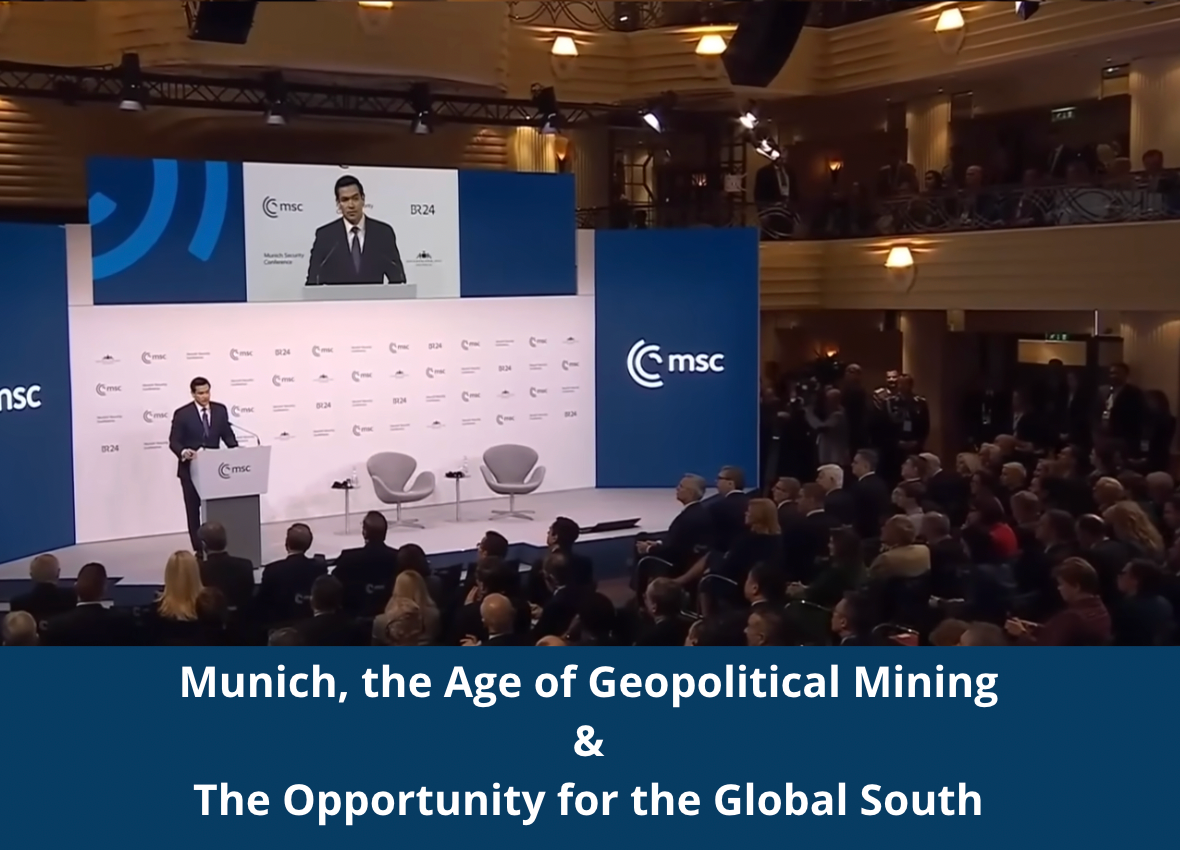
Marco Rubio’s address was striking not just for its rhetoric, but for its framing of the past three decades. He dismissed the end of history illusions, the belief that everyone would converge into liberal democracy, that global trade and institutions could replace national interest, that borders no longer mattered. He openly linked deindustrialisation and the loss of supply chain sovereignty to a weakening of Western power.
More importantly, he reframed how the United States sees its role in the system it largely built.
For decades, the US acted as the guardian of the system: underwriting security, providing markets, absorbing shocks and often paying more of the bill than others.
In return, it expected partners to align with its priorities and to rely on its security and economic guarantees. In Munich, the tone was different. The message was closer to:
The US remains the anchor economy. It can still heavily influence rules and norms. But it will no longer underwrite others’ inertia. Instead, it is asking allies and partners to behave as strategic peers, with their own share of the material and security burden.
That shift came through even more clearly in his Bloomberg interview on the sidelines of Munich. Asked whether he worried about European leaders travelling to Beijing (Mark Carney, Keir Starmer, Friedrich Merz) Rubio replied that nation states need to interact with one another. He noted that President Trump is willing to meet with anybody, that he himself had met his Chinese counterpart in this very forum, and that it would actually be irresponsible for great powers not to have relationships and talk through things to avoid unnecessary conflict. The key, he said, is that in the end we expect nation states to act in their national interest. Meeting China, in his view, in no way runs counter to working together where interests align; it is simply what major powers do.
Rubio’s call for a Western supply chain for critical minerals sits inside this logic. Security is tied to reindustrialisation, and reindustrialisation is tied to reliable access to critical inputs. But this is not framed as America alone. It is framed as a Western project in which serious allies are invited to move up the chain.
The implication for resource rich countries is significant. The old conversation, export ore and buy back finished goods, is no longer the only one on offer. If a partner can demonstrate capacity in extraction, processing and technology, and can do it with reliability and standards, Washington is signalling it is ready to integrate that into a longer chain.
That does not make the US less demanding. National interest is clearly stated. But the relationship is now explicitly conditional and transactional, and, crucially, open to co-production of value, not just extraction.
Domestically, the US will have to sustain this strategy with both social and economic credibility. The communities that host mines, plants and new infrastructure will expect this agenda to bring not only quality jobs, but also new business for local firms, visible investment on Main Street and a renewed sense that “we build things here” again. If reindustrialisation is perceived as something that happens somewhere else, in balance sheets and headlines but not in people’s lives and local economies, the political support needed to stay the course over multiple administrations will quickly erode.
2. China defending the framework that enabled its rise, and preparing to adapt
Wang Yi’s “Conversation with China” offered a different map.
Beijing’s narrative has a clear logic. The existing global framework (UN centred multilateralism, open trade, flexible bilateral engagement) allowed China to grow, invest abroad and secure dominant positions in processing, manufacturing and parts of the critical minerals chain. It is natural that China seeks to protect that framework.
Wang stressed sovereign equality, international law, true multilateralism and more democracy in international relations. He argued that global affairs should be decided by all, not by a few, and that the Global South deserves greater voice and representation. He warned against blocs and small exclusive circles.
At the same time, China’s comparative advantage has never been only in rhetoric. It has been in adaptability. For years, Chinese actors have tailored their approaches country by country and project by project, using a mix of state to state agreements, state owned enterprises, private firms and financial instruments. There is no reason to think this will stop if others redesign parts of the system.
As the US and Europe build new industrial, security and supply chain frameworks, China will adjust its tactics, its pricing, its partnerships. It will seek to protect its leadership in processing and midstream, to deepen ties where it can, and to present itself as a steady partner to countries that value the continuity of the previous model. For resource rich countries, the Munich sequence of Rubio followed by Wang crystallised what had been diffuse: two explicit invitations.
One offers integration into a Western industrial strategy, with an expectation of reliability, alignment and co-investment along the value chain. The other offers continuity in a multipolar, multilateral system where China acts as a major investor, buyer and industrial partner, while arguing for a larger Global South voice in governance.
Here as well, the question of legitimacy is present, even if not pronounced. Chinese domestic narratives about strategic minerals are deeply embedded; they frame these assets as national resources in a long term plan. Maintaining that legitimacy at home and in partner countries, in the face of more scrutiny and more competition, will be a central challenge in the coming decade.
3. Europe is awake: its weak points are time, narrative, and action
Europe’s role in Munich did not come from one speech alone. Taken together, the interventions of Merz, von der Leyen, Starmer and Macron amount to a European awakening.
They recognised openly that raw materials, technologies and supply chains are instruments of power; that deindustrialisation and energy dependence turned into vulnerabilities; that Europe has under used its extraordinary economic and technological potential.
They spoke about independence in defence, energy and digital; about European sovereignty and responsibility inside NATO; about bringing mutual defence clauses within EU treaties to life; about building a real European defence industry; about deep technologies, dual-use capabilities and industrial policy as tools of security.
In that sense, Munich marked a genuine change of tone. Europe is no longer speaking as if it were only a market with opinions. It wants to be a geopolitical actor with assets. But turning that awakening into reality will depend on three things: time, narrative and action.
On timing, the constraint is execution. The analysis is largely correct, and the declarations align with reality. Yet the machinery remains slow. Regulatory frameworks are heavy, decision making is complex, and internal differences, between member states and between institutions, remain real. Europe says it must move fast, but it is not obvious that it can. If the tempo of decisions does not change, the window for rebuilding its material base may not align with the speed at which risks are accumulating.
On narrative, the gap is deeper. Europe has not yet explained, clearly and consistently, to its own citizens that mining underpins many of the products, services and infrastructures they associate with modern life. It is not only about the energy transition. It is not only about AI and defence. Mining is also behind housing and transport, healthcare and medical technology, digital infrastructure, appliances and electronics, food systems, textiles and water networks. If mining is presented only as a sacrifice for climate targets, or as something that should happen elsewhere, it will remain politically impossible to build a credible European critical minerals strategy. Without at least some domestic extraction, processing and recycling capacity, declarations of independence rest on someone else’s mines and someone else’s risks.
On action, Europe will need to demonstrate that this is more than a shift in language. That means translating strategies and communiqués into concrete projects: new mines where viable, new processing and recycling plants, new cross border infrastructure, and permitting frameworks that are predictable and rigorous without being paralysing. It also means aligning industrial policy, trade instruments and research funding with the security goals now being articulated. Without visible action on the ground, the doctrine of independence will remain largely rhetorical.
Across all three dimensions, social legitimacy is the element that connects everything. In much of Europe, there is a degree of scepticism about whether major economic shifts will translate into broadly shared benefits. Any new industrial and mining push will need to demonstrate that environmental and social standards are robust, that value creation is not perceived as overly concentrated, and that communities see concrete improvements in jobs, infrastructure, services and opportunities. If those conditions are not met, resistance will be significant and Europe’s geopolitical awakening will struggle to move beyond the level of speeches.
4. Latin America, Africa and Asia beyond China, a window for real development if treated as a State project
From the vantage point of Latin America, Africa and Asia beyond China, Munich looks like a huge opportunity.
The three big players all, in their own way, are saying the same thing: the material base of their power matters; they need secure access to minerals, energy and technologies; and they cannot do this alone. The Global South has what they need: resources, geography, young populations, in many cases renewable potential. But today many of those resources are still just rock. Rock is nothing until it is extracted formally and safely, processed, integrated into value chains and used as a platform for industrial and technological development.
The invitation from the US, to work together as genuine strategic partners, the continued offer from China, and Europe’s awakening all create competition for partnership. That competition can be turned into a wave of industrialisation and development, or into another missed opportunity. The difference will not be geology. It will be politics, time and the quality of the negotiation.
In too many countries, mining and industrial policy swing with each electoral cycle. Projects become symbols in domestic conflicts. Long term contracts are negotiated as if they were short term campaign tools. Regulatory uncertainty, corruption and the absence of visible benefits for communities feed distrust. Under those conditions, neither Western nor Chinese offers will lead to genuine development.
The alternative is harder but possible: treat mining and the associated industrial strategy as State policy, not government policy. A policy that can be debated and improved, but that does not reset its fundamentals every few years. A policy that sees mining and midstream/downstream as part of a 30-40 year project, not just as a temporary source of revenue. The specific path will differ in Chile, Argentina, Zambia, Ghana or Indonesia, but the underlying requirement is the same: everyday politics will keep shifting, while the material base needs stability and continuity.
It also matters how, and with whom, these deals are negotiated. If decisions are driven only by short term political incentives and legal tactics, without sustained input from people who understand the ore bodies, the engineering, the project economics and the territories where operations sit, the negotiation will be asymmetric from the start. Serious choices about mineral strategy deserve a different configuration: political authority, yes, but anchored in technical, industrial and territorial knowledge that understands what a multi decade commitment really entails.
And then there is social legitimacy. Communities in Latin America, Africa and Asia have lived through cycles of investment and disinvestment without seeing enough change in their daily lives. Many are understandably sceptical when they hear about a new boom. If this new phase is experienced as a familiar pattern (environmental damage, displacement, inequality and wealth captured by a few) it will not last. Resistance will be strong, and trust even harder to rebuild.
Legitimacy here means that mining is formal, regulated and transparent; that environmental and social standards are serious, not cosmetic; that value does not disappear into opaque tax structures or narrow elites; and that people in producing regions see real improvements in their lives: jobs, roads, schools, hospitals, connectivity, local business opportunities. In other words, it is not mining at any cost. It is mining as part of a development strategy, where the cost benefit balance is visible and credible for society as a whole.
Only then will citizens in Latin America, Africa and Asia accept participation in Geopolitical Mining not as simply paying a price for someone else’s transition, but as a conscious choice to build a different future for their own societies.
5. When formal mining is blocked, anomic mining fills the void
There is also a dimension of this story that Munich did not really address, even though it is central to the logic of Geopolitical Mining.
When formal, regulated mining is blocked, delayed or delegitimised, while demand for minerals continues to rise, the result is not less mining. It is typically a shift towards activity in less visible parts of the system: illegal or informal operations, opportunistic intermediaries, environmental damage that is harder to monitor, fiscal losses and pressure on already fragile institutions. In other words, where formal projects are stalled by regulatory uncertainty, corruption or short-term politics, the space is often occupied by actors who do not observe ESG standards, are not accountable to communities and are disconnected from the long chain of value creation.
This is not a theoretical issue. It is already visible in parts of Latin America, Africa and Asia, where illegal gold, cobalt, coltan or copper flows feed global demand through opaque chains, while weakening state capacity and damaging ecosystems.
The distinction between formal and informal mining is therefore not just a technical matter; it is a political and security choice. If countries want to turn geology into development, they need not only investment and technology, but also a clear decision in favour of legal, regulated, transparent mining, and the institutional strength to reduce the space for informal economies that profit from ambiguity.
Munich spoke at length about security, but mainly in terms of budgets, deployments and alliances. The security implications of allowing anomic mining to expand, while formal projects stall, will become harder to ignore in the coming decade.
6. The institutional bottleneck, and the role of AI
Another missing piece in Munich’s conversation was the question of institutional capacity and speed.
Recognising that critical minerals and industrial projects are strategic is one thing; processing permits, evaluating impacts and enforcing standards at the pace required is another. In many jurisdictions, the real bottleneck in the next decade will not be geology, but bureaucracy: overloaded permitting systems, fragmented data, inconsistent criteria, insufficient technical staff.
This is where a new layer enters the picture: the use of data and artificial intelligence as part of the institutional infrastructure of Geopolitical Mining.
If deployed with care, these tools can help regulators process complex technical information faster and more consistently, monitor compliance and environmental indicators in near real time, identify risks earlier and more transparently, and provide communities with better visibility over what is happening on the ground. For investors and companies, better data and smarter processes can reduce uncertainty and delays. For governments, they can make it easier to align political ambition with administrative capacity. For communities, they can turn trust us into something closer to here is the evidence.
AI will not replace judgment, nor should it. But without new tools, the gap between the speed at which leaders now say they want to move and the capacity of overstretched institutions will become a structural constraint on any serious Geopolitical Mining strategy.
7. Munich’s message for Geopolitical Mining
Taken together, the Munich speeches send a clear message.
The age of acting as if mining belonged to the past is over. Minerals, energy, industrial capacity and logistics are at the centre of strategic thinking. The competition for access, processing and technology is explicit. It will be shaped by security doctrines, industrial policies, alliances, and by societies’ willingness to accept or reject specific projects.
The United States is moving from acting as the guardian of the system to acting as first among strategic peers: it still anchors the Western economy, but it is now asking allies and partners to assume a clearer share of the material and security burden. China is defending the framework that enabled its rise (multilateralism, open trade, bilateral flexibility) and preparing, once again, to adapt within it. Europe has woken up intellectually to the material dimension of power, but still needs to align time, narrative and action if its doctrine of independence is to move from speeches to projects.
For countries in Latin America, Africa and Asia beyond China, Munich is a confirmation and a warning. It confirms that the main powers now see minerals and industrial capacity as strategic, and that they are ready to compete for partnerships. It also warns that geology alone is not a strategy. Without State level policies, credible negotiations and social legitimacy, this moment will become another missed opportunity: more rock exported, more volatility, little structural change.
The path forward will hinge on three choices that apply everywhere, in the Global South, in Europe, in North America and in East Asia. The first is whether mining and industrial development are treated as long term State projects or as topics that simply follow short-term political cycles. The second is whether negotiations are conducted with the right mix of political authority and technical, industrial and territorial knowledge. The third is whether communities see mining as a credible vehicle for development, rather than as a repetition of past disappointments.
Alongside that, two shadows will define the decade. One is the risk that, as formal projects stall, anomic and illegal mining continues to expand, undermining states and ecosystems while still feeding global demand. The other is the risk that institutions remain too slow and under resourced to handle the volume and complexity of strategic projects. Tackling both will require not only political decisions, but also new institutional tools, including data and AI, to process information, enforce standards and give citizens visibility over what is happening.
Munich showed that the major powers are already thinking in Geopolitical Mining terms, even if they do not use that language. Minerals, energy, industrial capacity and logistics are now at the core of their security strategies.
The real test will not be whether Washington, Beijing, Brussels or any other capital can publish another strategy, but whether countries and societies are willing to treat mining and industry as what they really are: the material foundation of modern life and of any credible development project.
If that shift happens, and if mining and industry are treated as State-level commitments, socially legitimate, negotiated seriously and supported by capable institutions, the age of Geopolitical Mining can be more than a struggle for power. It can be the start of a different phase for the world as a whole: one where the material base of the economy is governed with strategic clarity and social responsibility, and where more of our collective energy can finally be focused on what comes next, developing new technologies, rebuilding industrial ecosystems and shaping the next era.
Sources
-
Munich Security Conference 2026 – Panel video
https://www.youtube.com/watch?v=aezzS7cJP-o -
Critical Minerals in Munich: Reading Rubio’s Speech as a Strategic Signal – Geopolitical Mining
https://geopoliticalmining.com/critical-minerals-in-munich-reading-rubios-speech-as-a-strategic-signal/ -
Conversation with China: What Wang Yi’s Munich Speech Signals for Global Governance – Geopolitical Mining
https://geopoliticalmining.com/conversation-with-china-what-wang-yis-munich-speech-signals-for-global-governance/ -
Europe Wakes Up: How Merz, von der Leyen, Starmer and Macron Are Grasping the New Moment – Geopolitical Mining
https://geopoliticalmining.com/europe-wakes-up-how-merz-von-der-leyen-starmer-and-macron-are-grasping-the-new-moment/

For board-level insight and decision support on mining, legitimacy and industrial strategy, visit Geopolitical Mining Advisory .

For the full Geopolitical Mining framework behind this article, see our book Mining Is Dead. Long Live Geopolitical Mining .