
Geopolitical Mining Weekly
Week of 9 – 15 February 2026
Authors: Marta Rivera | Eduardo Zamanillo
What this week really tells us
This week, five moves stood out in the critical minerals and mining space:
- Indonesia identified eight priority blocks with significant potential for rare earths and other strategic minerals and assigned them to a new state miner, Perminas, alongside dedicated research on processing.
- Codelco’s board in Chile released the results of an internal investigation into past safety incidents at El Teniente, announcing governance reforms and administrative measures against senior executives.
- In Mexico, Vizsla Silver issued updates after Mexican authorities confirmed that several colleagues who had been abducted near the Panuco project were found deceased, prompting a security review and operational adjustments.
- A new study by Verisk Maplecroft concluded that South America is emerging as the most stable and politically viable anchor for Western efforts to rebalance critical mineral supply chains away from China.
- An op-ed on MINING.COM argued that NI 43-101, while necessary after Bre-X, is no longer sufficient to protect investors in an era where the dominant risks are dilution, silence and misinformation rather than fabricated ore.
Taken together, these signals show how the era of substance in mining has three layers:
- System design at state level: Indonesia using a new state miner and research to build a rare earths platform; South America seen as an anchor in the West’s strategic realignment.
- Governance and security at company and project level: Codelco’s board responding to an internal audit around a fatal incident; Vizsla and Mexican authorities dealing with a tragic crime that affects both families and the perception of mining risk.
- Market rules and information quality: NI 43-101’s strengths and limits in a world where mining capital is mobilised through social media as much as through technical reports.
For boards and investors, the common pattern is that geology and prices are necessary, but no longer enough. The real risk and opportunity are increasingly shaped by how states structure access to critical minerals, how companies handle safety and security in difficult environments, and how markets distinguish between projects that move and projects that only exist on paper.
Signals of the week
Signal 1: Indonesia hands eight rare earth blocks to a new state miner
What happened
Indonesia’s Mineral Industry Agency announced that the government has identified eight mining blocks with significant potential for rare earth elements and other strategic minerals and has designated them as priority for development. The blocks are spread across Kalimantan, Sulawesi and Bangka Belitung.
According to agency head Brian Yuliarto, the blocks host rare earths as well as tungsten, tantalum and antimony, minerals that play an important role in defence and high tech industries. The newly established state owned miner Perminas will be responsible for these areas. In parallel, the government will launch two research projects in Mamuju, West Sulawesi, to develop rare earth processing technology. These research efforts will run alongside preparatory work for exploration.
Why it matters
Indonesia is broadening its critical minerals strategy. After using export restrictions and industrial policy to shift nickel up the value chain, it is now signalling that rare earths and defence linked metals will be handled through a state orchestrated pipeline: priority blocks, a dedicated state miner and early investment in processing know how.
Three aspects are notable:
- Integration: assigning the blocks to a single state entity and coupling that with processing R&D points to a vertically oriented approach, from exploration to midstream capacity.
- Security framing: explicitly naming minerals with defence uses adds a strategic lens to future partnerships and offtake negotiations.
- Timeline compression: running research projects in parallel with exploration suggests Indonesia wants to shorten the usual gap between resource identification and local processing capability.
Implications for capital and strategy
For investors and boards, Indonesia’s move reinforces that access to some critical minerals will increasingly be mediated by state companies and policy priorities, not only by open tender. Any strategy around Indonesian rare earths, tungsten, tantalum or antimony will need to account for Perminas’ role and for Jakarta’s industrial objectives.
For OEMs and refiners, this is a signal to think in terms of long term partnerships that combine offtake, technology co-development and local content, rather than purely transactional supply contracts.
For other producer states, Indonesia’s model illustrates a pattern: states are experimenting with institutional architectures (not just tax rates) to secure a larger share of value and influence in critical minerals.
Signal 2: Codelco’s El Teniente case, governance and accountability after a fatal incident
What happened
On 13 February, Chilean state miner Codelco announced administrative measures following an internal audit and an external consultancy review into past events at its El Teniente division, including a rockburst in 2023 and a subsequent accident in 2025 in which workers lost their lives.
According to Codelco’s public statements and Chilean media:
- the investigations identified inconsistencies and omissions in how technical information was reported to the mining regulator Sernageomin;
- the company decided to remove three senior executives from their positions, including the chief operations officer and the head of El Teniente;
- the board committed to a set of governance reforms, including unalterable digital signatures for technical reports and closer cooperation with the Public Prosecutor’s Office.
In a public declaration, the board stated that Codelco will not be the same company after this tragedy and emphasised the need to restore trust in its safety and reporting systems.
Why it matters
El Teniente is the world’s largest underground copper mine and a critical asset for Chile and global copper supply. Codelco’s response is significant because it connects safety, technical reporting and governance in a way that goes beyond individual accountability.
Three points stand out:
- Link between safety and disclosure: the case highlights that the integrity of technical reporting to regulators is not a paperwork detail; it is part of how risk is managed and understood across a large, complex operation.
- Board level ownership: the board is framing the changes as part of a radical reorganisation and a cultural shift, not only as personnel changes. That matters for future credibility with regulators, workers and investors.
- Precedent for other SOEs: as one of the most visible state owned mining companies, how Codelco handles this episode will be watched as a reference by other state miners facing similar pressures on safety and performance.
Implications for capital and strategy
For investors and boards, the El Teniente case is a reminder that operational risk and governance risk are tightly linked. In large producers, safety incidents can reveal deeper issues in internal reporting, incentives and oversight that need board level attention, not just local fixes.
For Codelco’s partners and customers, the key question will be whether governance reforms translate into sustained improvements in safety and transparency over time. That will affect perceptions of Codelco not only as a copper supplier but as a partner in new ventures, including in lithium.
For other producers, the lesson is that the era of substance applies inside the fence as well: the credibility of mining as a strategic industry depends on how companies respond to difficult events, not only on how they talk about ESG in good times.
Signal 3: Vizsla Silver and Concordia, security risk as part of the mining equation in Mexico
What happened
On 9 February, Vizsla Silver Corp. issued an update stating that it had been informed by several families that colleagues who were taken from the company’s Panuco project site near Concordia, Sinaloa, had been found deceased. The company noted it was awaiting formal confirmation from Mexican authorities.
Mexican authorities have since confirmed that five of the ten missing workers have been identified among bodies found in clandestine graves, and investigations continue.
On 12 February, Vizsla released a further security and operations update, expressing its condolences, outlining support for families, and explaining that it has suspended operations at the affected site while it reviews security measures and works with local and federal authorities.
Why it matters
This is first and foremost a human tragedy for the families, colleagues and communities involved. From a geopolitical mining lens, it also underlines that in some jurisdictions security risk is not abstract: organised crime and territorial disputes can directly affect workers and projects, even when companies have not reported prior threats.
Three structural points:
- Security as a core risk, not a footnote: extortion, kidnappings and violence around mines in parts of Mexico have been reported for years, but incidents of this gravity bring the issue into sharper focus for boards and investors.
- Shared responsibility: companies, host governments and buyers all have roles to play in improving security conditions; none of them controls the situation fully.
- Impact on project timelines and cost of capital: security incidents can delay exploration and development, change insurance and financing terms, and raise questions about how risk is allocated across the value chain.
Implications for capital and strategy
For investors and boards, Concordia is a reminder that country risk must be understood at the level of specific regions and criminal dynamics, not just macro indicators. It also raises the question of how security assumptions are built into project screening, valuation and portfolio concentration.
For companies operating in similar contexts, the priority is to support families and staff and to work transparently with authorities. Over the medium term, strategies may need to integrate more robust risk assessments, community engagement and coordination with state security policies.
For downstream buyers, security incidents upstream are a reminder that supply chain ESG is not only about emissions and permits; it also encompasses the human cost of operating in contested territories.
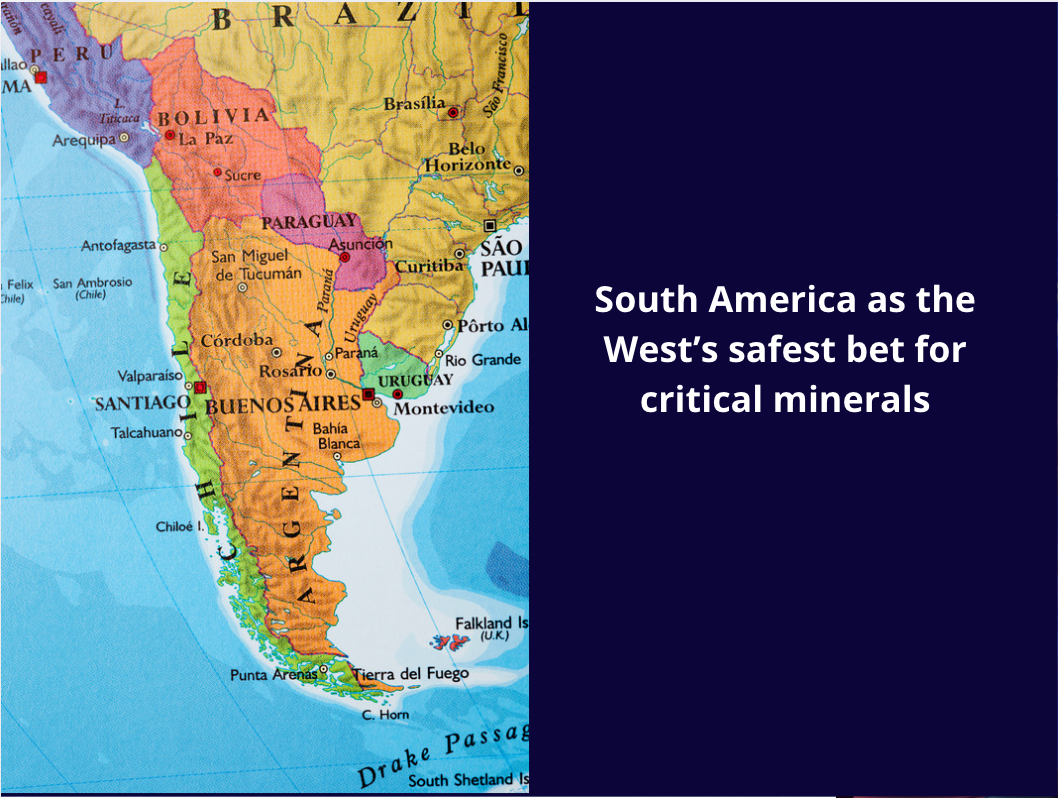
Signal 4: South America as the West’s safest bet for critical minerals
What happened
New research from Verisk Maplecroft concludes that South America is emerging as the most stable and politically viable option for Western governments seeking to rebalance critical mineral supply chains away from China.
Key points from the study:
- Countries such as Argentina, Brazil, Chile and Peru combine large endowments of lithium, copper, nickel, cobalt, graphite and rare earths with comparatively moderate levels of political risk and resource nationalism, as measured by Verisk’s indices.
- The region stands out not for reserves alone, but for the distribution of risk: many African and Asian suppliers have higher scores for instability, conflict or expropriation risk.
- The report emphasises that exposure to higher-risk jurisdictions will remain unavoidable for certain minerals, but South America can act as a strategic anchor in an otherwise constrained landscape.
Why it matters
This analysis aligns with what many policymakers have been saying and what we have described in our work on mining and geopolitics: South America is a central board in the new critical minerals order.
Three strategic implications:
- Anchor, not monopoly: South America can provide an anchor for Western strategies, but cannot replace all higher risk supply. That means the region will likely see intensified competition for assets, offtake and partnerships.
- Policy leverage if used well: countries that can combine macro stability, predictable rules and credible ESG standards can convert this position into long term leverage; those that drift into volatility or ad hoc interventions risk eroding the safest bet label.
- Portfolio consequences: for investors, a risk adjusted view of global supply chains suggests a structural re-weighting toward South American copper and lithium, while still managing diversification across countries within the region.
Implications for capital and strategy
For investors and boards, the Verisk assessment supports a strategy that treats South America as a core pillar of diversified critical mineral portfolios, with careful attention to differences between countries and sub-regions.
For South American policymakers, the report is a reminder that institutional quality and regulatory stability are strategic assets. Maintaining them may matter as much as finding new deposits.
For companies, it reinforces the case to invest in long-term relationships and local legitimacy in the region, not just opportunistic project acquisitions.
Signal 5: NI 43-101 necessary, but no longer sufficient in the era of substance
What happened
An op-ed (Erik Groves) published on MINING.COM this week, “NI 43-101 was necessary, not sufficient”, revisits National Instrument 43-101, Canada’s mineral disclosure standard introduced in 2001 after the Bre-X scandal.
The author argues that:
- NI 43-101 solved a specific problem: inconsistent and promotional technical disclosure that made it difficult for investors to compare projects and left room for extreme fraud.
- Today, however, the dominant risks for investors in exploration companies are different: chronic equity dilution over many financing rounds, projects that struggle to advance or communicate meaningful progress, and a communication environment shaped by social media and online promotion rather than only by formal technical reports.
- As a result, while NI 43-101 remains necessary, it is no longer sufficient to protect investors or ensure that capital is being allocated to projects that genuinely move toward development.
Why it matters
The op-ed connects directly with our era of substance theme. In the 2000s, the focus of disclosure reform was to ensure that resource and reserve numbers were technically sound. In the mid-2020s, the challenge is broader: ensuring that investors can tell the difference between companies that are steadily de-risking projects and those that are primarily issuing paper.
Three angles:
- Form vs. substance: a compliant technical report is necessary, but investors also need visibility on pace of work, capital structure and decision making, which can be obscured by selective communication.
- Information overload: in a world of social media, chat rooms and fast commentary, the signal-to-noise ratio has changed. NI 43-101 does not govern most of that ecosystem.
- Critical minerals lens: as governments and funds push more capital into critical projects, the cost of misallocated capital is higher, both financially and strategically.
Implications for capital and strategy
For investors and boards, the message is that technical compliance is a starting point, not an end point. Governance of disclosure, capital discipline and genuine project progress should be treated as core due diligence questions, especially in juniors marketing themselves as part of critical mineral supply chains.
For regulators and exchanges, the debate raises the question of whether complementary tools are needed: for example, standards on continuous disclosure of project milestones, clearer rules on promotional content, or enhanced guidance on capital raising practices.
For companies, the op-ed is a reminder that in the era of substance, credibility will depend not only on meeting reporting standards, but on demonstrating consistent, transparent progress in how projects are advanced and financed.
Signals to watch
- How Indonesia defines Perminas’ role and partnerships in the eight rare earth and strategic mineral blocks, including any joint ventures, offtake agreements or processing pilots that emerge in 2026.
- The implementation of Codelco’s governance and safety reforms at El Teniente and other divisions over the coming months, and how Chilean regulators and unions respond.
- Further updates from Mexican authorities and Vizsla Silver on the Concordia case, and whether industry associations or the federal government introduce new measures on security in mining regions.
- Policy and investment follow up to Verisk Maplecroft’s South America assessment, including how quickly Western governments and companies re-weight their critical mineral exposure toward the region.
- Any regulatory or industry discussion in Canada prompted by the NI 43-101 op-ed, particularly around disclosure practices and capital raising in critical minerals exploration.
Three strategic questions for this week
- Are we treating state-driven system design, from Indonesia’s Perminas framework to South America’s role as a regional anchor, as a central part of our strategic assumptions, or still focusing mainly on individual projects and companies?
- Are we learning as much as we can from how different jurisdictions respond to difficult events and building those differences explicitly into our valuation, governance expectations and engagement with local stakeholders?
- As more capital is directed toward critical juniors, are our due diligence practices evolving beyond checking NI 43-101 boxes to focus on dilution, real project progress and the quality of disclosure in a much noisier information environment?
Sources for this week’s note
- Reuters, “Indonesia identifies eight blocks with large rare earth reserve potential”, 9 February 2026. https://www.reuters.com/world/asia-pacific/indonesia-identifies-eight-blocks-with-large-rare-earth-reserve-potential-2026-02-09/
- Reuters, “Chile’s Codelco replaces top executives at El Teniente mine after investigation”, 13 February 2026. https://www.reuters.com/business/chiles-codelco-replaces-top-executives-el-teniente-mine-after-investigation-2026-02-13/
- Codelco, “Declaración Pública Directorio Codelco”, February 2026. https://www.codelco.com/declaracion-publica-directorio-codelco
- Codelco, “Adopción de medidas administrativas en Comité Ejecutivo de Codelco”, February 2026. https://www.codelco.com/prensa/2026/adopcion-de-medidas-administrativas-en-comite-ejecutivo-de-codelco
- Vizsla Silver Corp., “Vizsla Silver provides update on situation in Concordia, Mexico”, 9 February 2026. https://vizslasilvercorp.com/vizsla-silver-provides-update-on-situation-in-concordia-mexico/
- Vizsla Silver Corp., “Vizsla Silver provides security and operations update”, 12 February 2026. https://vizslasilvercorp.com/vizsla-silver-provides-security-and-operations-update/
- AP News, “Canada-based miners among bodies found in northern Mexico mass graves”, February 2026. https://apnews.com/article/0362aef9ed14c5db5c901a26b368b529
- MINING.COM, “South America seen as West’s safest minerals bet: report”, 12 February 2026. https://www.mining.com/south-america-seen-as-anchor-for-western-minerals-shift/
- Verisk Maplecroft, “South America holds key to realignment of West’s critical minerals supply chain”, 2026. https://www.maplecroft.com/solutions/consulting/political-risk/insights/south-america-holds-key-to-realignment-of-wests-critical-minerals-supply-chain/
- MINING.COM (Op-Ed), “NI 43-101 was necessary, not sufficient”, 13 February 2026. https://www.mining.com/ni-43-101-was-necessary-not-sufficient/