
Geopolitical Mining · Weekly
Geopolitical Mining Weekly
Week of April 13–19, 2026
Authors: Marta Rivera | Eduardo Zamanillo
April 20, 2026
What this week really tells us
This week gave clearer shape to the practical instruments now organizing mineral security. Europe activated demand coordination as a strategic capability through the Raw Materials Mechanism. Washington expanded the lane between laboratory promise and industrial application through a new DOE funding window. In Minnesota, the Senate placed domestic mineral access more squarely inside the American supply chain agenda. These moves do not sit on the same timeline, yet they point in the same direction: mineral strategy is becoming more operational, more structured, and more specific about delivery.
A second theme came from the processing system itself. Copper continues to be shaped by more than mine headlines. China’s smelting network reached record active capacity in March, even as treatment charges remained under pressure and sulfuric acid dynamics kept influencing margins and output decisions. At the same time, the sulfur squeeze linked to the Iran war pushed chemical inputs into the center of the copper and nickel story, giving more strategic weight to reagents, by-product economics, and shipping routes.
A third theme came from financing architecture. The joint framework announced by the major multilateral development banks brings minerals further into the language of infrastructure, corridors, capital mobilization, processing, and domestic value creation. The U.S. Treasury’s parallel call for the World Bank to move quickly on critical minerals reinforces that shift. The result is a wider field in which minerals are being treated as part of industrial development rather than as a narrow extractive category.
What gives the week coherence is the growing precision of the tools now in play. Demand aggregation, commercialization support, legal access, chemical resilience, and value chain finance are becoming the instruments through which supply security is built. Geology remains foundational. Execution architecture is doing more of the strategic work.

For private decision support on project, jurisdiction or capital questions, Geopolitical Mining Advisory applies a Systemic Mining Viability lens to assess whether a mining opportunity can become credible, legitimate and financeable before full due diligence begins.
Signal 1: Europe gives strategic form to demand coordination
What happened
On April 13, the European Commission launched the first call under its Raw Materials Mechanism, opening a new platform through which European off takers can aggregate demand, connect with European and global suppliers, access storage solutions, and engage with financial institutions and project development partners. The mechanism is structured around diversification rounds, project development rounds, and storage or stockpiling rounds, giving the Union a practical framework to organize commercial relationships across several parts of the raw materials chain. The platform covers all 17 strategic raw materials under the Critical Raw Materials Act, including copper, rare earths, lithium, nickel, cobalt, graphite, gallium, germanium, tungsten, and permanent magnets.
Reuters reported that the first phase opened on April 13 as part of a multi-month process and is focused on immediately available and soon to be available rare earths, battery materials, and defence related raw materials, with results expected in September. The Commission’s own description presents the mechanism as a market based tool designed to give companies, especially smaller ones, broader access to alternative suppliers, financial institutions, and storage providers, while helping project promoters engage with off takers and co-development partners.
Why it matters
This matters because Europe is beginning to use demand itself as an instrument of industrial strategy. For years, the European raw materials conversation has centered on vulnerability, dependence, and the need to diversify. This mechanism gives that ambition a more operational expression. It turns dispersed industrial needs into a more legible signal for the market, strengthens the commercial position of European buyers, and creates a more visible bridge between future projects and future customers.
Its significance also lies in the type of coordination it enables. The mechanism supports immediate diversification of supply chains, connects buyers with stockpiling solutions, and helps strategic projects find commercial and financial counterparts. That gives Europe a tool that reaches across procurement, project development, and resilience planning in the same architecture. The effect is subtle in form and meaningful in substance: Europe is shaping a more coherent marketplace around strategic raw materials.
A second point is equally important. The platform arrives within a broader policy framework that already gives the European Union measurable direction through the Critical Raw Materials Act and the REsourceEU agenda. Reuters notes that the EU’s 2030 benchmarks call for 10% of annual needs to be mined domestically, 25% recycled, 40% processed in the bloc, and dependence on any single country to remain below 65% of demand. In that context, the Raw Materials Mechanism helps translate policy ambition into a commercial process that companies can actually use.
Implications for capital and strategy
For capital, the value of this mechanism sits in speed, visibility, and structure. Its fastest effect will likely be felt in procurement discipline, supplier discovery, demand aggregation, and early project matching. Those are commercially relevant steps. They can strengthen bankability by making future demand easier to see and by helping strategic projects access buyers, investment partners, and storage solutions through a common platform.
For strategy, the deeper signal is that Europe is becoming more intentional about the commercial architecture of mineral security. The Union is using the size of its market more deliberately, and that has consequences well beyond this first round. A platform that helps buyers act with greater coordination can improve market legibility, support new supplier relationships, and strengthen the business case for projects that fit European industrial priorities. That kind of coordination is especially valuable in raw materials markets where opacity, concentration, and fragmented contracting have often limited strategic flexibility.
In practical terms, this is a 2026 instrument with a clear near term role. It can help organize commercial momentum this year, support diversification efforts already underway, and give suppliers and financiers a better read on where European demand is beginning to concentrate. That gives the mechanism immediate relevance, even as the larger build out of mining, refining, and processing capacity continues on its own industrial timetable.
Signal 2: Washington gives industrial form to the midstream
What happened
On April 7, the U.S. Department of Energy, through the Office of Critical Minerals and Energy Innovation and the Hydrocarbons and Geothermal Energy Office, opened a funding opportunity of up to $69 million under the Critical Minerals and Materials Accelerator Program. The program is designed to support industry led partnerships that can move promising processing technologies from bench scale performance into prototype and pilot stages, with support from the U.S. national laboratories. DOE describes the program as a pipeline for mid stage innovations, built around validation, benchmarking, testing in industry relevant environments, technoeconomic analysis, and life cycle assessment, with an expected path to domestic commercialization within three to seven years.
The funding window is organized around three strategic areas. The first supports production and material efficiency for critical materials, including rare earth elements, with an emphasis on recovery and production from postindustrial and postconsumer scrap. The second focuses on refining and alloying gallium, gallium nitride, germanium, and silicon carbide for semiconductor applications. The third targets cost-competitive lithium extraction, separation, and processing from brine and clay sources. The structure is also phased: projects begin with prototyping, and selected teams can advance into pilot demonstration through a down select process.
Why it matters
This signal matters because it gives institutional shape to one of the most strategically important stretches of the supply chain: the stage where scientific promise becomes industrial capability. The United States is directing public support toward exactly the kinds of processes that influence future strength in magnets, semiconductors, and battery materials. That focus gives the initiative a high strategic density. It is aimed at materials and processes that sit close to technological competitiveness, energy systems, and national manufacturing depth.
Its importance also lies in the way the program is designed. DOE is promoting collaborative industry partnerships, linking them to national-lab infrastructure, and building a route through prototype, pilot, and eventual commercialization. That creates a more coherent lane for technologies that already show technical promise and are ready for the discipline of industrial development. In practical terms, Washington is building a stronger bridge between innovation and production.
Implications for capital and strategy
For capital, this program increases visibility around the technologies most likely to gain public backing as they move toward industrial relevance. The strongest candidates will likely be those that combine technical credibility, reliable feedstock logic, industrial partners, and a clear pathway to qualification and deployment. That gives investors and strategic partners a more intelligible field in which to identify future capability.
For strategy, the deeper significance is that the United States is giving the midstream a firmer place inside its critical minerals architecture. Rare earth recovery, semiconductor grade materials, and lithium processing are being treated as areas where industrial leadership can be built through focused maturation, disciplined scaling, and better alignment between public support and private execution. That makes this signal larger than a funding announcement. It is part of a more defined effort to turn materials innovation into domestic industrial capacity.
Signal 3: Minnesota brings domestic mineral access into the center of the U.S. supply chain agenda
What happened
On April 16, the U.S. Senate passed H.J. Res. 140 by a 50–49 vote, overturning the Biden administration’s withdrawal of 225,504 acres in the Superior National Forest from mineral exploration and development. The measure gives new momentum to the Twin Metals Minnesota copper, nickel, and cobalt project and advances to President Trump, who is expected to sign it. The House Natural Resources Committee framed the resolution as a step toward restoring access to domestic mineral resources and reopening the path for project sponsors to move through the federal and state permitting system.
The vote gives this issue greater strategic visibility because it places a major domestic minerals question inside the formal language of public lands, critical materials, and industrial capacity. It also gives the market a clearer signal that access to prospective U.S. mineral districts is being treated with greater political attention at the federal level.
Why it matters
This matters because Minnesota now stands as a concentrated expression of a broader American question: how the United States will align domestic mineral potential, federal land decisions, state environmental standards, community process, and long-term supply-chain priorities. The value of this signal lies in the fact that these dimensions are now moving together in a more visible and more strategic way.
It also matters because projects such as Twin Metals carry a wider relevance than their local footprint. Copper, nickel, and cobalt sit close to the material base of electrification, defense, grid equipment, and industrial continuity. A Senate vote of this kind therefore resonates beyond Minnesota. It contributes to a larger national effort to define how the United States wants to source more of the materials that underpin advanced manufacturing and strategic resilience.
A second point adds depth to the signal. The Minnesota Department of Natural Resources stated on April 17 that the state’s environmental review and permitting framework remains grounded in rigorous science, public participation, and engagement with Tribal Nations and other parties. The DNR also stated that there are currently no active proposals for non-ferrous mining projects in the Rainy River watershed pending before the agency. That gives the market a clear sense of where the next stage of the story sits: the state process itself.
Implications for capital and strategy
For capital, this signal sharpens the profile of what makes a domestic critical minerals asset compelling in the United States. Geological relevance remains essential. Institutional sequencing, permitting quality, public process, and legal durability now stand alongside it as core variables in project value. Minnesota highlights that combination with unusual clarity.
For strategy, the deeper significance is that domestic mineral access is gaining a more defined place inside the American industrial conversation. The federal signal is becoming stronger. The state pathway is becoming more important. Together, they create a fuller picture of how U.S. mineral strategy is likely to advance: through the interaction of land access, scientific review, public legitimacy, and supply chain ambition. That is a meaningful framework for boards, investors, and policymakers following the next phase of U.S. mining development.
Signal 4: Copper is being shaped through the strength and concentration of the processing system
What happened
March offered a strong signal from the copper midstream. Earth-i reported that global copper smelting activity increased again, with the share of total capacity registered as inactive falling to 11.7%. China led that improvement. Its inactive capacity subindex fell to 3.9%, and its active copper smelting capacity reached a record 10.73 Mt, more than 775 kt above a year earlier and 1.49 Mt above the three year average. Activity in East and South Central China also strengthened, pointing to a processing system that remains highly active and commercially responsive.
This operational strength sits alongside a more demanding commercial environment. Reuters reported that Chinese smelters entered April with spot treatment charges for imported copper concentrate at minus $77 per tonne, while the annual benchmark for 2026 had already moved to $0 per tonne. The IEA adds an important layer to that picture: China’s expansion in smelting capacity has outpaced the growth in concentrate supply, and since 2005 the country has accounted for more than 90% of global growth in copper smelter output, lifting its share from around 15% to roughly half of global supply in 2025.
Why it matters
This matters because copper is increasingly being organized through the industrial capabilities of the processing system. Smelting capacity, operating discipline, by-product revenue, and access to concentrate are all helping define how the market functions in practice. Earth-i’s March data shows that China continues to operate from a position of scale and activity. The IEA’s analysis adds strategic depth: the copper midstream now sits at the center of a tighter market in which refining capability carries growing importance for electricity systems, transport, manufacturing, and AI-linked infrastructure.
It also matters because today’s copper market is rewarding the systems that can sustain throughput under more exacting commercial terms. The IEA notes that by product revenues such as gold, silver, and sulphuric acid have become a larger part of smelter economics, while Reuters reports that these same by product dynamics helped Chinese smelters maintain stronger output even as concentrate processing fees kept falling. That combination gives the Chinese processing system a meaningful degree of resilience and reinforces the central place of the midstream in copper strategy.
Implications for capital and strategy
For capital, this signal supports a broader reading of copper. The market is rewarding access to capable processing systems, reliable concentrate flows, and operating models that can function across changing fee structures and by-product cycles. That gives greater strategic value to refining and smelting assets, to integrated models that secure feedstock more effectively, and to jurisdictions that can present copper as part of a fuller industrial chain.
For strategy, the deeper message is that copper security is being built through processing architecture as much as through resource ownership. The IEA’s figures make that especially clear: with China representing around half of global copper smelting output and more than 90% of the growth in smelter production since 2005, the midstream has become one of the most consequential layers of the copper system. In that setting, capacity outside the dominant hub, stronger integration between upstream and downstream segments, and more deliberate commercial coordination all gain strategic weight.
Signal 5: The Iran war turns sulfur into a strategic variable for copper and nickel
What happened
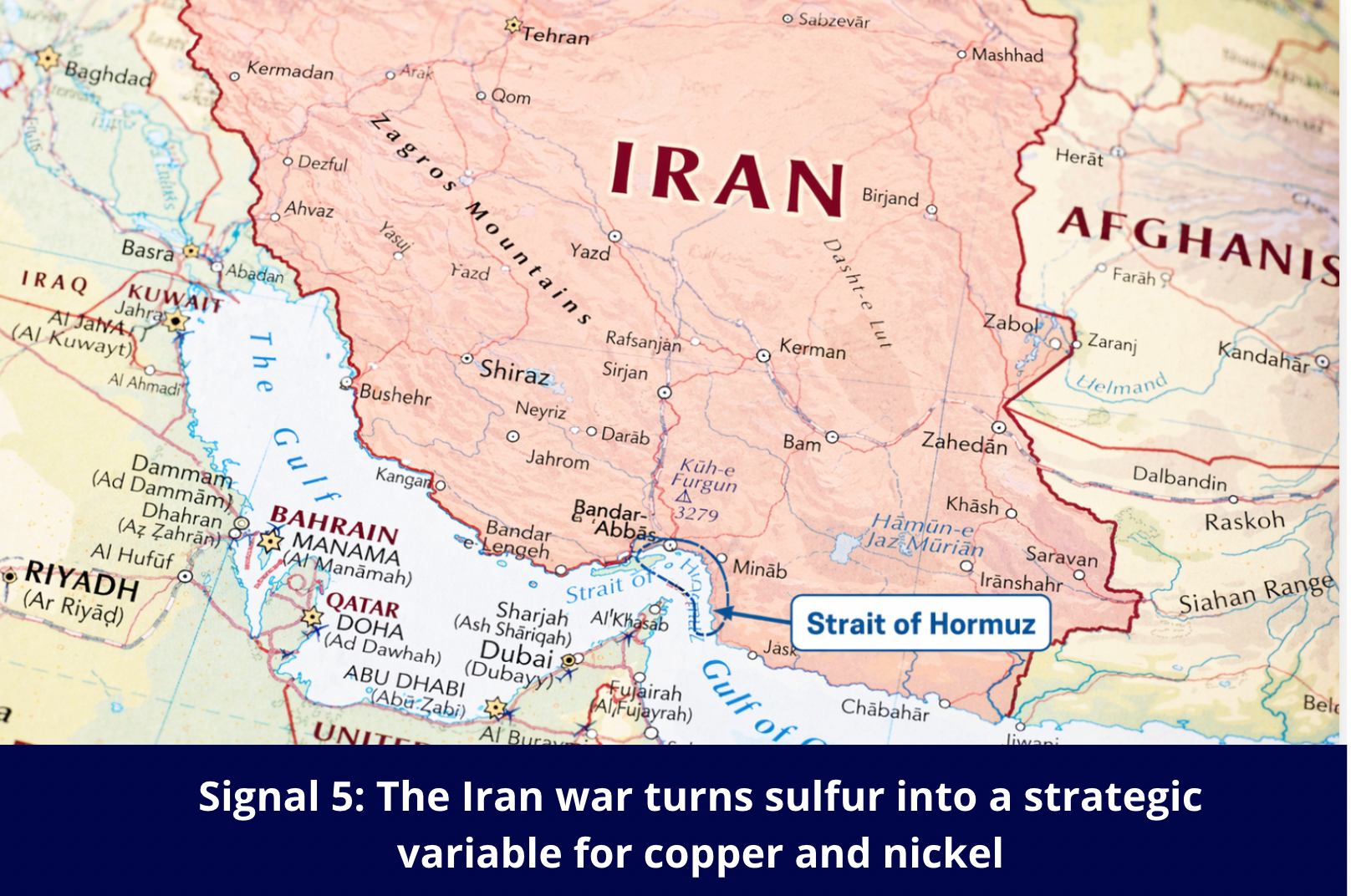
This week, sulfur moved into the strategic foreground of the mining conversation. Reuters reported that the war linked disruption in the Gulf has effectively trapped sulfur flows since the closure of the Strait of Hormuz on February 28, affecting a region that accounts for roughly a quarter of global sulfur production. That shift carries direct relevance for metals because sulfuric acid is a core input for copper solvent extraction electrowinning and for nickel HPAL processing. Reuters also reported that around one fifth of global primary refined copper comes from SX-EW, that the Democratic Republic of Congo relies heavily on Gulf sulfur for that route, and that Indonesia sources around 75% of its sulfur needs from the Middle East for nickel processing.
A second layer of the story came from China. Reuters reported on April 14 that Beijing’s planned halt to sulfuric acid exports from May is expected to reshape smelter economics and alter acid availability for key importing markets. China exported 4.65 million tonnes of sulfuric acid last year, with Chile and Indonesia among the major buyers. S&P Global added that Chile and Indonesia are particularly exposed to tighter supply conditions, and that sulfuric acid has become one of the most consequential variables in current mining cost structures.
Why it matters
This matters because it gives industrial chemistry a more visible place in the minerals map. Copper and nickel supply are being shaped here through reagent access, shipping routes, fertilizer demand, processing economics, and export policy. The sulfuric acid channel links oil refining, agriculture, base metals, and battery related materials in a single system. That wider connectivity gives sulfur a stronger strategic role than it usually receives in mining analysis.
Its importance also comes through in cost and continuity. Reuters reported that Chilean producers have already felt the effect of higher sulfuric acid costs, with Codelco’s chairman saying the Middle East war had raised the company’s costs by at least 10 cents per pound, while S&P Global noted that a doubling in sulfuric acid prices could add at least 50 cents per pound to SX-EW copper mining costs in Chile. These figures bring useful precision to the signal: sulfur is now influencing competitiveness, operating flexibility, and the economics of production in a much more direct way.
A third point gives this signal even more depth. Reuters reported earlier in the week that sulfuric acid had become a major support to Chinese smelter economics while treatment charges for copper concentrate stayed under pressure. In that setting, acid availability influences both the profitability of smelting and the cost base of mine side processing in other regions. That is a powerful reminder that industrial minerals strategy is increasingly being shaped through the interdependence of the midstream and upstream, not only through ore availability itself.
Implications for capital and strategy
For capital, sulfur and sulfuric acid now deserve a clearer place in project analysis, country risk assessment, and operating due diligence. SX-EW copper platforms and HPAL nickel projects sit especially close to this variable. Supply contracts, inventory coverage, import dependence, and freight exposure now carry greater strategic meaning. In practical terms, industrial chemistry is becoming a more visible part of what makes a project resilient and competitive.
For strategy, the deeper message is that mineral security is being built through wider industrial systems. Reagents, processing inputs, export restrictions, and by-product markets are gaining more influence over the final shape of supply. This week made that architecture easier to see. Sulfur entered the conversation as a strategic material within the copper and nickel chain, and that gives boards, investors, and policymakers a more complete map of where continuity and advantage are now being formed.
Signal 6: Development finance gives institutional shape to the minerals to manufacturing chain
What happened
On April 17, the African Development Bank Group, Asian Development Bank, European Bank for Reconstruction and Development, European Investment Bank, Inter-American Development Bank, and World Bank Group adopted a Joint Collaboration Framework on critical minerals to manufacturing value chains. In their joint statement, the six institutions said they will work together to support diversified, resilient, and responsible value chains, foster transparent and standards based markets, add value beyond extraction, and mobilize capital at scale for projects aligned with their development goals and ESG standards. The statement also places policy and regulatory support, regional cooperation, and infrastructure financing at the center of that effort.
Two days earlier, U.S. Treasury Secretary Scott Bessent called on the World Bank to move quickly on critical minerals. In his April 15 statement, he said the United States expects the Bank to support the policies, projects, and associated infrastructure needed to unlock more deals, diversify critical minerals supply chains, and increase domestic value capture across the chain. Reuters framed that message as a push for the Bank to give greater weight to mining and processing projects tied to supply chain diversification.
Why it matters
This matters because it gives the minerals conversation a broader financial and institutional framework. The chain is being presented through infrastructure, power, logistics, processing, market development, jobs, and regional integration. That widens the field in which producer countries, industrial platforms, and strategic projects can position themselves. It also gives greater legitimacy to the idea that critical minerals can be financed and evaluated as part of a larger development and industrial system.
Its significance also lies in the kind of development story this framework supports. The MDB statement explicitly connects client country mineral endowment and value add ambition with external demand, technology, and capital, while positioning the multilateral banks as bridges across those elements. That creates a more coherent architecture for countries that want to link extraction with infrastructure, processing, manufacturing, and stronger domestic economic participation.
Implications for capital and strategy
For capital, this framework strengthens the case for projects and jurisdictions that can present a fuller industrial proposition. Corridor logic, power and transport planning, processing pathways, realistic value add ambitions, and credible policy support are likely to carry greater weight in this setting. The financing environment becomes more receptive when a project reads as part of a broader system with development depth, rather than as an isolated asset.
For strategy, the deeper signal is that minerals are gaining a firmer place inside the architecture of development finance. That gives producer countries a wider platform through which to frame competitiveness, local value creation, and industrial continuity. It also gives boards and investors a clearer indication of where alignment is forming: around projects that can connect resource potential, infrastructure readiness, market access, and domestic upgrading in a single investable narrative.
Signals to watch
- The first real test of the EU Raw Materials Mechanism will be whether aggregated demand starts to generate usable commercial signals ahead of the September results. The Commission launched the first call on April 13, and Reuters reports that the first outcomes are expected in September.
- The DOE accelerator will become more revealing once the applicant field shows whether strong industrial consortia are forming around rare earth recovery, semiconductor-grade materials, and lithium processing. DOE’s April 7 call is explicitly designed to move those technologies toward pilot-scale and commercial relevance.
- Minnesota now moves into the next stage of the project pathway: federal follow-through, state process, environmental review, and permitting sequence. The Senate vote reopened access, while the Minnesota DNR made clear that the state’s science-based review framework remains fully in place.
- Copper and nickel will remain sensitive to sulfuric acid availability so long as Gulf sulfur flows stay constrained and China proceeds with its export halt. Reuters and S&P Global both point to Chile and Indonesia as especially exposed markets.
- The new MDB framework will matter more once it starts producing named corridors, country platforms, and co-financing structures that connect mining, infrastructure, processing, and manufacturing. The April 17 joint statement already places those elements at the center of the framework.
Three strategic questions for this week
- Which jurisdictions are building the strongest delivery architecture around mineral security: procurement coordination, technology maturation, legal access, chemical resilience, or financing depth? This question follows directly from the mix of instruments visible this week across the EU mechanism, DOE support, Minnesota, sulfur risk, and MDB coordination.
- Which copper and nickel strategies are most exposed to industrial-chemistry risk, especially where sulfuric acid supply, freight routes, and by-product economics are carrying more of the competitive weight? This is the wider strategic question opened by the Iran-war sulfur disruption and China’s planned sulfuric acid export halt.
- Which projects are already positioned to read as part of a wider industrial system rather than as stand-alone extraction stories? The new MDB language and Treasury’s framing both point toward projects that can connect resource potential, infrastructure, processing, and domestic value capture in one investable narrative.
For the full Geopolitical Mining framework behind this note, see our book Mining Is Dead. Long Live Geopolitical Mining.
Resources used
Signal 1
- European Commission — Commission launches platform to aggregate demand of raw materials and boost diversification
- EU Energy and Raw Materials Platform — Raw Materials Mechanism
- Reuters — EU launches operations of critical minerals procurement platform
Signal 2
Signal 3
- Reuters — US Senate narrowly overturns Minnesota mining ban, sending bill to Trump
- U.S. House Committee on Natural Resources — Senate Passes Legislation to Unleash Mineral Resources
- Minnesota Department of Natural Resources — DNR statement on federal action to overturn mining ban near the BWCAW
Signal 4
- Earth-i — Copper smelting rises again in March as China registers record active capacity
- Reuters — China copper smelters may press ahead with production curbs amid acid export ban
- IEA — Copper prices have hit record highs, but smelters face mounting strategic pressures
Signal 5
- Reuters — Iran war’s sulfurous fallout spreads to copper and nickel
- Reuters — China copper smelters may press ahead with production curbs amid acid export ban
- S&P Global — China’s sulfuric acid restrictions set to squeeze miners
Signal 6