
Geopolitical Mining Weekly
Week of 5 – 11 January 2026
Authors: Marta Rivera | Eduardo Zamanillo
What this week really tells us
This week, five moves stood out in the critical minerals and mining space:
- The US Treasury announced it will host G7 finance ministers and key partners in Washington to discuss how to reduce dependence on China for critical minerals.
- Rio Tinto and Glencore confirmed they are exploring a potential combination that would create one of the largest copper producers and traders in the world.
- Nickel prices swung sharply after Indonesia declined to clarify its 2026 output quotas, despite earlier hints of substantial cuts.
- Argentina’s government brought the Vicuña copper district into the presidential agenda under the RIGI regime, signalling a deliberate effort to reposition the country on the copper map.
- South Africa eased competition rules for energy intensive industries so they can coordinate on power infrastructure and supply, in an attempt to keep smelters and midstream capacity viable under extreme electricity costs.
Together, these signals highlight a common pattern: critical minerals risk is increasingly shaped by who sets the financial and regulatory framework (finance ministries, competition authorities, dominant producer states) and by how scale, energy costs and investment regimes evolve, not just by geology or spot prices.
For investors and boards, the key issues are less about a single commodity and more about:
• how future lending and de risking tools may be redesigned around trusted networks and strategic alignment,
• how consolidation and policy opacity could affect bargaining power and volatility in copper and nickel,
• how jurisdictions like Argentina and South Africa use policy to keep large projects and midstream alive, and
• how to distinguish between assets that benefit from these shifts and those that are left outside emerging frameworks.
Signals of the week
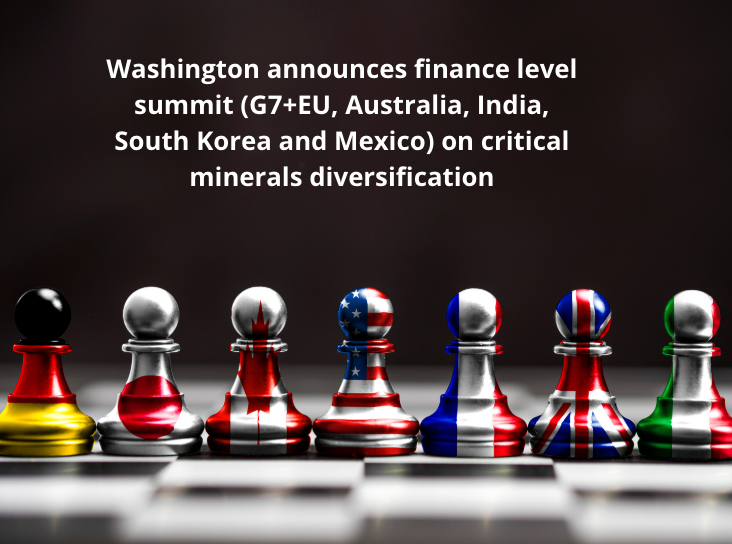
Signal 1: Washington announces finance level summit on critical minerals diversification
What happened
The US Treasury has announced that it will host G7 finance ministers (Germany, Canada, the United States, France, Italy, Japan and the United Kingdom) and counterparts from the EU, Australia, India, South Korea and Mexico in Washington to discuss how to reduce reliance on China for critical minerals. The meeting is scheduled for early next week. Together, these countries account for around 60% of global demand for critical minerals. The US has been pushing for this gathering since mid 2025, arguing that diversification progress has been too slow outside of Japan, which moved early after China’s 2010 rare earths cutoff. The planned agenda focuses on accelerating supply chain diversification, unlocking investment in allied projects and responding to Chinese export controls on key materials.
Why it matters
The signal this week is not about outcomes, but about who has been invited and at what level the conversation will happen:
- Critical minerals are now clearly on the finance minister agenda. That positions them alongside questions of macro risk, fiscal tools and public finance, not only sector specific policy.
- The guest list, EU, Australia, India, South Korea and Mexico alongside the G7, shows that supply and demand are being organised in blocs, rather than through isolated bilateral deals.
- The announcement suggests that core players accept the diagnosis (over reliance on China, under provision of non Chinese supply), but that the toolbox for acting together price support, guarantees, multilateral funding, is still being defined. As we analyse and explain in Mining Is Dead. Long Live Geopolitical Mining, this dependence has become a strategic vulnerability for the West, and it requires translating the diagnosis into finance grade instruments and operational alliances capable of accelerating non Chinese supply (https://geopoliticalmining.com/book/).
The meeting itself will be next week; this week’s signal is that finance actors are preparing to put risk tools and capital instruments, not just statements, on the table. This is consistent with the trend analysed in “When security joins ESG: how the U.S. NSS could reshape lending to mining” : lending criteria begin to incorporate security and strategic alignment alongside traditional ESG filters.
Implications for capital and strategy
- Participation in this emerging G7 plus framework may influence which projects and jurisdictions qualify for future de risking instruments (guarantees, concessional tranches, price support structures), and under what governance and ESG conditions.
- Banks and DFIs may progressively adjust their credit and risk criteria for mining and midstream projects to reflect security and strategic supply considerations, not only project level ESG, especially for assets that help reduce dependence on single suppliers or single countries.
- For portfolios, it will be increasingly important to distinguish between projects that can sit inside these trusted network criteria and those whose economics depend more heavily on Chinese offtake, processing or funding, and may be viewed differently by Western lenders.
Signal 2: Rio Tinto and Glencore explore a potential copper super major
What happened
Rio Tinto and Glencore have confirmed that they are in early stage discussions about a possible combination that would create one of the world’s largest diversified miners, with a particularly strong copper footprint. Under UK takeover rules, Rio Tinto has a limited time window to make a formal offer or walk away. Both companies are emphasising that there is no certainty a deal will be agreed. Analysts see copper exposure as the main strategic driver; Glencore’s coal and trading businesses, and likely antitrust scrutiny, are key complexities.
Why it matters
Even if the deal does not proceed, the fact that such talks are happening is a signal about how major players are thinking:
- Large-scale copper exposure is increasingly hard to replicate organically, so consolidation becomes an attractive route to secure scale and optionality.
- A combined Rio – Glencore would have significant influence on project pipelines, offtake and market information in copper, with implications for pricing power and counterparties.
- The regulatory questions, particularly around coal, trading and competition, will test how far regulators and governments are willing to allow consolidation in a sector that is systemically important for the energy transition.
For other majors, the prospect of such a combination also poses a strategic question: compete on scale, or differentiate on focus and project delivery.
Implications for capital and strategy
- Investors and boards should scenario test what a Rio – Glencore deal would mean for concentration risk in copper and for their own exposure to these counterparties.
- Boards of other large miners may face pressure to respond, through defensive moves, targeted acquisitions or clearer positioning around copper and other transition metals.
- Host governments will likely revisit how they think about negotiating with larger, more concentrated counterparties in future mine, midstream and infrastructure deals.
Signal 3: Nickel whipsaws as Indonesia stays vague on quotas
What happened
Nickel prices, after staging a strong rally at the end of 2025 on expectations of deep 2026 mining quota cuts in Indonesia, fell back when the government declined to provide details on the scale or timing of quota adjustments. Officials reiterated intentions to rationalise output and focus on supplying domestic smelters, but did not publish figures. Market participants had positioned for substantial reductions in mine approvals (RKABs), and the lack of clarity triggered a pullback in both London and Shanghai futures.
Why it matters
The episode illustrates how sensitive nickel markets have become to policy signals from a single dominant producer:
- Indonesia accounts for the bulk of global nickel mine supply feeding stainless steel and battery chains; quota and export decisions there can move prices quickly.
- The combination of state led industrial policy (prioritising local smelters) and limited transparency on quotas creates structural uncertainty for long term planning.
- For downstream buyers and investors, it becomes harder to distinguish between shocks driven by real supply demand shifts and shocks driven by expectation and policy opacity.
The broader lesson is that policy risk in dominant producer countries is now an integral part of pricing and investment decisions in several critical minerals, nickel among them.
Implications for capital and strategy
- Nickel strategies need to incorporate explicit policy risk scenarios in Indonesia, including both deeper cuts than expected and potential reversals once prices move.
- For companies active in Indonesia, engagement with regulators around quota timing and alignment with local processing capacity is not just a compliance issue; it is central to business continuity.
- For diversification efforts, investors need to be realistic about how quickly non Indonesian supply can scale, given permitting and ESG constraints elsewhere.
Signal 4: Argentina’s Vicuña copper district moves up the agenda under RIGI
What happened
Argentina’s president Javier Milei met senior executives from the Vicuña joint venture, which integrates the Josemaría and Filo del Sol copper deposits in San Juan province, to review project progress and its staged development plan under the Large Scale Investment Incentive Regime (RIGI). The JV has applied for RIGI benefits as a long term strategic export project. The meeting at Casa Rosada highlighted legal certainty, clear rules and stable conditions as priorities, and reaffirmed plans to advance technical studies and publish an integrated technical report in the first quarter of 2026.
Why it matters
This is an example of how a previously difficult jurisdiction can reposition itself in the copper map:
- San Juan already hosts several advanced copper projects; Vicuña would add a large, integrated development to that cluster.
- RIGI provides long term fiscal and regulatory stability for large investments, which can materially improve project economics and bankability in a country with a history of volatility.
- The fact that the president and key ministers are personally engaged signals that large scale copper projects are on the national agenda, not just on provincial or company radar.
For copper supply, the key question is whether Argentina can convert policy reform and high level signalling into timely project delivery, and how it will manage environmental, water and social debates, including around glacier protection.
Implications for capital and strategy
- Investors and boards should treat Argentina as an emerging copper option set, with RIGI as a central instrument, rather than as an automatic “too hard” jurisdiction.
- Project screening will need to weigh improved macro and regulatory frameworks against unresolved institutional and environmental challenges, especially in Andean provinces.
- For peers in the region, Argentina’s move raises the bar on incentives: stability and clear rules are becoming part of the competitive toolkit for attracting long term copper capital.
Signal 5: South Africa eases competition rules to keep energy intensive midstream alive
What happened
South Africa has temporarily eased certain competition rules to provide relief to energy intensive firms facing sharply higher power costs. The government has issued a block exemption that allows companies in sectors such as smelting and steelmaking to cooperate on energy related matters that would normally fall under anti trust scrutiny. Under the exemption, qualifying firms can: collaborate on developing or upgrading shared energy infrastructure, coordinate backup or alternative power solutions, and jointly negotiate power-supply contracts with Eskom or private providers.
The move follows years of rising electricity tariffs and supply instability, which have already led to the curtailment, mothballing or closure of several smelters and furnaces.
Why it matters
This is a form of defensive industrial policy targeted at the midstream:
- South Africa’s smelting and ferroalloy industries (ferrochrome, manganese alloys, steel) are structurally important for its mining value chains and export base, but they have been under severe pressure from high and volatile power costs.
- By relaxing competition rules in a narrow, time bound way, the government is effectively acknowledging that energy, not ore, is the binding constraint on competitiveness, and that some degree of coordination among energy intensive users is preferable to further deindustrialisation.
- The exemption does not solve the underlying power sector issues, but it does create space for joint solutions (shared generation, wheeling agreements, pooled procurement) that would otherwise be difficult or impossible under strict anti trust enforcement.
For critical minerals and metals, the signal is that maintaining midstream capacity in key producer countries is no longer being left entirely to market forces; energy policy and competition policy are being adjusted to keep parts of the value chain alive.
Implications for capital and strategy
- Assessing midstream investments in South Africa now requires an explicit view on power costs, the durability of this regulatory flexibility, and the feasibility of shared infrastructure solutions under the exemption.
- The case raises a broader question for other producer jurisdictions: if energy becomes the bottleneck for smelting and refining, will governments consider similar targeted relaxations of competition rules or coordinated energy user arrangements?
- For portfolios, it reinforces the need to treat energy and regulatory adaptability as core variables in midstream risk, not as secondary considerations behind geology and commodity prices.
Signals to watch
- The outcomes of the Washington finance level meeting on critical minerals: whether it produces concrete instruments (price support pilots, blended finance facilities, project lists) or remains mostly at the level of signalling.
- How the Rio Tinto–Glencore discussions evolve within the UK takeover timetable, and how regulators and host governments react if a formal proposal emerges.
- The timing and substance of Indonesia’s 2026 nickel quota decisions, and how price and investment expectations adjust once detailed numbers are published.
- Publication of the integrated technical report for the Vicuña district and early indications of permitting and community timelines in San Juan under RIGI.
- How South African smelters and steelmakers use the new block exemption in practice, which collaborations are formed, and whether further measures on power tariffs and infrastructure follow.
Three strategic questions for this week
Finance ministry and security filters
- As G7 and partner finance ministries move critical minerals into their remit, are we anticipating changes in how banks, DFIs and export credit agencies assess mining projects, including security and strategic-supply criteria on top of ESG?
Scale vs diversification
- In light of potential large scale consolidation in copper and heavy dependence on Indonesia in nickel, how are we balancing exposure to very large counterparties and dominant producer states against exposure to genuinely new and more diversified sources of supply?
Energy as a midstream constraint
- With South Africa relaxing competition rules to keep energy intensive midstream capacity alive, are we giving sufficient weight to power costs and regulatory flexibility when evaluating smelting and refining investments in other key jurisdictions?
Sources for this week’s note
-
Reuters, “G7 finance ministers to meet in Washington to discuss rare earths, three sources say,” 6 January 2026.
https://www.reuters.com/world/china/g7-finance-ministers-meet-washington-discuss-rare-earths-three-sources-say-2026-01-06/ -
Reuters, “Rio Tinto in talks to buy Glencore to form world’s biggest miner,” 8 January 2026.
https://www.reuters.com/business/glencore-rio-tinto-resume-talks-mining-mega-deal-ft-reports-2026-01-08/ -
MINING.COM / Bloomberg, “Nickel price extends drop amid lack of detail on Indonesia output cuts,” 8 January 2026.
Nickel price extends drop amid lack of detail on Indonesia output cuts
-
Panorama Minero, “Mining on the National Agenda: Vicuña presents progress to President Javier Milei,” 9 January 2026.
https://www.panorama-minero.com/en/news/mining-on-the-national-agenda-vicuna-presents-progress-to-president-javier-milei -
Reuters, “South Africa eases anti-trust rules for firms facing high power costs,” 7 January 2026.
https://www.reuters.com/sustainability/boards-policy-regulation/south-africa-eases-anti-trust-rules-firms-facing-high-power-costs-2026-01-07/