
Geopolitical Mining Weekly
Week of 2–8 February 2026
Authors: Marta Rivera | Eduardo Zamanillo
Independent weekly note for investors and strategic decision makers in critical minerals and mining.
What this week really tells us
This week, six moves stand out in the critical minerals system:
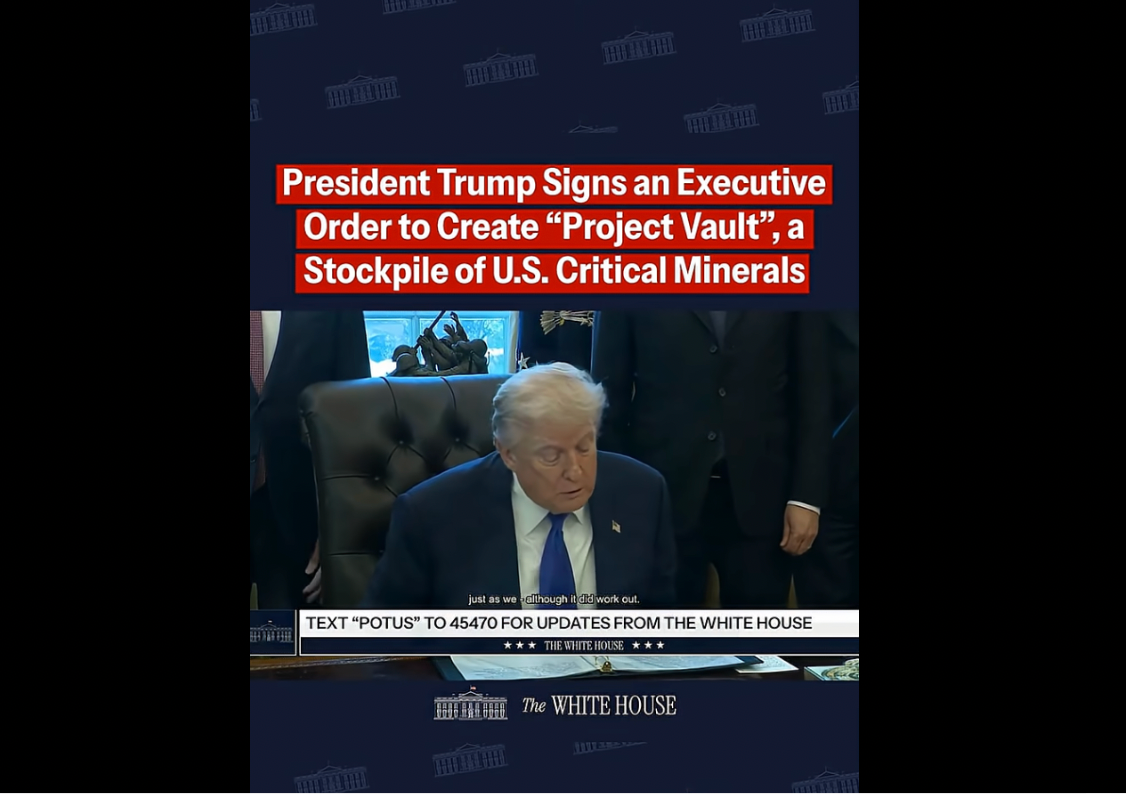
- The US government moved from speeches to inventory with Project Vault, a $12 billion strategic stockpile that formalises the U.S. Strategic Critical Minerals Reserve and makes the state a structural buyer of key materials.
- The UK-US critical minerals MoU gave critical minerals and rare earths a defined place inside the transatlantic industrial relationship, with explicit commitments on securing supply, coordinating investment and streamlining permitting.
- Japan’s Chikyu mission off Minamitorishima shifted deep-sea rare earth mud from concept to tested capability, embedding frontier extraction within Japan’s broader economic security and marine resource strategy.
- Codelco and Quiborax’s Minera Ascotán SpA showed how Chile’s National Lithium Strategy is being implemented through state-anchored joint ventures and CEOL-based partnership models beyond the Salar de Atacama.
- The Orion CMC-Glencore MoU signalled a structured U.S.-backed entry into the DRC Copperbelt, with a mission-driven consortium tied to the U.S.–DRC Strategic Partnership taking a proposed 40% stake in Mutanda and KCC.
- In Washington, the 2026 Critical Minerals Ministerial gathered 54 countries and the European Commission around a single fact sheet and agenda, connecting FORGE, bilateral frameworks, Project Vault, DFC/EXIM/DOE tools and Pax Silica into a visible U.S. centred architecture.
Taken together, these moves outline the early contours of an economic industrial base in critical minerals that is increasingly aligned with Western economies. Stockpiles, transatlantic frameworks, deep sea tests, state anchored joint ventures and mission driven consortia are being arranged as parts of one system: an architecture designed to secure supply for clean energy, defence and advanced manufacturing, and to shape how prices, access and bargaining power will evolve.
For boards and investors, the practical shift is clear. The question is no longer whether this architecture is emerging, but how to position within it: which assets and partnerships can sit comfortably inside these frameworks, which will remain outside, and how to manage the tension between strategic alignment, local legitimacy and long term investability.
Signals of the week
Signal 1: Project Vault, the US moves from policy speeches to a $12bn stockpile
What happened
The US government has launched Project Vault, a $12 billion strategic stockpile of critical minerals designed to protect manufacturers from supply shocks and, as Bloomberg notes, to reduce reliance on Chinese rare earths and other metals. The White House describes Project Vault as “a critical mineral stockpile for American businesses, unaffected by market disruptions.”
Key elements:
- Financing structure. According to EXIM, Project Vault is supported by a direct loan of up to $10 billion from the Export-Import Bank of the United States, alongside nearly $2 billion in private sector investment, bringing the total firepower of the reserve to around $12 billion.
- Scope. Project Vault establishes the U.S. Strategic Critical Minerals Reserve, an independently governed public-private partnership that will store essential raw materials in secure facilities across the United States. EXIM frames the initiative as a way to protect domestic manufacturers from supply shocks, support U.S. production and processing of critical raw materials, and strengthen America’s critical minerals sector and industrial resilience.
- Participants. EXIM identifies Clarios, GE Vernova, Western Digital and Boeing as initial participating manufacturers, and Hartree Partners, Mercuria Americas and Traxys as suppliers responsible for sourcing material for the strategic stockpile.
- EXIM’s own “Week in Review” presents Project Vault as an unprecedented, uniquely American approach to strengthening U.S. critical minerals supply chains and supporting the broader Strategic Critical Minerals Reserve effort.
Why it matters
Project Vault marks a clear transition from talking about security of supply to the US government directly holding inventory and shaping demand. It parallels the Strategic Petroleum Reserve, but for a more diverse set of materials that underpin manufacturing, clean energy and advanced technologies.
Three aspects are strategically important:
- Market role. The US becomes a structurally present buyer and holder of critical minerals. That can stabilise supply for participating manufacturers in a crisis, but also adds a new layer of political influence over when and how inventory is released or replenished.
- Financing signal. A $10 billion EXIM facility is a strong signal that US export credit and development finance tools will be deployed in favour of friendly critical mineral supply chains. It also creates expectations that similarly ambitious tools could be used in upstream and midstream projects.
- Club dynamics. Access to the stockpile will be organised through participating manufacturers and suppliers. In practice, that creates a distinction between firms that are inside the Project Vault framework and those that are not, with potential implications for who enjoys the most secure access to strategic materials in a disruption.
Implications for capital and strategy
For investors and boards, Project Vault confirms that policy and security factors are now part of the demand side: stockpiles, not just end user industries, will be absorbing tonnage, and government decisions will influence liquidity and volatility in some markets.
For project developers, the key question is how their products and counterparties intersect with Vault and related U.S. programmes. Producers that can qualify as trusted suppliers for participating manufacturers (in terms of origin, environmental and social performance, and traceability) may gain access to more stable offtake and financing. Those outside this perimeter will need alternative alignment strategies, including with other blocs.
For allies and competitors, Vault is a benchmark. It raises the bar for what a serious critical minerals strategy looks like and may prompt other jurisdictions to design their own stockpiles, reserves or coordinated procurement systems, with implications for price formation and trade flows.
Signal 2 – UK–US MoU: critical minerals become a transatlantic industrial pillar
What happened
On 4 February, the UK and US signed a Memorandum of Understanding on critical minerals in Washington DC. The text sets out “a common policy approach for the mining and processing of critical minerals and rare earths” and is explicitly framed as a way to secure supply and support the commercial and defence industries of both countries.
According to the MoU, the Participants commit to:
- Secure supply. Intensify cooperative efforts to accelerate the secure supply of critical minerals and rare earths needed to support advanced technology and defence manufacturing and their respective industrial bases, leveraging existing policy tools.
- Mobilise and coordinate investment. Mobilise government support, and encourage private-sector investment, in mining, separation and processing through tools such as guarantees, loans, equity investments, private offtake arrangements, insurance and regulatory facilitation; jointly identify projects of interest; take measures to provide financing for projects in each country; develop new mechanisms to strengthen critical minerals and rare earths supply chains; and inform each other, where appropriate, about investment activity that may significantly affect domestic capabilities.
- Streamline permitting. Take measures to streamline permitting timelines and processes for mining, separation and processing within their domestic regulatory systems.
- Address pricing and non-market behaviour. Work, in line with domestic law, to protect their critical minerals and rare earths industries from non market policies and unfair trade practices, including by establishing high standard marketplaces and working with partners on pricing challenges.
- Manage strategic assets and recycling. Use legislative and diplomatic tools, where relevant, to review and, if necessary, restrict asset sales on national security grounds; support recycling technologies and improve the management of scrap to support diversified supply chains.
- Cooperate with third countries and on geology. Collaborate with other international partners, as appropriate, to ensure supply chain security, and cooperate on geological mapping in the UK, the US and jointly determined locations to support diversified supply chains.
The MoU sits alongside broader UK efforts to strengthen critical minerals security and US initiatives such as the Inflation Reduction Act and emerging critical minerals programmes.
Why it matters
This MoU is not a treaty or a detailed financing facility, but it matters for three reasons:
- Industrial alignment. It signals that critical minerals and rare earths are now treated as part of the core industrial relationship between the UK and the US, not just as a peripheral trade or security issue. That matters for automakers, aerospace, defence and advanced manufacturing supply chains that span both markets.
- Standard and practice setting. Joint work on high standard marketplaces, investment tools, permitting practices and responses to non market behaviour will shape the practical benchmarks that projects need to meet to be seen as strategically aligned and bankable in London and Washington, even if those benchmarks are not codified in a single document.
- Coordinated investment platform. By committing to jointly identify projects, coordinate financing and consult on investment activity, the MoU creates a shared policy and investment framework that both governments can use when evaluating critical mineral and rare earth projects in their own jurisdictions and, where appropriate, in third countries.
Implications for capital and strategy
For investors and boards, the MoU is a reminder that eligibility for incentives and access to certain markets will depend increasingly on alignment with specific policy frameworks, not only on price and quality. Companies with global portfolios should map which of their assets can realistically fit into UK-US aligned supply chains for critical minerals and rare earths.
For project developers, the partnership creates an incentive to design projects with both in mind: technical standards and environmental and social practices that can satisfy expectations in both jurisdictions, offtake structures that can serve buyers in the UK and the US, and governance that can withstand scrutiny from regulators and investors in London and Washington.
For other jurisdictions, especially in the EU and Asia, the MoU illustrates the speed at which overlapping critical minerals alliances are forming. The result could be a more fragmented, club based trading system for critical minerals over the next decade.
Signal 3 – Japan’s deep-sea rare earth mud: technology, security and uncertainty
What happened
Japan’s Ministry of Economy, Trade and Industry (METI) has confirmed that the deep-sea scientific drilling vessel Chikyu successfully retrieved rare earth bearing mud from around 6,000 metres below sea level in waters off Minamitorishima, within Japan’s jurisdiction.
According to METI, the operation is part of a Cabinet Office field test on rare earth extraction being conducted around Minamitorishima under Japan’s broader marine resource and economic security strategy. The minister notes that industrialisation of rare earth mud mining will depend on verifying the entire chain from mining through separation and refining, and on assessing the overall economic feasibility of the project.
METI frames the successful retrieval as a meaningful achievement at the research and development stage, with implications for both economic security and comprehensive marine development.
Why it matters
Japan’s test mission matters less for immediate volumes and more as a technological and strategic marker within an already articulated policy framework:
- Technological capability. Demonstrating that Chikyu can support test mining of rare earth mud at depths of around 6,000 metres signals that Japan now has operational deep sea systems capable of accessing resources that were previously only mapped and modelled. This capacity is rare and places Japan among the few states capable of executing such trials at scale.
- Economic security strategy. In its revised Plan for the Development of Marine Energy and Mineral Resources and broader economic security agenda, the Japanese government has highlighted deep sea mineral resources as one potential pillar of long term supply security for critical materials. The Minamitorishima test is a concrete step in that direction: it moves the discussion from exploration data to proof-of-concept extraction.
At the same time, several uncertainties remain:
- Economics. METI itself emphasises that industrialisation must await verification of the full process (mining, separation, refining) and a rigorous assessment of economic feasibility of the project. At current cost structures, deep sea mud is unlikely to compete with established supply without strong strategic or pricing signals.
- Environmental governance. Japan’s ocean policy and marine resource plans recognise the need to balance resource development with environmental stewardship. Translating a test retrieval into routine production will require credible monitoring frameworks and mitigation measures that can withstand domestic and international scrutiny.
- Social and political acceptance. Even when activities occur within Japan’s exclusive economic zone, deep sea mining is politically sensitive. As Japan advances from tests to potential pilot production, it will face questions about how this fits with its broader positioning on nature-positive approaches and international ocean governance.
Implications for capital and strategy
For investors and boards, Japan’s mission should be treated as a medium to long term option, not a source of near term supply. What changes today is not the physical balance of the rare earth market, but the credibility of deep-sea resources as a strategic hedge that Japan may choose to develop if conventional supply becomes too constrained or politicised.
For companies, the key question is whether and how to engage: as technology partners in drilling, lifting and processing; as potential offtakers if the material is eventually commercialised; or as observers following the regulatory and social licence trajectory. Any involvement will need to internalise that deep-sea projects sit at the intersection of economic security, climate policy and environmental concern.
For other resource importing states, Japan’s move underscores that the race for supply security will increasingly include frontier, high capex technological bets, not only new conventional mines. Over time, that could reshape where cost curves, technology leadership and bargaining power sit in the rare earths value chain, especially if Japan decides to pair deep-sea capabilities with its broader economic security and alliance strategies.
Signal 4 – Codelco–Quiborax: Chile’s state-led lithium strategy deepens
What happened
Chile’s state owned miner Codelco and private company Quiborax have created a joint venture, Minera Ascotán SpA, to advance the process of obtaining a Special Lithium Operating Contract (CEOL) over the Salar de Ascotán salt flat in northern Chile’s Antofagasta Region.
According to Codelco’s official announcement:
- Minera Ascotán SpA has an initial shareholding structure of 34% for Codelco and 66% for Quiborax.
- The shareholders’ agreement stipulates that, once the CEOL has been granted, the JV will seek a new majority partner to develop a potential lithium project in Salar de Ascotán together with Codelco.
- Codelco’s mining properties and other assets in the salar may be contributed to Minera Ascotán after the CEOL is signed with the Ministry of Mining.
- Codelco and Quiborax applied as a consortium for this CEOL in January 2025, and the Ministry of Mining is expected to submit the corresponding Supreme Decree with the general terms and conditions to the Office of the Comptroller General in the coming weeks.
- Codelco emphasises that Salar de Ascotán is Chile’s third largest salt flat by surface area with underground brines, which has not yet been explored for lithium but is considered to have attractive exploration potential.
In the same statement, Codelco’s chairman Máximo Pacheco links Minera Ascotán directly to Chile’s National Lithium Strategy, presenting it as another step in maintaining Chile’s leadership in the global lithium industry and contributing to the energy transition, alongside the NovaAndino Litio JV in the Salar de Atacama and the partnership with Rio Tinto in Maricunga.
Why it matters
Ascotán is not yet a producing salar, but this JV is strategically important for three reasons:
- Operationalising the National Lithium Strategy. Minera Ascotán illustrates how Chile’s state centred lithium policy is being implemented in practice: the State, through Codelco, anchors the project, brings in a private partner with existing rights, and anticipates a future majority partner under a CEOL framework defined by the Ministry of Mining. It is the architecture of the National Lithium Strategy applied to a new basin, beyond the flagship Atacama assets.
- Geographic diversification of Chile’s lithium map. By moving into Ascotán, described as the country’s third largest salar with underground brines and no prior lithium exploration, Codelco is signalling that Chile intends to broaden its lithium geography, not rely solely on Atacama and Maricunga. In portfolio terms, Minera Ascotán is an option on a new resource base under clear state leadership.
- Clarifying partnership models. The structure announced by Codelco, initial minority stake for the State company, majority for a private partner holding early stage rights, and an explicit plan to bring in a new majority partner once the CEOL is granted, offers a concrete template for how public-private partnerships in lithium may be structured under the National Lithium Strategy.
Implications for capital and strategy
For investors and boards, exposure to Chilean lithium increasingly needs to be assessed through alignment with state anchored vehicles rather than only through concessions held by juniors. The relevant question is less “who holds the ground today?” and more “who has a credible, state compatible path to a CEOL and to development under Chile’s lithium policy settings?”.
For potential partners, Minera Ascotán sends a clear signal: early, technically credible proposals on non Atacama salars that fit within the National Lithium Strategy can attract Codelco’s interest, but under conditions that include state equity, governance oversight and alignment with broader objectives on value creation and the energy transition.
For other lithium producing countries, Ascotán will be watched as a test case of Chile’s model: it concentrates strategic direction in a state owned company, offers scale and policy continuity, but also embeds political and timing risks. How Minera Ascotán progresses, from CEOL approval to partner selection, project design and community engagement, will shape perceptions of the viability of state led lithium strategies in a market where timing and scale matter.
Signal 5 – US-backed capital moves into the DRC Copperbelt
What happened
Glencore and the Orion Critical Mineral Consortium (Orion CMC) have signed a non binding Memorandum of Understanding for Orion CMC to acquire a 40% stake in Glencore’s interests in its Democratic Republic of Congo (DRC) assets, Mutanda Mining (Mumi) and Kamoto Copper Company (KCC). The transaction is expected to imply a combined enterprise value of around $9 billion for the two operations.
Under the MoU, Orion CMC would have the right to appoint non executive directors in respect of the assets and to direct the sale of its share of production to nominated buyers, in line with the U.S.-DRC Strategic Partnership Agreement, thereby securing critical minerals for the United States and its partners. Mumi and KCC would continue to be operated as part of the Glencore group.
Glencore’s statement explains that Orion CMC was established in October 2025, led by Orion Resource Partners in partnership with the U.S. government, as a mission driven consortium designed to support the United States and its allied and partner nations in developing secure, responsible and resilient supply chains for critical minerals.
The release also includes on the record statements from U.S. Deputy Secretary of State Christopher Landau and U.S. International Development Finance Corporation (DFC) CEO Ben Black, who both frame the proposed transaction as a concrete expression of the U.S.-DRC Strategic Partnership Agreement: encouraging greater U.S. investment in the DRC’s mining sector, securing reliable flows of critical minerals, and supporting economic opportunity and regional stability in the DRC.
Why it matters
Even though the MoU is non binding and subject to due diligence and regulatory approvals, it is strategically significant in three ways:
- A structured U.S. entry into the Copperbelt. Through Orion CMC, U.S.-backed capital is moving into two of the DRC’s flagship copper-cobalt assets, with explicit rights over a portion of production and a mandate tied to U.S. and allied supply security. That is a different model from simply relying on privately led deals: it links project-level exposure directly to a bilateral strategic partnership.
- A dedicated vehicle for future acquisitions. Orion CMC is described as the largest initiative to create secure critical mineral supply chains for the United States and its allies, and the MoU explicitly envisages further investment opportunities in the DRC and the wider African Copperbelt. That makes the consortium not just a one off buyer of a stake in Mumi and KCC, but a potential platform for additional assets in the region.
- Institutional endorsement on both sides. The presence of senior U.S. officials in the announcement, together with the reference to working with the DRC government and Gécamines, underlines that this is being framed as a model transaction for the U.S.-DRC Strategic Partnership. It is meant to show that U.S. and allied capital can enter high risk upstream contexts under a rules based, state supported framework.
Implications for capital and strategy
For investors and boards, the Orion CMC-Glencore MoU confirms that U.S. foreign policy and development finance instruments are now directly involved in upstream copper-cobalt assets in the DRC. Portfolio exposure to the Copperbelt can no longer be analysed only in terms of project economics and country risk; it also needs to be mapped against the emerging architecture of U.S. backed vehicles, bilateral partnerships and critical minerals programmes.
For mining companies and project developers in the region, the proposed transaction offers a template for what strategically aligned capital may look like: a consortium with a clear mandate on critical minerals, anchored in a U.S. government partnership, prepared to take minority positions in large assets with rights over offtake and board representation. That raises the bar on governance, transparency and alignment with host-country objectives, but also opens a path to scale financing under a strategic umbrella.
For the DRC and other resource rich states, the MoU signals that competition for Copperbelt assets is now explicitly geopolitical. The question is no longer only which bidder offers the highest headline price, but which structure best fits long term national strategies, institutional capacity and expectations around social and environmental performance. How the DRC manages this proposed Orion CMC stake, and any future U.S. backed deals, will shape perceptions of whether strategic partnerships can translate into durable, broadly beneficial investment on the ground.
Signal 6 – Washington’s Critical Minerals Ministerial: the control room of U.S. geopolitical mining
What happened
On 4 February, the United States hosted the 2026 Critical Minerals Ministerial at the Department of State in Washington, DC. According to the official State Department Fact Sheet, Secretary of State Marco Rubio, Vice President JD Vance and other senior officials convened representatives from 54 countries plus the European Commission, including 43 foreign and other ministers, with the stated goal of “reshaping the global market for critical minerals and rare earths” and building secure, diversified and resilient supply chains. (U.S. Department of State, 2026 Critical Minerals Ministerial – Fact Sheet)
The Fact Sheet highlights several concrete actions taken “in one day”:
- The United States and its partners took action to build secure and resilient critical mineral supply chains, committing to build new sources of supply and transform the global market into one that is secure, diversified, and resilient, end to end.
- The U.S. signed eleven new bilateral critical minerals frameworks or MOUs with partner countries, including Argentina, the Cook Islands, Ecuador, Guinea, Morocco, Paraguay, Peru, the Philippines, the United Arab Emirates and Uzbekistan, adding to a growing network of agreements concluded over the previous five months.
- The U.S. announced new government financing opportunities for strategic critical mineral projects and explicitly framed more than $30 billion in letters of interest, loans, investments and other support over the past six months as part of a coordinated effort to secure supply chains in partnership with the private sector.
- Secretary Rubio announced the creation of the Forum on Resource Geostrategic Engagement (FORGE) as the successor to the Minerals Security Partnership, with the Republic of Korea chairing FORGE through June. FORGE is tasked with leading bold and decisive action to address challenges in the global critical minerals marketplace and to strengthen diversified, resilient and secure supply chains at both policy and project level.
The Fact Sheet also links the ministerial agenda to Pax Silica, the plurilateral initiative focused on securing strategic technology stacks, and to a wider set of instruments, including Project Vault, the Department of Energy’s loan portfolio and the U.S. International Development Finance Corporation’s critical minerals investments, as well as Pax Silica, the U.S.-led economic security coalition that, as we argued in our Geopolitical Mining Weekly (week of 8-14 December 2025), “Geopolitical Mining Weekly – Week of 8–14 December 2025” , explicitly links critical minerals, semiconductors and AI infrastructure as one strategic system, from minerals to chips to compute.
In our own analysis at Geopolitical Mining, “Welcome to the Era of U.S. Geopolitical Mining” and “U.S. Investments in the Era of Geopolitical Mining” , we argued that the 2026 Ministerial is the moment when the United States stopped treating critical minerals primarily as “supply chain risk” and began to articulate them as industrial strategy and geopolitical architecture, connecting diplomacy, finance, technology and stockpiles into a single system.
Why it matters
If Project Vault is the instrument, the 2026 Critical Minerals Ministerial is the control room of this emerging architecture. On the basis of the Fact Sheet and the official announcements, three dimensions stand out:
- Scale and coalition. Bringing 54 countries and the European Commission into the same room around a shared diagnosis, that today’s concentrated critical minerals market is a tool of political coercion and supply chain disruption, turns critical minerals into a collective strategic agenda, not just a series of bilateral supply issues. The explicit goal is to reshape the global market for critical minerals and rare earths with a broad coalition, rather than leaving them to a narrow set of dominant suppliers.
- From initiatives to architecture. The Ministerial formally links and sequences a set of U.S. instruments: FORGE as the successor to the Minerals Security Partnership and the central platform for policy and project level collaboration; a growing web of bilateral frameworks and MOUs as the diplomatic and legal scaffolding for cooperation; Project Vault, DOE loans, EXIM facilities and DFC investments as the financial arm of this strategy; and Pax Silica as the interface with technology supply chains and the private sector. In our Geopolitical Mining framework, this is the constitutional moment of U.S. geopolitical mining: the point at which disparate tools are presented as one coherent architecture rather than as separate, ad hoc initiatives.
- Strategic signalling to markets and producers. The Fact Sheet makes clear that critical minerals and rare earths are now treated as foundational to AI, robotics, batteries, defence and advanced manufacturing, and that the existing market structure is seen as unacceptable from a national security perspective. The message to producing and consuming countries alike is that U.S. diplomacy, export finance, development finance and industrial policy will increasingly move in lockstep around these materials.
Implications for capital and strategy
For investors and boards, the Ministerial confirms that critical minerals are now organised as a sector of strategic cooperation and control, not simply as a commodity basket. Portfolio exposure should be mapped explicitly against this emerging architecture (FORGE, Project Vault, the web of bilateral frameworks and the initiatives linked to Pax Silica) rather than treating U.S., EU, Japan and other partners as disconnected policy streams. Assets that can sit comfortably inside this system, in terms of origin, governance and ability to demonstrate secure and resilient supply, are likely to enjoy structural advantages in access to capital and offtake.
For producer countries, the Ministerial is both an opportunity and a filter. Those that can credibly offer trusted supply (combining geological potential with institutional capacity, transparency and social licence) are being invited into closer partnership through frameworks, MOUs and financing windows. Those that cannot match these expectations will face more scrutiny and may find it harder to position themselves within the U.S. centred architecture.
For companies, a passive stance is increasingly risky. The proliferation of overlapping initiatives (FORGE, Project Vault, bilateral agreements, Pax Silica linked projects) means that clarity of positioning becomes a strategic choice: with whom to align, on what terms, and with which safeguards for host country relationships and community legitimacy. As we argued in our own pieces, the era of U.S. geopolitical mining will favour actors who can speak both the language of projects and the language of architecture, and who can explain how individual investments fit into a rapidly formalising system of alliances, price signals and strategic supply chains.
Signals to watch
- How Project Vault is operationalised. Governance, mineral mix, storage and release rules, transparency and whether additional allies are brought into a broader “Vault aligned” architecture will determine how far the U.S. stockpile reshapes market expectations.
- Implementation of the UK-US MoU. Concrete steps such as jointly identified projects, co-financed investments, streamlined permitting practices and any move on “high-standard marketplaces” will show how the MoU translates into real project pipelines.
- Japan’s next steps at Minamitorishima. Technical and economic assessments of the Chikyu test, the design of environmental monitoring frameworks and any decision on pilot-scale production will indicate whether deep sea rare earth mud remains an option value or moves toward a defined development path.
- The CEOL process and partner structure for Minera Ascotán. The timing and terms of the Supreme Decree, the conditions attached to the CEOL, and how Codelco and Quiborax structure the entry of a future majority partner will be an early test of Chile’s National Lithium Strategy beyond Atacama.
- The evolution of the Orion CMC-Glencore transaction. Due diligence outcomes, regulatory approvals, final ownership and offtake arrangements (and whether Orion CMC announces additional transactions in the DRC or wider African Copperbelt) will signal how quickly U.S. backed capital scales in high-risk upstream environments.
- The first wave of FORGE labelled projects. Which countries and assets are prioritised under FORGE, how financing is structured and how FORGE interacts with existing MOUs and initiatives such as Pax Silica will help define the practical shape of the U.S. centred critical minerals architecture over the next 12-24 months.
Three strategic questions for this week
- How do instruments like Project Vault, FORGE and the UK-US MoU change our assumptions about demand, price formation and access in the critical minerals we rely on most? Stockpiles, club based frameworks and coordinated investment platforms mean that part of demand will be driven by policy and security choices. What does that imply for how we model liquidity, volatility and long-term price signals in our core commodities?
- When we map the emerging U.S.-centred architecture (Vault, FORGE, transatlantic and bilateral frameworks, Orion CMC), are we explicitly distinguishing between countries and companies that are “inside the room” and those that are not, and what does that mean for key suppliers such as Chile and the DRC? How are we classifying our own assets and partnerships along that dimension, and what adjustments are needed for projects that currently sit outside the main alignment corridors?
- In state shaped environments, from Chile’s National Lithium Strategy to the DRC Copperbelt under the U.S.-DRC Strategic Partnership, what partnership models would we require to participate, and how would we demonstrate that our involvement improves governance and outcomes on the ground? Which conditions on governance, community engagement, transparency and environmental performance would make these opportunities genuinely investable for us, and how do we communicate that to both host governments and our own stakeholders?
Sources for this week’s note
-
The White House. (2026, February 2). Introducing Project Vault, a critical mineral stockpile for American businesses (video and social media posts).
https://www.whitehouse.gov/videos/introducing-project-vault-a-critical-mineral-stockpile-for-american-businesses-%F0%9F%92%8E%F0%9F%87%BA%F0%9F%87%B8/ -
Export–Import Bank of the United States (EXIM). (2026, February 4). EXIM Approves Project Vault Loan to Launch America’s Strategic Critical Minerals Reserve.
https://www.exim.gov/news/project-vault -
Export–Import Bank of the United States (EXIM). (2026, February 6). Week in Review: Project Vault and the U.S. Strategic Critical Mineral Reserve.
https://www.exim.gov/news/week-review-project-vault-and-strategic-critical-mineral-reserve -
Bloomberg. (2026, February 2). Trump to Launch $12 Billion Critical Mineral Stockpile to Blunt Reliance on China.
https://www.bloomberg.com/news/articles/2026-02-02/trump-launches-12-billion-minerals-stockpile-to-counter-china -
UK Department for Business and Trade; Foreign, Commonwealth & Development Office. (2026, February 5). UK and US sign Memorandum of Understanding on critical minerals.
https://www.gov.uk/government/news/uk-and-us-sign-memorandum-of-understanding-on-critical-minerals -
UK Department for Business and Trade; Foreign, Commonwealth & Development Office. (2026, February 5). New UK–US partnership to drive investment and bolster critical minerals supply chains.
https://www.gov.uk/government/news/new-uk-us-partnership-to-drive-investment-and-bolster-critical-minerals-supply-chains -
Ministry of Economy, Trade and Industry (METI), Japan. (2026, February 3). Press Conference by Minister Akazawa (Excerpt): Successful test mining of rare earth mud off the coast of Minamitorishima Island.
https://www.meti.go.jp/english/speeches/press_conferences/2026/0203001.html -
Ministry of Economy, Trade and Industry (METI), Japan. (2024, March 22). Plan for the Development of Marine Energy and Mineral Resources (revised plan).
https://www.meti.go.jp/english/press/2024/0322_002.html -
Codelco. (2026, February 6). Codelco y Quiborax crean joint venture para avanzar en la obtención de CEOL que permita explotar el litio en el Salar de Ascotán.
https://www.codelco.com/codelco-y-quiborax-crean-joint-venture-para-avanzar-en-la-obtencion-de -
Glencore. (2026, February 3). Proposed acquisition by US-backed Orion Critical Mineral Consortium of a strategic stake in Glencore’s DRC assets (Mutanda Mining and Kamoto Copper Company).
https://www.glencore.com/media-and-insights/news/proposed-acquisition-by-us-backed-orion-critical-mineral-consortium-of-a-strategic-stake-in-glencores-drc-assets -
U.S. Department of State. (2026, February 4). 2026 Critical Minerals Ministerial — Fact Sheet.
https://www.state.gov/releases/office-of-the-spokesperson/2026/02/2026-critical-minerals-ministerial -
U.S. Department of State. (2026, February 2). The United States to Host Critical Minerals Ministerial.
https://www.state.gov/releases/office-of-the-spokesperson/2026/02/the-united-states-to-host-critical-minerals-ministerial -
Geopolitical Mining. (2026, February). Welcome to the Era of U.S. Geopolitical Mining.
Welcome to the Era of U.S. Geopolitical Mining
-
Geopolitical Mining. (2026, February). U.S. Investments in the Era of Geopolitical Mining.
U.S. Investments in the Era of Geopolitical Mining
-
Geopolitical Mining. (2025, December). Geopolitical Mining Weekly – Week of 8–14 December 2025 (Pax Silica and the minerals–chips–compute architecture).
Geopolitical Mining Weekly | Week of 8–14 December 2025

For the full Geopolitical Mining framework behind this Weekly, see our book Mining Is Dead. Long Live Geopolitical Mining .