
Geopolitical Mining · Weekly
Geopolitical Mining Weekly
Week of May 4–10, 2026
Authors: Marta Rivera | Eduardo Zamanillo
May 11, 2026
What this week really tells us
This week’s signals showed how critical minerals strategy is moving deeper into the systems that make supply chains durable: trade architecture, bilateral project pipelines, strategic reserves, midstream processing, federal coordination and territorial execution.
The G7 placed critical minerals inside a broader trade and economic security agenda, identifying concentration, export restrictions, market distortions and economic coercion as supply-chain risks that require coordinated tools. Australia and Japan translated critical minerals cooperation into a project-level pipeline, with public finance, offtake logic and industrial partnerships supporting rare earths, gallium, fluorite, magnesium, nickel and mineral sands. In the United States, Project Vault returned to the policy stage as EXIM’s Deal of the Year, reinforcing the idea that critical minerals security is becoming a question of reserves, public-private finance and industrial-base resilience.
Canada moved cobalt sulfate closer to North American midstream execution through federal support for Electra Battery Materials’ refinery in Ontario. Argentina launched the Mesa Federal Minera as a public-private coordination mechanism designed to improve investment conditions in a federal mining system. And in Greenland, Critical Metals received government approval to acquire a majority stake in 60° North Greenland ApS, strengthening the logistics and operational platform around Tanbreez.
Taken together, the week’s coherence is clear: critical minerals competition is moving from strategy statements into operating systems. The decisive question is increasingly whether states, companies and capital can build the institutional, financial and logistical architecture that allows mineral potential to become strategic supply.

For the full Geopolitical Mining framework behind this note, see our book Mining Is Dead. Long Live Geopolitical Mining.
Signals of the week
Signal 1: The G7 is moving critical minerals into trade architecture
What happened
On May 6, 2026, G7 trade ministers issued a communiqué in Paris that placed critical minerals directly inside the G7’s economic security and trade agenda. The communiqué expressed concern about economic coercion, including arbitrary export restrictions that can disrupt supply chains, especially for critical minerals. It also recognized that critical minerals supply chains remain vulnerable to concentration, supply disruptions and market-distorting practices.
The communiqué then moved into the tools that may be required to support diversification. It referenced resilience criteria, standards-based approaches, transparency and traceability mechanisms, demand and supply-side measures, diversification requirements, revenue stabilization mechanisms including price-gap subsidies, joint procurement instruments, quotas and price floors. It also emphasized market intelligence, data quality and shared analysis as foundations for coordinated decision-making with like-minded partners.
Why it matters
This matters because the G7 is giving critical minerals a more explicit market-architecture frame. The discussion is no longer limited to identifying dependency. It is moving toward the instruments that could change the economics of alternative supply.
The signal is important because diversified supply chains often struggle against concentrated incumbents, weak price signals and unstable demand visibility. By naming tools such as price-gap subsidies, joint procurement, traceability, standards and price floors, the G7 is acknowledging that strategic supply requires more than geological availability. It requires a market environment capable of sustaining projects, processing capacity and downstream demand outside dominant supply systems.
Implications for capital and strategy
For capital, the signal is that policy alignment may increasingly shape the investability of selected minerals and midstream assets. Projects that fit trusted supply, traceability, standards, industrial resilience and allied-market criteria may become more attractive if these mechanisms gain operational form.
For strategy, the deeper message is that critical minerals are becoming part of trade design. Economic security is now being translated into tools that may influence pricing, procurement, standards and supply-chain eligibility. This gives the G7 agenda a more practical and potentially more consequential role in the next phase of mineral competition.
Signal 2: Australia and Japan are turning critical minerals cooperation into project-level strategy
What happened
On May 4, 2026, Australia and Japan issued a Joint Statement on Elevated Critical Minerals Cooperation. The two governments said they would focus on strategic projects addressing urgent supply-chain vulnerabilities in mining, refining and downstream manufacturing. The Australian Government, through the Critical Minerals Facility and Export Finance Australia, is providing support of up to AUD1.3 billion, including non-binding letters of support, to critical minerals projects involving Japan. Japan, through JOGMEC, has provided approximately AUD370 million in investments and grants to selected projects, with further support expected as projects advance.
The joint statement identified a shared project pipeline that includes Lynas Rare Earths, Alcoa’s gallium recovery project, Magnium’s magnesium project, Tivan’s fluorite project, RZ Resources’ mineral sands project and Ardea Resources’ Kalgoorlie Nickel Project. These projects cover rare earths, gallium, magnesium, fluorite, mineral sands, nickel and cobalt, linking mining, refining and advanced manufacturing across Australia and Japan.
Why it matters
This matters because Australia and Japan are giving critical minerals cooperation a project-level structure. The relationship is moving through identified assets, financing channels, industrial users and strategic materials rather than broad cooperation language.
The signal is especially relevant because Japan brings industrial demand, technology, trading houses and financial institutions, while Australia brings resource endowment, processing ambitions and allied-market positioning. The combination creates a more complete supply-chain model: resource base, public finance, private-sector participation, offtake logic and downstream use.
Implications for capital and strategy
For capital, the signal is that projects linked to bilateral economic-security frameworks may gain stronger financing visibility and strategic relevance. Public support does not remove project risk, but it can improve the way investors read demand alignment, partner credibility and long-term policy support.
For strategy, the deeper message is that critical minerals alliances are becoming more operational. Australia and Japan are showing how trusted supply chains can be built around specific projects, not only around general commitments. This is where critical minerals diplomacy begins to look like industrial planning.
Signal 3: Project Vault is becoming a model for U.S. critical minerals reserve finance
What happened
On May 4, 2026, EXIM announced Project Vault as its Deal of the Year at its Annual Conference. The transaction was approved by EXIM’s Board of Directors in February, so the project itself is not new this week. The signal this week is that EXIM publicly elevated Project Vault as a landmark transaction for U.S. critical minerals security and industrial strength.
Project Vault is a public-private partnership to establish a U.S. Strategic Critical Minerals Reserve. EXIM describes it as an independently governed structure that will store essential raw materials in facilities across the United States. The transaction includes a direct loan of up to US$10 billion and brings together original equipment manufacturers and key suppliers under a single structure designed to strengthen supply-chain resilience and industrial competitiveness.
Why it matters
This matters because Project Vault gives critical minerals security a balance-sheet form. The United States is not only discussing supply-chain vulnerability; it is creating a reserve model that links stockpiling, private capital, manufacturers, suppliers and public finance.
The timing of this week’s recognition is important. By naming Project Vault as Deal of the Year, EXIM is signaling that critical minerals are becoming central to how export finance, industrial policy and national resilience are being connected. The project is being positioned as a financial and institutional template, not only as a one-off transaction.
Implications for capital and strategy
For capital, the signal is that critical minerals may increasingly be financed through structures that connect national-security objectives with commercial users. This could create new models for inventory finance, supplier alignment, offtake security and reserve-backed resilience.
For strategy, the deeper message is that the United States is turning critical minerals into part of its industrial-base architecture. Strategic reserves, public-private finance and manufacturer participation are becoming tools to reduce exposure to supply shocks and foreign-controlled supply chains. This week’s signal was the institutional consolidation of that model.
Signal 4: Canada is moving cobalt sulfate into North American midstream execution
What happened
On May 4, 2026, the Government of Canada announced a C$20 million investment in Electra Battery Materials Corporation through the Strategic Response Fund. The funding will support Electra’s C$99.4 million project to repurpose and expand its refinery in Temiskaming Shores, Ontario, for the production of battery-grade cobalt sulfate. The Government of Canada described the facility as North America’s first cobalt sulfate refinery and linked it to Canada’s Auto Strategy, Defence Industrial Strategy and Critical Minerals Strategy.
At full capacity, the facility is expected to supply the cobalt sulfate required for the equivalent of up to one million electric vehicles annually. The official announcement also framed domestic cobalt sulfate production as relevant to EVs, defence manufacturing, semiconductors and emerging medical technologies.
Why it matters
This matters because Canada’s critical minerals agenda is moving further into midstream execution. The signal is not only about mining or exploration. It is about producing a battery-grade chemical input inside North America.
That distinction is important. Mineral security increasingly depends on the capacity to process and refine materials into usable industrial inputs. Cobalt sulfate sits closer to the battery supply chain than raw ore or concentrate. If completed and scaled, Electra’s refinery would give Canada a more concrete position in the North American battery-materials system.
Implications for capital and strategy
For capital, the signal is that midstream assets are becoming more central to project value and policy relevance. Refineries, chemical conversion facilities and processing plants may become key investment targets as governments try to close the gap between mineral endowment and industrial use.
For strategy, the deeper message is that North American mineral security will be built through processing capacity as much as extraction. Canada’s advantage will depend on whether it can connect resources, permitting, Indigenous partnerships, energy, infrastructure, refining and downstream demand into a more complete supply-chain system.
Signal 5: Argentina is testing federal coordination as a mining investment instrument
What happened
On May 7, 2026, Argentina’s Presidency announced the launch of the Mesa Federal Minera in San Juan. The government described it as a public-private coordination space designed to promote mining investment in Argentina. The meeting brought together federal officials, governors, representatives of mining companies, provincial mining chambers and unions.
The official release emphasized legal certainty and macroeconomic order as conditions for attracting investment in mining provinces. It also highlighted the Régimen de Incentivos para Grandes Inversiones (RIGI) and proposed changes to the Glaciers Law as instruments that could support sector development. The release stated that these initiatives could allow mining exports to reach US$20 billion by 2035.
Why it matters
This matters because Argentina’s mining challenge is not only geological. It is institutional. The country has significant copper, lithium, gold and silver potential, but project execution depends on the relationship between federal policy, provincial authority, permitting, infrastructure, fiscal stability, communities and capital confidence.
The Mesa Federal Minera is relevant because it attempts to create a coordination layer across that system. In a federal country, mining investment cannot be organized only from the national level. It requires alignment among provinces, companies, unions, regulators and national policy instruments. That makes institutional coordination itself part of the investment signal.
Implications for capital and strategy
For capital, the signal is that Argentina is trying to make its mining pipeline more legible to investors. RIGI, legal certainty, macroeconomic stabilization and federal-provincial coordination are being presented as part of the country’s mining value proposition. The real test will be whether that framework translates into permits, infrastructure, community agreements, financing and operating mines.
For strategy, the deeper message is that Argentina is working to turn mineral potential into a more organized national development agenda. The Mesa Federal Minera gives the sector a public-private forum, but its strategic value will depend on execution discipline and policy continuity over time.
Signal 6: Greenland shows why rare earth strategy also depends on logistics and territorial execution
What happened
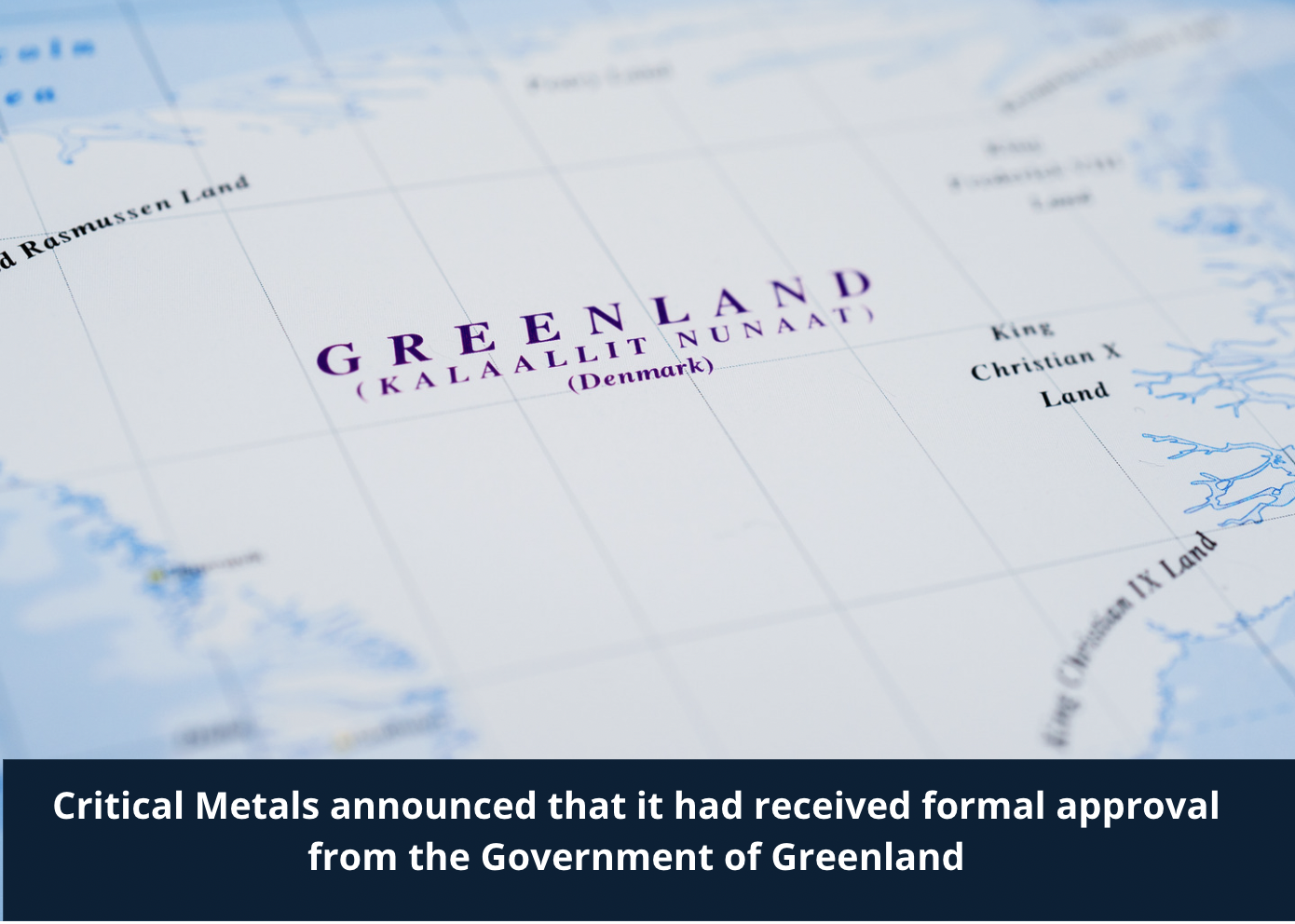
On May 5, 2026, Critical Metals announced that it had received formal approval from the Government of Greenland, through the ministry responsible for land and infrastructure, for its proposed acquisition of 70 percent of 60° North Greenland ApS. The approval allows Critical Metals to acquire a majority stake in the Greenland-based company and indirectly acquire title to the associated land and asset portfolio referenced in its application.
Critical Metals described 60° North as a Greenland-based provider of construction, logistics, drilling and project development services supporting mineral exploration and mining operations across the region. The company said the acquisition would enhance in-country operational capabilities, provide access to Arctic logistics and field services, and support the accelerated development of Tanbreez, its rare earth project in southern Greenland.
Why it matters
This matters because rare earth strategy depends on more than ownership of a deposit. In frontier jurisdictions, execution capacity can become as important as geology. Logistics, drilling services, local construction capacity, land access, field support and infrastructure proximity all shape whether a strategic project can move from asset control toward development.
The signal is especially relevant in Greenland. Arctic conditions raise the importance of local capacity, transport access, seasonal planning, community relationships and regulatory credibility. By strengthening its operational footprint around Tanbreez, Critical Metals is addressing a practical part of the rare earth development challenge.
Implications for capital and strategy
For capital, the signal is that rare earth projects should be evaluated through execution systems as well as resource size. Ownership consolidation matters, but so do logistics, permitting, infrastructure, technical work, local capacity and downstream access.
For strategy, the deeper message is that Western rare earth diversification will depend on the ability to build full operating platforms in difficult jurisdictions. Greenland’s role in critical minerals will be shaped not only by deposits, but by the institutions, infrastructure and companies able to make those deposits developable.
Signals to watch
- Whether the G7 critical minerals language begins to move from communiqué language into concrete plurilateral mechanisms, especially around price-gap support, joint procurement, traceability and price floors.
- Whether the Australia-Japan project pipeline begins to translate into final investment decisions, offtake agreements, processing capacity and downstream manufacturing resilience.
- Whether Project Vault becomes a repeatable model for strategic reserves and public-private critical minerals finance in the United States.
- Whether Electra’s cobalt sulfate refinery advances through construction and commissioning into reliable battery-grade production.
- Whether Argentina’s Mesa Federal Minera becomes a durable coordination mechanism across federal policy, provincial authority, permitting and capital execution.
- Whether Critical Metals’ Greenland strategy moves from asset consolidation into permitting, technical validation, logistics readiness and development execution around Tanbreez.
- Whether Grasberg’s recovery timeline becomes a more visible copper supply signal. FCX’s formal first-quarter release already shows that the Grasberg Block Cave ramp-up depends on modifications to ore-loading infrastructure, with production rates expected to move through a phased recovery path. Recent market reporting points to a possible extension of the full-capacity timeline into early 2028, so we will be watching for further official company updates from Freeport-McMoRan or PT Freeport Indonesia.
Three strategic questions for this week
- Which countries are turning critical minerals from policy priorities into operating systems?
- Which projects are becoming more investable because public finance, industrial demand and execution capacity are beginning to align?
- Where is the next phase of mineral security being shaped: in the mine, the refinery, the reserve, the trade instrument, or the logistics platform?
Resources
Signal 1
Signal 2
Signal 3
- EXIM — EXIM Announces Project Vault as Deal of the Year, Advancing U.S. Critical Minerals Security and Industrial Strength
- EXIM — EXIM Approves Project Vault Loan to Launch America’s Strategic Critical Minerals Reserve and Support Manufacturing Jobs
Signal 4
Signal 5
Signal 6
Signals to watch