
Geopolitical Mining · Weekly
Geopolitical Mining Weekly
Week of March 16-22, 2026
Authors: Marta Rivera | Eduardo Zamanillo
What this week really tells us
This week, seven developments showed that the critical minerals system is being built through sharper instruments and under rising narrative pressure. The United States and Japan published an action plan that explicitly contemplates border adjusted price floors or other measures, coordinated stockpiling, and priority support for selected projects. India opened a global tender to build 6,000 MTPA of integrated rare earth permanent magnet capacity with subsidies and limited assured NdPr supply. Lynas signed a U.S. rare earth supply arrangement with a NdPr floor price and then produced its first samarium oxide in Malaysia. Freeport filed a major environmental application in Chile for El Abra. Aclara inaugurated a separation pilot plant in Virginia and raised fresh capital. At the Vatican, church representatives and indigenous rights activists launched a mining divestment platform. And in Ghana, Parliament ratified the Ewoyaa mining lease, reopening the question of how producing countries balance value add ambitions with project economics and execution.
This week also arrived against a wider backdrop. A Climate Energy Finance report released this week said China has committed more than $120 billion since 2023 to overseas mining and upstream processing, reinforcing the scale at which Beijing is still operating while allied countries refine their own policy tools. That matters because many of this week’s Western and allied moves read as efforts to close capability gaps in magnets, separation, project finance, and market design. Ghana adds a different but equally important dimension: producing countries are also testing how far they can push domestic value addition without undermining the economics needed to get first projects built.
The common pattern is clear. Governments and companies are moving deeper into the mechanisms that shape real supply: price support, magnet-manufacturing incentives, offtake structures, pilot scale separation, large copper permitting, and financial structures that aim to turn strategic intent into industrial capability. At the same time, first-project approvals such as Ewoyaa show that the value add debate is also moving from aspiration into execution. The field is becoming more specific about how supply security will be delivered, and under what economic terms.
A second pattern matters just as much. Legitimacy risk is widening beyond permitting and community relations into finance and moral authority. The Vatican hosted launch of a mining divestment platform is important for that reason. It suggests that parts of the legitimacy debate are moving from critique into investment language. One implication, by inference, is that unless the industry draws a clearer distinction between formal mining and illegal or anomic mining, broad anti mining narratives can compress very different realities into a single moral category.
For boards and investors, the question is increasingly about placement: which assets, technologies, and jurisdictions are being pulled into the sharper lanes now forming around price support, trusted processing, magnet capacity, large scale copper continuity, more pragmatic value-add models, and socially contested narratives around mining itself.

For private decision support on project, jurisdiction or capital questions, Geopolitical Mining Advisory applies a Systemic Mining Viability lens to assess whether a mining opportunity can become credible, legitimate and financeable before full due diligence begins.
Signals of the week
Signal 1: The U.S. and Japan move from resilience language to market-shaping tools
a) What happened
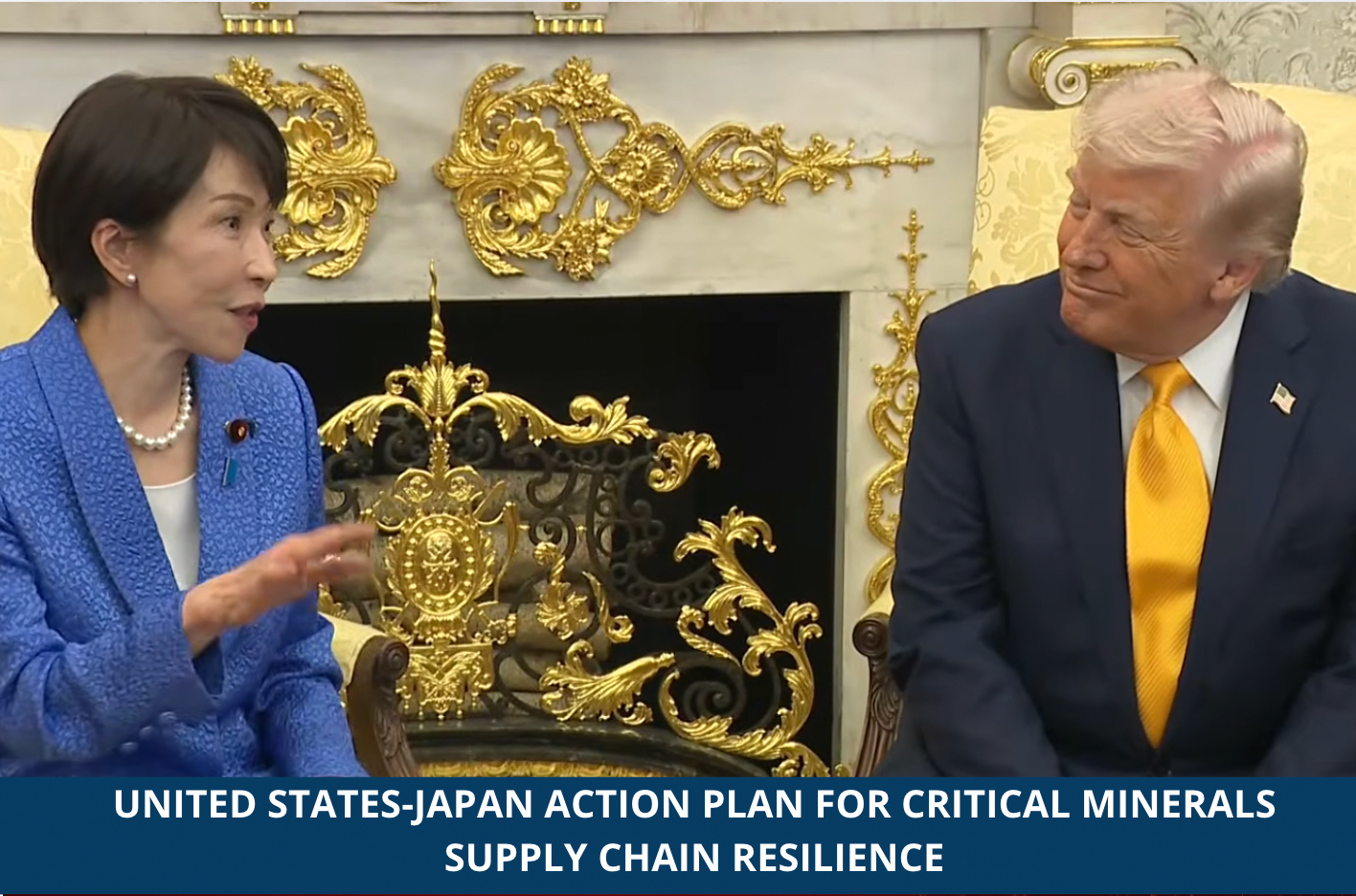
On March 19, the United States and Japan published the United States-Japan Action Plan for Critical Minerals Supply Chain Resilience. The document says both sides seek a plurilateral trade initiative in critical minerals supported by price floors or other measures. It also calls for coordinated trade policies, standards, technical and regulatory cooperation, investment promotion and screening, geological mapping coordination, coordinated rapid responses to disruption, research and development, coordinated stockpiling, and coordination on actions to address economic coercion. The plan also says the two governments will identify specific mining, processing, and manufacturing projects in the U.S., Japan, or third countries and prioritize financing and policy support for them.
b) Why it matters
This is one of the clearest signals so far that critical minerals policy is entering explicit market design. Price floors are not a symbolic phrase. They point to a willingness to intervene in the economics of trade and procurement when concentrated supply, non market behavior, or geopolitical coercion are seen as strategic risks. That has direct implications for financeability, project selection, and who sits inside future policy supported trade lanes.
c) Implications for capital and strategy
For investors and boards, this implies that future value may depend as much on policy alignment as on mineral endowment. Projects inside these lanes may gain stronger financing visibility and more resilient market access than comparable assets outside them.
Signal 2: India puts magnet manufacturing into procurement mode
a) What happened
On March 20, India’s Ministry of Heavy Industries invited bids through a global tender to establish integrated sintered NdFeB rare earth permanent magnet manufacturing facilities with total capacity of 6,000 MTPA. The scheme offers a capital subsidy of ₹750 crore (about US$80 million) and a sales-linked incentive of ₹6,450 crore (about US$691 million), with limited assured supply of NdPr oxide from IREL for the three lowest bidders. The government said the goal is to build a complete value chain from NdPr oxide to finished magnets in India and reduce import dependence in a sector that serves EVs, wind turbines, electronics, aerospace, and defence.
b) Why it matters
This is a significant signal because India is turning concern about rare earth dependence into an investable industrial mechanism. The magnet layer matters strategically. The contest is no longer only about mines or oxides. It is also about who can convert materials into magnets and retain more of the value chain domestically. India is now trying to build that capacity through procurement design, subsidy, and feedstock support.
c) Implications for capital and strategy
For boards and investors, this implies that India is becoming more relevant not only as a demand center, but as an emerging magnet-manufacturing node. That could affect partnership structures, offtake planning, and the positioning of upstream rare earth assets relative to future midstream demand.
Signal 3: Lynas makes non-China rare earth supply more concrete
a) What happened
Lynas released two important announcements this week. On March 16, it said Lynas USA LLC had signed a binding Letter of Intent with the U.S. Department of War to finalize a rare earth oxide supply agreement. The arrangement allocates about US$96 million to purchase light and heavy rare earth oxide products from Lynas and sets a floor price of US$110/kg for NdPr oxide over a four year period. Then on March 19, Lynas said it had achieved first production of samarium oxide at Lynas Malaysia, ahead of schedule, increasing its separated heavy rare earth product range to three products and reinforcing its position as the only commercial producer of separated heavy rare earth oxides outside China.
b) Why it matters
These two announcements show how non China rare earth strategy is becoming more tangible. One part is commercial architecture: state backed offtake and floor price support. The other is physical capability: separated product coming out of a non China processing hub. Together they show that resilience in rare earths is being built through a sequence of processing milestones and policy backed contracts, not through one large breakthrough.
c) Implications for capital and strategy
For investors and boards, this implies that rare earth pricing structures, offtake design, and separated product capability are becoming central valuation variables. In this segment, policy support and actual separation capacity increasingly move together.
Signal 4: Freeport brings copper, water, and long duration supply back to the center
a) What happened
Freeport filed an Environmental Impact Assessment application with Chile’s SEIA for the future of El Abra. According to the filing description reported by International Mining, the US$7.5 billion project combines continuity of existing operations with a new copper sulphide concentrator and a transition toward desalinated water. The project is designed to extend operations by an additional 40 years and includes a concentrator with ore processing capacity of 300,000 tonnes per day, a thickened tailings deposit, pit expansion, and associated water infrastructure. Reuters also reported the expansion could raise annual copper output substantially from current levels.
b) Why it matters
This is a strong real supply signal because it brings copper, permitting, and water transition into one frame. Copper remains central to electrification and grid buildout, but major copper continuity increasingly depends on desalination, long cycle environmental review, and infrastructure heavy project design. El Abra is therefore more than a mine life extension. It is an example of how future copper supply is being rebuilt through capital intensity, water transition, and institutional endurance. It also arrived in a week when BHP submitted the New Escondida Concentrator to Chile’s environmental system, reinforcing that large scale copper continuity in Chile is moving through multiple long cycle permitting tracks at once, even if the Escondida filing is framed more around sustaining approved capacity than around a water transition story.
c) Implications for capital and strategy
For investors and boards, this implies that copper growth options in Chile should be evaluated through water infrastructure, permitting durability, and execution timelines as much as through grade or scale. In long life assets, these factors increasingly determine whether supply actually reaches market.
Signal 5: Aclara links pilot scale separation to fresh capital
a) What happened
On March 19, Aclara’s site listed two same day announcements: inauguration of a rare earth separation pilot plant at Virginia Tech to advance U.S. supply of heavy rare earths, and a non brokered private placement of US$50 million. The financing announcement says proceeds will support continued development of the Carina Project in Brazil, Aclara’s integrated supply chain strategy, and development of its heavy rare earth facility in Louisiana, along with related initiatives. Aclara also describes itself as building a vertically integrated heavy rare earth supply chain with ionic clay deposits in Brazil and Chile and a dedicated separation facility in the United States.
b) Why it matters
This matters because it is not a single asset story. It is a supply chain design story. Aclara is linking South American feedstock, U.S. separation, and fresh capital in one sequence. Pilot plants do not guarantee commercial success, but they do represent the stage where supply chain strategy starts turning into process validation, engineering knowledge, and financing requirements. That is especially important in heavy rare earths, where separated product capacity remains scarce outside China.
c) Implications for capital and strategy
For boards and investors, this implies that pilot stage separation capability and secure feed alignment may become major sources of strategic value well before full scale production. In heavy rare earths, technical progress at this stage can be more informative than headline resource size alone.
Signal 6: The Vatican launch turns mining legitimacy into a finance question
a) What happened
On March 20, the Holy See Press Office hosted a press conference for the launch of a Mining Divestment Platform. The speakers included Cardinal Fabio Baggio, Cardinal Álvaro Ramazzini, Bishop Vicente Ferreira, indigenous leader Yolanda Flores, and other faith based representatives. Vatican News reported that church representatives and indigenous rights activists launched a global platform for divestment from mining activities affecting local communities in Latin America. The Iglesias y Minería network’s own campaign language says it proposes divestment from mining and aims to stop financing what it describes as socio-environmental crimes and an extractivist economic model.
b) Why it matters
This is a legitimacy signal, not an immediate supply signal, and that is precisely why it matters. It shows that parts of the social debate around mining are moving into financial language and moral authority, not remaining only in the domain of protest or local opposition. That can influence institutional investors, faith based portfolios, and broader public narratives about the industry. The platform’s framing is broad, which makes the distinction between formal mining and illegal or anomic mining more important, not less, for any industry response. This last point is an inference from the platform’s language and its likely narrative effects.
c) Implications for capital and strategy
For boards and investors, this implies that social legitimacy should be monitored not only through permitting and community engagement, but also through how mining is described in the moral and financial arenas. Narrative compression can become a strategic risk when it affects capital allocation and reputational tolerance.
Signal 7: Ghana ratifies its first lithium mine and quietly reopens the value add question
a) What happened
On March 20, Ghana’s Parliament ratified the mining lease for Atlantic Lithium’s Ewoyaa project, formally approving what the company describes as Ghana’s first lithium mine and processing plant. Atlantic Lithium said the ratification enables funding discussions and movement toward a final investment decision. The ratified lease includes revised fiscal terms aligned with current Ghanaian law, including a sliding royalty for lithium projects ranging from 5% to 12% depending on spodumene prices.
b) Why it matters
This matters because Ghana has tried to position lithium within a broader Green Minerals and value add framework, including restrictions on raw lithium exports. But independent analysis has also warned that a domestic refining strategy would face limited feedstock and high costs at current scale. Ewoyaa therefore matters not only as a project approval, but as a sign that Ghana may be moving toward a more flexible model: secure the first mine, preserve local upside, and allow a staged path toward processing rather than forcing refinery economics too early.
c) Implications for capital and strategy
For investors and boards, this implies that African critical mineral strategies should be read less as fixed ideological positions and more as evolving attempts to balance value addition, bankability, and geopolitical alignment. In Ghana’s case, the investable signal is that the state appears willing to move from aspiration to execution.
Signals to watch
- Whether the U.S.-Japan action plan produces mineral by mineral priorities, draft plurilateral language, or actual pilot use of price floors and coordinated stockpiling.
- Whether India’s tender attracts credible industrial bidders and whether IREL’s limited assured NdPr supply becomes an effective bridge to real magnet capacity.
- Whether Lynas converts its Letter of Intent into a definitive agreement and expands further separated heavy rare earth output beyond samarium, dysprosium, and terbium.
- Whether El Abra’s EIA moves smoothly through Chile’s review process and how the water transition and infrastructure components shape timing and cost.
- Whether Aclara’s pilot plant and financing materially advance a commercially viable U.S. linked heavy rare earth separation route across Brazil, Chile, and the United States.
- Whether the Vatican linked divestment platform remains symbolic or begins influencing real investment mandates, especially in ways that blur or sharpen the distinction between formal and illegal mining.
- Whether Ghana’s first lithium mine moves quickly from ratification to financing and production, and how Ewoyaa’s development shapes the balance between Ghana’s value-add ambitions and its U.S.-linked route to market.
Three strategic questions for this week
- As price floors, offtake support, and magnet incentives become more explicit, are we still analyzing critical minerals as a geology story, or as a market shaping and industrial policy story?
- In rare earths, are we giving enough weight to separated product capability, pilot scale validation, and policy backed commercial structures, rather than focusing mainly on upstream resource size?
- As legitimacy pressures begin to move into investment language, are we clearly distinguishing formal mining from illegal or anomic mining in the way we explain, defend, and finance the sector?

For the full Geopolitical Mining framework behind this article, see our book Mining Is Dead. Long Live Geopolitical Mining.
Sources for this week’s note
-
United States Trade Representative / Government of Japan, United States-Japan Action Plan for Critical Minerals Supply Chain Resilience, March 19, 2026.
https://www.mof.go.jp/policy/international_policy/convention/dialogue/U.S.-Japan-Critical-Minerals-Action-Plan3.19.2026.pdf -
Government of India, Ministry of Heavy Industries, March 20, 2026.
https://www.pib.gov.in/PressReleasePage.aspx?PRID=2242811&lang=2®=3 -
Lynas Rare Earths, Lynas and US DoW sign Letter of Intent for Rare Earth Supply, March 16, 2026.
https://company-announcements.afr.com/asx/lyc/64222f2a-20b9-11f1-bf56-6ed41f3358b5.pdf -
Lynas Rare Earths, Lynas Malaysia Produces First Samarium Oxide, March 19, 2026.
https://company-announcements.afr.com/asx/lyc/0acb5067-2315-11f1-a634-868c961b0f77.pdf -
International Mining, Freeport files EIA for continuity of El Abra operations plus switch to desal water supply, March 20, 2026.
https://im-mining.com/2026/03/20/freeport-files-eia-for-continuity-of-el-abra-operations-plus-switch-to-desal-water-supply/ -
Aclara Resources, Aclara News, including the March 19, 2026 announcements on the Virginia Tech rare earth separation pilot plant and the US$50 million private placement.
https://www.aclara-re.com/news -
Holy See Press Office, Notice of Press Conference – Mining Divestment Platform launch, March 19, 2026.
https://press.vatican.va/content/salastampa/en/bollettino/pubblico/2026/03/19/260319b.html -
Vatican News, Indigenous peoples and Church launch mining divestment platform, March 20, 2026.
https://www.vaticannews.va/en/vatican-city/news/2026-03/iglesias-y-mineraria-platform-mining-divestment-launch-platform.html -
Iglesias y Minería, Plataforma de Desinversión, March 2026.
https://iglesiasymineria.org/2026/03/18/hoy-inicia-encuentro-internacional-de-la-plataforma-por-la-desinversion-en-mineria/ -
Climate Energy Finance, Raw Power: China FDI into Critical Minerals and Metals, March 18, 2026.
https://climateenergyfinance.org/wp-content/uploads/2026/03/CEF_Raw-Power-China-FDI-into-Critical-Minerals-and-Metals_18Mar2026.pdf -
Atlantic Lithium Limited, Parliamentary Ratification of Ewoyaa Mining Lease, March 20, 2026.
https://www.investegate.co.uk/announcement/rns/atlantic-lithium-limited-npv-di—all/parliamentary-ratification-of-ewoyaa-mining-lease/9483510