
Geopolitical Mining · Weekly
Geopolitical Mining Weekly
Week of April 20–26, 2026
Authors: Marta Rivera | Eduardo Zamanillo
April 26, 2026
What this week really tells us
This week gave clearer form to the instruments now shaping critical minerals strategy. The most relevant signals came from the parts of the system where delay, uncertainty, and concentration usually accumulate: trade design, permitting speed, industrial policy, planning authority, corridor finance, and input security. The United States and the European Union moved critical minerals coordination into a more operational phase through a formal Action Plan on supply chain resilience. Chile paired a new critical minerals agreement with the United States with a stronger push on permitting speed. Brazil kept giving strategic minerals a more defined place inside its industrial agenda through processing, value addition, and selective state support.
A second theme came from execution capacity. Norway brought the planning process for the Fen rare earth project under national authority, giving planning itself a more visible place inside Europe’s rare earth strategy. At the same time, the Lobito system gained more financial weight through new commitments from AFC, the African Development Bank, and Italy, alongside a clearer view of the offtake needed to support the railway’s commercial logic. These are important signals because they show how strategic minerals increasingly depend on the institutions and infrastructure that turn resource potential into usable supply.
A third theme came from the wider industrial system. The war in Iran is widening mining’s exposure to diesel, sulfur, and sulfuric acid, while China’s sulfuric acid restrictions add further pressure to already sensitive copper and nickel chains. That gives greater visibility to a part of the sector that often stays below the surface: energy, chemicals, freight, and inventory discipline are becoming more central to how continuity, cost, and resilience are managed.
What gives the week coherence is the growing precision of the tools now in play. Trade instruments, permitting reform, value add policy, state planning, corridor finance, and input resilience are all becoming part of the same strategic field. Taken together, these developments suggest that the next phase of critical minerals competition will be shaped as much by system-building capacity as by geology itself.

For the full Geopolitical Mining framework behind this note, see our book Mining Is Dead. Long Live Geopolitical Mining.
Signals of the week
Signal 1: The United States and the European Union move from coordination into trade instruments
What happened
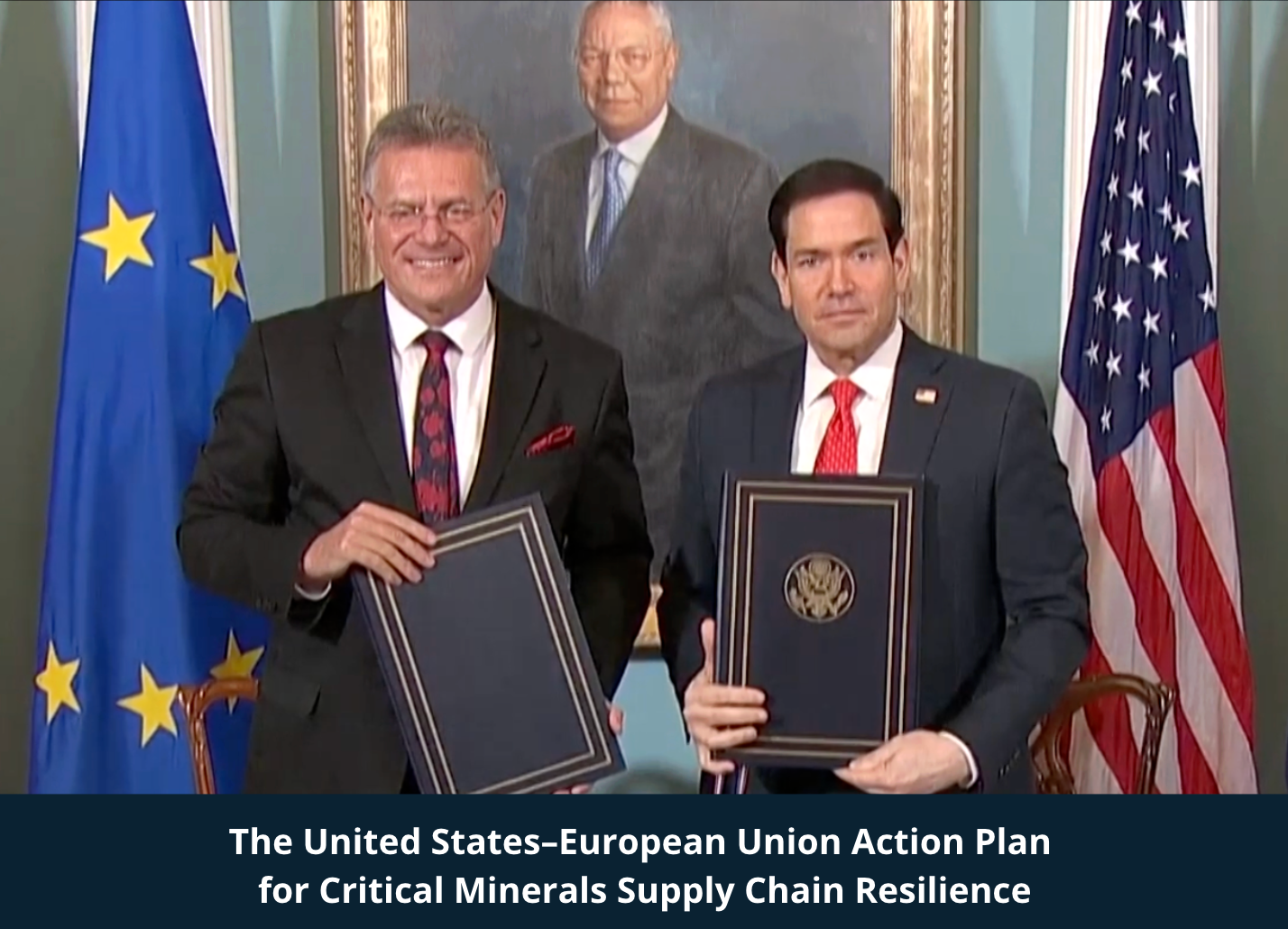
On April 24, USTR announced the United States–European Union Action Plan for Critical Minerals Supply Chain Resilience. In the USTR release, the Action Plan is described as the primary U.S.-EU mechanism to coordinate trade policies and measures on critical minerals supply chains, with a view to concluding a binding plurilateral agreement on trade in critical minerals. The text of the Action Plan gives that ambition a clear operational frame. It says the participants intend to discuss coordinated trade policies and mechanisms based on reference prices, including border adjusted price floors, standards based markets, price gap subsidies, and offtake agreements, initially focused on mutually agreed select critical minerals and associated supply chains. It also sets out a wider field of cooperation covering standards, technical and regulatory coordination, investment promotion and screening, rapid responses to disruptions, research and development, and stockpiling.
What makes the announcement especially notable is its level of specificity. Bloomberg reported that the agreement includes collaboration on price floors, subsidies, and other trade measures to strengthen a critical minerals market among participating nations. That gives the Action Plan a more practical and commercially legible shape than many earlier coordination efforts.
Why it matters
This matters because the transatlantic critical minerals agenda is gaining a stronger market architecture. The Action Plan places trade design much closer to the center of the conversation. Reference prices, coordinated support measures, standards, offtakes, and stockpiling all speak directly to the conditions under which supply chains become more resilient, more financeable, and more attractive for long term investment. In that sense, the significance of this week’s move lies in the fact that the United States and the European Union are giving strategic minerals coordination a more commercial language and a more usable policy form.
Its importance also lies in the scale of what it could enable. The Action Plan explicitly frames itself as a step toward a plurilateral trade initiative with like minded partners. That expands the horizon from bilateral coordination into the possibility of a wider trusted framework around selected minerals and associated supply chains. The result is a more structured pathway for market oriented economies that want to reinforce supply resilience through aligned rules, coordinated support, and stronger trade cooperation.
Implications for capital and strategy
For capital, this opens a more defined conversation around how non China supply can be supported and scaled. Price floors, price gap support, offtake structures, and standards based markets all have direct relevance for project bankability, demand visibility, and strategic positioning. Projects that fit these emerging mechanisms may increasingly be read inside a clearer industrial perimeter, especially where trusted supply, downstream integration, and policy alignment are becoming more valuable.
For strategy, the deeper signal is that critical minerals policy in the United States and Europe is moving further into the design of markets themselves. That is a meaningful evolution. It suggests that future competitiveness will depend not only on resource access, but also on the institutional tools that help organize pricing, standards, investment, and supply continuity across allied systems. This week gave that direction sharper form.
Signal 2: Chile is giving strategic form to speed, investment, and external alignment
What happened
On April 21, Chile signed a new Memorandum of Understanding with the United States on critical minerals. Chile’s foreign trade undersecretariat said the agreement is designed to promote investment, exchange experience, and develop capabilities across the value chain, from exploration to processing. The same official statement framed the move as part of Chile’s broader effort to strengthen its international position in critical minerals while opening new opportunities for growth and investment.
That diplomatic step arrived alongside a more operational domestic agenda on permitting. Chile’s Ministry of Economy has been advancing the implementation of the Ley Marco de Autorizaciones Sectoriales, a reform designed to reduce waiting times for investment initiatives by between 30% and 70%, and by 50% for projects classified as strategic. The ministry also highlights tools such as parallel processing of authorizations, a digital one-stop window, and a specialized technical institutional framework. In January, it reported that the SUPER platform had surpassed 250 procedures and was already concentrating permits for key sectors including mining, energy, and infrastructure.
Mining.com added a market facing layer to that picture this week. On April 20, it reported that Chile is moving to accelerate mining permit approvals to unlock more than $100 billion in investment, simplify roughly 200 procedures, and revive momentum in a project pipeline that has recently seen more than $17 billion enter environmental review, including El Abra, Escondida, and Albemarle’s Transition to Direct Lithium Extraction Project (TED project).
Why it matters
This matters because Chile is bringing together three elements that increasingly define mineral competitiveness: external positioning, regulatory speed, and investment readiness. The MoU with the United States strengthens Chile’s place in the emerging diplomatic architecture around critical minerals. The permitting reform agenda strengthens the domestic conditions that allow that positioning to translate into projects, capital, and timelines. Together, they give Chile a more legible strategic profile.
Its significance also lies in the kind of signal it sends to the market. A country with Chile’s copper and lithium relevance gains additional weight when it can present a clearer path on authorizations, stronger institutional coordination, and an outward facing minerals diplomacy at the same time. That combination supports confidence because it links resource scale with a more structured delivery environment.
Implications for capital and strategy
For capital, the value of this signal sits in the possibility of a more investable operating environment. Faster sectoral authorizations, clearer institutional pathways, and stronger external cooperation can improve project visibility and strengthen confidence around pipeline conversion. In practical terms, Chile is working to make time itself a more supportive variable for investment.
For strategy, the deeper message is that Chile is defining a model in which mineral weight is reinforced by regulatory modernization and international alignment. That is a meaningful combination in a period when critical minerals are being assessed through both industrial relevance and delivery capacity. This week gave that direction sharper form.
Signal 3: Brazil is shaping a value-add path with selective state support
What happened
At Hannover Messe on April 21, Brazil’s Ministry of Development, Industry, Trade and Services placed critical minerals inside a broader industrial and sustainability agenda through Nova Indústria Brasil. In the session on the Brazil–European Union strategic partnership in critical minerals and sustainable development, Secretary Uallace Moreira emphasized international partnerships and said Brazil wants to add productive value to its mineral base by strengthening domestic industry and generating jobs and income. The same official note presented this agenda as part of a wider industrial strategy linked to decarbonization, innovation, and productive capacity.
Brazil’s 2026 Investor Guide on Critical Minerals gives that direction more institutional depth. The guide says the National Policy on Critical and Strategic Minerals (PNMCE) is under construction and is intended to reduce information asymmetries and exploration risks, strengthen mineral production and processing on national territory, promote value addition and industrial densification, reduce external vulnerability, and position Brazil more effectively in global value chains. It also states that Brazil seeks investment in both exploration and mineral processing projects, alongside international partnerships, financing support from official banks and development agencies, and research and innovation aimed at mining and mineral processing. The same guide highlights tax advantaged debentures for strategic mineral processing projects linked to the energy transition.
Mining.com added an important market signal this week. According to the report, Brazil’s government sees strong global demand as sufficient to attract investment, while tools such as Eco Invest would be used selectively to support projects. The same article says officials see no need for a state run critical minerals company and remain focused on attracting private investment and expanding refining capacity.
Why it matters
This matters because Brazil is giving critical minerals a more legible industrial logic. The signal this week was not only that the country wants more value from its mineral base. It was that Brazil is beginning to connect mineral endowment, domestic processing, industrial policy, development finance, and international partnerships within a more coherent strategic frame. That gives the country a clearer profile in a field where policy direction often remains diffuse.
Its significance also lies in the way value addition is being framed. In Brazil’s case, value creation is being attached to production, processing, industrial densification, infrastructure, financing tools, and downstream capability. That gives the agenda more substance. It moves the conversation closer to implementation and helps position critical minerals inside a wider national development strategy.
Implications for capital and strategy
For capital, this model becomes more attractive as its instruments become clearer. Brazil is signaling openness to private investment across exploration and processing, while also pointing to targeted public tools, official-bank support, and financing mechanisms for selected downstream activities. That combination can improve how investors read project pipelines, processing opportunities, and the country’s longer term industrial direction.
For strategy, the deeper signal is that Brazil is shaping a minerals policy that connects resource scale with industrial depth. Processing, partnerships, selective state support, and value add ambition are starting to sit inside the same framework. If that framework keeps gaining clarity, Brazil could emerge as one of the more defined Latin American models for linking critical minerals to industrial development.
Signal 4: Norway is bringing state planning into Europe’s rare earth strategy
What happened
On April 22, Norway’s government decided that the planning process for Fensfeltet (Fen Complex) will proceed as a state regulatory plan, with the Ministry of Local Government and Regional Development acting as the planning authority. The decision followed a request from the municipality of Nome, which said the project raises significant land use questions and broader national considerations. Bloomberg reported that Nome asked the state to assume the planning process because of the scale of potential land use conflict and the need to weigh local and national interests more directly.
The Norwegian government’s own statement adds important institutional detail. Under a state regulatory plan, the ministry takes over the municipality’s role as planning authority and carries the process through to the final zoning decision. At the same time, the ordinary requirements for public participation, consultation, and public review of the planning program and zoning proposal remain in place. The same statement describes Fensfeltet as Europe’s largest documented occurrence of rare earth elements and links the project to Norway’s and Europe’s supply security and competitiveness.
On the project side, Rare Earths Norway announced in March that the updated JORC-compliant resource estimate for the Fen Carbonatite Complex increased total rare earth oxide content in indicated and inferred resources from 8.8 million tonnes in 2024 to 15.9 million tonnes in 2026, while also introducing an Indicated resource category for the first time. The company said the revised estimate confirms Fen as by far Europe’s largest deposit of rare earth elements and highlighted the strategic importance of neodymium and praseodymium for magnets and wider industrial applications.
Why it matters
This matters because it gives planning authority a more visible place inside rare earth strategy. Europe’s minerals debate often centers on resource dependence, refining concentration, and the need for new projects. Fen adds another layer to that conversation: the institutional level at which a strategic project is planned and coordinated. Norway’s move gives that layer much sharper form.
Its significance also lies in what the state is choosing to carry. The government explicitly links Fensfeltet to supply security, competitiveness, strategic value chains, and the importance of neodymium and praseodymium for strong magnets. That gives the project a wider national and European frame. In that setting, planning becomes more than a local administrative stage. It becomes part of the state’s capacity to organize a strategic mineral asset.
A second point gives the signal even more weight. Rare Earths Norway’s upgraded resource estimate moves Fen into a different category of relevance. A project of that size, with a first indicated resource category and stronger geological confidence, naturally attracts a wider policy horizon. The planning decision therefore reflects both the scale of the deposit and the growing strategic importance attached to it.
Implications for capital and strategy
For capital, this raises the profile of Fen as a project with stronger national visibility and a more structured planning track. The state’s direct role can give investors and strategic partners a clearer read on how Norway intends to carry a project that sits at the intersection of land use, industrial policy, and European raw materials strategy. The official framework also clarifies that planning, consultation, and the broader permitting sequence are being handled within a more defined institutional setting.
For strategy, the deeper message is that some European governments are becoming more willing to treat rare earth development as a matter of state capacity as much as private project execution. That is an important evolution. It suggests that where a deposit is seen as materially relevant to supply security and industrial competitiveness, planning itself can move upward into the state. Fen may therefore carry relevance well beyond Norway as Europe continues to think more concretely about how strategic deposits move from geology into production.
Signal 5: Corridor finance is giving the Lobito system more operational weight
What happened
On April 24, Bloomberg reported, and Mining.com carried, that the Africa Finance Corporation and the African Development Bank each committed $500 million to the railway that will link Zambia’s copper belt to global markets through the port of Lobito in Angola. Italy is expected to add $320 million. The new 830 kilometer rail line could cost as much as $5 billion, with construction expected to begin this year, completion targeted for 2030, and financial close expected in the fourth quarter of 2027. AFC Executive Director Sameh Shenouda also said the project needs 2.5 million to 3 million tons of offtake to be viable, already has commitments for about 1 million tons, and sees a pathway toward 5 million tons.
This announcement builds on a longer institutional effort around the corridor. AFC’s own statements show that the corporation was appointed lead developer under the 2023 memorandum involving the United States, the European Union, the African Development Bank, and the governments of Angola, the Democratic Republic of the Congo, and Zambia. AFC has also described the broader Lobito rail system as an open-access corridor with the potential to shorten export timelines from 45 days to 7 days, materially improving access from inland mineral districts to the Atlantic.
Why it matters
This matters because corridors gain strategic force when they acquire financing structure, sponsor depth, and a visible path to throughput. Lobito is increasingly being expressed in exactly those terms. Capital commitments, offtake thresholds, expected time savings, and a phased financing pathway are giving the corridor a stronger operational shape. That moves it closer to the category of mineral architecture: infrastructure that directly conditions how copper and cobalt reach markets, how project economics are read, and how regional supply chains are organized.
Its significance also lies in the kind of system it is helping build. AFC describes the Zambia-Lobito rail line as part of a connected route from Zambia into the Benguela line in Angola and onward to the port of Lobito. That gives the corridor a wider role than transport alone. It becomes part of a larger platform for exports, trade integration, and industrial logistics across mineral-rich territory. In that setting, rail, port access, freight commitments, and institutional coordination all become part of the same strategic field.
Implications for capital and strategy
For capital, this signal strengthens the case for reading mineral infrastructure as part of the resource system itself. A corridor with clearer financing support, stronger developer backing, and visible offtake logic gives investors a more grounded basis for evaluating upstream assets that depend on it. It also supports a wider reading of bankability, one that includes logistics efficiency, export timing, and corridor reliability alongside geology and mine economics.
For strategy, the deeper message is that the next phase of mineral competition is being shaped through system building projects. Lobito continues to show that copper and cobalt geoeconomics depend on rail, ports, throughput, and coordinated institutions as much as on ore bodies. This week gave that reality more financial substance.
Signal 6: The war in Iran is widening mining’s exposure to fuel and chemical inputs
What happened
This week, the war in Iran gave sharper visibility to a part of the mining system that usually stays in the background: fuel and industrial chemistry. Mining.com, citing Bloomberg, reported that the strongest effects are now moving through diesel and sulfur. The article says the Middle East accounts for about half of the world’s seaborne sulfur and at least 10% of shipped diesel, while sulfuric acid remains a vital input for SX-EW, a processing route that accounts for 17% of copper supply. It also reported that local sulfur prices have climbed to around $1,200 a ton, roughly double pre-war levels, and that China’s planned halt to sulfuric acid exports from May could remove about 1.5 million tons from the seaborne acid market through December.
The exposure is already becoming more geographically specific. Mining.com reported that Congo is especially sensitive because most of its sulfur comes from the Middle East and its copper and cobalt output relies heavily on SX-EW. S&P Global adds that China exported 4.6 million metric tons of sulfuric acid and related products in 2025, making it the world’s largest exporter, and that import dependence is meaningful in key producing countries: Chile sourced 37.1% of its foreign sulfuric acid supplies from China in 2025, while Indonesia sourced 61.6%. S&P also notes that more than three-quarters of Indonesia’s sulfur imports come from China.
Why it matters
This matters because it gives industrial inputs a more visible place inside mining strategy. Sulfur, sulfuric acid, diesel, freight routes, and inventory cover are all becoming more central to how copper and nickel systems operate. S&P Global described sulfuric acid as a “binding constraint” across both agriculture and metals processing, while Mining.com’s reporting makes clear that disruptions in the Gulf are now feeding directly into mineral processing economics. That gives the current squeeze a wider significance than a short term cost move.
Its significance also lies in timing and industrial sensitivity. S&P says Chile appears supplied for now, while the tighter point may come in the second half of the year, especially where contract coverage is thinner and spot exposure is higher. In nickel, the pressure can move faster. S&P notes that constraints on sulfur supply, a critical component in HPAL operations, could tighten battery grade nickel availability, and that higher sulfuric acid prices could curb marginal output. This gives the signal real industrial weight across both copper and nickel.
Implications for capital and strategy
For capital, this raises the strategic value of variables that often sit outside the headline project narrative: reagent security, diesel exposure, contract structure, inventory planning, and sourcing geography. Operations built around SX-EW copper or acid-intensive nickel processing now read more clearly through those lenses. In practical terms, resilience is becoming more dependent on how well companies manage industrial inputs as part of the operating model.
For strategy, the deeper message is that mining is being shaped through wider industrial systems. Energy flows, sulfur markets, acid exports, shipping routes, and processing technologies are all interacting more tightly. This week gave that architecture sharper visibility. The war in Iran has widened the field through which mining risk and mining continuity are now being understood.
Signals to watch
- Whether the U.S.-EU Action Plan starts turning trade coordination into a clearer commercial framework for selected minerals. The key issue now is implementation: which minerals are prioritized first, how reference price mechanisms are shaped, and whether the plurilateral track begins to acquire institutional and market depth.
- Whether Chile’s push on permits begins to show visible effects in project timing and investment confidence. Chile has already paired its critical minerals cooperation with the United States with a more explicit agenda on permitting speed and strategic project processing. The next signal will come from execution.
- Whether Brazil gives more operational clarity to its value add agenda. The direction is becoming clearer: processing, industrial densification, partnerships, and selective financial tools. The next phase will matter because it will show how that model translates into instruments, projects, and investment pathways.
- Whether Norway’s central role in Fen becomes a wider template for strategic deposits in Europe. Fen now has stronger national visibility, a larger resource estimate, and a state led planning track. That combination could carry broader relevance for how Europe handles other rare earth and critical mineral projects.
- Whether Lobito secures the throughput and financing momentum needed to reinforce its development path. Fresh capital commitments have given the corridor more operational shape. The next step is whether offtake, delivery milestones, and execution discipline continue to strengthen the project’s financial logic.
- Whether fuel and chemical pressure begins to show up more visibly in copper and nickel operations. Sulfur, sulfuric acid, and diesel have moved closer to the center of mining continuity. The next signal will come from how strongly those pressures affect cost, output, and inventory strategy across exposed systems.
Three strategic questions for this week
- Which jurisdictions are building the strongest delivery architecture around critical minerals?
- Which projects are becoming more investable because the system around them is getting stronger?
- How should mining strategy account more explicitly for energy, sulfur, diesel, and corridor dependence?
Resources
Signal 1
- USTR — Ambassador Jamieson Greer Announces United States-European Union Action Plan for Critical Minerals Supply Chain Resilience
- USTR — United States-European Union Action Plan for Critical Minerals Supply Chain Resilience (PDF)
Signal 2
- Subsecretaría de Relaciones Económicas Internacionales de Chile — Gobierno de Chile firma acuerdos con Estados Unidos para fortalecer cooperación en minerales críticos y seguridad
- Ministerio de Economía de Chile — Ley Marco de Permisos Sectoriales: Consulta pública abre paso al nuevo Reglamento de Tramitación Ágil para Iniciativas de Inversión Estratégica
- MINING.COM — Chile targets faster permits to unlock $100B pipeline
Signal 3
- MDIC Brazil — MDIC destaca NIB, descarbonização e minerais críticos na Hannover Messe
- Ministry of Mines and Energy of Brazil — Brazil’s Critical Minerals: A Guide for Foreign Investors 2026 (PDF)
- MINING.COM — Brazil rejects ‘TerraBras’ as US minerals deal stalls
Signal 4
- Government of Norway — Statlig reguleringsplan for Fensfeltet
- Rare Earths Norway — Updated Mineral Resource Estimate: Near Doubling of Europe’s Largest Documented Deposit of Rare Earth Elements
Signal 5
- MINING.COM — Funders commit $1.3 billion to Zambia critical minerals rail
- Africa Finance Corporation — Africa Finance Corporation to Lead U.S.-backed Development of the Lobito Corridor and Zambia-Lobito Rail Line
Signal 6