
Geopolitical Mining Weekly
Week of 22–28 December 2025
Authors: Marta Rivera | Eduardo Zamanillo
Independent weekly note for investors and strategic decision makers in critical minerals and mining.
What this week really tells us
This week, four moves stood out in the critical minerals and metals space:
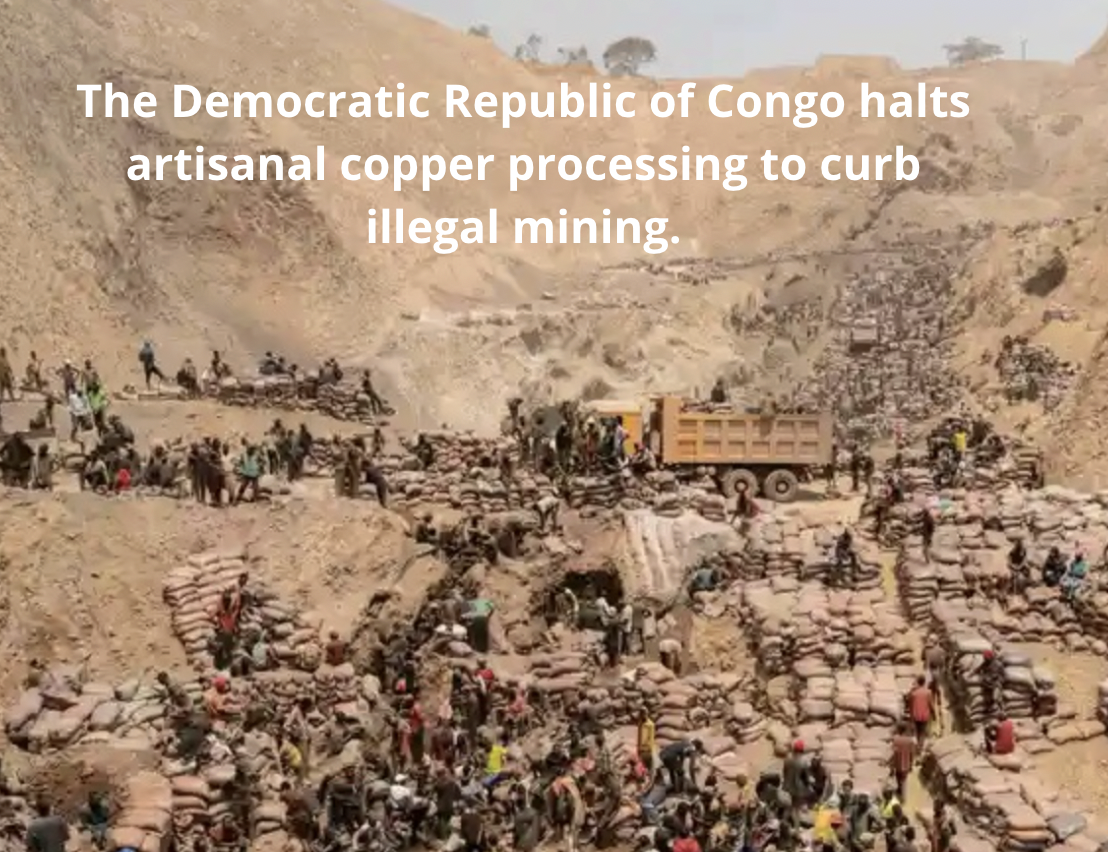
- The Democratic Republic of Congo (DRC) ordered a suspension of artisanal copper and cobalt processing, tying any restart to legality and traceability standards.
- China launched a nationwide mine-safety and illegal-mining inspection campaign, identifying tens of thousands of abandoned shafts and hundreds of illegal-mining cases.
- Chile finalised a state-led lithium joint venture between Codelco and SQM in the Atacama salar, giving the state a decisive role over one of the world’s richest lithium resources until 2060.
- Copper prices ended the year at or near record levels across major exchanges, after a year of mine underperformance, disruptions and policy noise.
The common pattern is clear:
States are tightening control over who is allowed to mine, process and export critical minerals, just as markets are absorbing the reality that bringing new supply online is slower, riskier and more institutionally constrained than expected.
For investors and boards, the key questions are shifting from “where are the resources?” to:
• who defines and enforces the rules of access,
• who controls the strategic vehicles around key deposits, and
• how quickly tight physical markets translate into credible, long-term investment and regulatory responses.
Signals of the week
Signal 1 – DRC suspends artisanal copper and cobalt processing
What happened (facts)
The DRC government has ordered all entities that process and market artisanal copper and cobalt to suspend operations until they can demonstrate that their feedstock comes from legal sources and meets traceability requirements. A commission is being set up to review evidence and authorise restarts. The move is presented as part of a broader push to address illegal mining, tax leakage and governance risks in the sector. Artisanal activity supports many livelihoods and contributes a portion of cobalt output, but has often moved through channels with limited oversight.
Why it matters (analysis)
The decree clarifies regulatory expectations around artisanal-linked material and raises the compliance bar for processors and traders. In the near term, it may reduce the volume of artisanal material that can flow into formal supply chains or increase the cost of making it compliant. Over time, the impact will depend on two practical questions:
- whether industrial, fully traceable operations can expand fast enough to compensate for tighter controls on artisanal processing, and
- whether artisanal miners are offered viable ways to participate in formal systems, or activity instead shifts into less visible or less regulated channels.
Those questions go directly to the balance between ESG credibility, social stability and real-world cobalt and copper supply.
Implications for capital and strategy
- Portfolio exposure to the DRC needs to distinguish clearly between industrial operations with auditable traceability and exposure that depends on artisanal or semi-formal circuits now under scrutiny.
- Pricing, offtake and ESG narratives should be explicit about which part of the DRC supply chain they refer to; treating all cobalt from the country as homogeneous obscures very different risk profiles.
- Engagement with counterparties and authorities should consider not only compliance rules but also the enabling conditions for formal projects to proceed, to reduce the risk that supply gaps are filled in uncontrolled ways.
Signal 2 – China steps up inspections to crack down on illegal mining
What happened (facts)
China’s State Council Work Safety Committee Office has deployed inspection teams in two batches to 12 regions to carry out mine-safety checks focused on abandoned shafts and illegal mining. Officials report that 96,666 abandoned mine shafts have been identified nationwide, with more than 92% sealed so far. Since the start of the rectification campaign, 568 cases of illegal mining have been investigated, leading to administrative penalties, transfers to judicial authorities and several hundred criminal sentences.
Why it matters (analysis)
The campaign aims to reduce accidents, address legacy environmental risks and tighten enforcement against unlicensed extraction. It also signals a more active central role in determining which operators remain part of the system and under what conditions. For markets, the key uncertainties are:
- how far this campaign extends into commodities relevant for strategic supply chains, and
- whether it becomes a standing enforcement framework or remains a time-bound effort focused on the worst cases.
The answers will shape both the stability of Chinese domestic supply and the degree to which compliant operators can expand under stricter oversight.
Implications for capital and strategy
- Any exposure that depends on smaller or lightly regulated Chinese mining operations carries higher enforcement risk; supply and pricing may be affected by future inspection waves even if demand does not change.
- The profile of domestic supply is likely to continue shifting toward larger, better-capitalised operators that can meet safety and environmental requirements, with implications for cost structures.
- For actors outside China, the priority is to monitor how this enforcement trend evolves and to factor it into diversification, inventory and sourcing strategies, rather than assuming that Chinese supply will always adjust smoothly.
Signal 3 – Codelco–SQM Atacama JV becomes Chile’s long-term lithium lever
What happened (facts)
Chile’s state copper company Codelco and SQM have completed a transaction to create a joint venture, widely reported as NovaAndino Litio SpA, that will control lithium exploration, production and sales in the Atacama salar until 2060. SQM’s current Atacama contract will transition into the JV from 2031, and concessions in another salar will be transferred from SQM to Codelco. The joint venture is the central vehicle for Chile’s national lithium strategy in Atacama: the state, through Codelco, sets overall direction, while SQM remains the operating partner.
Why it matters (analysis)
The Codelco–SQM JV consolidates a tier-one lithium resource under a state-shaped governance structure. It gives Chile a direct lever to align Atacama production with fiscal, environmental and social priorities over several decades. It also places additional responsibility on Codelco, which is already navigating high capex requirements, operational challenges and a leveraged balance sheet in its copper business.
For the market, the key questions are:
- how Codelco manages the combined copper and lithium portfolio from a capital-allocation and execution standpoint, and
- how the JV reconciles domestic expectations on value capture and ESG with the need to provide predictable, bankable supply to global battery and EV customers.
The way these questions are answered will influence how investors and offtakers view Chile as a lithium supplier and how they evaluate similar state-led partnership models elsewhere.
Implications for capital and strategy
- Exposure to Atacama lithium is now closely tied to Codelco’s financial and operational capacity as majority partner in the JV; policy stability and corporate risk need to be analysed together.
- Long-term supply agreements will increasingly involve engagement with a state-owned, high-visibility counterparty whose decisions are shaped by domestic politics and social expectations as much as by market signals.
- Other resource states may treat this structure as a reference, making it more important for companies to understand how to operate within state-led joint ventures in strategic minerals.
Signal 4 – Copper closes the year at record or near-record levels
What happened (facts)
Copper prices rose strongly in the final week of December. Benchmark prices in London moved above previous records. Futures in Shanghai traded near the equivalent of US$12,000 per tonne, indicating tight local conditions and some regional divergence. New York contracts for early 2026 delivery reached their highest levels since the mid-year spike. These moves follow a year in which several major copper mines underperformed guidance, some operations were disrupted by accidents or force majeure, and trade and regulatory developments affected flows between producers and consumers.
Why it matters (analysis)
The price behaviour reflects more than a short-term squeeze. It speaks to a system where new supply is difficult to deliver at scale and on time, even as copper’s role in power networks, EVs, renewable integration and data-centre infrastructure keeps expanding. Many projects in the pipeline face a combination of permitting complexity, cost inflation and elevated social expectations in key jurisdictions.
Strategically, the issue is not only how high prices can go, but what they are telling us about:
- the time and risk required to bring new projects to production in higher-governance environments, and
- the extent to which incremental supply will come from jurisdictions with weaker institutions if capital and policy do not support credible projects elsewhere.
Implications for capital and strategy
- Long-term copper price decks should be stress-tested against scenarios in which structural constraints on project delivery persist, rather than assuming a quick reversion to historical averages.
- Portfolio analysis should pay close attention to where growth is expected to come from and how exposed those projects are to permitting, community and regulatory risk in each jurisdiction.
- Companies with credible copper growth options in relatively stable environments may find stronger strategic interest, but also more scrutiny on how they manage ESG and social licence.
Signals to watch
- Implementation of the DRC decree: how long the suspension of artisanal copper/cobalt processing lasts, what criteria the commission uses, and whether activity shifts into other formal or informal channels.
- Depth and duration of China’s inspection campaign: whether it becomes a standing governance framework for mine safety and illegal mining, or remains a time-limited rectification effort.
- Early decisions from the Codelco–SQM Atacama JV: investment timelines, ESG frameworks, and how the venture manages relationships with global EV and battery makers alongside Codelco’s copper and debt priorities.
- Copper price behaviour in early 2026 as mines update guidance and as markets digest both 2025 underperformance and a stricter policy and ESG environment in key producer countries.
Three strategic questions for this week
Artisanal vs industrial risk
- Are we clearly distinguishing between artisanal-linked and industrial, traceable exposure in the DRC, and reflecting that difference in our risk, pricing and ESG assumptions?
State-shaped resource spheres
- With the Codelco–SQM Atacama venture as a reference, are we adjusting our strategies to a world where access to tier-one resources is mediated through state-shaped joint ventures and geopolitical alignments, rather than neutral concession regimes?
Structural vs cyclical repricing in copper
- Given copper’s year-end levels and repeated supply underperformance, are we treating this mainly as a cyclical spike, or as a signal that our long-term assumptions about cost, risk and time-to-supply may need recalibration?
Sources for this week’s note
- Reuters, “Congo suspends artisanal copper and cobalt processing as part of anti-corruption and traceability drive,” 23 December 2025.
- Xinhua / Global Times, “China sends inspection teams to 12 key regions for mine safety checks targeting abandoned shafts and illegal mining,” 22 December 2025.
- Bloomberg via MINING.COM, “Codelco, SQM seal lithium venture in Chile’s Atacama desert,” 27 December 2025.
- MINING.COM / Bloomberg, “Copper price surges again as London, Shanghai and New York end the year near record levels,” 26–27 December 2025.