
Geopolitical Mining · Weekly
Geopolitical Mining Weekly
Week of 16–22 February 2026
Authors: Marta Rivera | Eduardo Zamanillo
What this week really tells us
This week, six developments showed how critical minerals are being locked into a new geopolitical and institutional architecture.
In North America, Mexico and Canada announced that they are preparing a joint action plan that will explicitly focus on minerals, ports, infrastructure and supply chains, adding a second continental lane alongside the US-Mexico critical minerals plan agreed at the Washington Ministerial. In the Indo-Pacific, the Philippines-US critical minerals memorandum moved from signature to implementation agenda in the bilateral strategic dialogue, confirming Manila’s place inside the US trusted supplier perimeter.
In the Global South, India and Brazil formalised a rare earths and critical minerals MoU in New Delhi, presented by both leaders as part of a broader effort to deepen resilient trade between the two largest democracies in the Global South.
On the market side, a rare earths price rally pushed neodymium-praseodymium prices in China to about US$123/kg, above the US$110/kg floor guaranteed to MP Materials in its Pentagon contract, reminding everyone that China still anchors both physical supply and price discovery even as the US experiments with price support schemes.
In Canada, implementation capacity and tools came into sharper focus. Ontario fast tracked Kinross Gold’s Great Bear project under its One Project, One Process framework, and Ottawa deployed the Canada Growth Fund (CGF) as an investor in the Thompson nickel complex in Manitoba, taking a US$85 million position in a turnaround consortium. At the same time, B.C. Budget 2026 left overall funding for the Ministry of Mining and Critical Minerals essentially flat at around C$57 million, prompting the Association for Mineral Exploration (AME) to warn that strategic ambition on critical minerals is not yet matched by institutional resources.
Taken together, these moves reinforce three themes in the era of substance:
- Architecture: who is inside the emerging webs of agreements (US/Mexico/Canada, US-Philippines, India-Brazil), and under what conditions.
- Market infrastructure: how pricing and benchmarks, not just tonnage, are being shaped in rare earths.
- Institutional and financial depth: whether jurisdictions like Canada and B.C. are backing critical mineral strategies with permitting systems, budgets and public-capital tools that can actually deliver.
For boards and investors, the question is less whether a new critical minerals system is taking shape, and more where each asset sits relative to it: inside or outside these clubs; on which side of China’s pricing power; and in jurisdictions that are scaling their institutions and instruments, or mainly multiplying strategies and messages.

For board-level insight and decision support on mining, legitimacy and industrial strategy, visit Geopolitical Mining Advisory.
Signals of the week
Signal 1: Mexico and Canada build a second North American lane on minerals and infrastructure
What happened
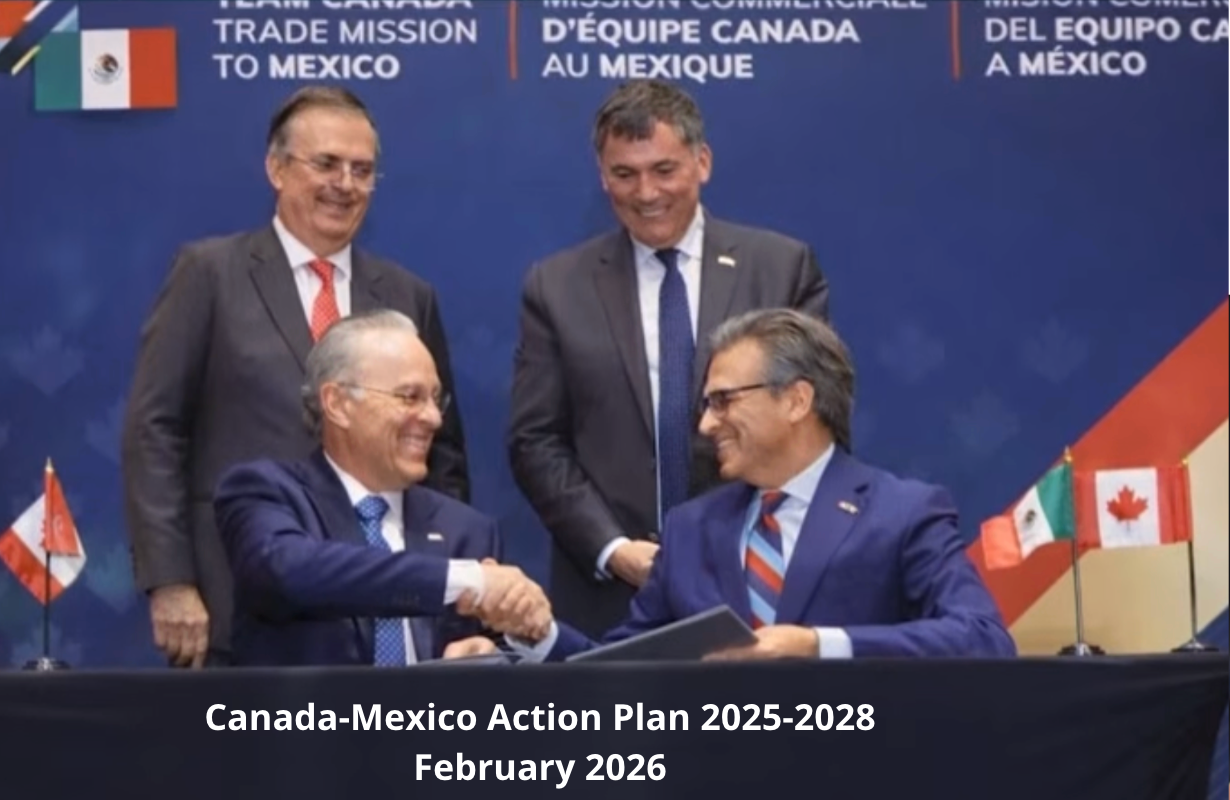
Following meetings in Washington and Mexico City around the Critical Minerals Ministerial, Mexican Economy Minister Marcelo Ebrard and Canadian Trade Minister Dominic LeBlanc said the two countries are preparing a joint action plan to deepen their economic relationship under USMCA (also called T-MEX or CUSMA). According to Ebrard, the plan, to be announced in the second half of 2026, will focus on cooperation around minerals, investment in ports, infrastructure and supply chain security.
The initiative will build on the Canada-Mexico Action Plan 2025-2028, an official document that already commits both countries to collaborate on resilient supply chains and strategic sectors, and is being developed in parallel to the new US-Mexico 60 day plan on critical minerals trade policies.
Why it matters
The US-Mexico critical minerals plan announced at the Ministerial created one North American lane. The Mexico-Canada action plan is a second lane. Together, they indicate that North America is beginning to treat minerals, infrastructure and supply chains as a continental system, not just a series of bilateral relationships with Washington.
For Mexico, putting minerals, ports and supply chain security at the centre of the plan is a way to position itself as a processing and logistics actor, not only a source of ore. For Canada, the plan offers an additional route for capital and technology into Mexico and a hedge against future turbulence in US trade or industrial policy.
Implications for capital and strategy
For investors and boards, North American exposure should increasingly be mapped at USMCA system level. Assets that can connect into both US-Mexico and Mexico-Canada frameworks may have more diversified options for offtake, financing and infrastructure than those aligned with only one bilateral track.
For companies in Mexico and Canada, the emerging geometry suggests that de-risking critical mineral projects will often involve triangular structures in which all three USMCA partners play roles in investment, processing and logistics.
However, one point matters enormously in this analysis: Mexico’s internal security environment. Beyond any treaty or partnership, mining only scales if operations can run safely and material can move reliably people on site, contractors in the field, and corridors that connect projects to ports and processing hubs. If that operating layer is fragile, projects become vulnerable regardless of the architecture, and the impact shows up fast in timelines, security costs, insurance and financing terms, and investor appetite.
Signal 2: Philippines-US MoU turns the Indo-Pacific into a critical minerals theatre
What happened
The joint statement of the 12th Philippines–United States Bilateral Strategic Dialogue, released by both governments, lists as one of its key outcomes the signing of a Memorandum of Understanding Concerning Cooperation to Diversify Global Critical Minerals Supply Chains and Promote Investments.
A separate press release from the Philippine Embassy in Washington confirms that Environment Secretary Raphael Lotilla signed the MoU with the United States on 4 February at the Critical Minerals Ministerial. The MoU commits both countries to cooperate on diversifying critical minerals supply chains and promoting investment.
Why it matters
The Philippines is a significant nickel and copper producer in the first ring around China. Bringing it formally into a US critical minerals MoU turns the Indo-Pacific into a front line theatre for supply chain alignment, not only for defence and diplomacy.
For Washington, the MoU extends the trusted supplier perimeter beyond established partners like Australia and Japan into Southeast Asia. For Manila, it offers a path to develop a Filipino led processing and industrial base linked to US and allied value chains, rather than remaining predominantly an exporter of ores.
Implications for capital and strategy
For investors and boards, this signal confirms that US-aligned critical minerals opportunities in Asia are broadening. Projects in the Philippines that can credibly meet environmental and social standards and align with MoU priorities may see improved access to US-linked finance and offtake.
For companies, any long term strategy in the Philippines will need to be framed as part of a broader industrial and security partnership, with expectations around transparency, consultation and performance that go beyond traditional project level metrics.
Signal 3: India and Brazil sign a Global South rare earths and critical minerals pact
What happened
The official List of Outcomes of President Lula’s state visit to India, published by India’s Ministry of External Affairs, lists as outcome number one an “MoU on cooperation in areas of Rare Earth Minerals and Critical Minerals” between India’s Ministry of Mines and Brazil’s Ministry of Mines and Energy.
Coverage by AP and Indian media says the MoU is non binding but politically significant, covering cooperation in exploration, mining, processing, technology and related applications, and is presented as a step toward building more resilient, diversified supply chains and reducing reliance on dominant suppliers, particularly China.
Why it matters
The India–Brazil pact is a clear example of South–South alignment in critical minerals. It shows that large emerging economies are not only being courted by the US and China; they are also building their own horizontal networks to increase strategic autonomy.
For Brazil, the MoU turns its rare earth and critical mineral endowment into a more explicit diplomatic asset, complementing its separate engagements with the US and EU. For India, it broadens its portfolio of critical mineral partners beyond Western countries and China, supporting its ambition to be both a large market and a midstream hub.
Implications for capital and strategy
For investors and boards, the pact suggests that future critical mineral value chains will likely feature more Global South nodes and hybrid alliances. Brazilian assets that can be structured to serve Indian, Western and domestic demand may enjoy additional options and bargaining power.
For policymakers, it underscores that producer countries are beginning to use critical minerals as tools of agency and negotiation, not only as commodities.
Signal 4: Rare earths price rally exposes China’s continued grip on pricing
What happened
Reuters reports that prices of neodymium and praseodymium (NdPr) oxide in China have surged to about US$123/kg, nearly double their level seven months ago and the highest since mid-2022. The rally has been driven by firm magnet demand and deliberate supply management in China, including reductions in mining and smelting quotas.
A separate Reuters analysis notes that NdPr prices are now above the US$110/kg floor set in the US Department of Defense contract with MP Materials. As long as prices remain above that level, Washington does not need to subsidise MP’s output; instead, it shares in the upside. The column also underscores that prices in Western contracts, including the MP agreement, are still benchmarked against Chinese indices such as Asian Metal and Shanghai Metal Market.
Why it matters
The rally is supportive for producers in the short term. Strategically, it highlights that China still anchors both physical supply and price discovery in rare earths. Even as the US deploys tools such as floor prices and long-term offtakes, the reference prices are still drawn from Chinese centred market infrastructure.
For Western governments, this underscores that diversifying supply has to be matched by diversifying pricing and benchmarking. Without credible alternative benchmarks and trading venues, efforts to design prices for critical minerals will remain constrained by indices shaped under Chinese regulations and policy decisions.
Implications for capital and strategy
For investors and boards, rare earth exposure needs to be evaluated not just on cost curves, but also on benchmark risk: how sensitive contracts and project economics are to movements in indices anchored in China.
For policymakers and exchanges, building independent price discovery mechanisms, as has begun in lithium, is becoming part of the critical minerals agenda itself, not a secondary technical issue.
Signal 5: Canada’s toolkit in action, federal capital for Thompson, fast track for Great Bear
What happened
On 19 February, the Canada Growth Fund (CGF) announced that it will invest up to US$85 million (about C$116 million) as part of a consortium acquiring and revitalising the Thompson Mine Complex in Manitoba from Vale Base Metals. The consortium (led by Exiro Minerals Corp. with Orion Resource Partners and Vale) will capitalize a new company, Exiro Nickel Company Inc., which plans to invest up to US$200 million in an operational turnaround and long term production plan. The Thompson complex includes two underground nickel mines and a mill along the Thompson Nickel Belt. Vale will retain an 18.9% stake in Exiro Nickel and an offtake agreement for nickel concentrate.
In parallel, on 17 February, Ontario designated Kinross Gold’s Great Bear project near Red Lake under its One Project, One Process (1P1P) framework, describing it as one of Canada’s premier gold projects. The province states that 1P1P is designed to cut government review times by up to 50% by consolidating provincial and federal approvals into a single coordinated process, while maintaining environmental and consultation standards, including engagement with Indigenous communities. Great Bear is the third project accepted into this fast-track program, after Frontier Lithium’s PAK lithium project (lithium) and Canada Nickel Company’s Crawford project (nickel), both designated in January 2026.
With Thompson, CGF is also adding to a growing critical minerals portfolio. Recent CGF investments include:
- Mangrove Lithium (Delta, BC): an up to US$85 million structured financing led by CGF, announced 15 January 2026, to commercialise and deploy Mangrove’s lithium refining technology in Canada and abroad.
- Cyclic Materials (Ontario): a US$25 million CGF investment, announced 23 January 2026, as part of a US$75 million Series C to build out a rare earth magnet recycling “Centre of Excellence”, strengthening Canada’s rare earth supply chain.
- Rio Tinto Scandium Project (Sorel-Tracy, Québec): an approximately C$25 million equity like royalty investment by CGF, announced 31 October 2025, to expand Rio Tinto’s scandium oxide facility at its Critical Minerals and Metallurgical Complex.
Why it matters
Taken together, Thompson and Great Bear show two layers of Canada’s toolkit for mining and critical minerals:
At federal level, CGF is acting as an active investor in strategic assets across the critical minerals chain, from mine turnaround (nickel at Thompson) to processing technology (Mangrove Lithium), recycling (Cyclic Materials) and niche metals (Rio Tinto’s scandium). Ottawa is not just regulating; it is taking balance sheet risk to keep and grow capacity in trusted materials.
At provincial level, Ontario is testing whether a fast-track framework like 1P1P can accelerate approvals for large mines, lithium, nickel and now gold, without eroding standards or Indigenous rights.
For Canada’s broader positioning, this combination of capital instruments (CGF) and process instruments (1P1P) is a concrete expression of its critical minerals strategy, beyond policy documents and speeches.
Implications for capital and strategy
For investors and boards, the Thompson transaction confirms that in Canada public capital can materially change the risk profile and trajectory of key assets. Strategic or turnaround projects that align with national priorities may qualify for CGF style support, which affects valuation, financing terms and counterpart risk.
Great Bear, meanwhile, is a reference point for how much weight to place on fast track regimes in risk models. If Ontario delivers predictable, robust decisions on visible projects under 1P1P, spanning lithium (PAK), nickel (Crawford) and now gold (Great Bear), it will influence how investors view other 1P1P eligible assets, including critical mineral projects.
For companies, these moves show what kind of stories resonate with Canadian governments: clear critical mineral relevance, regional economic importance and credible paths to operational improvement or timely, responsible development.
Signal 6: B.C. Budget 2026, high critical minerals rhetoric, flat institutional capacity
What happened
B.C. Budget 2026, via the Ministry of Mining and Critical Minerals 2026/27 Service Plan, sets operating funding for the Ministry at C$57.3 million for 2026/27, with only minor changes projected over the following two years. This follows a separate announcement that the government will invest C$3 million to support key permitting initiatives such as the Mineral Claims Consultation Framework (MCCF) and Notice of Work (NoW) permitting, and more than C$40 million over three years to streamline permitting across natural resource sectors.
In its response, the Association for Mineral Exploration (AME) welcomed the targeted funding but noted that ministry funding is essentially flat at C$57 million and described the lack of a broader uplift as concerning, given expectations for the sector and existing permitting backlogs.
Why it matters
B.C. has been active in launching strategies and signing agreements on critical minerals, and has approved major projects. Budget 2026, however, illustrates a pattern seen in several Western jurisdictions: strategic ambition moving faster than administrative resourcing.
Creating a dedicated ministry and adding targeted permitting funds are positive signals. But if overall capacity in permitting, enforcement, Indigenous engagement and geoscience remains flat, there is a risk that performance will lag expectations and that bottlenecks in exploration and project development will persist or worsen.
Implications for capital and strategy
For investors and boards, B.C. remains a high-governance jurisdiction, but project timelines and execution risk should be modelled with realistic assumptions about institutional capacity, not purely on the basis of strategic intent. Administrative risk (delays, consultation backlogs, policy implementation) needs to be part of the valuation and risk premia.
For policymakers, Budget 2026 is a reminder that in the era of substance, credibility in critical minerals rests on whether ministries and regulators have the people and tools needed to deliver predictable, high quality decisions at the pace the energy transition requires.
Signals to watch
- The content of the Mexico–Canada joint action plan when it is unveiled, and how it complements or overlaps with the US–Mexico critical minerals plan and the 2026 USMCA review.
- Implementation of the Philippines–US MoU: identification of specific projects, downstream investments and regulatory changes in the Philippines, and reactions from local communities and industry.
- Early steps under the India–Brazil rare earths and critical minerals MoU, including joint working groups, technology partnerships and any Brazilian projects that see Indian capital or offtake interest.
- The evolution of rare earth pricing and benchmarks: whether alternative indices gain traction in Western contracts, or whether Chinese references continue to dominate, keeping Western price support schemes tied to Beijing’s market management.
- How Ontario applies the One Project, One Process framework at Great Bear over the next 12-24 months, particularly around Indigenous engagement, environmental assessment and litigation risk, and whether similar designations are extended to critical mineral projects.
- How the Canada Growth Fund builds out its mining portfolio beyond Thompson, and whether federal public capital becomes a regular feature in de-risking strategic Canadian critical mineral assets.
- Any adjustments to B.C.’s mining and critical minerals funding in future updates, and how permitting timelines, exploration activity and DRIPA-related reforms evolve under current resourcing.
Three strategic questions for this week
- As the US-centred architecture extends to Mexico, Canada, the Philippines, and as India and Brazil weave their own axis, are we mapping our portfolio against these overlapping systems, including key suppliers who are still outside a formal framework?
- In markets like rare earths, where China still anchors both supply and price discovery, are we treating benchmark and pricing infrastructure as a strategic variable in our risk and investment decisions, rather than assuming that diversifying supply alone will resolve vulnerability?
- When governments in Canada, B.C. and elsewhere multiply forums, strategies and announcements about critical minerals, are we learning as much as we can from how different jurisdictions actually translate those plans into budgets, permitting capacity, governance and public-capital tools, and building those differences explicitly into our valuation, expectations and engagement with local stakeholders?

For the full Geopolitical Mining framework behind this article, see our book Mining Is Dead. Long Live Geopolitical Mining.
Sources for this week’s note
- – Global Affairs Canada, “Canada–Mexico Action Plan 2025–2028”, 8 January 2026.
https://international.canada.ca/en/global-affairs/corporate/reports/mexico-partnership/action-plan-2025-2028 - – Reuters, “US, Mexico to develop coordinated trade policies on critical minerals”, 4 February 2026.
https://www.reuters.com/world/china/us-mexico-develop-coordinated-trade-policies-critical-minerals-2026-02-04/ - – U.S. Department of State, “Joint Statement on the Philippines–United States Bilateral Strategic Dialogue”, 16 February 2026.
https://www.state.gov/releases/office-of-the-spokesperson/2026/02/joint-statement-on-the-philippines-united-states-bilateral-strategic-dialogue - – Embassy of the Philippines – Washington, D.C., “PHILIPPINES SIGNS MOU ON CRITICAL MINERALS SUPPLY CHAINS”, 6 February 2026.
https://philippineembassy-dc.org/philippines-signs-mou-on-critical-minerals-supply-chains/ - – India Ministry of External Affairs, “List of Outcomes: State Visit of the President of Federative Republic of Brazil to India (February 18–22, 2026)”, 21 February 2026.
https://www.mea.gov.in/bilateral-documents.htm?dtl/40811/List_of_Outcomes_State_Visit_of_the_President_of_Federative_Republic_of_Brazil_to_India_February_18-22_2026 - – AP News, “Brazil and India agree to boost cooperation on rare earths and critical minerals”, 21 February 2026.
https://apnews.com/article/f9298c4050f8402e12c81401a6e88f20 - – Reuters, “Rare earths surge above price floor given to MP Materials”, 18 February 2026.
https://www.reuters.com/business/energy/rare-earths-surge-above-price-floor-given-mp-materials-2026-02-18/ - – Reuters, “West needs its own pricing to escape China’s rare earths grip”, 20 February 2026.
https://www.reuters.com/markets/commodities/west-needs-its-own-pricing-escape-chinas-rare-earths-grip-2026-02-20/ - – Department of Finance Canada, “Government welcomes Canada Growth Fund investment in Thompson nickel mine”, 19 February 2026.
https://www.canada.ca/en/department-finance/news/2026/02/government-welcomes-canada-growth-fund-investment-in-thompson-nickel-mine0.html - – Canada Growth Fund, “Canada Growth Fund announces up to US$85 million investment in critical minerals for acquisition of Manitoba’s Thompson Mine nickel complex”, 19 February 2026.
https://www.cgf-fcc.ca/en/news/canada-growth-fund-announces-up-to-us-85-million-investment-in-critical-minerals-with-key-strategic-partners-for-acquisition-of-manitobas-thompson-mine-nickel-complex/ - – Government of Ontario, “Ontario fast-tracks one of Canada’s premier gold mines under ‘One Project, One Process’”, 17 February 2026.
https://news.ontario.ca/en/release/1007051/ontario_fast_tracks_one_of_canadas_premier_gold_mines_under_one_project_one_process - – Government of British Columbia, “Ministry of Mining and Critical Minerals – 2026/27–2028/29 Service Plan”, Budget 2026.
https://www.bcbudget.gov.bc.ca/2026/sp/pdf/ministry/mine.pdf - – Association for Mineral Exploration (AME), “B.C. Budget 2026 highlights the need for a stronger mineral exploration sector”, February 2026.
https://amebc.ca/news/b-c-budget-2026-highlights-the-need-for-a-stronger-mineral-exploration-sector/