
Geopolitical Mining Weekly
Week of 12 – 18 January 2026
Authors: Marta Rivera | Eduardo Zamanillo
Independent weekly note for investors and strategic decision makers in critical minerals and mining.
What this week really tells us
This week, five moves stood out in the critical minerals space:
- Washington brought processed critical minerals under a new Section 232 action, using national security to frame midstream imports.
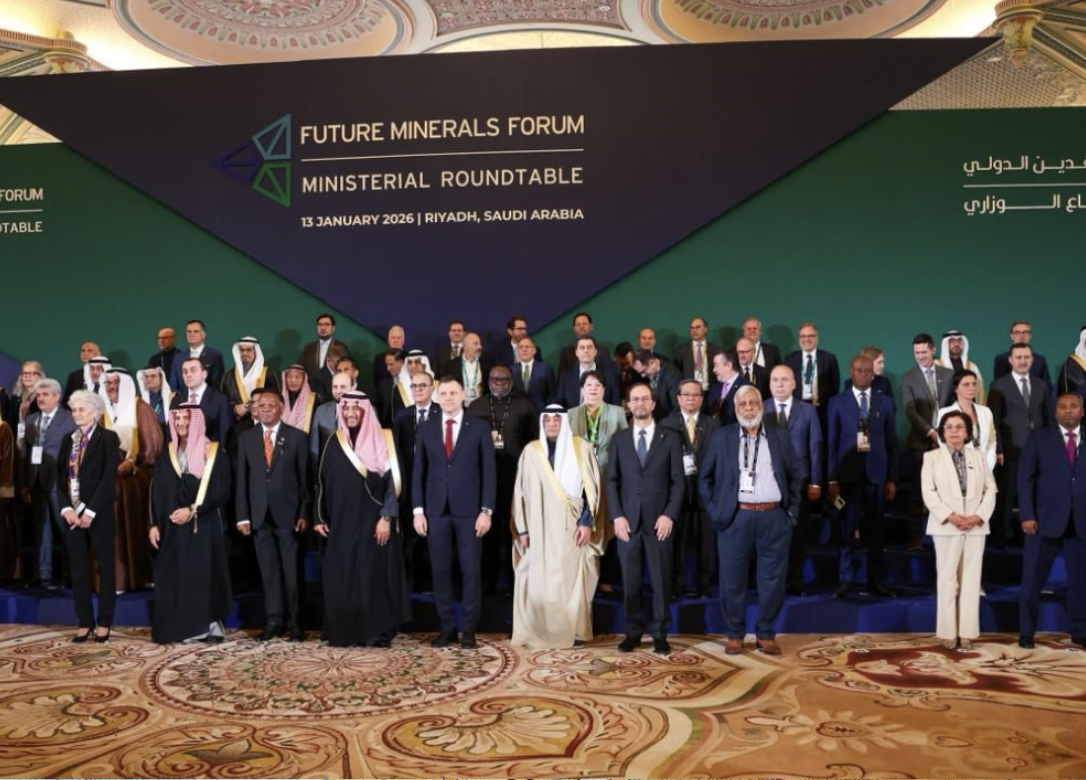
- Riyadh used the Future Minerals Forum to deepen its role as a convening hub for mining, capital and geopolitical influence, including a new Canada – Saudi critical minerals MoU.
- Tesla confirmed its Texas lithium refinery is operational, offering a concrete example of accelerated onshoring of midstream capacity in North America.
- The European Union and Mercosur finally signed a free trade agreement after 25 years of negotiation, opening a large corridor for industrial goods, agriculture and minerals.
- Ontario designated the Crawford nickel project under its “One Project, One Process” fast-track framework, presenting it as the Western world’s largest nickel development.
Seen together, these moves point to a common pattern. The centre of gravity in mining is shifting from who has the ore to who designs and controls the corridors, processing hubs and rules. Washington is building a security based framework around processed minerals; Riyadh is positioning itself as a neutral broker and platform for Gulf – Africa – Asia – West corridors; Brussels is locking in a preferential trade zone with South America; Tesla and Ontario are turning that macro competition into concrete midstream and upstream assets in North America.
The underlying tension is that strategic ambition is now moving faster than regulatory capacity and social legitimacy. Governments are promising fast track regimes, security clubs and new trade corridors; communities, Indigenous nations, courts and environmental standards still move at their own pace. The risk for investors is not a lack of ambition, but the growing gap between geopolitical narratives and what projects can realistically deliver, on time and with durable licence to operate.
In simple terms: power is migrating toward the midstream and the rules around it, but the ability to convert that power into real supply still depends on slow, contested processes on the ground.
Signals of the week
Signal 1: Section 232 moves from ores to processed critical minerals
What happened
On 14 January 2026, President Trump issued a proclamation under Section 232 of the Trade Expansion Act titled “Adjusting Imports of Processed Critical Minerals and Their Derivative Products into the United States”. The proclamation is paired with a White House fact sheet that frames processed critical minerals and their derivatives (PCMDPs) as a national security concern and directs the Secretary of Commerce and the U.S. Trade Representative to negotiate agreements with key partners before any tariffs or price floors are imposed. The administration explicitly defers immediate duties, using Section 232 primarily as leverage for a new round of critical minerals trade deals.
As we argued in our recent Geopolitical Mining note, “Rare Earths: The US Treasury, Baotou and Crucible” , this move extends the same logic that has been applied to rare earths: shift the focus from raw ore dependence to control over midstream processing, pricing frameworks and risk standards.
Why it matters
This is not a classic tariff shock; it is the codification of a new security governance layer over midstream capacity. The combination of the proclamation and the fact sheet does three things at once:
- It formally treats processed critical minerals, not just ores, as strategic infrastructure.
- It signals to allies that access to the U.S. market will increasingly be conditional on security-aligned supply chains.
- It keeps the option open for minimum import prices or tariffs if negotiations do not produce “satisfactory” outcomes.
For miners, refiners and OEMs, the immediate question is not only who produces, but where processing and pricing power sit. The measure interacts with the dynamics we described in the Treasury, Baotou and Crucible piece: Washington is moving from reacting to Chinese dominance to actively designing benchmarks, corridors and risk frameworks around critical minerals.
There is also a legitimacy angle. By pushing more processing into friendly jurisdictions, the U.S. effectively compresses timelines for new refining projects in those countries. That increases the probability of friction between national security timelines and local permitting, Indigenous rights and community expectations. If Section 232 pressure is not matched by credible processes on the ground, some of this midstream ambition will stall in courtrooms and local consultations rather than in trade talks.
Implications for capital and strategy
- For investors and boards, this means midstream exposure must now be modelled with trade policy at the centre, not at the margin. Every long term offtake, tolling or JV structure linked to U.S. demand should be stress tested against at least three scenarios: (1) negotiated agreements with no tariffs, (2) selective measures by origin, and (3) broader tariffs or price floors that change netbacks for certain refineries.
- Projects that can credibly route material through trusted processing hubs will need to demonstrate more than geography. The premium will go not only to assets in U.S. aligned jurisdictions, but to those that can show a defensible permitting path, credible community engagement and low litigation risk, because Section 232 pressure will compress timelines and magnify any local opposition.
- Price formation in some critical mineral segments will carry an explicit political layer. When governments experiment with minimum prices, support schemes and trusted supplier clubs, investors should assume that part of the margin will be shaped by policy design, not only by market supply demand, and adjust valuation, hedging and contract structures accordingly.
Signal 2: Future Minerals Forum positions Riyadh as a convening hub
What happened
From 13–15 January 2026, more than 100 countries and a wide range of companies, financial institutions and multilaterals gathered at the Future Minerals Forum (FMF) in Riyadh, Saudi Arabia. The Saudi led platform positioned itself as a global convening hub for mining and critical minerals, launched the inaugural Future Minerals Barometer to track value chain progress, and hosted a dense agenda of ministerial meetings and MoUs. According to official statements, the 2026 edition concluded with over one hundred agreements and memorandums of understanding covering exploration, mining, financing, R&D, sustainability and value chain investments, including new mineral cooperation MoUs between Saudi Arabia and countries such as Chile, Canada and Brazil, alongside deals between Saudi entities and international companies across the mining value chain. Geopolitical Mining will publish a dedicated FMF special shortly, offering a structured analysis of the forum as a whole, the main themes, country positions and what they signal for the next phase of critical mineral diplomacy.
Why it matters
FMF is consolidating into a geopolitical platform, not just a conference. By convening resource holders from Africa and Asia with capital from the Gulf, Asia and the West, Riyadh is positioning itself as an orchestrator of new corridors that may bypass traditional Western financing and governance channels.
The launch of the Future Minerals Barometer is symbolically important. It suggests an ambition to define metrics and narratives around responsible supply that do not necessarily match Western ESG taxonomies one to one. For investors, this raises a practical question: which benchmarks will ultimately matter for access to capital and to premium markets, Western standards alone, or a more plural mix in which Saudi backed tools also shape the conversation?
The Canada–Saudi MoU illustrates the changing geometry. Canada, long framed as a safe allied supplier for the U.S. and EU, is now explicitly anchoring relationships with Gulf actors that are building their own influence over African and Asian assets. For project developers, this means that capital stacks and offtake structures could increasingly combine Western, Gulf and Asian interests within the same asset or corridor.
Implications for capital and strategy
- For investors and boards, FMF should now be treated as an early mapping tool for Gulf backed influence over supply chains. Tracking which countries, commodities and corridors are repeatedly highlighted in Riyadh provides a practical shortcut to see where Saudi and allied capital, refineries and logistics are likely to concentrate over the next decade.
- Counterparty and governance risk need to be reassessed for projects that sit at the junction of Western, Gulf and Asian frameworks. The same asset may be financed, insured and regulated under partially incompatible expectations on ESG, disclosure and state involvement; boards should decide explicitly what mix of frameworks they are comfortable with, instead of drifting into it deal by deal.
- Engagement with Saudi led platforms is becoming a strategic choice, not a public relations decision. For companies with upstream exposure in Africa, Central Asia or the broader FMF region, having a clear position (engage and shape, or stay out and accept others will write the rules) is now part of strategy, not something left to conferences and networking teams.
Signal 3: Tesla’s Texas lithium refinery becomes operational
What happened
Tesla released a detailed video update confirming that its lithium refinery near Robstown, Texas, is now fully operational, converting spodumene concentrate into battery grade lithium hydroxide for its Giga Texas cell plant. The facility moved from groundbreaking in 2023 to full integrated startup by 2025, and Tesla highlights an acid free alkaline leach process that eliminates hazardous by products and aims to supply enough lithium for roughly one million vehicles per year.
Why it matters
This is one of the clearest operational milestones in the onshoring of lithium midstream. It shows that, with an anchor OEM, political support and a willingness to compress feasibility, design and construction into overlapping phases, North America can bring first of kind refining capacity online in two to three years.
It also rebalances bargaining power along the value chain. By controlling refining, Tesla gains direct visibility over costs and process performance, while miners supplying spodumene are pulled into more integrated, long term arrangements rather than selling into a commoditised chemical market. For other OEMs, this raises the question of whether they can continue to rely on third party refiners or will need similar integrated structures to stay competitive.
Finally, Tesla is actively framing the plant as a cleaner, lower waste alternative to conventional refining, with a co product usable in construction materials instead of hazardous waste. Regulators and communities will test these claims over time, but the narrative itself is important: any new refining project in allied jurisdictions will now be compared against Tesla’s environmental messaging as a reference point.
Implications for capital and strategy
- For investors and boards, North American lithium refining needs to be analysed on a 2025–2030 horizon, not only as a distant 2030 story. Capacity is moving from slide decks to physical plants; risk now lies in ramp-up, reliability and operating costs, and these should be integrated into price decks and supply risk models.
- For miners, the default benchmark is shifting toward integrated OEM miner refiner ecosystems. Projects that can anchor long term relationships with OEMs, combining offtake, technical cooperation and possibly equity, will be seen as structurally stronger than standalone plays that hope to sell into a generic chemical market.
- For all actors, environmental process performance at refineries becomes a core variable in permitting and valuation. Claims about cleaner processes and reduced hazardous waste will be tested by regulators and communities; those who can substantiate them with data and monitoring will likely face smoother approvals and more durable social licence.
Signal 4: EU – Mercosur deal redraws trade corridors for minerals and industry
What happened
On 17 January 2026, the European Union and the Mercosur bloc (Argentina, Brazil, Paraguay and Uruguay) signed a long negotiated free trade agreement in Asunción, creating one of the world’s largest trade zones, covering around 700 million consumers. The deal aims to eliminate over 90% of tariffs between the two regions over time, including on industrial goods, agricultural products and a range of raw materials. It now requires ratification by the European Parliament and national legislatures, and faces opposition from parts of the European farming sector and environmental groups.
Why it matters
Although the public debate in Europe is focused on agriculture, the agreement has direct implications for mining and critical minerals. Mercosur states are significant exporters of iron ore, manganese, niobium, copper, lithium and other inputs to the energy and industrial transitions. Lower tariffs and clearer rules of origin could strengthen South America’s role as a diversified supplier to the EU at a time when Brussels is trying to reduce dependence on a small number of dominant players, particularly China.
At the same time, the deal embeds EU environmental and deforestation safeguards, and will likely be tested by domestic politics in member states where farmers and parts of civil society fear unfair competition and weak enforcement of climate commitments. For mining and processing projects in Mercosur countries, this creates both an opportunity and a constraint: preferential access to the EU market alongside higher scrutiny around traceability, land use and labour standards.
For investors, the main point is not the headline tariff cuts, but the strategic corridor the deal opens. If ratified and implemented, the EU gains a stronger platform to align Mercosur exports with its own evolving critical minerals strategy (ResourceEU, CRMA type measures), while Mercosur countries gain leverage in negotiating with both Europe and China. The real question will be whether South American producers move up the value chain, into processing and semi finished products, or remain primarily exporters of raw and minimally processed commodities.
Implications for capital and strategy
- For investors and boards, projects in Mercosur with EU facing offtake should be revisited as potential tier one suppliers if they can meet EU environmental and traceability conditions. The combination of tariff preferences and regulatory alignment can create a differentiated market segment with better margins and more resilient demand.
- Industrial and midstream investments in Mercosur deserve a fresh look. Co locating parts of the value chain (processing, semi finished products, cathode or alloy manufacturing) may capture more value than pure concentrate exports, especially if EU manufacturers seek to arbitrage tariffs and rules of origin.
- Ratification and implementation risk must be treated as a central scenario driver, not a footnote. Capital allocation should explicitly incorporate outcomes where the deal is delayed, watered down or politically contested, and understand how each scenario affects project economics, timelines and diversification away from other blocs.
Signal 5: Ontario fast tracks a flagship nickel project
What happened
The Government of Ontario announced that Canada Nickel Company’s Crawford nickel project near Timmins will be advanced under the province’s new One Project, One Process (1P1P) framework, describing it as the Western world’s largest nickel development. The designation is intended to cut permitting timelines by up to 50%, align provincial approvals under a single process, and support a fully integrated critical minerals supply chain, from mining and processing to downstream alloy production. Estimates suggest around C$5 billion in investment, over 4,000 jobs and one of the largest mine and mill complexes in North America.
Why it matters
Crawford is being positioned as a cornerstone nickel asset for stainless steel and EV supply chains. By explicitly tying it to the 1P1P fast track, Ontario is testing whether it can reconcile speed with rigorous environmental review and Indigenous engagement. The province is also framing the project as a response to geopolitical pressure, including new U.S. Section 232 actions and concerns over Chinese dominance in nickel value chains.
For markets, this is a live example of what many governments are now promising: a streamlined, whole of government permitting pathway for strategic projects. Whether this framework proves credible will depend on how it handles cumulative impacts, consultation with affected communities and potential legal challenges. If it works, it could become a template for other Canadian provinces and allied jurisdictions; if it encounters major setbacks, it will feed doubts about the feasibility of accelerating large, complex mines in high-standard environments.
Implications for capital and strategy
- For investors and boards, permitting regimes themselves have become part of the asset’s value proposition. A credible fast track framework like Ontario’s “One Project, One Process” can reduce schedule risk and the cost of capital, but only where environmental oversight, Indigenous rights and legal robustness are clearly evidenced in practice.
- Nickel market assumptions for the 2030s should be updated to include a successful Crawford scenario. If delivered broadly on time and at scale, Crawford would materially increase North American nickel availability, with consequences for pricing, regional premiums and the competitiveness of alternative sources such as Indonesia.
- For project developers, fast track status raises the bar on early engagement rather than lowering it. In a compressed timetable, unresolved issues with Indigenous nations and local communities can translate directly into injunctions and delays; investing upfront in genuine consultation is now a schedule protection measure, not only a reputational consideration.
Signals to watch
- Section 232 follow through: whether negotiations over processed critical minerals deliver formal agreements by mid 2026, or whether the U.S. shifts toward tariffs, price floors or differentiated treatment by origin.
- Concrete outcomes from FMF MoUs: which of the announcements made in Riyadh, including the Canada–Saudi critical minerals MoU, translate into funded projects, JVs or new processing hubs in Africa and Asia.
- EU–Mercosur ratification and safeguards: how debates in the European Parliament and key member states (notably France and others with strong farming lobbies) shape the final ratification timeline and the enforcement of environmental clauses.
- Replication of Tesla’s model: whether other OEMs announce integrated refining projects in North America or Europe, and how Tesla’s Texas refinery performs on throughput, costs and environmental metrics over the first 12 – 24 months.
- Delivery of Ontario’s 1P1P promise: how the Crawford project advances under the fast-track regime, including any legal challenges or community pushback, and whether additional Canadian projects are brought under similar frameworks.
Three strategic questions for this week
- Are we treating the location and governance of midstream capacity as a core driver of risk and value, or still assuming that refining will be available somewhere when our projects come online?
- Where do our key assets sit within the emerging architecture of platforms and corridors, U.S. Section 232 clubs, Saudi led FMF networks, EU – Mercosur trade routes, and are we actively shaping that positioning or letting it emerge deal by deal?
- Do our project timelines and return expectations realistically reflect the friction between accelerated political ambition (fast track regimes, security designations) and the slower dynamics of permitting, Indigenous rights and social licence?
Sources
-
The White House, “Adjusting Imports of Processed Critical Minerals and Their Derivative Products into the United States” (Presidential Proclamation) and “Fact Sheet: President Donald J. Trump Directs Negotiations to Adjust Imports of Processed Critical Minerals and Their Derivative Products into the United States”, 14 January 2026.
https://www.whitehouse.gov/fact-sheets/2026/01/fact-sheet-president-donald-j-trump-directs-negotiations-to-adjust-imports-of-processed-critical-minerals-and-their-derivative-products-into-the-united-states/
https://www.whitehouse.gov/presidential-actions/2026/01/adjusting-imports-of-processed-critical-minerals-and-their-derivative-products-into-the-united-states/ -
Natural Resources Canada, “Canada strengthens critical minerals and energy partnership with the Kingdom of Saudi Arabia at the 2026 Future Minerals Forum”, 2026.
https://www.canada.ca/en/natural-resources-canada/news/2026/01/canada-strengthens-critical-minerals-and-energy-partnership-with-the-kingdom-of-saudi-arabia-at-the-2026-future-minerals-forum.html -
Future Minerals Forum 2026 Official Event Brochure and related coverage.
https://www.miningweekly.com/article/future-minerals-forum-launches-pioneer-future-minerals-barometer-2026-01-14
https://www.futuremineralsforum.com/ -
Tesla, corporate video update and industry coverage on the Robstown, Texas lithium refinery, January 2026.
-
European Commission – DG Trade, “Factsheet: EU–Mercosur partnership agreement, enhancing trade and investment in critical raw materials”.
https://policy.trade.ec.europa.eu/eu-trade-relationships-country-and-region/countries-and-regions/mercosur/eu-mercosur-agreement/factsheet-eu-mercosur-partnership-agreement-enhancing-trade-and-investment-critical-raw-materials_en -
Reuters, AP and EU Council press materials on the EU–Mercosur trade agreement signed in Asunción on 17 January 2026.
https://www.reuters.com/world/americas/eu-mercosur-sign-trade-deal-after-25-years-negotiations-2026-01-17/ -
Government of Ontario and Canada Nickel Company releases on the Crawford Nickel Project and the “One Project, One Process” framework, January 2026.
https://news.ontario.ca/en/release/1006914/ontario-fast-tracks-western-worlds-largest-nickel-project-under-one-project-one-process

For the full Geopolitical Mining framework behind this Weekly, see our book Mining Is Dead. Long Live Geopolitical Mining .