
Geopolitical Mining · Weekly
Geopolitical Mining Weekly
Week of May 25–31, 2026
Authors: Marta Rivera | Eduardo (Ed) Zamanillo
June 1, 2026
What this week really tells us
What stood out this week is how quickly mineral security is becoming practical. The conversation is moving into the places where supply is actually built: investment frameworks, publicsector execution, fiscal rules, logistics, industrial capacity and institutional trust.
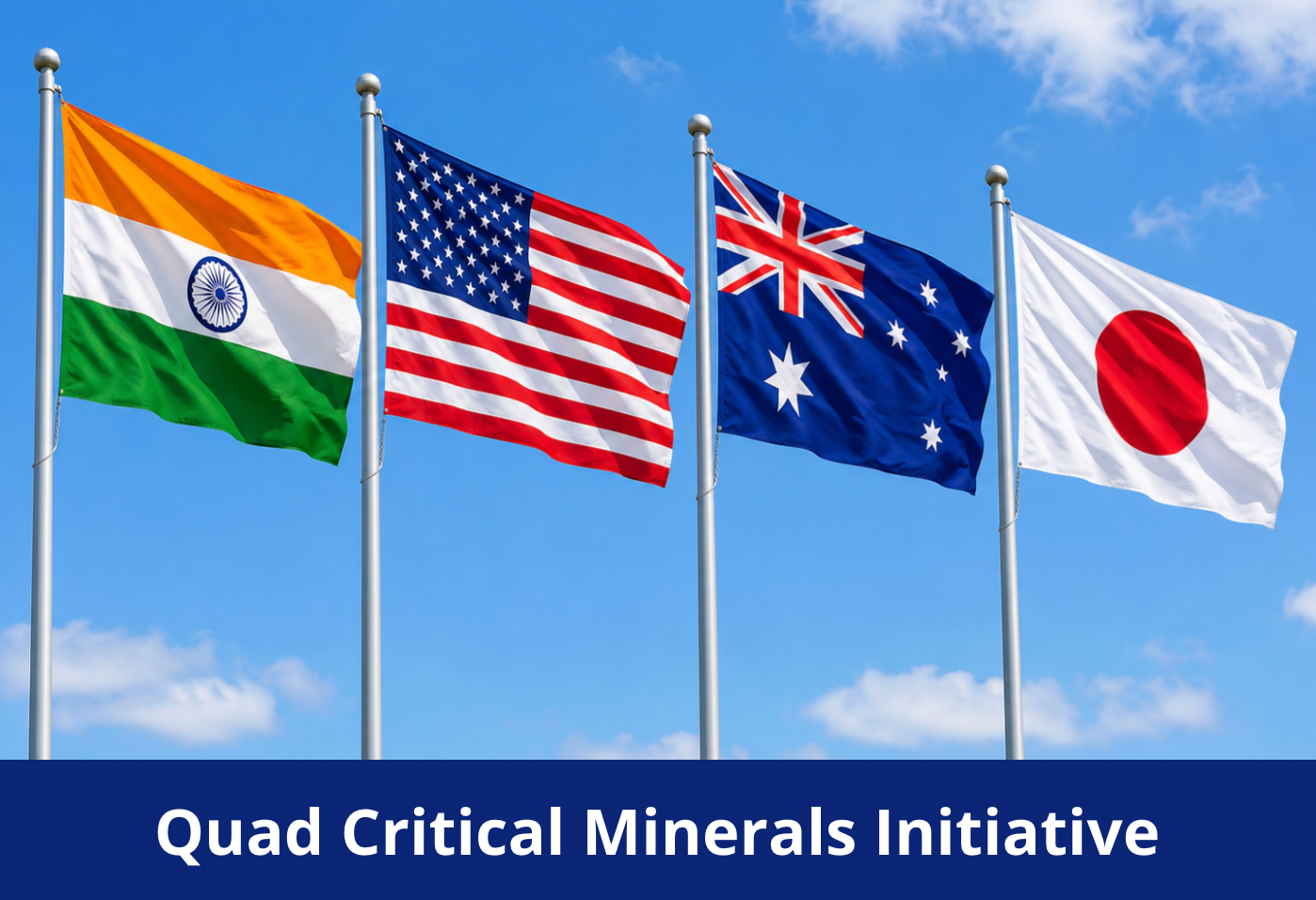
In the Indo-Pacific, the Quad gave critical minerals cooperation a more concrete investment frame. India, Australia, Japan and the United States are seeking to mobilize up to US$20 billion in government and private sector support for mining, processing and recycling. This is a meaningful shift. Critical minerals cooperation is beginning to look less like diplomatic alignment and more like coordinated capital deployment.
In Washington, the White House focused on another part of the same challenge: talent. By approving critical position pay authority for up to 400 national security investment roles, it recognized that execution also depends on the state’s ability to attract financial, legal, engineering and investment expertise. Mineral strategy now requires people who can structure deals, evaluate projects, understand risk and move complex supply chain programs forward.
In the Democratic Republic of Congo, the expansion of the strategic minerals list showed how classification can become a fiscal and sovereign control tool. In Saskatchewan, Cameco’s restart of McArthur River and Key Lake after a flooding related logistics disruption showed why uranium supply security depends on roads, bridges and reliable access as much as on the mine itself. In Quebec, Rio Tinto’s AP60 expansion placed low carbon aluminium capacity inside the North American industrial resilience conversation. And in Panama, the delay of the final Cobre Panamá audit showed that copper restarts require trust, transparency and institutional credibility.
Taken together, these signals show a clear shift: mineral security is moving from strategic intent into the practical work of building supply. Capital must be mobilized. Talent must be available. Rules must be credible. Logistics must hold. Industrial capacity must exist. Institutions must be trusted. That is the deeper signal of the week: mineral potential becomes reliable supply only when the system around it can carry it.

For the full Geopolitical Mining framework behind this note, see our book Mining Is Dead. Long Live Geopolitical Mining.
Signals of the week
Signal 1: The Quad is turning critical minerals into coordinated investment architecture
What happened
On May 26, India, Australia, Japan and the United States released the Quad Critical Minerals Initiative Framework. The framework states that Quad partners intend to support secure critical minerals supply chains and use economic policy tools and coordinated investment to accelerate diversified and fair critical mineral markets. It sets out cooperation across mining, processing, recycling, regulatory alignment, project development, recovery from e-waste and scrap, and measures to address non market policies and unfair trade practices.
The framework says Quad partners intend to mobilize up to US$20 billion in government and private sector support through new and existing efforts to strengthen critical minerals supply chains. It refers to export credit agencies, development finance institutions, private capital, guarantees, loans, equity participation, insurance, subsidies, offtake and other commercial arrangements as possible tools.
On the same day, India and the United States concluded a bilateral framework on “Securing of Supply in the Mining and Processing of Critical Minerals and Rare Earths.” India’s Ministry of External Affairs said the framework aims to deepen cooperation across mining, processing, recycling, investments, financing and scrap management.
Why it matters
This matters because the Quad is giving critical minerals cooperation a more operational shape. The framework moves beyond strategic alignment and begins to identify the instruments required to build supply: capital, guarantees, insurance, offtake, recycling, regulatory cooperation and project development support.
That level of detail is important. Diversified supply chains usually face pressure at the same points: early stage project risk, limited patient capital, uncertain offtake, permitting complexity, processing bottlenecks and competition from concentrated supply systems. By naming the financial and institutional tools that could support projects, the Quad is beginning to address the practical conditions that determine whether alternative supply can actually be built.
The US$20 billion figure also matters because it frames critical minerals as an investment architecture rather than a narrow resource agenda. Mining, processing and recycling are being treated as connected parts of the same system. That is where the signal becomes more strategic. A supply chain becomes stronger when capital, policy, industrial demand and project execution are aligned across more than one country.
The India-U.S. bilateral framework adds another layer. It shows how the broader Quad structure can be reinforced through more specific bilateral channels focused on mining, processing, rare earths, financing and scrap management. That combination is important because critical minerals strategy now requires both scale and execution: plurilateral frameworks to organize the direction, and bilateral arrangements to move specific workstreams forward.
Implications for capital and strategy
For capital, the signal is that projects connected to Quad priorities may become more visible if they address real supply chain gaps and can fit into allied market demand. This could improve how investors read projects located in Quad countries, operated by Quad linked companies, financed through Quad aligned institutions or supplying Quad markets.
It may also strengthen the relevance of projects that sit outside the mine gate. Processing, recycling, scrap recovery, rare earth separation, midstream capacity and offtake backed projects could gain more strategic weight if the framework begins to translate into concrete financing decisions.
For strategy, the deeper message is that critical minerals are becoming part of Indo-Pacific economic architecture. The Quad is trying to organize a supply system where public finance, private capital, industrial demand, regulatory alignment and strategic trust can work together.
The next phase will depend on execution. The framework will carry real weight if it moves from policy language into project selection, financing commitments, offtake structures, permitting cooperation, processing capacity and measurable delivery across the supply chain.
Signal 2: The United States is treating critical minerals execution as a state capacity challenge
What happened
On May 29, the White House approved the use of critical position pay authority for up to 400 positions supporting investment programs related to national security. The memorandum authorizes the Office of Personnel Management, in consultation with the Office of Management and Budget, to allocate these positions to executive departments and agencies and approve pay of up to US$400,000 where justified by market comparability and national security urgency.
The memorandum states that the action is intended to recruit investment, engineering, financial and legal professionals needed to expand U.S. capacity in critical minerals, advanced materials and other essential components of strategic supply chains. It links this workforce need to mineral production, essential technologies, industrial resilience and reducing dependence on foreign sources.
Why it matters
This matters because critical minerals execution is becoming a state capacity problem. Governments can announce strategies, funding programs and supply chain priorities, but execution depends on people who can structure investments, evaluate projects, manage risk, negotiate agreements, understand engineering constraints and move capital into strategic assets.
The signal is especially relevant because the memorandum recognizes a capability gap inside the state itself. Critical minerals strategy requires technical, financial and legal expertise that can compete with private sector talent. Without that expertise, public investment programs risk becoming slow, fragmented or poorly aligned with project realities.
Implications for capital and strategy
For capital, the signal is that U.S. public investment programs may become more sophisticated if agencies can recruit the right technical and financial professionals. That could improve project evaluation, deal structuring, risk allocation and the speed of investment execution.
For strategy, the deeper message is that mineral security requires institutional talent. The state is not only a regulator or funder. It is becoming an investment actor, and its ability to execute will increasingly depend on whether it can build the human capacity required to understand complex mineral systems.
Signal 3: The DRC is turning critical mineral classification into fiscal sovereignty
What happened
Mining.com, citing Bloomberg and Congolese government proceedings, reported that the Democratic Republic of Congo approved the addition of lithium, tantalum, niobium, tungsten, uranium and rare earths to its list of strategic minerals. Under the DRC mining code, strategic minerals are subject to 10% royalties, compared with the usual 3.5% for non ferrous metals. Cobalt, germanium and coltan were already on the strategic minerals list.
The report says the measure was approved by the Council of Ministers through a decree and that the stated objective is to allow the country to benefit from the critical and geostrategic character of the minerals found in its soil. It also notes that DRC hosts major hard rock lithium potential, with Zijin’s Manono lithium project expected to be commissioned in June and KoBold Metals having launched a large lithium exploration project in April.
Why it matters
This matters because critical minerals classification is becoming a fiscal sovereignty instrument. By placing lithium, rare earths and other strategic minerals into a higher royalty category, the DRC is signaling that it intends to capture more value from minerals that have become central to global technology, energy and industrial supply chains.
The signal is important because it shows that resource nationalism does not only appear through export bans or state ownership. It can also appear through classification systems, royalty schedules and fiscal design. As minerals become more strategic, governments may increasingly adjust the legal and fiscal treatment of those minerals to reflect their perceived geopolitical value.
Implications for capital and strategy
For capital, the signal is that project economics in the DRC may need to be read through a changing strategic minerals framework. Higher royalties can affect margins, financing assumptions and investor risk, especially for projects entering development or early production.
For strategy, the deeper message is that mineral rich states are becoming more deliberate in how they define strategic value. The DRC is not only a supplier of cobalt, copper and lithium potential. It is also a jurisdiction actively using fiscal tools to reposition the value of its mineral endowment.
Signal 4: Cameco shows why uranium security depends on logistics resilience
What happened
On May 27, Cameco announced that the Key Lake mill and McArthur River mine had returned to full production activities after a disruption caused by flooding in northern Saskatchewan. Cameco said its northern Saskatchewan sites were not directly impacted by flood waters, but the Smoothstone River Bridge, located on the primary route used to transport supplies to the sites, partially collapsed due to flooding.
The company said restrictions on the alternative roadway interrupted delivery of critical operating materials, but that it had been able to resume full operations by consistently delivering required materials through the secondary route. Cameco maintained its 2026 consolidated production outlook at 19.5 million to 21.5 million pounds of U3O8.
Why it matters
This matters because uranium supply security depends on logistics resilience. In this case, the mine and mill were not directly flooded. The disruption came through the transport system that supports operations. That distinction is important.
The uranium supply chain is often discussed through production, reserves, enrichment, nuclear energy demand and geopolitical concentration. But operational continuity also depends on roads, bridges, weather, seasonal thaw, materials delivery and the ability to keep remote sites supplied under difficult conditions.
Implications for capital and strategy
For capital, the signal is that logistics risk should be treated as part of operational risk in remote mining systems. Investors assessing uranium assets need to consider not only resource quality and processing capacity, but the resilience of access routes and supply lines.
For strategy, the deeper message is that critical mineral and uranium security requires infrastructure continuity. A strategic asset can be technically strong and still vulnerable if the surrounding logistics system is fragile. Cameco’s restart shows both the risk and the value of adaptive operational capacity.
Signal 5: Rio Tinto’s AP60 expansion links aluminium capacity with North American industrial resilience
What happened
On May 29, Rio Tinto announced that it had started commissioning its US$1.5 billion AP60 smelter expansion at Complexe Arvida in Quebec. The company said the start up began in March and is expected to be completed by the end of 2026, with all 96 new pots operating. The expansion will increase the plant’s production capacity by approximately 160,000 metric tonnes of primary aluminium annually, bringing total AP60 technology production to 220,000 metric tonnes.
Rio Tinto described AP60 as one of the most efficient and lowest carbon commercial scale aluminium smelting technologies available. It also said the expansion strengthens its ability to supply North American customers with low carbon, high quality aluminium for transportation, construction, electrical applications and consumer goods.
Why it matters
This matters because industrial metals capacity is becoming part of supply chain resilience. Aluminium may not always appear in critical minerals discussions in the same way as rare earths, lithium or cobalt, but it is a foundational material for modern industrial systems.
The signal is relevant because North American resilience depends not only on the minerals that feed batteries or defense systems, but also on the industrial metals that support transportation, construction, power systems and manufacturing. Low carbon aluminium capacity in Quebec sits directly inside that wider industrial base.
Implications for capital and strategy
For capital, the signal is that industrial metals projects tied to low carbon production, stable energy and North American demand may gain strategic value beyond commodity price exposure. The combination of hydropower, technology and regional demand strengthens the project’s industrial relevance.
For strategy, the deeper message is that mineral security includes industrial capacity. A resilient supply chain needs the ability to produce and process foundational metals at scale, especially when trade uncertainty, tariffs and geopolitical competition increase the value of domestic and allied production.
Signal 6: Cobre Panamá shows why copper restarts require institutional legitimacy
What happened
On May 29, Panama’s Ministry of Environment announced that SGS Panama Control Services had requested an extension to deliver the final report of the comprehensive audit of the Cobre Panamá mine. MiAmbiente said the extension was requested to complete final verifications and compile the corresponding annexes. The ministry said the final report will present technical, environmental and operational findings, and that it will be made public once received and reviewed under established procedures.
Mining.com reported earlier in the week that Panama was preparing to publish the final audit of First Quantum’s shuttered Cobre Panamá mine, a report expected to influence the government’s next decision on the suspended operation. The article noted that Cobre Panamá was one of the world’s largest copper operations before its shutdown, producing 350,000 tonnes in 2022 and contributing about 5% of Panama’s GDP.
Why it matters
This matters because copper restarts are becoming legitimacy tests. Cobre Panamá is not only a mining asset. It sits at the intersection of copper supply, national revenue, environmental governance, public protest, legal certainty and institutional trust.
The audit delay shows that technical evaluation alone is not enough. The process must also be credible to the public, transparent to institutions and capable of supporting a decision that can withstand political and social pressure. In that sense, the restart question is not only operational. It is institutional.
Implications for capital and strategy
For capital, the signal is that suspended strategic mines must be evaluated through the quality of the institutional process around them. Investors need clarity on technical findings, legal conditions, environmental obligations, public acceptance and government decision making.
For strategy, the deeper message is that copper supply security increasingly depends on legitimacy. Large copper projects may hold world class resource value, but their future can still be determined by whether governments can rebuild trust around regulation, transparency and long term public interest.
Signals to watch
- Whether the Quad Critical Minerals Initiative moves from framework language into concrete project selection, financing tools, offtake structures and processing capacity.
- Whether the U.S. critical position pay authority helps agencies recruit the investment, engineering, financial and legal expertise required to execute mineral and supply chain programs at scale.
- Whether the DRC’s strategic minerals classification is formalized through decree and how the higher royalty framework affects lithium, rare earth and other strategic mineral projects.
- Whether Cameco’s primary supply route to McArthur River and Key Lake is restored, and whether spring thaw or further precipitation creates additional logistics constraints.
- Whether Rio Tinto’s AP60 commissioning remains on schedule through year end 2026 and strengthens low carbon aluminium supply for North American industrial markets.
- Whether Panama’s final Cobre Panamá audit is released in a way that strengthens public transparency, regulatory credibility and the government’s ability to define a durable path forward.
- Whether copper tariff expectations continue to redirect metal flows toward the United States and create further stress between Comex and LME linked markets.
Three strategic questions for this week
- Which countries are building the strongest investment architecture around critical minerals?
- Where is mineral security being shaped most clearly: finance, fiscal policy, logistics, industrial metals capacity or institutional legitimacy?
- How should investors read strategic assets when project value increasingly depends on the system around the asset, not only the asset itself?
Resources
Signal 1
- Ministry of External Affairs, Government of India — Quad Critical Minerals Initiative Framework Among India, Australia, Japan and the United States
- Ministry of External Affairs, Government of India — India-U.S. Framework on Securing of Supply in the Mining and Processing of Critical Minerals and Rare Earths
Signal 2
Signal 3
Signal 4
Signal 5
Signal 6