
Geopolitical Mining Weekly
Week of 1–7 December 2025
Independent weekly note for investors and strategic decision makers in critical minerals and mining.
Authors: Marta Rivera | Eduardo Zamanillo
What this week really tells us
This week, key developments underscored how state actors and large commodity players are consolidating control over critical minerals supply, favouring export jurisdictions with strong institutions, and elevating second-tier metals into strategic status.
- State trader integration in Africa via a marketing deal between a major state miner and a global trader.
- Downstream integrated lithium financing in Europe that binds resource, refining and offtake under one industrial strategy.
- Smelter agreement in Chile signalling intent for domestic refining and value capture.
- Warnings of copper supply stress under accelerating demand from AI and energy infrastructure.
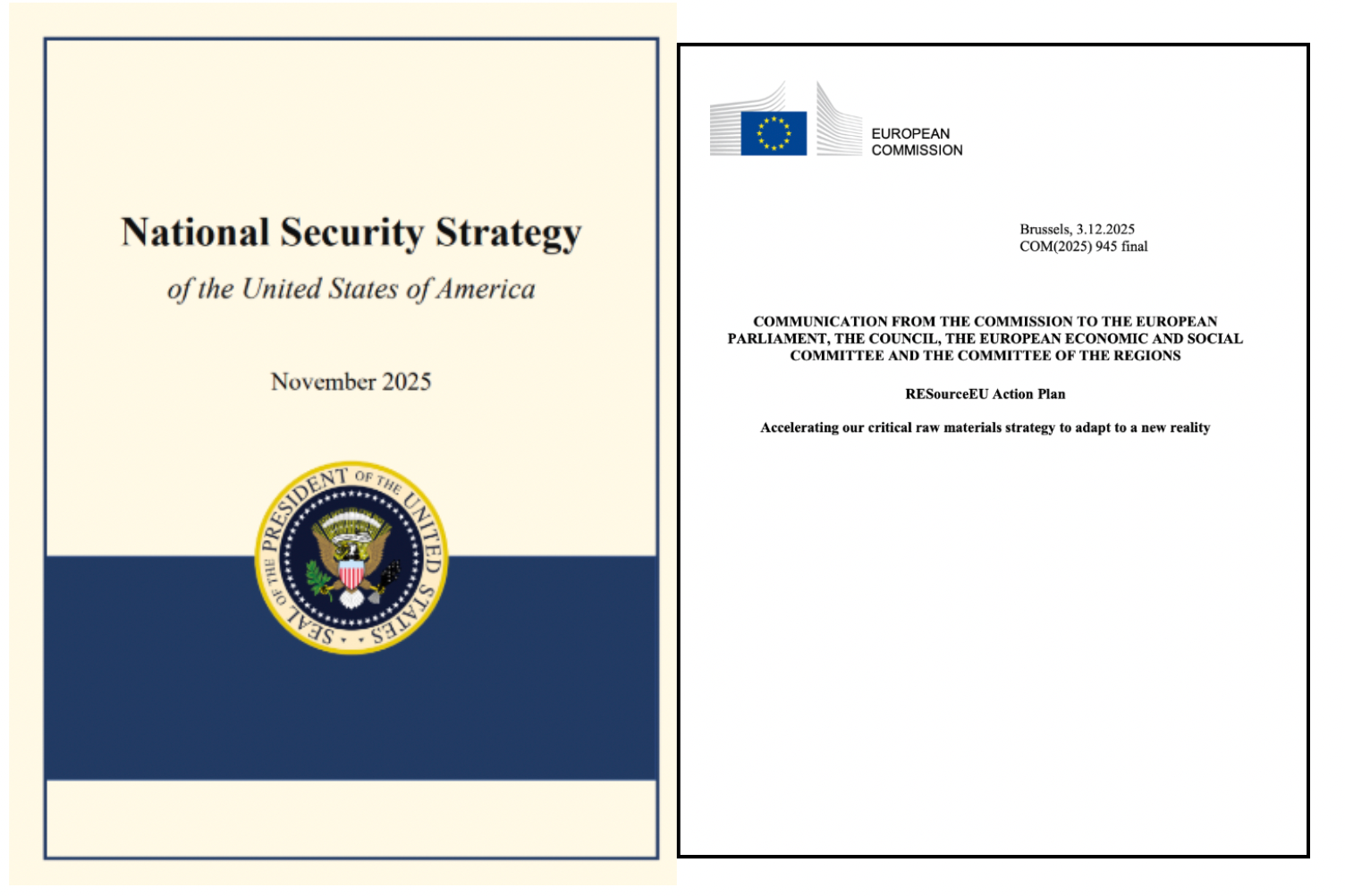
- Major policy shift in the EU, via RESourceEU, signalling that critical raw materials are a core pillar of European industrial and supply chain security.
- Institutional strategy push in the U.S., with strategic minerals now embedded in national security doctrine.
These moves, from Africa to Europe and the Americas, reflect a broader shift: critical minerals supply is being restructured not just around extraction, but around strategic partnerships, state-backed financing, processing capacity, industrial policy and demand spikes. The interplay among geopolitics, industrial policy and real supply is becoming more explicit.
For investors and boards, the core tension is clear: winning the race for critical minerals will increasingly depend on the ability to align projects with sovereign or state-backed value chains, combined with integration in downstream/refining operations, not just having “ore in the ground.”
Signals of the week
Signal 1 – DRC: Gécamines partners with Mercuria to market copper, cobalt and more
What happened
On 5 December 2025, state-owned Gécamines (DRC) signed a partnership with Swiss trader Mercuria to manage marketing of copper, cobalt and other critical minerals. The deal includes infrastructure investment, logistics, financing and aims to make exports more transparent and efficient. Mercuria will help with export infrastructure and trading, giving Gécamines direct control over production sales.
Why it matters
This agreement follows a trend of resource-rich countries asserting greater control over their critical-minerals supply chains. Through a partnership with a major global trader, the DRC is moving away from opaque, incremental export models toward a more structured and globally integrated commercial channel. For cobalt (essential for batteries) and copper, this could reduce supply chain risk and dampen middle-man leverage, improving revenue capture by the state.
It also signals that African supply will increasingly feed Western supply-chain diversification strategies, under more scrutiny and traceability standards. That could enhance legitimacy for investors that demand ESG compliance, but raise barriers for speculative or informal actors.
Implications for capital and strategy
- For investors/boards, backing from a trade-house partner can derisk marketing and logistics, making DRC projects more investable under structured frameworks.
- Due diligence should emphasise traceability compliance, infrastructure reliability, and stability of export regime terms, not only geology.
- Portfolios should distinguish between assets relying on free-market commodity sales and those integrated in long-term, state-backed contracts with traceability commitments.
Signal 2 – Europe: Vulcan Energy’s major lithium financing underlines shift toward downstream and high-end processing
What happened
European lithium producer Vulcan Energy secured a €2.56 billion funding package (debt, equity and government-linked financing) to advance its Lionheart project in Germany. The financing involves participation from European public agencies, export credit institutions and commercial banks. Construction is slated to begin imminently.
Why it matters
The deal reflects a rising trend in which critical minerals projects in developed jurisdictions are judged not only by deposit quality, but by potential to supply processed, refined materials ready for batteries and industrial use. With over 90 % of its output already contracted, Vulcan’s project exemplifies the mine-to-battery model that reduces reliance on external refining, increases supply chain security, and aligns with EU industrial policy.
This adds a new dimension to supply-chain risk management: the bottleneck may not be resource, but financing, permitting and integrated processing. For investors, backing projects that combine mining, refining and offtake creates resilience against commodity price cycles and geopolitically driven disruptions.
Implications for capital and strategy
- For investors/boards, projects combining extraction + refining/processing + long-term offtake will likely outperform standalone mines in returns and stability.
- Financing models should favour blended capital (public + private) to spread risk and align with policy-driven industrial strategies.
- Portfolios should consider prioritising European (and allied) downstream projects, particularly in lithium, battery metals, and other high-demand minerals.
Signal 3 – Chile: Codelco–Glencore smelter MoU, a push for domestic refining and value capture
What happened
As of early December, Codelco and Glencore signed a Memorandum of Understanding to jointly develop a copper smelter in Chile’s Antofagasta region (or Tocopilla), potentially processing up to 1.5 million tonnes of copper concentrate per year, with Codelco supplying 800,000 tonnes annually for at least a decade. The project aims to reduce Chile’s reliance on foreign smelters and increase domestic processing capacity.
Why it matters
The agreement marks a strategic pivot toward in-country value capture: instead of exporting raw concentrate, Chile aims to upgrade to smelting and potentially refining. This shift reflects growing global demand for semi-processed or refined copper amid supply chain constraints and political pressure to reduce foreign dependence.
For global copper markets, facing supply pressure (see below), adding domestic refining capacity in Chile enhances supply-chain diversification and may reduce volatility. For investors, increased local processing improves margins and reduces logistics and geopolitical risk tied to overseas smelting.
Implications for capital and strategy
- For investors/boards, backing mining projects with integrated smelting/refining capacity will become more attractive than raw concentrate-only operations.
- Copper portfolios should value not just ore grade but also downstream integration potential, refining bottlenecks and concentration policy shifts in producing countries.
- Firms should monitor domestic regulatory and environmental standards: compliance and social licence will matter more in smelting-heavy operations.
Signal 4 – Global copper shortage concerns: AI-driven demand surge raising stress on supply
What happened
Analysts warn that the rapid build-out of AI data centres and associated energy infrastructure may push global copper demand beyond what existing and planned mines can deliver. Estimates suggest that by 2035 demand could exceed supply by a significant margin; a 2025 copper deficit of 304,000 tonnes has already been flagged.
Why it matters
The growing gap between copper demand (driven by electrification, digital infrastructure and AI) and constrained supply – due to declining ore grades, delays in new mining/refining projects, and regulatory and permitting bottlenecks – introduces a structural bull signal for copper and copper-linked assets. For critical minerals strategists, this reinforces copper’s centrality, not only for energy transition but also for digital and data-economy infrastructure.
But supply pressure also raises ESG, permitting and social-licence challenges: rushed projects may face regulatory or community resistance, and downstream bottlenecks (refining, smelting) may become the real choke points.
Implications for capital and strategy
- For investors/boards, copper projects – especially those integrated with downstream capacity – should be prioritised, but expected return profiles should factor in higher social, permitting and environmental risk.
- Exploration for copper must be accelerated to avoid mid-term shortages; late-stage developers should license and permit fast.
- Consider hedging strategies, including recycling, substitution (where feasible), or investment in alternative metals (e.g. aluminium, copper alloys) to mitigate long-term supply stress.
Signal 5 – Europe: RESourceEU makes critical minerals a core of strategic-industrial policy
What happened
On 3 December 2025 the European Commission formally adopted the RESourceEU Action Plan. The initiative mobilises roughly €3 billion over the next 12 months to support projects across the critical raw materials value chain (mining, processing, refining, recycling), reduce reliance on China, and promote supply-chain diversification. It builds on the existing Critical Raw Materials Act (CRMA) and is designed to support both European and allied overseas projects through financing, streamlined permitting and joint purchasing / stockpiling mechanisms.
Why it matters
RESourceEU transforms what was largely a regulatory and incentives framework into a much more interventionist, supply-chain security mission. By embedding critical raw materials into European industrial and economic security policy, the EU is signaling that mining, processing and refining are strategic, not optional. This reduces political and market risk for projects that fit the new paradigm, and increases structural risk for those outside it (e.g. raw export models, non-compliant supply chains, or metals outside the strategic list).
For companies and investors, it raises the bar: success will depend on integration into value chains, ESG compliance, and demonstrated capacity to serve as dependable supply nodes for European industry. It also reinforces the trend of allied blocs (EU, U.S., Australia, etc.) building parallel supply-chain architectures outside China’s domain.
Implications for capital and strategy
- For investors/boards, projects (domestic or abroad) that can align with RESourceEU criteria – production, refining, recycling, traceability – will likely enjoy priority access to public funding, regulatory support, and long-term offtake frameworks.
- Supply-chain diversification strategies should prioritise jurisdictions and assets that fit into bundled upstream–downstream–recycling value chains; simple export-oriented mines become harder to justify.
- Portfolio risk assessment must flag projects that fail to meet emerging geopolitical–industrial filters (e.g. ESG compliance, supply-chain transparency, downstream integration), not just geological merit.
Signal 6 – United States: Critical minerals enter the core of national security doctrine
What happened
The 2025 United States National Security Strategy (NSS) was published this week and, among other geopolitical priorities, explicitly positions critical minerals and supply-chain security as central to U.S. economic and strategic power. The NSS recognizes that minerals essential for defence, energy transition, technology and infrastructure are strategic assets, and indicates that the U.S. will deploy policy, finance and diplomacy to secure supply, develop domestic capacity, and partner with allied producers (as previewed in our recent article on the subject).
Why it matters
By elevating critical minerals to the level of national security, the U.S. formally reframes them as strategic resources akin to energy or defence infrastructure. This makes supportive policies, permitting acceleration, public finance, trade and diplomatic investment, far more likely and durable. For mining companies, this may translate into subsidised capital, priority processing permits, and preferential access to U.S. markets or defence-linked supply chains.
For global investors, the move increases demand pressure on minerals in the U.S. critical list, particularly when supply from China remains constrained. Jurisdictions that offer transparent mining, refining and export frameworks, especially aligned with U.S. allies, may benefit most. Projects outside those frameworks may face funding scarcity or demand uncertainty.
Implications for capital and strategy
- For investors/boards, assets producing minerals on the expanded U.S. critical minerals list – and supply-chain compliant – are likely to attract strategic capital, possibly at better terms, thanks to public mandate backing them.
- Permitting, export, and offtake assumptions should now include a premium for “strategic security aligned” supply; this influences discount rates, long-term contracts and financing conditions.
- Global portfolios should be reassessed for alignment with the U.S. and allied supply-chain architectures: projects in jurisdictions outside those architectures may face increasing competitive and regulatory headwinds.
Signals to watch
- Implementation outcomes of the Gécamines–Mercuria partnership: infrastructure upgrades, export processing reforms, and traceability / compliance systems, especially for cobalt and copper exports.
- Progress on the Codelco–Glencore smelter project: prefeasibility studies, permitting, environmental and community consultations, and timeline toward construction (2026–2030).
- Permitting, financing and construction timeline for Vulcan Energy’s Lionheart lithium project in Germany, including how quickly it moves from financing to production.
- Global copper supply vs. demand trajectory: monitoring announcements of new copper mines/refineries, rate of expansion in data-centre build-out and energy infrastructure deployment.
- Emergence of other downstream or refining capacity projects in Latin America, Africa or Australia, especially for battery metals, rare earths or specialty metals beyond lithium and copper.
- Implementation and project selection under RESourceEU: which EU / third-country mines, refineries or recycling projects receive funding or offtake support.
- Whether U.S. strategic minerals doctrine leads to new public–private funding vehicles, export incentives, or security-linked offtake contracts for non-U.S. producers.
- How capital markets and lenders react: potentially tighter credit criteria for mines not meeting strategic supply-chain thresholds.
- ESG and compliance pressure on supply-chain transparency, traceability, labour and environmental standards in all major mining jurisdictions, especially those exporting to EU- or U.S.-aligned value chains.
- Competition dynamics between allied supply-chain blocs (EU, U.S., Australia, Canada) over access to favoured mining jurisdictions and refining capacity, especially as demand for battery and high-tech metals accelerates.
Three strategic questions for this week
Three strategic questions | Market & Supply
- Are we re-weighting our portfolio toward mining assets that integrate downstream processing (smelting/refining), not just extraction?
- For projects in jurisdictions like DRC or Chile, how robust is our evaluation of export infrastructure, traceability regimes and social / environmental licence?
- Are we stress-testing copper supply under scenarios of accelerated AI-driven demand and constrained permitting?
Three strategic questions | Geopolitical Alignment
- Are our projects aligned with emerging geopolitical supply-chain blocs (EU-backed, U.S.-aligned, allied downstream)?
- Do our financing frameworks reflect the growing premium on ESG compliance, traceability and refining integration?
- Are we prepared for a bifurcated mining world: strategic-compliant vs. non-aligned assets?
Sources for this week’s note
- Reuters, “Congo’s Gécamines partners with Mercuria to market critical minerals”, 5 December 2025.
- Financial Times / GlobalMiningReview, “Vulcan Energy secures €2.56 bn financing for Europe’s largest lithium project”, 4 December 2025.
- GlobalMiningReview, “Codelco and Glencore MoU for Chilean smelter project”, 4 December 2025.
- The Guardian / global analysts, “AI data-centre buildout pushes copper toward shortages, analysts warn”, 4 December 2025.
- Geopolitical Mining, “REsourceEU: Is Europe finally moving beyond form on critical minerals?”, 2025. Link
- Geopolitical Mining, “America’s 2025 National Security Strategy: When economic power and critical minerals move to the center”, 2025. Link