
Geopolitical Mining · Weekly
Geopolitical Mining Weekly
Week of May 11–17, 2026
Authors: Marta Rivera | Eduardo Zamanillo
May 18, 2026
What this week really tells us
This week’s signals showed how critical minerals strategy is moving deeper into the instruments that make supply chains visible, financeable, governable and executable.
In the United States, the DOMINANCE Act advanced through the House Foreign Affairs Committee, giving critical minerals diplomacy a more formal legislative structure. USGS and NASA expanded the use of hyperspectral mapping to identify critical minerals from 65,000 feet, turning mineral intelligence into strategic infrastructure. Canada moved public capital into the expansion of North American Lithium, its largest operating lithium mine. In Alaska, the Arctic Project gained FAST-41 coverage, placing permitting coordination directly inside domestic mineral security. In New York and British Columbia, Titan Mining and Teck began evaluating germanium recovery from existing mine waste streams. And in Chile, the renewal of Codelco’s board turned the governance of a state-owned copper champion into a strategic supply signal.
Taken together, the week’s coherence is clear: critical minerals competition is increasingly moving into the systems behind supply. Diplomacy, data, public capital, permitting, waste recovery and corporate governance are becoming part of the same strategic field.
The question is no longer only where the minerals are. It is whether countries and companies can build the institutional, technical and financial architecture required to turn mineral potential into reliable supply.

For the full Geopolitical Mining framework behind this note, see our book Mining Is Dead. Long Live Geopolitical Mining.
Signals of the week
Signal 1: The DOMINANCE Act moves critical minerals deeper into U.S. foreign policy architecture
What happened
On May 13, 2026, the House Foreign Affairs Committee passed H.R. 7037, the Developing Overseas Mineral Investments and New Allied Networks for Critical Energies Act, or DOMINANCE Act, out of markup. The bipartisan bill was led by Representatives Young Kim and Ami Bera and is framed around strengthening global critical minerals supply chains and securing America’s energy future with allies.
The committee text gives the bill a wider institutional frame. It includes energy diplomacy and security within the Department of State, critical mineral specific training, assistance to diversify supply chains, and a proposed Special Advisor to the President for Critical Minerals and Supply Chains. The bill also states that the United States remains heavily dependent on China for the production and processing of many key critical minerals and materials.
Why it matters
This matters because critical minerals diplomacy is becoming more formalized. The DOMINANCE Act treats minerals not only as a supply chain issue, but as a diplomatic, financial and national security field that requires dedicated institutions, training and coordination.
The signal is important because the United States is increasingly trying to build mineral capacity beyond its borders through alliances, project support and strategic engagement. That requires diplomats who understand geology, extraction, finance, governance, country risk and supply chain structure. In that sense, the bill points to a deeper evolution: minerals are becoming part of statecraft.
Implications for capital and strategy
For capital, the signal is that U.S. aligned critical minerals projects abroad may increasingly be read through a foreign policy and security lens. Projects that support supply chain diversification, allied access and strategic processing may gain visibility if diplomatic and financing instruments continue to develop.
For strategy, the deeper message is that critical minerals are becoming a diplomatic capability. The next phase of mineral competition will depend not only on domestic permitting and industrial policy, but also on how effectively countries can support projects, partnerships and supply chains across borders.
Signal 2: USGS and NASA are turning mineral intelligence into strategic infrastructure
What happened
USGS and NASA announced an expansion of airborne hyperspectral surveys over the western United States. The surveys are part of the USGS Earth Mapping Resources Initiative and the NASA–USGS Geological Earth Mapping Experiment, using NASA’s high altitude ER-2 aircraft to collect high-resolution spectral information that can identify minerals and assess geological hazards.
The flights from Colorado Springs began on April 1 and are expected to continue until May 20, weather permitting. USGS said the aircraft carries instruments that measure dozens to hundreds of wavelengths of light, including ultraviolet, short wave infrared and thermal infrared, allowing scientists to detect “spectral fingerprints” that can be used to identify minerals.
Why it matters
This matters because mineral intelligence is becoming part of national strategic infrastructure. The ability to map critical minerals at scale changes how countries understand their own geological base, legacy mine sites, exploration priorities and future supply options.
The signal is especially relevant because mineral security begins before permitting, financing or mine development. It begins with knowledge. Better geoscience data can reduce exploration uncertainty, identify overlooked mineral systems, and help governments and companies make better decisions about where to invest time, capital and institutional attention.
Implications for capital and strategy
For capital, stronger public geoscience data can reduce early-stage uncertainty and improve the quality of exploration targeting. It can also help investors distinguish between geological potential and credible mineral systems.
For strategy, the deeper message is that data is becoming a mineral security tool. Countries that can map their resources with greater precision will be better positioned to design policy, prioritize infrastructure, support exploration and build domestic supply chains around real geological evidence.
Signal 3: Canada is moving public capital into operating lithium capacity
What happened
On May 12, 2026, the Government of Canada welcomed an investment of up to C$145 million by the Canada Growth Fund to support the expansion of North American Lithium, Canada’s largest operating lithium mine, located in Quebec’s Abitibi region and owned by Elevra Lithium Limited. The investment will support a staged brownfield expansion designed to increase production capacity, improve cost competitiveness and strengthen the North American lithium supply chain.
The official statement also framed lithium production as essential to rechargeable batteries, electric vehicles and renewable storage systems, linking the project to Canada’s low carbon economy and domestic supply chain security.
Why it matters
This matters because Canada is moving public capital into operating capacity, not only future potential. North American Lithium is already producing, which makes the signal different from an early stage exploration announcement. It points to a more practical question: how to expand, improve and strengthen existing assets that can contribute to regional supply chains.
The signal also builds on the broader Canadian direction we have been observing in recent weeks. Canada is not only identifying critical minerals as strategic. It is beginning to use public capital to support assets that can strengthen supply chain depth, cost competitiveness and industrial resilience.
Implications for capital and strategy
For capital, this signal reinforces the value of brownfield expansion in strategic minerals. Existing operations with infrastructure, permits, technical history and operating teams may become more attractive when public capital is available to support scale and competitiveness.
For strategy, the deeper message is that mineral security will depend on upgrading existing assets as much as developing new ones. Canada’s lithium position will be shaped by whether it can connect mining, processing, financing, Indigenous partnerships, energy and downstream demand into a coherent North American supply chain system.
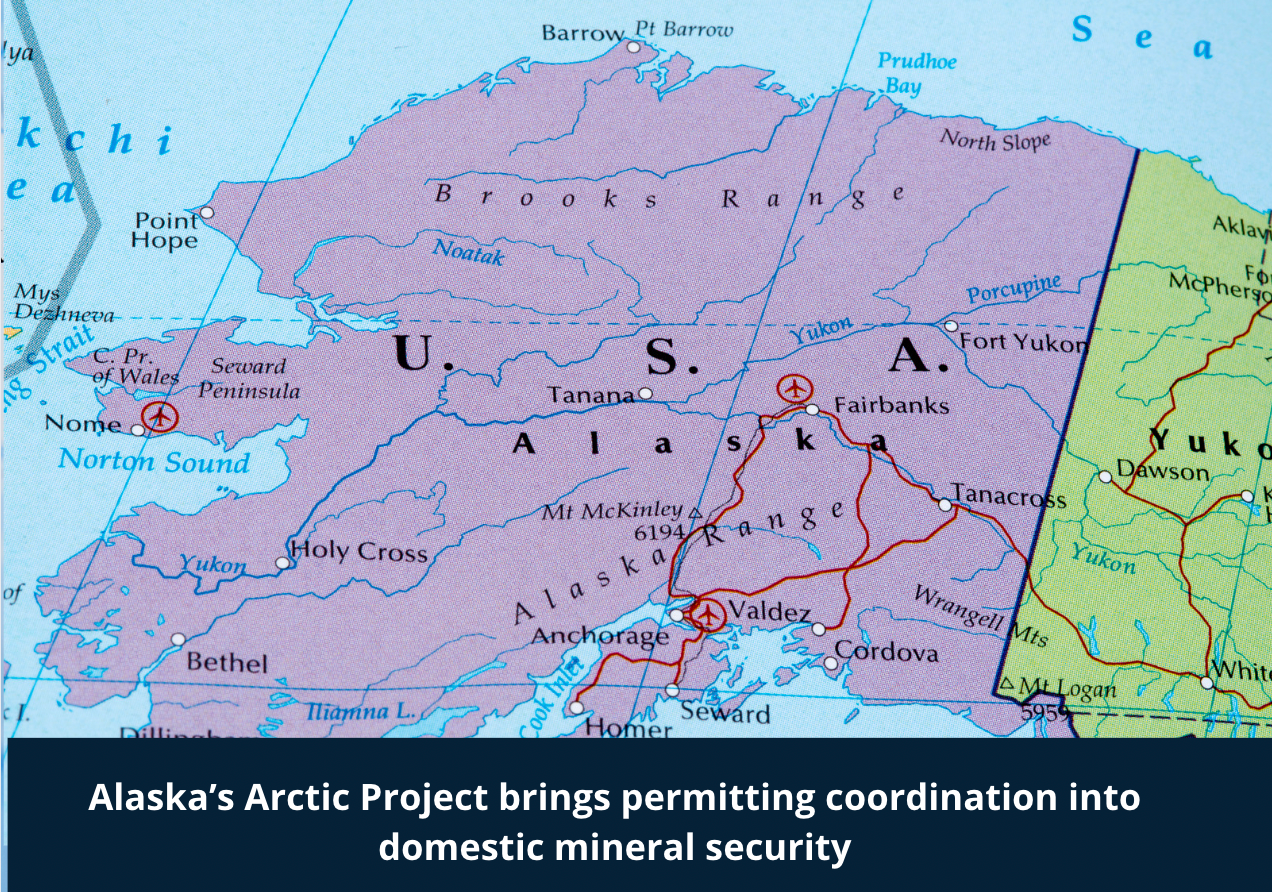
Signal 4: Alaska’s Arctic Project brings permitting coordination into domestic mineral security
What happened
On May 15, 2026, the Federal Permitting Improvement Steering Council announced that the Arctic Project had gained FAST-41 coverage. The project is located in Alaska’s Ambler Mining District and aims to mine copper, zinc, lead and other valuable minerals. According to the Permitting Council, the site has 46.7 million tons of probable mineral reserves, and project sponsors estimate production of 10,000 tons of ore per day over a 13-year mine life.
The Arctic Project is sponsored by Ambler Metals LLC, a joint venture between Trilogy Metals and South32, with the U.S. Army Corps of Engineers serving as the lead federal permitting agency. The Permitting Council described FAST-41 coverage as a way to provide greater transparency, predictability and coordination in the federal environmental review and authorization process.
Why it matters
This matters because permitting coordination is becoming part of domestic mineral security. The Arctic Project is not simply a mining project in Alaska. It sits inside a broader debate about U.S. dependence, domestic supply, critical infrastructure, Indigenous and regional engagement, environmental review, and the capacity of the federal system to move strategic projects through a clear process.
FAST-41 does not eliminate environmental review or project risk. Its relevance is procedural. It gives the project a more structured federal permitting track and makes timeline, agency coordination and public visibility more central to how the project is evaluated.
Implications for capital and strategy
For capital, this signal shows why permitting architecture matters to project value. Strategic mineral assets become more investable when the review process is transparent, coordinated and legible, even when substantive approvals remain ahead.
For strategy, the deeper message is that domestic mineral security depends on institutional speed and credibility. The United States can identify strategic deposits, but turning them into supply requires a permitting system that can manage complexity without losing legitimacy.
Signal 5: Germanium recovery is moving into existing mine and processing systems
What happened
On May 13, 2026, Titan Mining announced a cooperation agreement with Teck Resources to evaluate the recovery of germanium from existing processing streams at Titan’s Empire State Mines in upstate New York. Titan said the agreement could evaluate the potential for approximately 13,000 kg per year of contained germanium from existing process streams, with no additional mining required.
Titan also stated that Teck’s Trail Operations is the only commercial scale facility in North America recovering germanium from primary sources. The company framed germanium as a critical mineral used in defense applications, semiconductor and chip manufacturing, and fiber optic and communications infrastructure.
Why it matters
This matters because critical mineral supply does not always require a new mine. In some cases, it may come from existing operations, waste streams, tailings, by products and processing systems that were not originally designed around strategic minerals.
The signal is important because germanium is small in volume but high in strategic relevance. It is tied to defense, infrared optics, semiconductors and communications infrastructure. Recovering it from material already being mined and processed could create a capital efficient pathway to supply without expanding the mining footprint.
Implications for capital and strategy
For capital, this signal highlights the growing value of by product recovery and waste stream analysis. Existing mines may contain strategic optionality that is not fully reflected in traditional project valuation.
For strategy, the deeper message is that critical mineral security will increasingly depend on how intelligently existing systems are used. Mine waste, process streams and metallurgical partnerships may become part of the next supply frontier, especially for minerals that are too small or dispersed to justify stand-alone mines.
Signal 6: Codelco shows why state owned copper champions are becoming governance tests
What happened
This week, Chile’s Ministry of Mining announced new directors for Codelco, including Bernardo Fontaine, Luz Granier and Alejandro Canut. The ministry’s announcement said the new directors would assume with a special mandate of investigation and possible external audit to gather information.
Codelco’s relevance makes this governance signal strategic. The company’s own 2025 figures show production of 1,334,445 tonnes of copper and contributions to the Chilean treasury of US$1.778 billion. Codelco also describes its mission as maximizing economic, environmental and social value and its contribution to the Chilean state through copper mining and by-products.
Why it matters
This matters because Codelco is not only a company. It is a state owned copper champion, a fiscal pillar for Chile, and a structural actor in global copper supply. When copper becomes more strategic for electrification, infrastructure, defense, AI data centers and industrial policy, the governance of companies like Codelco becomes part of mineral security.
The signal should not be reduced to board politics. The deeper issue is institutional confidence. State owned mining companies carry a dual responsibility: they must deliver production and financial performance while also preserving public legitimacy, transparency and long term national value.
Implications for capital and strategy
For capital, the signal is that governance, transparency and production credibility matter deeply in state owned mining systems. Investors, partners and offtakers need confidence not only in the asset base, but in the institution managing that asset base.
For strategy, the deeper message is that copper security depends on governance as much as geology. Countries with state owned mining champions will be judged by their ability to combine national ownership, technical execution, financial discipline, transparency and continuity. Codelco is becoming a clear example of that test.
Signals to watch
- Whether the DOMINANCE Act advances beyond committee and begins to shape a more formal U.S. mineral diplomacy architecture.
- Whether USGS–NASA hyperspectral mapping produces data that materially improves exploration targeting, mine waste assessment and public geoscience capacity.
- Whether Canada’s public-capital support for North American Lithium translates into meaningful brownfield expansion, lower costs and stronger North American lithium supply.
- Whether FAST-41 coverage gives the Arctic Project a clearer federal permitting path while maintaining environmental review, community engagement and regulatory legitimacy.
- Whether Titan and Teck can move germanium recovery from technical evaluation into commercial feedstock, processing and offtake structures.
- Whether Codelco’s board renewal strengthens confidence around production governance, financial discipline, transparency and execution capacity.
- Whether The Metals Company and Allseas’ commercial agreement for offshore nodule recovery moves from engineering and regulatory progress into a credible project finance pathway. TMC said the commercial system would have nameplate capacity of 3.0 million wet tonnes per year, with commissioning targeted for Q4 2027, subject to regulatory approvals.
Three strategic questions for this week
- Which countries are building the strongest institutional systems around critical minerals?
- Where is mineral security being shaped most clearly: diplomacy, data, public finance, permitting, processing or governance?
- How should investors read projects when strategic value increasingly depends on the system around the asset?
Resources
Signal 1
- Congresswoman Young Kim — Reps. Kim, Bera DOMINANCE Act Passes House Foreign Affairs Committee
- House Foreign Affairs Committee — H.R. 7037, DOMINANCE Act committee text
Signal 2
Signal 3
Signal 4
Signal 5
Signal 6
- Ministerio de Minería de Chile — Biministro Daniel Mas Anuncia Nuevos Directores para Codelco
- Codelco — Codelco Closed 2025 with an EBITDA of US$6.67 Billion, a Consolidated Profit of US$2.423 Billion and a Contribution to the Treasury of US$1.778 Billion
Signals to watch