
Geopolitical Mining · Davos 2026
Davos 2026 | Fifth Axis of Analysis. Milei and Carney: Values, Order and the West’s Internal Conversation
Authors: Marta Rivera | Eduardo Zamanillo
This piece is part of our Davos 2026 analysis series at Geopolitical Mining. For the full framework behind our reading of these speeches, see “Davos 2026: Coordinates of the New Geopolitical Era” .
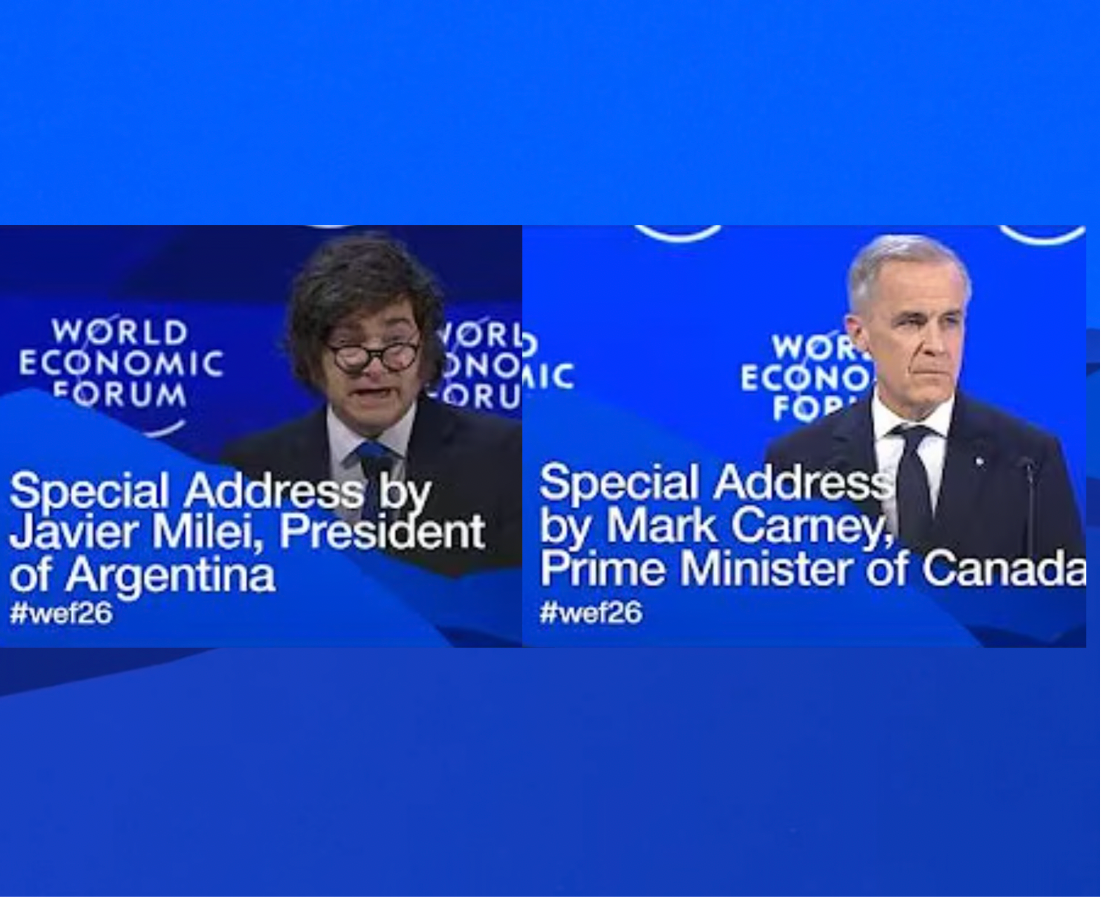
In the speeches by Javier Milei and Mark Carney, Davos 2026 opens a different layer of discussion: what “the West” means today, which values are being upheld, and how those values connect to geopolitical strategy.
Milei speaks from political philosophy and the ethics of capitalism: natural law, freedom, private property and markets as pillars of Western civilisation, and a frontal critique of the currents that, in his view, have eroded those foundations. Carney, by contrast, speaks from institutional architecture and the role of middle powers: he recognises the breakdown of the rules-based order and proposes a “value-based realism” in which those principles are translated into concrete designs for policies, alliances and standards.
This axis puts those two perspectives into dialogue. First, Milei’s defence of free-enterprise capitalism as an ethical and efficient system. Then, Carney’s proposal to use values as a criterion for building a second level of the world order, less dependent on the great powers. Finally, a joint reading of what both are saying (from different planes) about the West’s internal renegotiation of its own narrative in a tougher and more fragmented world.
1. Javier Milei: Ethics, Markets and the Roots of the West
Milei’s speech is built as a defence of economic freedom and of the Western tradition in a broad sense. Its structure has four clear pillars.
1. Natural law, rights and legitimacy
Milei starts with a distinction between natural law and positive law. Natural law, he argues, is that which derives from human nature itself and is valid in all times and places. Positive law is the set of rules that States create for reasons of convenience.
His thesis is that positive laws cease to be legitimate when they stray too far from natural law. From there he grounds three basic rights: life, liberty and property, and argues that any political order that erodes them ultimately generates poverty, corruption and concentration of power.
2. Libertarian liberalism as a moral order
He then describes what he calls “libertarian liberalism”: unrestricted respect for other people’s life projects, the non aggression principle and the defence of each person’s right to dispose of their own time and effort. The image he proposes is a society of voluntary exchanges, where the State is limited to protecting rights and ensuring that no one resorts to violence.
3. Free-enterprise capitalism as a fair and efficient system
In the more economic part, Milei moves from Adam Smith to modern growth theories to argue that free enterprise capitalism achieves two things at once. It generates more production, innovation and material well being than any other system, and it does so (in his reading) while respecting the rights mentioned above. For him, the problems do not come from the market, but from State intervention that distorts prices, captures rents and creates privileges.
4. The West, cultural crisis and a call to “return to the sources”
The closing of the speech moves up a level. Milei speaks of a “crisis of the West” associated with the advance of ideologies that relativise freedom and individual responsibility. He vindicates four roots of Western civilisation: Greek philosophy, Roman law, the Judeo Christian tradition and the market economy.
He presents them as pillars that made possible the historical leap in prosperity and human dignity. And he argues that the Americas can become the place from which that legacy is “reignited.”
Taken together, his message places values and economics in the same equation: an order that respects life, liberty and property would be, for him, at the same time fairer and more efficient. The implicit diagnosis is that part of the West has drifted away from that framework and that, without a “return to the sources,” it will be hard to sustain either prosperity or influence.
2. Mark Carney: Value-Based Realism and the Role of Middle Powers
Mark Carney’s speech operates on a different plane, but is equally loaded with normative content. He begins by acknowledging something that many leaders imply but few state so openly: the international rules based order has fractured.
“Rupture” of the order and the end of a comfortable fiction
Carney speaks of a “rupture in the world order” and of “the end of a pleasant fiction” in which it was assumed that rules restrained excessive power. He describes a scenario in which great powers use tariffs, financial systems, supply chains and sanctions as instruments of geopolitical coercion.
He does not stop at denunciation: he states that this era has arrived, and that middle powers cannot continue acting as if they still lived in the previous world.
“Value-based realism”
The response he proposes he formulates as value based realism: realism because one must accept that there is great power rivalry, that institutions have limits and that not all actors share the same principles; value based because, even so, Canada and other intermediate countries want to anchor their foreign policy in clear minima: sovereignty and territorial integrity, human rights, sustainable development, cooperation and respect for one’s word.
The message is that values are not abandoned, but nor is a no longer existing order idealised. One acts with one’s feet in reality and one’s eyes on a framework of shared principles.
Middle powers as architects, not spectators
Carney argues that mid-sized countries (Canada, European states, some Asian and Latin American countries) are not doomed to be spectators of great-power rivalry. They can: build strategic autonomy in energy, food, finance, minerals and key technologies; coordinate among themselves to define standards, trade agreements and investment frameworks; and use their combined weight to shape a “second tier” of the world order, less dependent on decisions taken in Washington, Beijing or Moscow.
The phrase that condenses this (repeated later in analyses and commentaries) is that “if middle powers are not at the table, they will be on the menu.”
Values as institutional design, not just discourse
Unlike Milei, Carney translates values in a very operational way. He speaks, for example, of strengthening alliances with countries that share basic standards of sovereignty and respect for rights, building coalitions to address specific issues (climate, critical minerals, AI) in which middle powers coordinate, and using Canada’s foreign and financial apparatus to support actors that respect certain principles and limit dependence on those who do not.
His speech is less philosophical than Milei’s, but also starts from a judgement of value: there are practices he considers unacceptable (territorial aggression, extreme instrumentalisation of trade), and he believes the answer cannot be nostalgia but new institutions and new alliances built around minimum value criteria.
3. What They Reveal Together About the West’s Internal Debate
Read in parallel, Milei and Carney are not on the same political line, but their speeches can be seen as two sides of an internal Western conversation.
1. On the diagnosis of crisis
Milei speaks of a deep cultural crisis: he believes the West has moved away from the principles of freedom, individual responsibility and property, and that this opens the door to statism and ideologies that, in his view, erode both growth and ethics. Carney speaks of a crisis of order: he recognises that the institutional architecture built after the Second World War has degraded and that rules are now used as weapons in the hands of great powers.
The planes are different, but both start from the idea that the Western status quo no longer works as it once did.
2. On the role of values
For Milei, values are a premise: a system will only be legitimate and effective if it respects certain universal principles (life, liberty, property). Institutions must adjust to that foundation, not the other way around. For Carney, values are a design criterion: they serve to filter alliances, set foreign policy priorities and structure the use of economic tools in a competitive world.
In both cases, values cease to be decorative discourse and become variables that influence concrete decisions: whom to trade with, what to finance, which conflicts are considered intolerable.
3. On the type of West they want to build
Milei imagines a West that is rebuilt “from within,” recovering philosophical and economic foundations that, in his reading, made the historical expansion of freedom and prosperity possible. The Americas appear as the space where that “reigniting” could occur.
Carney imagines a more plural and polycentric West, where middle powers have a more active role, and where values are translated into architectures of cooperation, not just narrative. The emphasis is on practical arrangements: agreements, coalitions, standards, coordinated investment.
This fifth axis brings out something that many quick readings of Davos miss: while the world is debating tariffs, minerals, AI and wars, it is also renegotiating what “the West” means and under what principles it wants to continue operating.
That backdrop matters for mining for two reasons:
- The type of narrative that prevails, more centred on free enterprise and individual rights, or more oriented towards structured cooperation among middle powers, will influence how mining projects are justified and regulated, which standards are required and how value is shared between companies, States and communities.
- The West’s credibility outward will depend on whether it manages to align its value narrative with its material decisions: what it buys, what it finances, from whom it imports and under what conditions. Mining, given its symbolic and environmental weight, will be one of the places where that coherence (or incoherence) is most visible.
4. How This Axis Feeds the Overall Framework
The Milei – Carney axis adds to the overall framework something that is not as visible in other speeches: the normative layer of the new geopolitics, that is, how the West is redefining its own principles in parallel with the industrial and material turn.
It gives substance to the discussion on the social contract and legitimacy, but in the key of values. While other leaders speak about wages, consumption, social programmes or stability, Milei and Carney discuss under what principles those decisions should be taken. Milei argues that without a framework of life, liberty and property, prosperity ends up being unsustainable; the problem is not just economic but one of coherence between institutional order and values. Carney maintains that, in a world of hard competition, middle powers must still be guided by minimums of sovereignty, human rights, sustainable development and respect for one’s word, while not denying the reality of coercion and the political use of rules.
This axis reinforces the second insight from another angle: legitimacy does not depend solely on material outcomes, but also on whether people feel that the system respects principles they can understand and accept.
It shows that values are also tools of institutional design, not just discourse. In the overall framework we argue that the order is moving from form to substance: from declarations to execution. Milei and Carney show that this also applies to values. Milei places them as a premise: institutions must adapt to certain principles, not vice versa. Carney uses them as design criteria: they serve to filter alliances, decide what is financed, and determine which practices are tolerated and which are not.
In both cases, values cease to be “ornament” and become design variables. This feeds into the first and second insights: the industrial and material turn, and the reconstruction of the social contract, are not neutral; they are shaped by the struggle over what is considered acceptable when power, wealth and risks are distributed.
It directly connects the Western narrative, resources and standards for mining. This axis also has a direct translation into mining and supply chains. If a narrative more centred on free enterprise and individual rights (such as Milei’s) prevails, the emphasis will be on reducing barriers, ensuring legal stability and attracting capital, with the discussion focused on how not to choke off investment.
If a narrative more oriented towards structured cooperation among middle powers and “value-based realism” (such as Carney’s) prevails, we will see more weight given to coalitions and shared standards on climate, critical minerals, human rights and due diligence. In both cases, decisions on how mining projects are justified and regulated, which standards are demanded and how value is shared between companies, States and communities will be influenced by this internal debate on what “the West” is and what “rules-based order” means.
Finally, this axis underlines something that will be central to geopolitical mining: the West’s external credibility will depend on its ability to align its value narrative with its material decisions, what it buys, what it finances, from whom it imports and under what conditions. Given mining’s symbolic and environmental weight, it will be one of the first places where that coherence (or lack of it) becomes visible.
This axis connects with the other five we analyse for Davos 2026. To see how they all fit into a single framework, you can read the full article: “Davos 2026: Coordinates of the New Geopolitical Era” .

For the full Geopolitical Mining framework behind this article, see our book Mining Is Dead. Long Live Geopolitical Mining .