
Geopolitical Mining · Article
Critical Minerals in Munich, Reading Rubio’s Speech as a Strategic Signal
Authors: Marta Rivera | Eduardo Zamanillo
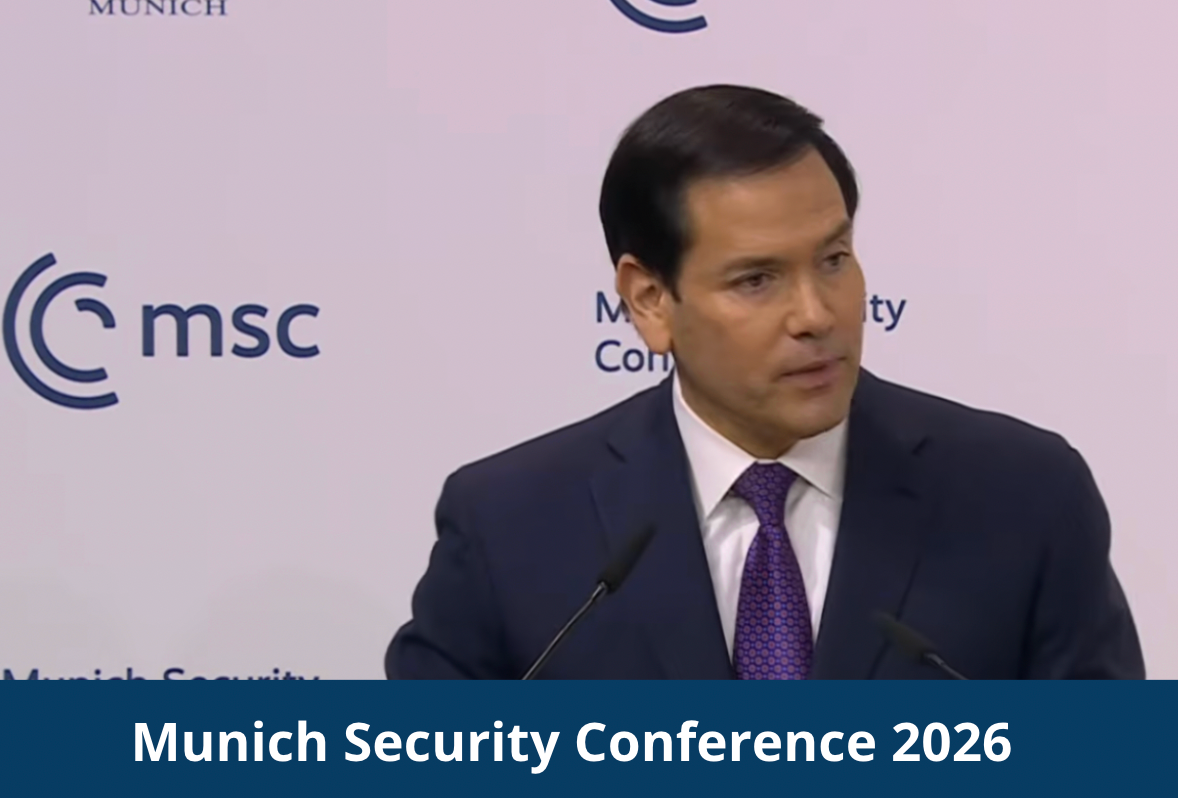
Secretary Marco Rubio’s speech at the Munich Security Conference is already being interpreted as a message to Europe: the United States still wants a strong transatlantic partnership. But if we read the full transcript carefully, the text does something more specific. It offers a compact narrative of how this version of the West explains the past thirty years, what it believes went wrong, and what it now intends to rebuild.
For anyone working on critical minerals and industrial strategy, the value of the speech is not in policy detail. It lies in the way it makes the political direction explicit and in how clearly it places critical minerals inside that direction.
1. How the past thirty years are framed
Rubio opens in familiar historical territory: early 1960s Munich, the Berlin Wall, the Cuban Missile Crisis, the sense that thousands of years of Western civilization hung in the balance. The transatlantic alliance is presented as a project that could have failed but did not, because Europe and America prevailed together and rebuilt a continent.
The real pivot comes later. He argues that the euphoria after the fall of the Berlin Wall produced a dangerous delusion. The idea that history had effectively ended, that every nation would eventually become a liberal democracy, that trade and global rules could replace national interest, and that borders had become almost irrelevant.
From there, he draws a straight line to the present. In his view, Deindustrialisation was a policy choice, not a natural outcome. Loss of supply chain sovereignty was a voluntary transformation, not the mark of a healthy trading system. Mass migration is a structural crisis, not a fringe concern. Over reliance on international institutions left Western states exposed in a world where others invested heavily in hard power.
Without judging that diagnosis, the internal logic is clear: the West weakened itself by outsourcing too much of its industrial base, accepting deep dependencies in critical supply chains, and assuming that a rules based order would be enough to manage threats.
Mining and minerals are not mentioned explicitly in this section. But they sit inside the broader category of productive capacity and supply chain sovereignty that, according to the speech, were traded away too easily.
2. What he wants to rebuild, a materially grounded West
After this diagnosis, the text turns toward the future. Under President Trump, Rubio says, the United States will pursue renewal and restoration, and it would rather do so with Europe than alone. The justification for that preference is civilizational: America is presented as a child of Europe, tied to the continent not just economically or militarily, but culturally, spiritually and historically.
This civilizational language is doing concrete work. It anchors the answer to a simple question: what exactly is being defended? Rubio argues that national security debates are not just about defence budgets or force deployment. Armies, he says, do not fight for abstractions; they fight for a people, a way of life, a civilization.
From a Geopolitical Mining perspective, that framing matters. It means that questions about industrial policy, energy security and critical minerals are now part of a larger project aimed at: restoring control over key elements of the material economy, and sustaining the ability of this civilisation to shape its own economic and political destiny.
In this context, mining and processing are no longer peripheral or purely sectoral. They are part of the infrastructure that underpins the kind of civilisation to defend.
3. The crucial sentence on critical minerals
The most explicit reference to our field arrives when Rubio describes what the new alliance should work on. The list is short, but dense: commercial space travel and cutting edge artificial intelligence; industrial automation and flex manufacturing; creating a Western supply chain for critical minerals not vulnerable to extortion from other powers; and a unified effort to compete for market share in the economies of the Global South.
This single sentence contains several signals that are directly relevant for critical minerals.
First, critical minerals are placed at the same level as frontier technologies. They appear alongside commercial space, AI and industrial automation. The implication is clear: access to and control over these materials is treated as basic infrastructure for strategic capabilities, not as a legacy extractive sector that sits at the margins of the economy.
Second, the supply chain is explicitly defined as Western, not simply global. The text does not talk about neutral or open supply chains optimised only for efficiency. It speaks of a supply chain with political boundaries:
- Inside: the U.S., Europe and aligned partners.
- Outside: “other powers” with the capacity to use dependencies as leverage.
The key risk here is described as extortion. The concern is not just price volatility; it is geopolitical vulnerability in which a single actor, or a very small group, can restrict access, weaponise trade flows or impose conditions.
Third, the sentence connects this Western supply chain directly to the Global South. Immediately after mentioning critical minerals, Rubio calls for a unified effort to compete for market share in the economies of the Global South. That is where many of the reserves that matter for batteries, electrification and defence are located.
Taken together, this tells us three things. The West is not only trying to rebuild capacity at home and among close allies. It is also preparing to be more deliberate in how it competes for influence, access and industrial presence in resource rich regions. Critical minerals are one of the lenses through which this competition will be structured.
For Geopolitical Mining, the sentence functions as confirmation of a direction we have already seen in policy: critical minerals have moved from technical annexes into the centre of the strategic conversation.
4. Europe’s role: reassurance, expectations and conditions
A large part of the speech is addressed to European partners. Rubio repeats that the United States and Europe belong together, that the West is a single civilisation, and that America wants a Europe that is strong, able to defend itself and proud of its heritage.
At the same time, he is explicit about what Washington expects from its allies. The U.S. does not want partners who are weak, paralysed by guilt or attached to what he calls a broken status quo. It wants allies who: invest seriously in defence,regain control over their borders, and are willing to revisit policies that, in this narrative, contributed to deindustrialisation and vulnerability, including some energy and climate strategies.
For Europe, this means that the partnership is being redefined around three intersecting pillars:
- Security and defence capabilities: a more substantial European contribution to collective deterrence.
- Industrial and energy resilience: policies that keep societies prosperous and reduce strategic dependence.
- A role in the critical minerals chain: participation not only as consumer, but as builder of processing capacity, regulation and standards.
This raises an important question that the speech itself does not answer: will Europe act as a co-designer of the Western critical minerals architecture, or will it primarily adapt to arrangements driven from Washington? The answer will depend on how European initiatives such as the Critical Raw Materials Act, national industrial plans and ESG frameworks interact with American policies and diplomatic efforts.
5. Institutions, hard power and clubs
Another section of the speech deals with international institutions, notably the United Nations. Rubio acknowledges that they can be tools for good, but argues that on key crises (Gaza, Ukraine, Iran, Venezuela) they have played virtually no role. The text attributes progress not to multilateral bodies, but to U.S. leadership, including the use of force.
From a governance perspective, this suggests that the centre of gravity is moving away from broad, universal institutions toward smaller, politically aligned coalitions. In the world of critical minerals, this may translate into:
- standards and ESG norms defined by groups of like minded countries,
- permitting and best practice frameworks shared within clubs rather than agreed globally,
- and access arrangements negotiated through minilateral or bilateral deals, not primarily through large multilateral platforms.
This does not mean that global institutions disappear, but it narrows the space where they are expected to be decisive. The practical architecture of a Western supply chain for critical minerals is likely to be built in more concentrated formats, G7 style groupings, regional compacts, or issue specific alliances.
6. What this means for Geopolitical Mining
If we take the speech as a political signal rather than as a technical plan, several elements become useful for our frameworks.
First, the diagnosis is now explicit. Deindustrialisation and loss of supply chain sovereignty are labelled as mistakes that must be corrected. Dependence on a single rival for strategic inputs is framed as unacceptable. A Western centred supply chain for critical minerals is named as a strategic goal.
Second, the scope of the project is clear. This is not only about reopening mines or financing new processing plants. It is about reconfiguring: how industrial capacity is distributed between North America and Europe, how alliances are structured around material capabilities, and how engagement with the Global South is approached in a context of open competition with other major powers.
Third, the speech formalises a link between civilisational language and material policy. The defence of a way of life is tied to control over industrial and resource infrastructures. That connection will influence how domestic debates on permitting, ESG standards, community relations and industrial policy are framed and contested.
These elements do not tell us which specific projects will go ahead, where capital will actually be deployed or how much risk investors will tolerate. But they do indicate the direction of travel under this leadership. They provide a reference point against which upcoming policies, partnerships and conflicts can be interpreted.
Source
- U.S. Department of State — “Secretary of State Marco Rubio at the Munich Security Conference” (February 2026). https://www.state.gov/releases/office-of-the-spokesperson/2026/02/secretary-of-state-marco-rubio-at-the-munich-security-conference

For board-level insight and decision support on mining, legitimacy and industrial strategy, visit Geopolitical Mining Advisory .

For the full Geopolitical Mining framework behind this article, see our book Mining Is Dead. Long Live Geopolitical Mining .