Geopolitical Mining · Weekly
Geopolitical Mining Weekly
Week of March 2–8, 2026
Authors: Marta Rivera | Eduardo Zamanillo
What this week really tells us
This week, six developments showed that critical minerals are moving further away from broad strategy language and deeper into delivery systems, regulatory control and security framing. Canada used PDAC to bundle alliances, capital, infrastructure and permitting tools into a single mine to market platform. Washington put new Defense Production Act money into domestic antimony. Brussels advanced amendments to the Critical Raw Materials Act. Malaysia renewed Lynas’ rare earth processing licence, but under harder waste related conditions. The UN Security Council held a formal briefing on energy, critical minerals and security. Australia paired a fresh resource stocktake with new refining support and tighter allied coordination.
The common pattern is clear. The competitive edge in critical minerals is being shaped less by declarations of intent and more by whether states can connect geology to infrastructure, processing, financing, compliance and political durability. In some places, that means public capital and permitting tools. In others, it means waste governance, stockpiling logic or corporate vulnerability mapping. The system is becoming more institutional, more security linked and more selective.
A second signal also matters. Real supply is no longer only about what can be mined. It is about what can be processed, financed, permitted, socially sustained and benchmarked. Antimony illustrated that clearly this week: the United States moved defence money into domestic supply while Fastmarkets launched new CIF Rotterdam/Antwerp assessments, showing that even smaller minerals are beginning to acquire their own strategic market infrastructure.
For boards and investors, the question is less whether critical minerals remain strategic, and more which assets sit inside systems that can actually deliver: systems with state support, institutional clarity, midstream ambition and enough legitimacy to keep operating when politics, security or public scrutiny intensify.
For private decision support on project, jurisdiction or capital questions, Geopolitical Mining Advisory applies a Systemic Mining Viability lens to assess whether a mining opportunity can become credible, legitimate and financeable before full due diligence begins.
Signals of the week
Signal 1: Canada turns PDAC into a delivery platform
a) What happened
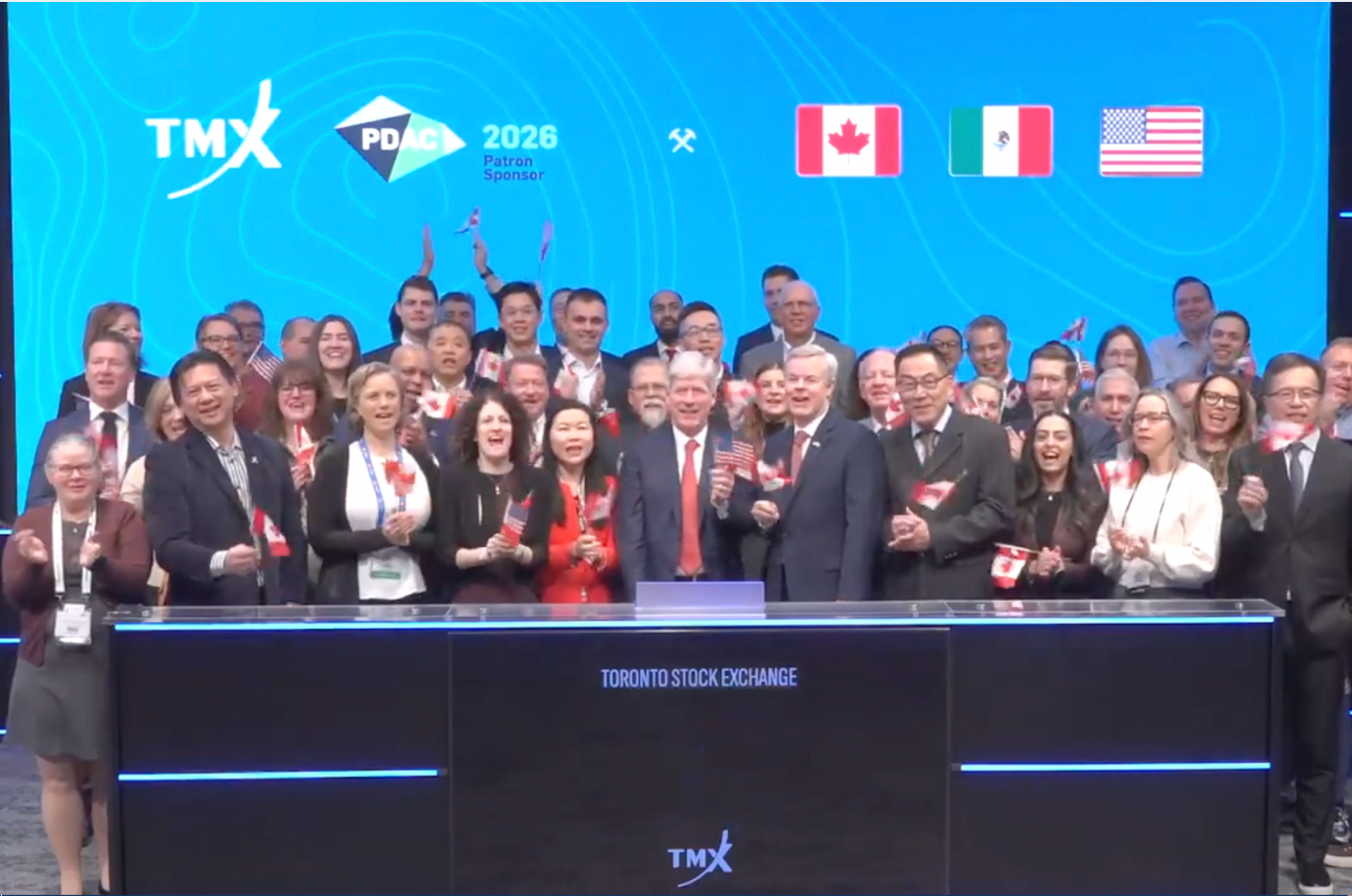
At PDAC, Canada moved beyond general positioning and announced a bundled package of delivery tools. Natural Resources Canada said the government had secured a second round of 30 partnerships and investments under the Critical Minerals Production Alliance, expected to unlock over C$12.1 billion across projects with 12 allied partners. It also announced over C$3.6 billion in new programs and investments, including up to C$165.2 million for 22 projects, the formal launch of the C$1.5 billion First and Last Mile Fund, the coming spring launch of the C$2 billion Critical Minerals Sovereign Fund, and a new Mine Permit Navigator tied to “One Project, One Review” and two year approval timelines.
b) Why it matters
This matters because Canada used the week not just to tell a story about critical minerals, but to assemble a full delivery architecture: alliance based capital attraction, enabling infrastructure, public investment tools and regulatory visibility. That is a more serious competitive proposition than simply advertising resource abundance. It also shows how Western jurisdictions are trying to close the gap between upstream promise and downstream execution.
c) Implications for capital and strategy
For investors and boards, this implies that Canada should be assessed less as a generic safe jurisdiction and more as a jurisdiction trying to integrate financing, infrastructure and permitting into a strategic production system. That can materially affect timelines, risk premia and project bankability.
Signal 2: Antimony is moving from specialty metal to strategic system
a) What happened
On March 4, the U.S. Department of War announced a US$27 million DPA Title III investment in U.S. Antimony Corporation for domestic extraction, processing and refinement of antimony, including capacity expansion in Montana and support for an extraction initiative in Alaska. One day earlier, Fastmarkets announced the launch of two twice weekly CIF Rotterdam/Antwerp antimony price assessments, effective March 4.
b) Why it matters
Antimony is a useful signal because it sits at the intersection of defence need, supply vulnerability and market opacity. This week showed movement on two fronts at once: public money aimed at physical capacity, and new benchmark infrastructure aimed at making the market more legible. That does not yet solve the supply problem, but it does show that smaller critical minerals are moving into the same policy-and-market treatment once reserved for larger battery and rare earth chains.
c) Implications for capital and strategy
For investors and boards, this implies that niche minerals should no longer be treated as peripheral. Where defence demand, concentrated supply and thin price discovery coincide, the policy response can become a major valuation variable.
Signal 3: Europe pushes critical minerals deeper into corporate governance
a) What happened
On March 4, the Council of the European Union adopted its position on amendments to the Critical Raw Materials Act. The Council said the revised approach would move the responsibility for identifying large CRM using companies to the European Commission, improve transparency and accountability around vulnerabilities, clarify the Commission’s authority to propose risk-mitigation measures, and allow digital product passports to satisfy permanent-magnet information requirements.
b) Why it matters
The EU is moving beyond supply ambitions and into the governance of dependence. This is important because it widens the critical minerals agenda from mines and projects into procurement, reporting, vulnerability management and traceability. In practice, Europe is trying to govern exposure to concentrated supply in a more systematic way, including in industrial segments such as permanent magnets that matter for both clean tech and defence-adjacent manufacturing.
c) Implications for capital and strategy
For companies selling into Europe, this implies that access will increasingly depend not only on supply availability, but also on the ability to document origin, manage vulnerability and fit into a stricter compliance environment.
Signal 4: Malaysia keeps Lynas in the system, but on stricter legitimacy terms
a) What happened
Malaysia renewed Lynas Malaysia’s operating licence for 10 years effective March 3, according to Bernama, which cited the company’s statement that it had received a letter from the Malaysian regulator. AP reported that the renewed licence requires Lynas to stop producing radioactive waste by 2031, while The Edge Malaysia reported that the licence will also be subject to a comprehensive review after five years.
b) Why it matters
This is one of the most important rare earth signals of the week because it captures a tension that will likely define non China processing in the years ahead. Diversification remains strategically valuable, but operating legitimacy still has to be earned and maintained. Malaysia did not shut the system down. It renewed it under harder conditions. That is a useful reminder that midstream resilience outside China will depend not only on industrial support, but also on waste governance, public trust and regulatory durability.
c) Implications for capital and strategy
For boards and investors, this implies that rare earth processing assets outside China should be modelled not only through strategic scarcity, but also through waste management obligations, review risk and the durability of social licence.
Signal 5: Critical minerals enter the UN Security Council vocabulary
a) What happened
On March 5, the UN Security Council held a formal briefing on “Energy, Critical Minerals and Security”. UN coverage of the session said speakers framed critical minerals as underpinning the digital economy and the energy transition, and discussed them explicitly through a security lens.
b) Why it matters
This does not create immediate legal obligations for mining projects, but it does mark a meaningful shift in framing. Once critical minerals enter formal security discourse at that level, they are less likely to remain confined to trade, industry or energy policy. That widens the field of institutions that may shape the sector, from defence planners and foreign ministries to multilateral bodies and strategic stockpiling systems.
c) Implications for capital and strategy
For investors and boards, this implies that geopolitical mining analysis has to include security institutions more explicitly. The next phase of market shaping may come as much from security logic as from industrial policy.
Signal 6: Australia pairs reserve depth with refining and allied alignment
a) What happened
Australia used the week to connect three layers of strategy. On March 2, Geoscience Australia released AIMR 2025, saying the country remains well placed to support global demand and that critical minerals such as antimony and rare earths recorded significant resource-estimate increases. On March 6, the Albanese government awarded A$53 million to the Critical Metals for Critical Industries CRC to commercialise refining technologies, with 62 partners contributing a further A$185 million. And on March 5, Australia and Canada confirmed in a joint statement that Australia had joined the G7 Critical Minerals Production Alliance and would deepen collaboration between Australia’s Critical Minerals Strategic Reserve and Canada’s Critical Minerals Sovereign Fund.
b) Why it matters
This is a more complete strategic posture than a simple resource power narrative. Australia is showing three things at once: upstream depth, a stated push into refining capability, and tighter integration with allied production and reserve frameworks. That combination matters because the premium is shifting from resource ownership alone toward the ability to connect deposits to processing, public support and trusted market lanes.
c) Implications for capital and strategy
For investors and boards, this implies that Australian assets gain added strategic value when they can connect into refining pathways and alliance backed supply systems, rather than remaining only upstream export stories.
Signals to watch
- Whether Canada’s Production Alliance announcements translate into named project milestones, financing closes or construction starts over the next 6-18 months.
- Whether the First and Last Mile Fund and Critical Minerals Sovereign Fund materially change the economics of stranded or infrastructure-constrained projects in Canada.
- Whether U.S. public support for antimony expands from one company award into a broader domestic pipeline of extraction, refining and stockpiling action.
- Whether the EU’s CRMA amendments translate into sharper obligations for large industrial users, especially around vulnerability mapping and permanent-magnet traceability.
- Whether Lynas can maintain operating continuity in Malaysia while meeting the tougher waste-related conditions and mid-term review requirements.
- Whether Australia can convert stronger resource depth and CRC backed refining R&D into commercial midstream capacity within allied supply systems.
Three strategic questions for this week
- As more governments move from mineral strategy to delivery architecture, are we mapping our portfolio against actual systems of infrastructure, public capital, permitting and allied access, rather than treating resource quality alone as the key advantage?
- In minerals such as antimony, are we treating benchmark formation, defence procurement and supply chain concentration as material strategic variables, or still viewing them as secondary market details?
- As non-China processing hubs such as Malaysia remain strategically valuable but politically and socially contested, are we integrating legitimacy and waste-governance risk into our midstream analysis with the same discipline we apply to capex, metallurgy and offtake?
For the full Geopolitical Mining framework behind this article, see our book Mining Is Dead. Long Live Geopolitical Mining.
Sources for this week’s note
- Government of Canada, “Canada charts a decisive path for mining at PDAC 2026”, March 3, 2026.
https://www.canada.ca/en/natural-resources-canada/news/2026/03/canada-charts-a-decisive-path-for-mining-at-pdac-2026.html - Natural Resources Canada, “Government of Canada invests to unlock Canada’s critical minerals advantage”, March 3, 2026.
https://www.canada.ca/en/natural-resources-canada/news/2026/03/government-of-canada-invests-to-unlock-canadas-critical-minerals-advantage.html - Natural Resources Canada, “Canada secures 30 new critical minerals partnerships and unlocks $12.1 billion in mining project capital”, March 3, 2026.
https://www.canada.ca/en/natural-resources-canada/news/2026/03/canada-secures-30-new-critical-minerals-partnerships-and-unlocks-121-billion-in-mining-project-capital.html - U.S. Department of War, “Department of War Invests $27M for the Domestic Excavation, Extraction, Processing, and Refinement of Antimony”, March 4, 2026.
https://www.war.gov/News/Releases/Release/Article/4421101/department-of-war-invests-27m-for-the-domestic-excavation-extraction-processing/ - Fastmarkets, “Launch of two antimony metal CIF Rotterdam/Antwerp price assessments: pricing notice”, March 3, 2026.
https://www.fastmarkets.com/insights/launch-of-two-antimony-metal-cif-rotterdam-antwerp-price-assessments-pricing-notice/ - Council of the European Union, “Raw materials: Council adopts position to reinforce the security of supply and the circularity of EU industry”, March 4, 2026.
https://www.consilium.europa.eu/en/press/press-releases/2026/03/04/raw-materials-council-adopts-position-to-reinforce-the-security-of-supply-and-the-circularity-of-eu-industry/ - Bernama, “Lynas Malaysia’s Operating Licence Renewed For 10 Years”, March 2, 2026.
https://www.bernama.com/en/region/news.php?id=2529506 - AP News, “Malaysia renews Australian rare earths license”, March 2, 2026.
https://apnews.com/article/malaysia-lynas-rare-earths-license-a9e3f931987ca2011133fee15f666fac - The Edge Malaysia, “Lynas must stop generating radioactive waste by 2031 under renewed licence, says minister”, March 2, 2026.
https://theedgemalaysia.com/node/794590 - United Nations, “Critical Minerals Create ‘Generational Opportunity’ for Economic Transformation, yet Intensify Security Risks in Fragile Settings, Security Council Hears”, March 5, 2026.
https://press.un.org/en/2026/sc16310.doc.htm - Geoscience Australia, “Release of Australia’s Identified Mineral Resources 2025 (AIMR) report”, March 2, 2026.
https://www.ga.gov.au/news/release-of-australias-identified-mineral-resources-2025-aimr-report - Australian Government, “$53 million in grants to help create a critical metal refining industry”, March 6, 2026.
https://www.industry.gov.au/news/53-million-grants-help-create-critical-metal-refining-industry - Prime Minister of Canada, “Joint statement by Prime Minister Mark Carney and Prime Minister Anthony Albanese”, March 5, 2026.
https://www.pm.gc.ca/en/news/statements/2026/03/05/joint-statement-prime-minister-mark-carney-and-prime-minister-anthony