Geopolitical Mining · Article
Why USA’s Americas Counter Cartel Conference and Shield of the Americas Summit matter for mining in the Americas
By Marta Rivera | Eduardo Zamanillo
Geopolitical Mining
Two March meetings, one larger signal
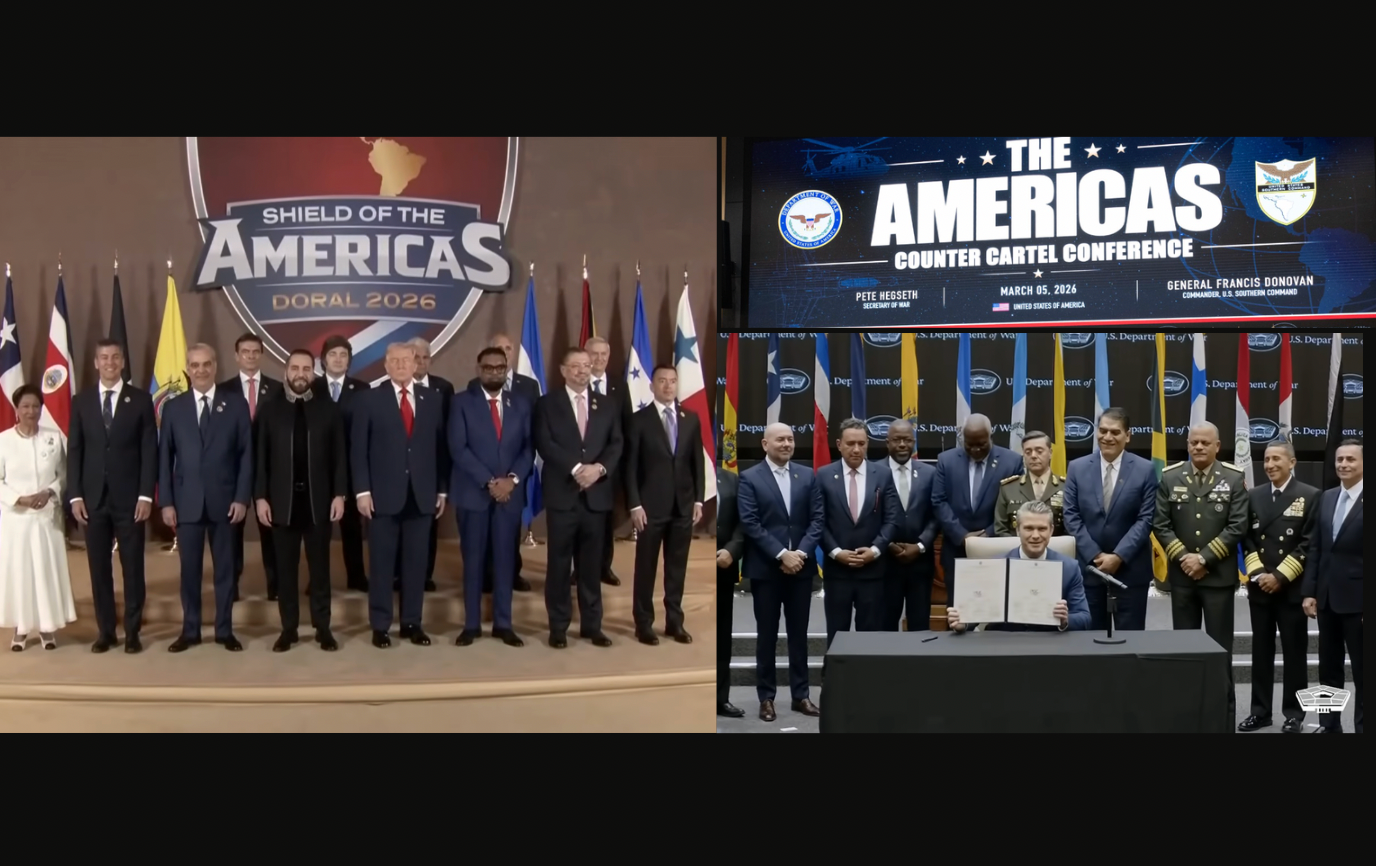
In early March, the United States convened two back to back hemispheric meetings that, at first glance, seemed to belong mainly to the security sphere. On 5 March, the Americas Counter Cartel Conference gathered U.S. officials and partner countries around cartel violence, border control, deterrence and coordinated action. Two days later, on 7 March, the Shield of the Americas Summit expanded that frame, linking security to trade, commerce, energy, migration control and foreign influence in the Western Hemisphere.
Taken separately, each meeting looked significant. Read together, they point to something larger. What the United States is building is not only a tougher anti-cartel posture. It is a broader hemispheric architecture built around territorial control, sovereignty, infrastructure, burden sharing and economic coordination. That matters for mining.
From a Geopolitical Mining perspective, the relevance is straightforward. Modern mining depends on far more than ore bodies and commodity prices. It depends on secure territory, functioning borders, predictable infrastructure, state capacity, legitimate institutions and the ability to keep illicit economies from capturing the same routes, regions and communities that formal mining needs in order to operate. That is why these March meetings deserve attention from the mining industry, even if they were not mining events in the narrow sense.
This reading is also consistent with the broader direction already visible in U.S. strategy. As we argued in “America’s 2025 National Security Strategy: When Economic Power and Critical Minerals Move to the Center”, Washington has already elevated industrial power, supply chains and critical materials into the national security conversation. The March meetings suggest that territorial security in the hemisphere is increasingly being treated as part of the same strategic system.
March 5: the hemisphere as a security space
The Americas Counter Cartel Conference was presented as an operational forum, not a symbolic gathering. In the official remarks, General Francis Donovan framed narco trafficking and cartel violence as the single gravest threat to regional security and called for aggressive collective action, burden sharing and deterrence. SOUTHCOM’s public summary also stated that representatives from 17 nations participated and that the conference concluded with a joint security declaration.
The strategic message became sharper in the interventions by Joseph Humire, Stephen Miller and Pete Hegseth. In Humire’s remarks, the Americas were described as an extension of U.S. homeland defense and as a region whose strategic importance rests on geography, not simply trade or population. In Miller’s intervention, cartels were described as the ISIS and the al-Qaeda of the Western Hemisphere, and he argued that there is no purely criminal justice solution to the cartel problem.
Hegseth then placed that logic inside a much broader doctrine. His official remarks invoked the Monroe Doctrine, argued that border security is national security, called for going on offense against narco terrorists, and outlined a map of hemispheric defense tied to key terrain, trade routes, the Panama Canal and what he called Greater North America. In his formulation, the problem was not limited to crime. It was about defending sovereign territory, industrial access and the hemisphere’s strategic space from both narco terrorist groups and external powers.
One of the most important details for the mining industry came not from Washington but from Peru. In its intervention, Peru explicitly linked transnational criminal organizations not only to drug trafficking, weapons and human trafficking, but also to illegal mining. That matters because it makes visible a connection the mining sector already knows well: in parts of Latin America, illegal mining is not separate from wider criminal economies. It intersects with territorial capture, corruption, violence and weak state presence.
That point is reinforced by the UNODC’s Minerals Crime report, which defines minerals crime as criminal activity across the supply chain, not only illegal extraction. The report states that minerals crime undermines political and economic stability, fuels corruption, weakens governance and often operates in parallel with organized criminal groups, thereby undermining state authority and the rule of law. It also notes that illegal gold mining has become highly profitable and that organized crime groups have diversified into gold because of the sector’s margins and vulnerabilities.
From a mining perspective, this matters for a simple reason: where states lose control over territory, logistics and local legitimacy, formal mining becomes harder to permit, harder to finance and harder to sustain. Illegal mining is not only an environmental problem or a law enforcement problem. It is a strategic vulnerability.
For the full Geopolitical Mining framework behind this article, see our book Mining Is Dead. Long Live Geopolitical Mining .
What was signed on March 5
The conference was not only rhetorical. It produced a joint security declaration, published by the U.S. Department of Defense, committing participating states to deeper cooperation against transnational criminal organizations and cartel linked threats. The public declaration lists signatories from Argentina, Bahamas, Belize, Bolivia, Costa Rica, Dominican Republic, Ecuador, El Salvador, Guatemala, Guyana, Honduras, Jamaica, Panama, Paraguay, Peru, and Trinidad and Tobago, in addition to the United States.
That document matters for it signals: the United States was not merely delivering a warning. It was beginning to formalize a coalition logic around hemispheric security. The distinction is important. It suggests that Washington is trying to move from diagnosis to architecture.
Time also appears as a strategic variable here. Jamaica’s representative explicitly noted how unusual it was to move from initial contact in December to a real hemispheric meeting by March. That speed matters. It fits a pattern that is increasingly visible in U.S. critical minerals and industrial policy: the administration is often describing what it is already putting in motion, rather than discussing a distant aspiration. This is one of the clearest traits of the current U.S. approach, and one we have already highlighted in “Welcome to the Era of U.S. Geopolitical Mining.”
March 7: from security to hemispheric architecture
The Shield of the Americas Summit on 7 March widened the frame. The archived event transcript identifies Donald Trump, Marco Rubio and Pete Hegseth as the three formal speakers in the main session. Trump’s remarks linked cartel violence, sovereignty, migration and strategic geography, while Rubio’s and Hegseth’s interventions reinforced the argument that the hemisphere should be treated as an immediate security perimeter.
The language of the 2026 National Defense Strategy helps explain why. The strategy states that the Department of War’s foremost priority is to defend the U.S. homeland, including by defending American interests throughout the Western Hemisphere. It specifically calls for countering narco terrorists deeper in the hemisphere, securing key terrain from the Arctic to South America, and ensuring access to the Panama Canal, the Gulf of America and Greenland. It also says that Canada and Mexico have strong roles in hemispheric defense and that partners across the hemisphere can do more to degrade narco terrorists and prevent adversaries from controlling key terrain.
This matters because it reveals the scale of the shift. The hemisphere is no longer being described only as a diplomatic neighborhood. It is being described as a security and access system.
That same logic became even more explicit in the working lunch remarks by Marco Rubio and Kristi Noem. Rubio emphasized that the initiative was not only about security, but also about trade, commerce, energy and Treasury, adding that economic progress depends on security. He also made clear that this was meant to be an issue of action, not a summit cycle that produces annual papers. To reinforce that point, he announced Noem as a special envoy dedicated to this hemispheric relationship. The message was institutional: Washington wanted follow through, not symbolism.
Noem then connected security to sovereignty, migration control, prosperity and foreign influence. She said the Shield of the Americas was intended to help member states defend their own sovereignty and economic prosperity, defeat cartel organizations, and reverse harmful foreign influences in business and technology. She also argued that security creates the conditions for business and investment relationships.
This is an important widening of scope. By the time of the 7 March summit, the frame had become:
- security,
- migration control,
- trade and commerce,
- energy,
- economic prosperity,
- and resistance to external influence.
That is not a police agenda. It is a hemispheric ordering agenda.
Why this matters for mining in the Americas
This is the point where the mining angle becomes clearer. The relevance of these meetings is not that U.S. officials spent hours discussing copper, lithium or gold. The relevance is that they are describing a hemispheric system in which territory, sovereignty, infrastructure, routes, burden sharing and foreign influence are treated as connected problems. Mining operates inside that same system.
Formal mining needs:
- secure territory,
- access to ports, roads and energy,
- clear and enforceable state authority,
- predictable permitting,
- and legitimacy strong enough to differentiate formal activity from criminal extraction.
Illegal mining, especially in gold, attacks those same foundations. UNODC’s report shows that illegal gold mining is profitable, networked and often linked to organized crime, corruption, smuggling and the use of shell companies and fraudulent documentation. It also notes that complex minerals supply chains create loopholes and due diligence challenges.
That is why Peru’s mention of illegal mining was so important. It functioned as a bridge between the formal security agenda and a reality long familiar in parts of Latin America: in several mining regions, the threat is not simply that illegal actors steal ore. It is that they capture corridors, corrupt institutions, intimidate communities, distort local economies and weaken the very conditions that formal mining and industrial development require.
This is especially relevant in the case of gold. Gold is easier to extract, easier to transport, easier to launder into legal trade, and already embedded in illicit systems in parts of the Amazon basin and beyond. Trump’s later reference to Venezuela, oil and gold therefore deserves attention. Even if that line was not developed in detail at the summit, it suggests that minerals are increasingly entering the U.S. security imagination not only as industrial inputs, but also as part of territorial and illicit-economy competition. That is a line worth watching closely.
For board-level insight and decision support on mining, legitimacy and industrial strategy, visit Geopolitical Mining Advisory .
A larger signal for the industry
For the mining industry in the Americas, the larger signal is this: the United States appears to be taking two issues with increasing seriousness and increasing speed.
The first is industrial and material security. That has already been visible in U.S. policy on critical minerals, stockpiles, financing, permitting and industrial strategy, as we discussed in our previous Geopolitical Mining analysis. The second is territorial security across the hemisphere. The March meetings suggest that Washington increasingly sees secure territory, controlled borders and reduced criminal capture as necessary conditions for broader economic and industrial goals.
From a Geopolitical Mining perspective, the two are connected. A serious industrial minerals strategy cannot rest on unstable territorial conditions. And a serious hemispheric security strategy cannot ignore the fact that illicit economies increasingly intersect with strategic resources, legal supply chains and state legitimacy.
The result is that the next few years could be especially consequential for mining in the Americas. Not simply because demand for critical minerals remains strong, but because some of the structural conditions that determine whether mining can actually be built (speed, security, sovereignty, routes and state capacity) are moving closer to the center of strategic policy.
What to watch next
Three questions now matter.
First, will this hemispheric security architecture remain centered on migration and cartels, or will it increasingly incorporate resources, infrastructure and strategic supply corridors more explicitly?
Second, can partner countries move at a pace that matches Washington’s current speed? If time is now being treated as a strategic variable, then slow political systems, fragmented permitting and weak territorial governance become more costly.
Third, will governments in the region understand that illegal mining is not only a local environmental problem, but a strategic one? If not, they risk losing not only tax revenue and legitimacy, but also a place in the more secure and integrated value chains that the United States appears to be trying to build.
For mining boards, investors and policymakers, this is the core point. These March meetings were not mining conferences. But they may still prove highly relevant to mining. They show the United States moving toward a more integrated hemispheric view in which security, sovereignty, infrastructure and prosperity are no longer treated as separate files.
And in the era of Geopolitical Mining, that is exactly the terrain where the future of formal mining will be decided.
Sources
-
U.S. Department of War — 2026 National Defense Strategy
https://media.defense.gov/2026/Jan/23/2003864773/-1/-1/0/2026-NATIONAL-DEFENSE-STRATEGY.PDF -
UNODC — Minerals Crime: Illegal Gold Mining
https://www.unodc.org/documents/data-and-analysis/Crimes%20on%20Environment/ECR25_P2b_Minerals_Crime.pdf -
U.S. Southern Command — Americas Counter Cartel Conference summary
https://www.southcom.mil/MEDIA/NEWS-ARTICLES/Article/4423441/southcom-commander-stresses-importance-of-partnership-to-combat-cartels/ -
Americas Counter Cartel Conference — Joint Security Declaration (5 March 2026)
https://media.defense.gov/2026/Mar/05/2003885537/-1/-1/1/AMERICAS-COUNTER-CARTEL-CONFERENCE-JOINT-SECURITY-DECLARATION.PDF -
YouTube — FULL EVENT: The 2026 Americas Counter Cartel Conference including Pete Hegseth – 03/05/26
https://www.youtube.com/watch?v=tD0bwSezaRA -
The White House — President Trump Delivers Remarks to the Shield of the Americas Summit
https://www.whitehouse.gov/videos/president-trump-delivers-remarks-to-the-shield-of-americas-summit/ -
U.S. Department of State — Secretary of State Marco Rubio and Secretary of Homeland Security Kristi Noem at the Shield of the Americas Summit Working Lunch
https://www.state.gov/releases/office-of-the-spokesperson/2026/03/secretary-of-state-marco-rubio-and-secretary-of-homeland-security-kristi-noem-at-the-shield-of-the-americas-summit-working-lunch/ -
Geopolitical Mining — America’s 2025 National Security Strategy: When Economic Power and Critical Minerals Move to the Center
https://geopoliticalmining.com/americas-2025-national-security-strategy-when-economic-power-and-critical-minerals-move-to-the-center/ -
Geopolitical Mining — Welcome to the Era of U.S. Geopolitical Mining
https://geopoliticalmining.com/welcome-to-the-era-of-u-s-geopolitical-mining/