Country & Region Analysis · Mexico
Sixty Days for Mexico: How a Short Action Plan Opens a Long Critical Minerals Game
Authors: Marta Rivera | Eduardo Zamanillo
Why the U.S.-Mexico critical minerals plan matters for North American supply, midstream projects and the next T-MEC review.
Why this matters now
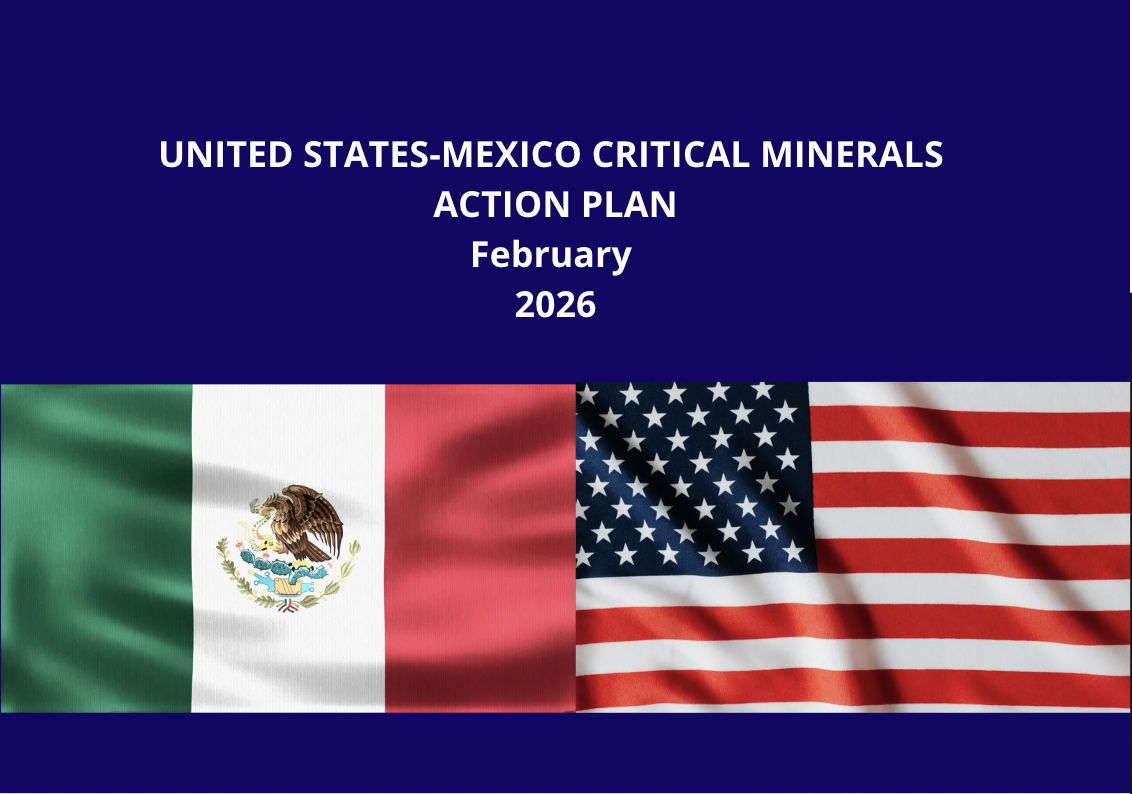
In February 2026, the United States and Mexico agreed on a 60 day Action Plan on critical minerals. On paper it looks modest: a few pages, a short timeline and no detailed list of minerals. In practice, it is the first structured attempt to align trade tools, project pipelines and geological data between both countries in a space that will define North American industry for the next decade.
The agreement comes in a dense moment. Washington had just hosted the Critical Minerals Ministerial, where senior officials spoke about the need to correct a market that underprices strategic minerals and concentrates processing capacity in a handful of locations. At the same time, the calendar for the first T-MEC/USMCA review is getting closer: from mid-2026, the three partners must decide whether to extend the agreement for sixteen more years or move into a more uncertain cycle of annual reviews.
Investors and decision makers looking at Mexico now have three overlapping layers to read:
- a bilateral plan on critical minerals with a fixed 60 day clock;
- a Ministerial agenda that promotes price floors, stockpiles and club type arrangements;
- and a trade agreement review where critical minerals will sit next to rules of origin, clean energy supply chains and industrial policy.
This note focuses on the first layer and how it connects to the other two.
The Action Plan: what is actually on the table
The United States-Mexico Critical Minerals Action Plan does three clear things.
First, it asks both governments to examine coordinated trade policies, including border adjusted price floors for critical minerals imports. The Plan does not pre-define which minerals will be covered. It speaks of select critical minerals to be determined. That is a political choice, the list will be negotiated, not announced upfront.
Second, it opens the door to a plurilateral agreement on trade in critical minerals. The Action Plan sets out the type of provisions such an agreement could contain: trade measures to support a resilient marketplace, common regulatory standards for mining and processing, technical and regulatory cooperation, investment promotion and screening, coordination of geological mapping, joint responses to supply disruptions, research and development, and coordinated stockpiling.
Third, it mandates a joint project pipeline and geological information sharing. The United States and Mexico commit to identify mining, processing and manufacturing projects of mutual interest in their own territories or in third countries, to give them priority in financing and policy support, and to share information from the U.S. Geological Survey and the Mexican Geological Survey on potential deposits.
For a board or an investment committee, the key message is simple: the two governments are building a shortlist of minerals, a shortlist of projects and a shared information base, and they are using this as a testbed for price instruments and club rules.
Incentives and asymmetries in the 60 day window
Behind the neutral wording, there is an asymmetry in how each side arrives at this 60 day exercise.
For the United States, the Action Plan is one piece of a broader strategy that has already been articulated at the Critical Minerals Ministerial. Washington comes with a clear objective: reduce exposure to non market practices, rebuild midstream capacity in friendly jurisdictions and show, ahead of the T-MEC review, that it has a credible framework for critical minerals with at least one major neighbour. It brings instruments it is already testing elsewhere: public loans and equity, stockpiles, club type arrangements and tighter screening of supply chains.
Mexico arrives with different assets and uncertainties. On the asset side, it offers geology, existing production and an industrial base that already exports mining-based manufactures to the United States. On the uncertainty side, it has an evolving regulatory framework for mining, a still unsettled model for lithium, and an operating environment where permitting, community relations and security risks can stretch timelines in ways markets do not always price correctly. Security is not an abstract factor: it shapes access to sites, the attractiveness of specific regions for capital and, in some corridors, the basic conditions under which workers and contractors operate. Any serious discussion about Mexico as a long term mining partner for the U.S. has to factor these institutional and security risks alongside geology and cost.
That asymmetry matters for investors because it frames the negotiation. The United States is using the Plan to give structure to its security and industrial goals. Mexico has an opportunity to use the same instrument to move from being seen mainly as a resource jurisdiction to being recognised as a structured partner in North America’s material system. Whether that happens depends less on the language of the Plan and more on the minerals and projects Mexico chooses to put on the table.
The Ministerial context: from language of risk to tools
The Critical Minerals Ministerial that framed this plan sets the tone for how Washington wants to handle the sector.
U.S. officials described critical minerals supply chains as exposed to economic coercion and pervasive non market practices. They argued that price alone is a poor signal for investment in these minerals and that the result is underinvestment, long lead times and concentrated refining hubs. They presented a menu of tools: price floors, joint stockpiles, coordinated public finance and preferential trade arrangements among trusted partners.
Seen from Mexico’s side, this means the Action Plan is not a routine technical annex. It is the first practical piece of a broader alliance based strategy that is likely to reappear during the T-MEC review. The questions are: which minerals enter this first round, which projects are put forward, and how this shapes Mexico’s role in North America’s material system.
Mexico’s critical minerals profile: what its own data reveals
To understand Mexico’s starting point, it is useful to look at how its own institutions describe the sector. The joint CIDE-CAMIMEX study on the relevance of the Mexican mining sector offers a clear baseline.
Mining (excluding hydrocarbons) represents around 4.7% of Mexico’s GDP, a weight comparable to education and higher than several service sectors. The United States is the main destination for mining and metallurgical exports, and more than half of that value reaches U.S. territory embedded in manufactures, not as raw ore. Mexico is a significant producer of copper and zinc, and holds relevant reserves of copper, zinc, lead, graphite and fluorite. A group of non metallic minerals (silica sand, barite, fluorite, graphite and gypsum) shows very high forward linkages into chemicals and manufacturing. On the transition side, the study notes a large lithium resource in Sonora and quantifies how much more mineral intensive electric vehicles are compared to conventional vehicles.
In the language of Mining Is Dead. Long Live Geopolitical Mining, Mexico is not just a resource holder. It is already part of the material infrastructure of North American industry, both as a supplier of concentrates and metals and as a platform for manufacturing based on those inputs.
For investors, this means that any attempt to redraw North America’s critical minerals architecture will, by definition, touch Mexican mines, Mexican midstream opportunities and Mexican manufacturing corridors. The Action Plan is the first document that starts to align that reality with explicit instruments.
Midstream capacity: the Tennessee signal and Mexico’s place in it
The Action Plan also has to be read alongside the way the United States is reshaping midstream capacity.
The Crucible project in Clarksville, Tennessee, led by Korea Zinc and Nyrstar, is one of the clearest signals. Company information presents Crucible as a large integrated smelter designed to produce a broad set of non ferrous metals, most of them on the U.S. critical minerals list, with capacity to process roughly 1.1 million tonnes of feedstock per year. The project relies on a mix of private capital and U.S. federal support and is framed as an economic security asset.
In an interview reported by Fastmarkets, a Korea Zinc representative explained that Crucible will prioritise feedstock from within the United States, including existing Nyrstar mines, and will also source concentrates from new mines across a wider North American region, including Mexico. Zinc concentrates are expected from the U.S. and Mexico, and lead concentrates from Mexico, Peru and the U.S.
The combination of these two elements (a bilateral plan on critical minerals and a flagship smelter that explicitly plans to use Mexican concentrates) sends a clear signal to boards.
Midstream capacity is being built inside the U.S., with a long term horizon and with direct political backing. That capacity expects to be fed by North American mines, including Mexican assets. The rules being tested in the Action Plan (price floors, standards, project screening, geological coordination) will influence how stable and investable those flows look.
For Mexican projects, this is not an abstract story. It is a question of whether their concentrates will feed strategic smelters under predictable rules and long term arrangements, or whether they will sit outside this emerging system and remain exposed to more volatile markets and less structured offtake.
Which minerals are closest to the first 60 day list?
The Action Plan does not list minerals, but the combination of Mexican data, U.S. objectives and midstream plans suggests a first circle of candidates.
Copper
Copper is at the centre of the picture. Mexico has meaningful production and reserves, and copper is central to almost every element: power grids, EVs, charging networks, data centres and defence systems all depend on it. For the United States, securing copper supply under a framework that combines market signals with security considerations is critical. For Mexico, bringing copper into the Action Plan is a way to frame it as a strategic asset inside a rules based arrangement rather than leave it entirely to global cycles and domestic permitting bottlenecks.
The constraint is not geology. It lies in permitting timelines, community conflict and the capacity of institutions to handle large, complex projects with predictability. Capital that makes sense in this space is patient, technically strong and used to operating in jurisdictions where social legitimacy and regulatory clarity are as important as grade and strip ratio.
Zinc
Zinc rarely dominates public debate, yet it is essential for infrastructure and corrosion protection, and it is directly linked to Crucible’s future feedstock. Mexico’s production and reserves give it real leverage here. For Washington, zinc offers a way to test price instruments and stockpiles on a metal that is already widely traded and deeply embedded in industrial uses.
In practical terms, zinc is a strong candidate for early inclusion if the Plan moves forward with price floors or coordinated stockpiling. The main risks are familiar: local permitting friction, infrastructure constraints in some regions, and the ability to align practice and reporting with the standards expected around a U.S. strategic smelter.
High leverage non metals: fluorite, barite, silica sand
Fluorite, barite and silica sand sit in a different category. They do not tend to appear in political speeches about critical minerals, but the CIDE-CAMIMEX study shows that their forward linkages into chemicals, glass, aluminium and other industrial uses are long and dense.
For North America’s industrial system, these minerals behave like quiet infrastructure. Disruptions or underinvestment do not necessarily generate headlines, but they can slow or raise the cost of a wide range of activities. Including them in the bilateral conversation would not require visibility at Ministerial level. It would require regulators and project sponsors to treat them as part of industrial security and to design permitting, standards and potential stockpiles accordingly.
Graphite
Graphite plays a double role: it is a key industrial input and, at the same time, a central material for batteries. The Mexican data shows high forward linkages into manufacturing. Globally, graphite is at the centre of efforts to diversify anode supply away from highly concentrated sources.
For the U.S.-Mexico conversation, graphite is likely to be approached in two phases. In the near term, it can be treated as an industrial input whose availability and price affect a broad range of manufacturing activities. In the medium term, it will become part of any credible North American battery strategy. That second phase will require more than trade tools: it will need clear rules on investment screening, offtake structures and technology transfer.
Lithium
Lithium is the most complex of the candidates. The Sonora resource is large and real, and it matters for any regional battery strategy. The institutional framework around lithium is still evolving: state control, the role of private operators, and the degree of integration with downstream industrial policy are all under discussion.
In a 60 day window, lithium is unlikely to produce a long list of concrete projects ready for financing. It is more likely to appear as a set of principles and conditions: under what governance model, with which environmental and social standards, and with what kind of integration into North American battery chains could lithium projects in Mexico become part of a structured critical minerals club.
For investors and boards, this mineral by mineral map is useful not as a prediction of every decision, but as a way to locate where early movement is more likely: copper and zinc announcements, pilot arrangements around non metals, and careful, principle based language on graphite and lithium.
Where does Canada fit in this picture?
One striking feature of the Action Plan is its scope. It is a bilateral instrument inside a trilateral agreement.
Canada is a major producer of critical minerals and a full partner in T-MEC. Yet it is not part of this 60 day plan. Ottawa is advancing its own critical minerals partnerships with the United States, the European Union and other allies, and it will bring its own agenda to the T-MEC review. The U.S.-Mexico Action Plan runs in parallel to that.
If the bilateral track between Washington and Mexico proves effective (on price instruments, project pipelines and standards) it can become a template for how North America handles critical minerals, with Canada joining through a separate but compatible route. That dynamic gives Mexico both an opportunity and a responsibility. The opportunity is to demonstrate early that it can move from geology to bankable, standards compliant projects that fit a North American security and industrial strategy. The responsibility is to avoid using this window only to secure short term advantages and to think instead in terms of how its choices will interact with Canada and with the broader T-MEC negotiation.
How this connects to the T-MEC review
The first T-MEC joint review is scheduled for mid-2026. At that point, the three partners must decide whether to extend the agreement for sixteen more years or allow it to move into a more fragile regime of annual reviews. Trade lawyers focus on the clauses; investors will focus on the signals for stability, timelines and rules in sectors with long investment cycles.
Critical minerals fit naturally into that discussion. They touch rules of origin (for automotive and batteries), clean energy and defence supply chains, industrial policy and security. The U.S.-Mexico Action Plan offers a preview of how two of the three partners want to address these issues: through specific minerals, concrete projects and a set of tools that combine trade, standards and public finance.
If the Plan delivers a small but credible package (say, a short list of minerals, a visible project pipeline and tested instruments for price support and geological sharing) it will be easier for both governments to argue, during the T-MEC review, that critical minerals can be handled through a structured, alliance compatible framework rather than through ad-hoc measures.
Mexico’s position will depend on what it chooses to bring into this first stage. A clear, internally coherent list of priority minerals and projects, aligned with its own development goals, would strengthen its hand in the broader review. A fragmented, reactive approach would make it harder to influence how critical minerals are written into the region’s long-term rules.
For boards, the 60 day plan translates into three practical questions:
- Which of our assets in Mexico could realistically qualify as “projects of mutual interest” under this framework?
- What changes (in permitting strategy, ESG practice or offtake structure) would be needed to make them credible candidates?
- How does this emerging bilateral architecture interact with our assumptions about T-MEC rules of origin and future requirements for EV, battery and grid related content?
A first layer of architecture
The United States-Mexico Critical Minerals Action Plan is now the main reference point for how North America starts to organise critical minerals policy. Three dynamics frame this moment: the emergence of an alliance based system for critical minerals, the build out of new smelting and refining capacity in North America, and the upcoming review of the region’s main trade agreement.
Mexico brings to that intersection a documented material base, an existing manufacturing platform, and now a 60 day window to translate those assets into a structured position. The substance of that position will be defined by a short list of minerals, a short list of projects, and a set of instruments that align national development goals with the new rules of the game in critical minerals.
Resources
- United States–Mexico Critical Minerals Action Plan (Office of the United States Trade Representative & Secretaría de Economía, 4 February 2026).
- 2026 Critical Minerals Ministerial – official statements and background materials (U.S. Department of State).
- Relevancia del sector minero mexicano en el desarrollo económico nacional (Centro de Investigación y Docencia Económicas – CIDE & Cámara Minera de México – CAMIMEX, 2024).
- Crucible smelter project, Clarksville, Tennessee – Korea Zinc and Nyrstar public disclosures.
- Korea Zinc feedstock sourcing statements for Crucible, including references to concentrates from Mexico (Fastmarkets interview and analysis).
- USMCA/T-MEC joint review and Article 34.7 – see, for example, White & Case, North America Prepares for 2026 USMCA Review and Potential Renegotiation (2024), White & Case, Public Consultations on the USMCA (T-MEC) (2025), and the Wilson Center, A Practical Guide to the USMCA 2026 Review (2024), for legal and policy analysis of the six-year review and extension mechanism.
For the full Geopolitical Mining framework behind this article, see our book Mining Is Dead. Long Live Geopolitical Mining .