Geopolitical Mining · Country & Region Analysis
Saudi Arabia’s Mineral Strategy: Vision 2030 in an Era of Geopolitical Challenges
A mineral-industrial strategy advancing through a more contested geopolitical landscape
By Marta Rivera & Eduardo Zamanillo
Geopolitical Mining. May 2, 2026
Vision 2030 and the Early Mineral Turn
Saudi Arabia’s modern mineral strategy was elevated through Vision 2030, launched in April 2016, building on an earlier institutional mining base that included Ma’aden’s creation in 1997. The strategy gained stronger regulatory and investment momentum after the approval of the new Mining Investment Law in 2020, which came into force in 2021.
This institutional sequence gives the strategy its strategic weight. Ma’aden gave the Kingdom a national mining anchor. Vision 2030 elevated minerals into the broader transformation agenda. The Mining Investment Law strengthened the regulatory and investment framework needed to scale the sector. Together, these milestones show a long running institutional buildout now gaining geopolitical relevance.
Vision 2030 gave mining a broader national frame. The Kingdom’s long term transformation plan sought to diversify the economy, reduce dependence on oil, attract investment, expand industrial capacity and use Saudi Arabia’s location between Asia, Europe and Africa as a platform for trade and logistics. The original Vision 2030 framework explicitly referred to natural resources beyond oil, including gold, phosphate, uranium and other minerals.
That framing gave Saudi Arabia an early strategic position. The Kingdom placed minerals inside a national strategy of diversification, industrial development, logistics, investment and post-oil positioning before critical minerals became the dominant language of industrial security in Washington, Brussels and other advanced economies.
The global environment has since become more complex. Critical minerals are now linked to defense, processing capacity, industrial policy, supply chain security, trade tools, strategic reserves and regional infrastructure risk. For Saudi Arabia, this does not change the logic of the strategy. It makes the next phase more consequential: deepening an existing mineral industrial base and connecting it to the more demanding architecture of the new mineral economy.
The central question is no longer whether Saudi Arabia can place mining on the global agenda. It already has. The question is how the Kingdom converts Vision 2030, sovereign capital, convening power and existing industrial capacity into operating projects, processing depth, resilient supply chains and long term industrial credibility.
Movement I: A Post-Oil Vision with Mineral Foundations
Saudi Arabia’s mining ambition starts from an existing industrial platform. The Kingdom already has a mineral-industrial base built around energy, infrastructure, processing, logistics and state backed industrial development. That base is important because the next phase of critical minerals will reward countries that can do more than identify deposits. It will reward those able to process materials, connect them to industrial customers, move them through ports and logistics systems, and integrate them into wider economic strategy.
Ma’aden is the institutional anchor of Saudi Arabia’s mineral industrial platform. Established by royal decree in 1997 to develop the Kingdom’s mineral resources, the company is described by the Public Investment Fund (PIF), Saudi Arabia’s sovereign wealth fund, as a multi-commodity mining and metals company active in gold, phosphate, fertilizer, base metals and aluminium, and as the largest mining company in Saudi Arabia and the Middle East. PIF also links Ma’aden’s expansion to Vision 2030 and the ambition to make mining the third pillar of the Saudi economy (Pillar 1: A vibrant society, Pillar 2: A thriving economy, Pillar 3: An ambitious nation). Ma’aden’s own corporate history shows how this platform has evolved. Since 1997, the company says it has built a portfolio across phosphates, aluminium, gold and copper, operating 17 sites, employing more than 6,800 people and exporting to over 30 countries. Its timeline also shows a progression from gold operations into phosphate, ammonia, aluminium, copper, PIF backed expansion and Manara Minerals.
Phosphate is the most developed example of Saudi Arabia’s mineral industrial logic. Ma’aden’s phosphate operations are anchored by two major hubs: Wa’ad Al Shamal in the north and Ras Al Khair on the Arabian Gulf coast. Wa’ad Al Shamal focuses on mining and processing, while Ras Al Khair handles finishing, storage and exports. The Phosphate 3 project is designed to expand and upgrade both hubs, increasing production capacity by 50% to reach 9 million tons annually. This phosphate system matters because it is already connected to global demand beyond the energy transition. Fertilizers sit inside food security, agriculture and industrial trade. In that sense, Saudi Arabia’s mineral story already includes a geopolitical dimension: it exports processed mineral products into markets where food systems, agricultural productivity and supply reliability matter.
Aluminium adds a second processing pillar. Ma’aden describes its US$10.8 billion aluminium complex at Ras Al Khair as the world’s largest vertically integrated aluminium production facility. The system runs from bauxite mining at Al Ba’itha to alumina refining, smelting and rolling at Ras Al Khair. Ma’aden states that it produces more than 1 million tons per year of premium grade aluminium, exports to 22 countries across five continents, and supplies applications linked to automotive, aerospace, renewable energy, electric vehicles and advanced manufacturing. That aluminium base is strategically relevant because it shows what Saudi Arabia can already do in an energy intensive value chain: link mineral input, power, industrial infrastructure, rail, processing and export markets. This is the type of capability that matters in the midstream heavy critical minerals economy now emerging.
Copper occupies a smaller but still relevant place in the current platform. Jabal Sayid, located about 350 kilometers northeast of Jeddah, is a 50/50 joint venture between Ma’aden and Barrick. Barrick states that the first shipment of copper concentrate took place in December 2015 and that the mine entered commercial production in July 2016. Copper gives Saudi Arabia exposure to a metal that is increasingly central to electrification, grid expansion, advanced manufacturing and clean energy systems. Its current role is not yet comparable to the country’s phosphate or aluminium platforms, but it anchors Saudi Arabia inside one of the most important industrial metals of the next decade.
Taken together, phosphate, aluminium and copper show the practical foundation behind the Saudi mineral strategy. The Kingdom already has experience in mining, processing, integrated industrial sites, export logistics, global customers and state backed industrial coordination. Its next move is to extend that platform toward more strategic mineral chains: rare earths, lithium, separation, refining, advanced materials and global mining investments. The Saudi mineral strategy therefore begins from a specific advantage: an energy industrial system that can be redirected toward the material economy of the next industrial cycle.
Movement II: Turning Geology into an Investment Language
A country can announce mineral potential, but capital needs something more precise: geological data, mapped belts, clear license areas, transparent rules, competitive processes, technical reports, digital access and a credible pathway from exploration to development. Saudi Arabia has been working on that translation. The Kingdom’s mineral endowment has been increasingly framed through an investment lens. In December 2025, the Ministry of Industry and Mineral Resources announced the 10th round of exploration license competitions across three mineralized belts covering approximately 13,000 km². These belts are prospective for gold, silver, copper and zinc, and the announcement again referred to Saudi Arabia’s mineral resources as being valued at approximately SAR 9.4 trillion.
The detail behind the round is important. The belts span Madinah, Makkah, Riyadh, Qassim and Hail, and include extensions from areas offered in the ninth licensing round. The Ministry identified the Nabithah/Ad Duwayhi belt, which includes the Ad Duwayhi mine with annual production capacity of around 180,000 ounces of gold; the Sukhaybarat/Al-Safra belt, prospective for gold, copper, silver, zinc and nickel; and the Al-Nuqrah belt, associated with gold deposits and volcanic massive sulphide mineralization rich in copper and zinc.
This is the language of a mining jurisdiction becoming more investable: belts, mineral systems, mine references, exploration history, commodity targets and licensing architecture. It gives investors a map of where to look, what to look for and how the state intends to organize access. The progression is also notable. The Ministry states that Saudi exploration licensing moved from one site in Al-Khunayqiyah, covering 353 km² in the first round in 2021, to more than 24,000 km² offered in Round Nine in 2024, and more than 13,000 km² announced in Round Ten. It also reports that private-sector exploration spending rose from SAR 155 million, about US$41 million, in 2021 to SAR 863.5 million, about US$230 million, in 2024, reaching a total of SAR 1.05 billion, about US$280 million. The licensing system is being supported by digital infrastructure. The Ministry describes the National Geological Database as the cornerstone of the Kingdom’s mineral wealth and mining information system, designed to unify mineral resources, mining information and geological data, provide trusted information to the public and private sectors, and give investors and researchers online access to surveys, maps and resource evaluation data.
The Ta’adeen platform adds another layer. For reconnaissance licenses, the platform states that investors can access relevant data and maps from the Saudi Geological Survey; the Ministry’s 10th round announcement also says geological and technical data for the sites were made available through Ta’adeen, including previous license reports and survey data. The licensing process itself is described as automated, transparent and competitive, with prequalification, GIS based site selection and multiround live auctions. Round Nine gives an additional signal of market response. In December 2025, the Ministry announced that 24 companies and consortia had won licenses across 172 mining sites, including 76 sites that advanced to a multiround public auction. The total committed exploration spend exceeded SAR 671 million, or about US$179 million, during the first two years of the work programs.
Taken together, these details show a deliberate effort to turn the Saudi subsurface into an investable proposition. The Kingdom is not only promoting mineral potential. It is building the information system, licensing process and competitive structure through which investors can engage with that potential. For a mining state, this is foundational. Geological ambition becomes strategically relevant when it can be read by capital, tested by companies, governed by rules and advanced through projects.
Movement III: Sovereign Capital and Global Mineral Exposure
Saudi Arabia is using sovereign capital to enter the mineral system while its domestic mining pipeline gains depth. That is the strategic role of Manara Minerals. Created as a joint venture between Ma’aden and the Public Investment Fund, Manara was designed to invest internationally in mining assets, specifically through minority investments and strategic partnerships with world class mining businesses. The company describes its mandate as global, investment led and focused on unlocking value across the mining value chain.
The ownership structure also matters. According to Ma’aden’s Saudi Exchange announcement, Manara is held 51% by Ma’aden and 49% by PIF. That structure combines technical mining exposure through Ma’aden with sovereign capital and national investment strategy through PIF. It gives Saudi Arabia a vehicle that can move beyond domestic exploration and participate directly in global mineral assets.
The first major transaction was Vale Base Metals. In July 2023, PIF announced that Manara had signed an agreement with Vale to acquire a 10% equity interest in Vale Base Metals, the holding entity of Vale’s Energy Transition Metals business. PIF described the transaction as giving Manara access to strategic minerals supply chains, including nickel, copper and cobalt, and aligned it directly with Vision 2030, which positions mining as the third pillar of the Saudi economy. Vale completed the transaction in April 2024. The company announced an approximately US$2.5 billion sale to Manara Minerals, giving Manara a 10% stake in Vale Base Metals. Vale also stated that Vale Base Metals is expected over the next decade to invest in projects across Brazil, Canada and Indonesia, with copper production targeted to rise from 350 kt/year to 900 kt/year and nickel production from 175 kt/year to 300 kt/year.
This gives Saudi Arabia something domestic exploration alone cannot provide quickly: exposure to operating jurisdictions, established mining teams, copper and nickel growth pipelines, and the learning curve of a global base metals platform. Domestic mining depth takes years to build. International investment allows the Kingdom to participate immediately in the mineral economy while its own geological pipeline advances through surveys, licensing, exploration, feasibility, permitting and construction.
The Vale Base Metals transaction gives Manara a seat inside one of the major energy transition metals platforms at a moment when copper, nickel and cobalt are being pulled deeper into electrification, batteries, advanced manufacturing and industrial policy. For Manara, the next step is capability building. Its investments can become a bridge between Saudi capital and mining expertise, helping the Kingdom move from participation in global assets toward deeper influence in strategic mineral value chains.
Movement IV: The Midstream as the Strategic Layer
Saudi Arabia’s most interesting mineral signal is its focus on the midstream: the industrial layer where mineral feedstock becomes strategic material. Separation, refining, conversion, chemical processing, magnet production, industrial customers and downstream supply chains are no longer secondary stages of the mining economy. They are the point where mineral policy becomes industrial policy.
Rare earths are the clearest example. In May 2025, Ma’aden and MP Materials signed an agreement to explore the development of a vertically integrated rare earth supply chain in Saudi Arabia, covering mining, separation, refining and magnet production. That framework became more concrete in November 2025, when Ma’aden signed a binding term sheet with MP Materials, backed by the U.S. Department of War, to build and operate a rare earth refining and separation facility in the Kingdom. The proposed facility would process rare earth feedstock from Saudi Arabia and other global regions, and produce separated light and heavy rare earth oxides for Saudi, U.S. and allied manufacturing and defence sectors. Under the proposed structure, Ma’aden would hold no less than 51% of the joint venture, while MP Materials and the U.S. Department of War would hold a targeted 49% position.
The strategic relevance is clear. Rare earth power is not defined only by deposits. It is shaped by the capacity to separate, refine and transform material into inputs usable by magnet makers, defence suppliers, clean energy manufacturers and advanced industrial customers. By placing itself in rare earth refining and separation, Saudi Arabia is moving toward one of the most sensitive and valuable parts of the critical minerals chain.
Lithium points in the same direction. In January 2025, Aramco and Ma’aden signed non-binding Heads of Terms to explore a minerals exploration and mining joint venture in Saudi Arabia, focused on energy transition minerals and direct lithium extraction technologies. Aramco stated that commercial lithium production could potentially begin by 2027, and pointed to its technological innovation, resource and data management capabilities, existing infrastructure, drilling operations and more than 90 years of geological data. It also stated that it had identified several areas with lithium concentrations of up to 400 parts per million in existing areas of operation.
This is where Saudi Arabia’s oil era capabilities become relevant to minerals. Subsurface knowledge, drilling experience, infrastructure, energy, industrial land, ports, capital and state coordination do not automatically create rare earth or lithium processing capability. But they give the Kingdom a credible foundation for entering mineral value chains that require more than extraction. The midstream is technical, capital intensive and difficult to scale. Rare earth separation requires chemical expertise, feedstock consistency and environmental control. Lithium extraction from subsurface brines or oilfield related sources requires technology performance, water management, processing discipline and commercial validation.
That is why the Saudi midstream strategy matters. It targets the part of the chain where resource access becomes industrial capability. This space is difficult and often underestimated, but it is also where much of the strategic value in critical minerals is created.
Movement V: FMF and the Architecture of Mineral Diplomacy
The Future Minerals Forum has given Riyadh a role that goes beyond hosting a sector conference. It has become a form of mineral diplomacy infrastructure: a place where governments, mining companies, investors, development institutions, technology providers and resource holding regions can discuss supply, processing, infrastructure, finance, standards, responsible sourcing and industrial development in the same strategic space. That role matters because critical minerals are no longer a purely technical industry issue. They now sit inside national security, industrial policy, energy transition, supply chain resilience and the balance between resource holding regions and demand centres.
The fifth edition of FMF, held at the King Abdulaziz International Conference Center in Riyadh from 13 to 15 January 2026, showed the scale of that ambition. Saudi Press Agency reported 132 agreements and memoranda of understanding with a total value of SAR 100 billion, or approximately US$26.6 billion, covering exploration, mining, financing, research and development, innovation, sustainability, value added chains and mining industries. The post-forum announcement also reported 21,500 participants, including investment leaders, heads of major mining companies, technical specialists and global experts, alongside ministers from more than 100 governments and 59 international organizations.
Scale alone does not create mining depth, but it does create agenda setting capacity. FMF gives Saudi Arabia a strategic convening position in one of the central questions of the new mineral economy: how to coordinate capital, infrastructure, processing, standards and industrial demand around future supply. Through the forum, Riyadh is helping frame the agenda around financing new projects, building processing capacity, connecting resource regions with customers, defining responsible supply and converting geological potential into bankable infrastructure. The forum’s own positioning reinforces this ambition. FMF describes itself as a government led mineral platform designed to bring together industry leaders, experts, governments, academia and stakeholders to drive mineral resilience and responsible supply.
There is already evidence that FMF is functioning as both a diplomatic and commercial platform. Canada used the 2026 forum to sign a memorandum of understanding with Saudi Arabia on mineral resources, covering trade and investment across critical mineral value chains, knowledge sharing and sustainable supply chains. It also highlighted the Northern Graphite-Obeikan partnership to develop a battery anode material processing facility in Saudi Arabia. At the same forum, Saudi Arabia signed mineral cooperation MoUs with Chile and Brazil, extending Riyadh’s mineral diplomacy toward major resource jurisdictions across the Americas.
The strategic signal is clear. FMF allows Saudi Arabia to connect sovereign diplomacy, resource countries, industrial partners, processing ambitions and future supply chains in one platform. For the Kingdom, this is more than visibility. It is a way to expand its diplomatic surface, attract commercial relationships and position Riyadh as one of the places where the future of mining is framed, financed and negotiated. As Saudi Arabia’s critical minerals agenda gains project depth, FMF gives that agenda a global coordination platform.
Movement VI: Measuring the Super Region
Saudi Arabia’s FMF strategy also moves through metrics. The Future Minerals Barometer is one of the most interesting pieces of the FMF architecture because it tries to convert a broad geopolitical idea, the Super Region, into something measurable. FMF defines the Super Region as spanning Africa, Western Asia, Central Asia and Latin America, and presents the Barometer as the world’s first comprehensive tool for measuring readiness and progress across critical mineral value chains in those regions. This is more than a research product. It is an attempt to create a shared reference point for a fragmented mineral landscape. The Barometer consolidates data, stakeholder sentiment and project-level analysis into a single platform, and benchmarks how governments, industry and investors are advancing mineral ecosystems from exploration through advanced manufacturing.
The framework is built around the conditions that determine whether mineral value chains can scale responsibly and competitively. FMF identifies several foundational enablers, including policy and regulations, financing, infrastructure, sustainability, talent, technology and geology. These categories are practical. They move the discussion beyond who has minerals toward a more useful question: which jurisdictions can turn mineral potential into investable, buildable and socially durable value chains? This is where measurement becomes influence. Whoever helps define readiness also helps define where capital, policy attention and institutional support may move. A country or region can hold significant mineral potential and still struggle to attract long term investment if infrastructure is weak, permitting is unclear, skills are limited, ESG frameworks are fragile, geological data is incomplete or financing pathways are uncertain.
The Barometer also shifts the conversation away from a purely demand side view. Most critical minerals strategies are written from the perspective of industrial consumers: the United States, Europe, Japan, Korea and other advanced economies asking how to secure supply, diversify away from concentrated processing and reduce geopolitical exposure. The FMF framework introduces a supplier region lens. It asks what Africa, Western Asia, Central Asia and Latin America need in order to build credible mineral value chains: geological data, infrastructure, capital, processing capacity, regulatory trust, technical skills, sustainability frameworks and customers willing to support long-term development.
That is the strategic meaning of the Super Region. It is not only a geography. It is an effort to give supplier regions a common language of readiness, bottlenecks and value creation. For Saudi Arabia, this is useful positioning. Riyadh is not only convening conversations about minerals; it is helping structure the way those conversations are measured. That can shape the attention of governments, investors, companies and development institutions.
Movement VII: Reputation Becomes Supply Speed
One of the most relevant signals coming out of FMF is the way reputation, trust and responsible supply have moved closer to the centre of the mineral conversation. This is not a soft issue. In modern mining, reputation affects the speed at which supply can be created. New mines already face long development timelines: the International Energy Agency has noted that major mines that came online between 2010 and 2019 took, on average, more than 16 years from discovery to first production, including more than 12 years for exploration and feasibility and another four to five years for construction. In that context, anything that adds friction matters. Regulatory uncertainty, weak community trust, environmental risk, unclear traceability, poor governance, conflict exposure and low institutional credibility can all slow the movement from resource to project, and from project to supply.
This is why FMF’s emphasis on responsible supply is strategically relevant. Mineral supply is now judged not only by geology, volume or cost, but also by standards, traceability, social performance and buyer confidence. In that sense, FMF is positioning Riyadh inside a broader governance architecture already shaping the global minerals system. The Forum’s government led platform brings together governments, industry, academia, civil society and future professionals around mineral resilience and responsible supply. This aligns with established frameworks such as the OECD’s responsible mineral supply chain guidance and ICMM’s Mining Principles, both of which reflect a wider shift: responsible supply has become part of supply security. For Saudi Arabia, that matters because a future mineral hub must offer more than resources and infrastructure. It must offer confidence.
For Saudi Arabia, placing governance, standards, sustainability and responsible supply inside the FMF agenda helps position Riyadh within the more serious part of the minerals debate. A mineral hub cannot rely only on location, capital or infrastructure. It also needs confidence: confidence from investors, buyers, governments, communities, insurers and development institutions. That confidence has operational value. It can support permitting credibility, financing conditions, customer relationships, offtakes and long term partnerships. It can also help distinguish formal, investable mineral development from supply chains exposed to illegality, opacity or reputational risk. The emerging development finance agenda is moving in the same direction. In April 2026, multilateral development banks issued a joint statement on critical minerals to manufacturing value chains, emphasizing resilient and responsible supply chains, quality infrastructure, skilled jobs, SME participation, community engagement and local economic benefits.
This is the deeper point for Geopolitical Mining: supply is no longer only a geological or financial question. It is institutional. It depends on the ability to build projects that are technically credible, socially durable, traceable, governable and financeable. In modern mining, trust is part of the delivery schedule.
Movement VIII: The Mineral Field Becomes More Competitive
Saudi Arabia’s early mineral vision is now moving through a more competitive global field. The shift is broader than geopolitical tension. Critical minerals are becoming a space where buyers, producers, processors, financiers and governments are all trying to improve their position at the same time. Demand centres want secure supply. Producing countries want more value capture. China continues to defend and reinforce its leadership across key processing nodes. The United States is re-entering with financing tools, industrial demand, price mechanisms and allied coordination. This makes the mineral landscape more crowded, more strategic and more demanding.
The United States is a central part of this change. Washington is no longer treating critical minerals only as a supply exposure; it is building market architecture around them. Project Vault, USTR’s 2026 plurilateral trade process and the MP Materials-Department of Defense agreement point in the same direction: strategic reserves, price visibility, offtake structures, financing tools, standards, investment screening and defense linked demand are being used to make domestic and allied supply more investable. This is no longer general concern. It is market design. For Saudi Arabia, the implication is clear: mineral diplomacy now has to connect with qualified customers, processing capacity, commercial relevance and securityaligned partnerships.
China remains the other structural force in the field. The IEA’s Global Critical Minerals Outlook 2025 notes that refining concentration increased between 2020 and 2024, with the average share of the top three refining nations rising from around 82% to 86%. The IEA also states that around 90% of refined supply growth came from the top single supplier alone: Indonesia for nickel and China for cobalt, graphite and rare earths. China’s position also extends into battery recycling capacity growth.
At the same time, resource rich regions are seeking a larger role in the value chain. Across Africa, Latin America, Central Asia, Western Asia and parts of Southeast Asia, the mineral agenda is increasingly moving beyond extraction toward infrastructure, logistics, power, water, skilled jobs, SME participation, community engagement and local economic benefits. Development finance is beginning to reflect that shift through the language of critical minerals to manufacturing value chains. The strategic signal is clear: mineral rich countries want their resources to support industrial capacity, investment, skills and development outcomes, not only exports of raw material.
This is the new strategic environment in which Saudi Arabia’s mineral strategy is advancing. The Kingdom enters this phase with meaningful positioning: Vision 2030 gave mining a national frame; FMF gave Riyadh a global platform; Manara provided exposure to international mining assets; and the Ma’aden–MP Materials initiative placed Saudi Arabia inside the rare earth processing conversation. At the same time, the critical minerals field is becoming more structured, more transactional and more geopolitical. Buyers are seeking security of supply, traceability, processing capacity and trusted partners. Resource rich countries are seeking infrastructure, domestic value creation, skills, financing and stronger development outcomes. Strategic partners are looking for projects that combine standards, resilience, execution and commercial logic.
For Saudi Arabia, this creates a significant strategic opening. Its capital base, energy system, logistics, industrial land, state coordination and convening power are valuable assets for partners seeking more resilient mineral chains. The next phase is to convert those assets into negotiated industrial architecture: agreements that connect upstream development, processing, infrastructure, finance, standards, customers, local value and long term trust. In that environment, mineral diplomacy gains weight when it becomes operational capacity. Saudi Arabia’s advantage will depend on its ability to turn visibility, capital and industrial ambition into credible partnerships across the full mineral system.
Movement IX: The Regional Challenge, Continuity Under Stress
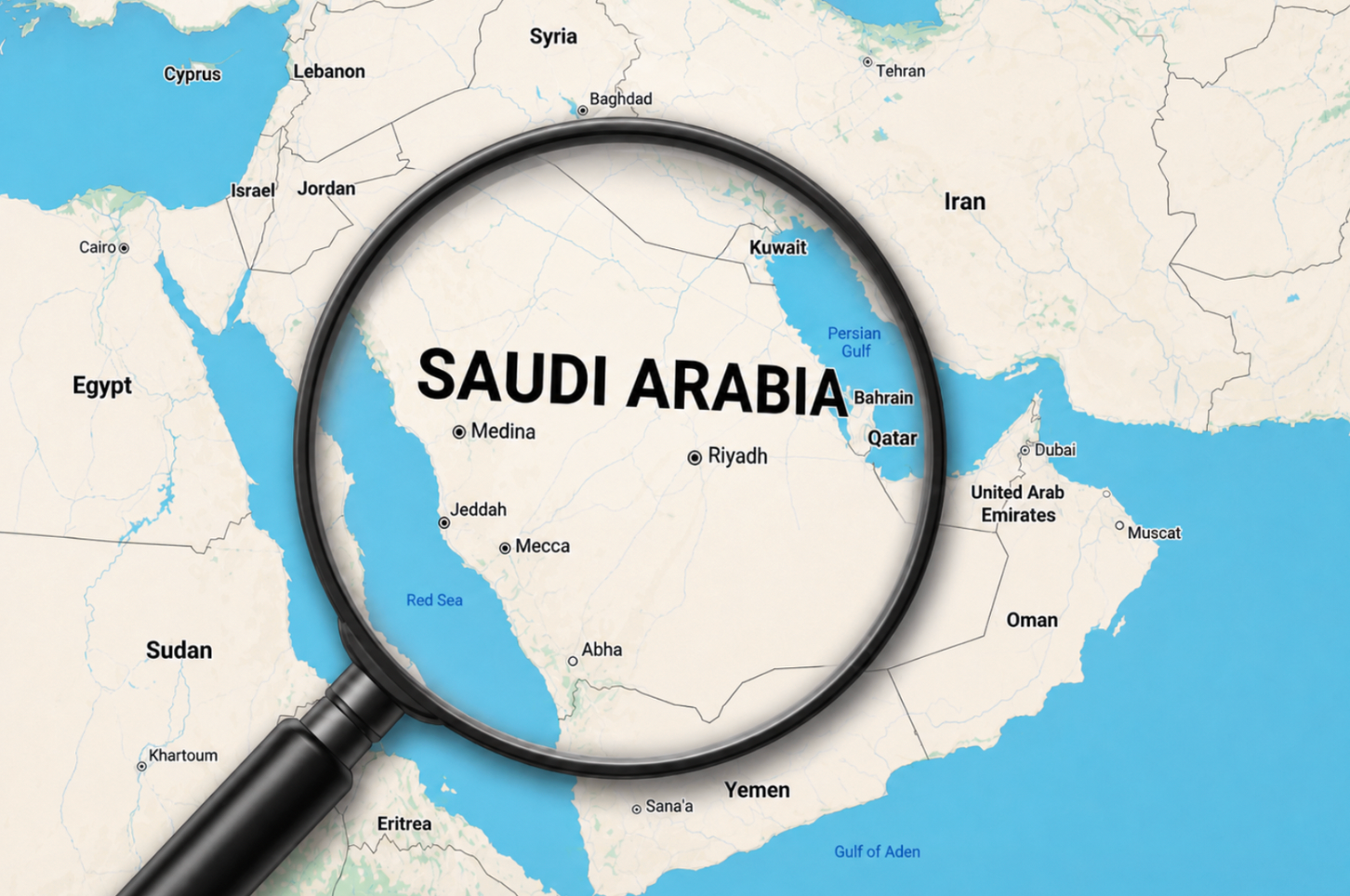
Saudi Arabia’s mineral strategy advances from a region that gives the Kingdom one of its greatest strategic advantages and one of its most demanding geopolitical conditions. Its position between Asia, Europe and Africa supports the logic of a logistics, energy and industrial platform. Its access to the Arabian Gulf and the Red Sea, together with its ports, pipelines, industrial zones, energy infrastructure and state coordination, strengthens the case for Saudi Arabia as a future mineral processing and logistics hub.
The central issue is continuity under stress. A mineral industrial platform must be able to operate when the regional environment becomes more difficult. Rare earth separation, lithium extraction, aluminium, phosphate fertilizers, industrial chemicals, battery materials and downstream manufacturing depend on reliable power, water, chemicals, ports, railways, insurance, digital systems, security assumptions and export routes. In a region shaped by Iran related tensions, maritime risk, Red Sea disruption and Gulf infrastructure exposure, continuity becomes part of the investment case.
This is where Saudi Arabia’s energy history becomes strategically relevant. The Kingdom has spent decades cultivating confidence as a major energy supplier from a region where disruption risk is part of the geopolitical landscape. That experience now becomes part of the mineral question. The issue is not whether Saudi Arabia can build a mineral industrial platform from scratch. The issue is whether it can extend its discipline of supply continuity into mineral processing, refining, logistics and industrial materials. The Strait of Hormuz remains the clearest reminder of the regional challenge. The IEA states that nearly 20 million barrels per day of oil were exported through the Strait in 2025, while LNG flows through the Strait represented almost one fifth of global LNG trade. Those figures underline the scale of regional exposure around energy, shipping and industrial reliability.
For Saudi Arabia, the current regional stress gives this question greater strategic weight. A country that can maintain supply confidence under pressure becomes more valuable to partners looking for resilient chains. In critical minerals, reliability will matter as much as resource access. Customers, governments and investors will look for partners that can provide not only processing capacity, but also operational continuity, logistics discipline and political coordination.
That is where Saudi Arabia could strengthen its position. If the Kingdom can translate the reliability it has cultivated in energy into the mineral industrial space, it could become a trusted processing, logistics and industrial partner in a region where continuity is difficult and therefore valuable. In a more contested world, continuity itself becomes part of mineral power.
Consolidating a Mineral Industrial Position in a More Contested World
Saudi Arabia has already built a meaningful mineral industrial position. Vision 2030 gave mining a national frame before critical minerals became the dominant language of industrial security. Since then, the Kingdom has developed several layers of a broader mineral architecture: Ma’aden, PIF, Manara, exploration licensing rounds, digital mining platforms, phosphate and aluminium systems, rare earth and lithium initiatives, the Future Minerals Forum, and a growing role in mineral diplomacy.
That position now advances through a more competitive and security sensitive environment. The United States is returning to critical minerals with financing tools, defense demand, price mechanisms, strategic reserves and allied coordination. China continues to hold significant influence across key processing nodes. Resource rich countries are seeking more value creation, infrastructure, processing capacity and long term development outcomes. Buyers are looking for traceability, reliability, diversified supply and partners able to operate through uncertainty.
This is the strategic test of consolidation for Saudi Arabia. The Kingdom has important advantages: capital, energy, logistics, industrial land, state coordination, regional connectivity and convening power. It has also begun to position itself in the parts of the chain where strategic value is increasingly created: processing, refining, separation, global mining investments, supplier-region diplomacy and mineral infrastructure.
The next phase will be shaped by the quality of conversion: projects that advance, facilities that operate, partnerships that endure, customers that commit, standards that are trusted, and supply chains that remain reliable under regional stress. This is where Saudi Arabia’s energy history becomes strategically relevant. The Kingdom has spent decades building credibility as a reliable energy supplier from a complex region. If it can extend that discipline of continuity into mineral processing, refining, logistics and industrial materials, it can strengthen its role as a trusted mineral industrial partner in the new mineral order.
Saudi Arabia’s opportunity is therefore geopolitical as much as industrial. Its task is to consolidate what it has already built into a durable platform able to connect resources, capital, processing, infrastructure, customers and continuity. In a more contested world, that combination may become one of the strongest forms of mineral power.
For the full Geopolitical Mining framework behind this article, see our book Mining Is Dead. Long Live Geopolitical Mining.
Resources
Saudi Vision 2030 and national mining frame
- Kingdom of Saudi Arabia — Vision 2030
- Saudi Ministry of Industry and Mineral Resources — Strategy for the Mining Sector
- Public Investment Fund — Saudi Arabian Mining Company, Ma’aden
Ma’aden and Saudi Arabia’s existing mineral-industrial base
- Ma’aden — Our Story
- Ma’aden — Phosphate Operations
- Ma’aden — Phosphate 3, Wa’ad Al Shamal and Ras Al Khair
- Ma’aden — Aluminium Operations, Ras Al Khair
- Barrick — Jabal Sayid Copper Operation
Geological data, licensing and investment language
- Saudi Ministry of Industry and Mineral Resources — 10th Exploration Licensing Round Across Three Mineralized Belts
- Saudi Ministry of Industry and Mineral Resources — 9th Licensing Round Results: 24 Companies and Consortia Awarded 172 Mining Sites
- Saudi Ministry of Industry and Mineral Resources — National Geological Database
- Ta’adeen Platform — Reconnaissance License and Access to Geological Data
Manara, PIF and sovereign capital
- Manara Minerals — Official Mandate and Strategic Role
- PIF — Manara Minerals Partners with Vale Base Metals
- Vale — Completion of Manara Minerals’ 10% Acquisition of Vale Base Metals
- Vale — Strategic Partnership Agreement with Manara Minerals, PDF
Rare earths, lithium and the midstream strategy
- Ma’aden — Ma’aden and MP Materials Collaborate to Establish Full Value Chain for Rare Earth Magnetics
- Ma’aden — Binding Term Sheet with MP Materials for Rare Earth Refining and Separation Facility
- MP Materials — MP Materials and U.S. Department of War Partner with Ma’aden on Rare Earth Refinery Joint Venture
- Aramco — Aramco Plans Transition Minerals Joint Venture with Ma’aden
Future Minerals Forum and Riyadh as a mineral stage
- Saudi Press Agency — 5th Future Minerals Forum Concludes with 132 Agreements Worth SAR 100 Billion
- Future Minerals Forum — Official Platform
- Future Minerals Forum — Who Attends
- FMF Post-Event Announcement — 21,500 Participants and US$26.6 Billion in Agreements
- Natural Resources Canada — Canada–Saudi Arabia Critical Minerals MoU at FMF 2026
Future Minerals Barometer and the Super Region
- Future Minerals Forum — FMF Barometer Report 2025
- GlobeScan — The Future Minerals Forum Barometer Report
Reputation, responsible supply and project timelines
- International Energy Agency — Reliable Supply of Minerals, Mine Development Timelines
- OECD — Responsible Mineral Supply Chains
- ICMM — Mining Principles, Social Performance
- World Bank / MDBs — Joint Statement on Critical Minerals to Manufacturing Value Chains
More competitive mineral field: United States, China and market design
- EXIM — Project Vault and the U.S. Strategic Critical Minerals Reserve
- USTR / Federal Register — Request for Comments on a Plurilateral Agreement on Trade in Critical Minerals
- MP Materials — Public-Private Partnership with the U.S. Department of Defense
- International Energy Agency — Global Critical Minerals Outlook 2025
- IEA — Global Critical Minerals Outlook 2025, Executive Summary
Gulf security, Hormuz and continuity under stress