
Country & Region Analysis · United States
Welcome to the Era of U.S. Geopolitical Mining
Authors: Marta Rivera | Eduardo Zamanillo
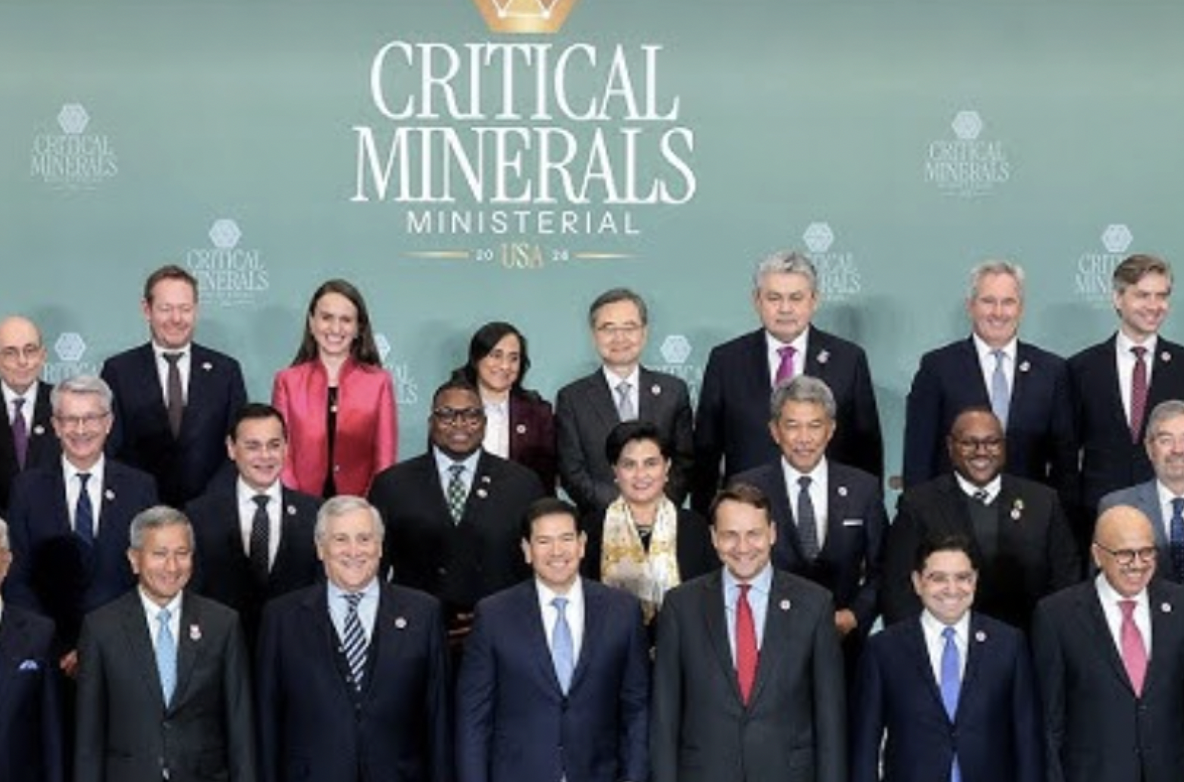
Opening of the Critical Minerals Ministerial. What the United States Just Put on the Table
The Trump administration has moved from diagnosing critical minerals risk to proposing a full architecture: a trade bloc with price floors, strategic reserves, public–private funds and accelerated permitting. For investors, this is one of the clearest signals so far that the era of Geopolitical Mining is no longer a theory.
What Washington Actually Said
In the Loy Henderson conference room in Washington D.C., Vice President J.D. Vance, Secretary of State Marco Rubio and senior White House advisor David Copley set out how the administration sees critical minerals, and what it plans to do. Three themes stand out: the material base of power, the shape of markets, and the role of the State.
1. Minerals as the Base Layer of the New U.S. Strategy
Vance set the tone by going back to fundamentals. After recalling conversations about Venezuela and the centrality of oil, he drew a direct line to critical minerals. However advanced data centres and digital platforms may be, the U.S. economy still runs on physical inputs. In his view, few are as essential today as oil and critical minerals.
This framing matters. It places copper, nickel, lithium, rare earths, gallium, silicon and others not in a narrow ESG or future tech silo, but at the centre of energy security, defence systems, advanced manufacturing and the AI build out. Introducing Copley, Jacob Helberg reinforced the point: the current wave of AI is pulling demand across almost the entire periodic table, and into midstream and manufactured products, from chips to telecoms equipment and industrial robots.
Rubio added a historical angle. He retold the story of Mountain Pass, the rare earth deposit discovered in California in 1949, and how it contributed to jet propulsion, the space age and early computing. He then drew a straight line from that period to today: the United States gradually outsourced mining as “dirty”, then outsourced manufacturing, and kept design and intangibles. This sequence is presented as a strategic error that has left the country dependent on external supply for technologies that are now central to its security and growth model.
The message is consistent: in Washington’s current view, there is no credible reindustrialisation strategy without new mines, smelters and processing plants, at home and among trusted partners.
2. A Distorted Market and a Proposed Bloc with Price Floors
Vance then moved from diagnosis to architecture. He described a pattern every mining investor recognises. A lithium project or a gallium recovery plant is announced after years of planning, foreign supply floods the market, prices fall sharply, investors withdraw, the project fails. In his words, the international market for critical minerals is failing, leaving projects in both advanced economies and developing countries without a viable price environment.
The proposed answer is a preferential trade zone for critical minerals among allies. The elements he outlined are straightforward:
- benchmark prices for critical minerals at different stages of production;
- those benchmarks acting as minimum prices inside the zone;
- and adjustable tariffs to prevent imports priced below those levels from outside the bloc from displacing producers within it.
The stated objective is to increase price predictability, enable long term capital to enter, and reduce exposure to strategic over supply and dumping. Vance repeatedly stressed that the countries present represent a large share of global GDP and, collectively, have the economic weight to sustain this system without depending on actors they cannot influence.
In parallel, Copley described what this looks like in practice for companies. He distinguished four pillars of U.S. action:
- Investing in projects through debt and equity, including recent deals with companies such as MP Materials, Lithium Americas, Korea Zinc and Ma’aden, and new public-private funds with partners like Orion and TechMet.
- Accumulating minerals, both in the National Defense Stockpile and through “Project Vault”, a new civilian strategic reserve of critical minerals under the Export – Import Bank.
- Protecting mining and processing companies from structurally weak prices linked to over production and dumping, using the preferential zone and trade instruments.
- Rebuilding the domestic ecosystem, with a federal priority list for projects, rewritten environmental procedures and a stated aim to compress environmental impact assessment timelines from decades to something closer to weeks for projects on that list.
The intention is explicit: move beyond reports on critical minerals and into execution, closing deals, protecting projects from extreme price swings and making the United States a jurisdiction where serious mining and processing investment can actually take place.
The State as Coordinator and Facilitator
Across the interventions, the State appears as coordinator and guarantor. Vance highlighted an Office of Strategic Capital with authority to issue up to USD 100 billion in loans for critical minerals. Copley described the U.S. government taking equity stakes for the first time in decades to close financing gaps and accelerate project development. Both referred to strategic reserves not as symbolic buffers, but as instruments to protect defence and commercial industry from supply shocks.
Rubio, for his part, emphasised convening power. He reminded the room that a similar energy focused meeting fifty years ago led to the creation of the International Energy Agency. The implication is clear: Washington now aims to play a comparable role in minerals, organising the forum, shaping the rules and coordinating a division of labour in which different allies contribute deposits, processing or industrial capacity.
One key sentence from Rubio captures a subtle but important shift: if a country does not possess minerals, it can still be a partner by refining them. In this architecture, a mining actor is not defined by the size of its ore body. It is defined by occupying a stable role somewhere along the chain, from rock to industrial product.
Why This Matters from a Geopolitical Mining Perspective
From the perspective of Mining Is Dead. Long Live Geopolitical Mining, the Washington ministerial is not about a single policy line. It is a visible step in consolidating a geopolitical mining order, where minerals, institutions and narratives are managed as a single system. Several points are worth highlighting for boards and capital allocators.
1. Mining Is Framed as a Complete Chain, Not a Narrow Sector
The speeches no longer treat mining as an isolated exploration and production activity. They describe a continuum:
deposits → extraction → refining and smelting → intermediate products → components for energy, defence, AI and advanced manufacturing.
Partners are invited to participate at any point along that chain. Some will host new mines. Others will specialise in processing or advanced materials. For investors, this means that value and bargaining power will not be concentrated only at the mine. They will increasingly sit where countries and companies can position themselves as indispensable nodes in that integrated system. This is what the book describes as the shift from mining as a sector to mining as infrastructure of power. Washington’s language now reflects that view.
2. Time and Price Are Treated as Strategic Variables
The ministerial places two constraints at the centre: development time and price environment. On time, the S&P figure of 29 years to bring an average mine into operation in the United States is presented as unacceptable. The response is priority lists, streamlined environmental procedures and explicit political backing for faster decisions. Time is not treated as a neutral technical detail; it is framed as a factor that determines who leads and who falls behind.
On price, the idea of a preferential zone with minimum thresholds is a clear attempt to move critical minerals inside the bloc out of a purely neutral commodity regime. Price floors, reserves and coordinated tariffs are tools to create a more attractive band for investment in projects that meet the bloc’s criteria. For investors, this suggests that time and price risk will become more political and more bloc dependent.
3. The State Positions Itself as Guarantor and Risk Buffer
The U.S. toolkit presented in Washington is coherent: loans, equity, reserves, alliances and regulatory reform. Taken together, they define a State willing to act as:
- guarantor of last resort demand in downturns,
- co-investor in strategically important projects,
- and coordinator of cross-border deals and standards.
This is not nationalisation; private capital and private firms remain central. But for investors used to a largely hands off U.S. State in mining, it is a significant shift. It increases the importance of understanding which minerals, jurisdictions and segments the State defines as strategic.
4. Reindustrialisation and the Working Class Are Part of the Mining Argument
A notable feature of Vance and Rubio’s rhetoric is the focus on work. Mining and processing are presented explicitly as the base for good, well paid jobs and for putting the working class back at the centre of economic policy. This is not an ESG narrative. It is a national political narrative about who benefits from reindustrialisation.
At the same time, the speeches say very little about communities around projects, indigenous rights or territorial governance. The legitimacy they emphasise is national and class-based, not local. This is a gap. Even with stronger macro level support, project level social and territorial risk will remain a decisive factor.
5. A Bloc Logic That Opens and Closes Doors at the Same Time
The ministerial clearly points towards a bloc logic in critical minerals. Washington is building a club of like minded countries with:
- shared benchmark prices and floors,
- preferential access to U.S. finance and reserves,
- a coordinated trade response to over supply and dumping,
- and a division of roles along the chain.
For resource rich countries in the Americas, Africa or Central Asia, joining such a bloc could bring more predictable demand and better structured capital. It also means operating under rules largely designed in Washington and a small circle of partners. The open questions for those countries are concrete:
- Will participation be limited to supplying concentrates, or will there be room to negotiate processing and component capacity on their territory?
- How will price floors and tariffs be set, and who will sit at that table?
- How will this architecture interact with existing relationships with China and other non-bloc buyers?
The answers will determine whether the emerging order becomes a platform for industrial upgrading and bargaining power, or a more orderly version of traditional dependence.
Speed, Partners and the Political Learning Curve
Behind all the instruments and architecture, one element stands out: speed. In a short period, the Trump administration has identified its main vulnerabilities in critical minerals and moved from broad concern to a concrete package: a preferential trade zone with price floors, strategic reserves, public–private funds, accelerated permitting and a clear reindustrialisation narrative tied to the working class.
Yet this raises three questions that matter for investors and for governments watching from the other side of the table.
First, will partners move at the same pace?
Washington is signalling that, on critical minerals, it is prepared to move beyond long-standing hesitation on industrial policy, finance and trade. Many potential partners operate with slower administrative cultures, more fragmented coalitions and more complex legislative processes. The bloc logic only works if other capitals are willing to adjust their own permitting, investment and industrial policies on a similar timeline.
Second, do politicians understand the real weight of what is at stake?
In Washington, critical minerals are being treated not as a niche topic, but as an organising principle for reindustrialisation, national security and working class prosperity. For resource rich countries, this could be the most concrete opportunity in decades to move from raw material exports to building industrial capacity for the first time, or to rebuilding it after years of erosion.
Whether that potential is realised will depend on whether political leaders understand:
- that this is not only about royalties and exports;
- that roles in processing and components are negotiable now, not in an abstract future;
- and that the social benefits (jobs, skills, tax base) can be substantial if policy is designed with that in mind.
Third, can institutions and societies absorb this acceleration without stalling on legitimacy?
The United States is shortening permitting timelines and overlaying strategic intent on a sector that has long been contested in many jurisdictions. Partner countries that try to follow will face similar tensions: moving faster on mines, plants and infrastructure while communities, courts and administrations still operate on slower cycles and under high expectations on environment and inclusion.
For boards and investors, this is where much of the real uncertainty lies. The architecture outlined in Washington is coherent and moves quickly. Its success will depend on three parallel learning curves: whether partners can keep pace; whether political systems can understand and own the depth of the shift; and whether legitimacy (national and local) can be rebuilt fast enough to sustain the projects this architecture is meant to unlock.
From a pragmatic Geopolitical Mining perspective, this is a solid proposal. It gives mining a clear strategic role, links it to reindustrialisation and working class prosperity, and puts real instruments on the table: a preferential trade zone, price floors, stockpiles, public-private capital and faster permitting. It is a serious attempt to correct a market that has been unable to support the projects that governments say they need.
The main risks we see are not in the concept, but in execution. First, whether partners are willing and able to move at a similar speed on permitting, investment and industrial policy. Second, whether political systems (in the U.S. and in resource countries) can build enough national and local legitimacy to support a faster build out of mines, plants and infrastructure.
If those two conditions are met, this initiative could become a turning point: a moment when critical minerals, and mining more broadly, recover a central and credible place in the industrial growth story of the United States and of the countries that choose to align with this new architecture.
Note: The participating delegations were: Angola, Argentina, Armenia, Australia, Bahrain, Belgium, Bolivia, Brazil, Canada, Cook Islands, the Czech Republic, the Democratic Republic of the Congo, the Dominican Republic, Ecuador, Estonia, the European Commission, Finland, France, Germany, Greece, Guinea, India, Israel, Italy, Japan, Jordan, Kazakhstan, Kenya, Lithuania, Malaysia, Mexico, Mongolia, Morocco, New Zealand, Norway, Oman, Pakistan, Paraguay, Peru, Philippines, Poland, Qatar, the Republic of Korea, Romania, Saudi Arabia, Sierra Leone, Singapore, Sweden, Thailand, the Netherlands, Ukraine, the United Arab Emirates, the United Kingdom, Uzbekistan, and Zambia.

For the full Geopolitical Mining framework behind this article, see our book Mining Is Dead. Long Live Geopolitical Mining .