
Country & Region Analysis · United States
U.S. Investments in the Era of Geopolitical Mining
Authors: Marta Rivera | Eduardo Zamanillo
A practical look at where Washington is actually putting capital
In recent months, the U.S. government has started to attach real numbers to its critical minerals strategy. According to official statements, more than $30 billion in letters of interest, loans, equity and other support have been deployed or announced across several agencies in partnership with the private sector.
For investors and decision makers, the key question is straightforward: where is this money going, and what does it reveal about U.S. priorities along the mining and materials chain? The answer matters because it shows which parts of the value chain the U.S. is trying to stabilise and where it is willing to take balance sheet risk.
This article looks at the portfolio in three dimensions: geography, position in the value chain, and implications for capital and strategy.
1. Inside the U.S.: mines, processing and a strategic reserve
A significant share of the announced capital is directed at projects in the United States itself. The emphasis is not only on new mines, but also on processing, recycling and a strategic stockpile designed to give industry a buffer against shocks.
The clearest example is Project Vault, announced on 2 February. EXIM approved a direct loan of up to $10 billion to create a U.S. Strategic Critical Minerals Reserve. The stated objective is to shield domestic manufacturers from supply disruptions, expand U.S. production and processing of critical raw materials and strengthen the sector structurally. In practical terms, a facility of this size can support long term supply contracts and offtake agreements that are hard to anchor in volatile markets.
Around this core, EXIM and the Department of Energy’s Loan Programs Office are supporting a series of domestic assets. On the upstream side, lithium carbonate projects such as Thacker Pass (Lithium Americas) and Rhyolite Ridge (Ioneer) have received large DOE loans and conditional commitments. On the midstream side, the U.S. is putting money into natural graphite processing (Syrah’s Vidalia facility), synthetic graphite (Novonix’s Project Kathari), and titanium processing and manufacturing (IperionX in Virginia, 6K Additive in Pennsylvania, Amaero in Tennessee). There is also support for Michigan Potash, combining mining and processing of potash, and for battery recycling projects that recover lithium, nickel, cobalt and manganese from end of life materials.
In addition, the Office of Strategic Capital has committed debt and equity into U.S. projects such as Ambler Metals (Alaska), Vulcan Elements (North Carolina) and ReElement (Indiana), often alongside sizeable private co-investment. This mix of loans and equity gives projects an option to close capital stacks that would otherwise struggle to reach final investment decision.
Taken together, these moves show a clear intention: build domestic capacity across the chain and back it with instruments that can actually move projects forward. For boards looking at U.S. based assets, the environment is changing from policy interest but funding uncertainty to a situation where aligned projects can realistically expect to access public support.
2. Outside the U.S.: a network of allied supply and processing
The funding programme is not limited to U.S. soil. A material portion of the portfolio targets upstream and midstream assets in allied or partner countries.
On the mining side, Reko Diq in Pakistan has received finance around $1.3 billion in EXIM support for copper and gold. In Brazil, DFC has approved a $565 million loan to expand Serra Verde, a rare earths mine that includes heavy rare earths, which are critical for advanced magnets. In Kazakhstan, DFC has issued letters of interest of up to $700 million for tungsten development at the Severniy Katpar deposit. There are also tickets connected to Jamaican bauxite and alumina through Atalco, and to other base and precious metals.
On the processing and industrial side, the U.S. is leaning on partners such as Australia, the Republic of Korea and the Gulf. Equity into Alcoa-Sojitz in Western Australia, large debt and equity packages for Korea Zinc in Korea and Tennessee, and a public-private platform with Orion Resource Partners and ADQ in the Gulf (the Orion Critical Minerals Consortium) are all examples of how processing and smelting capacity outside the U.S. is being integrated into the strategy.
In the Democratic Republic of Congo, DFC has supported a structure through Gécamines/Mercuria that secures copper volumes for the U.S. and for Gulf allies, with shipments already underway.
These transactions are not exploratory grants. They are specific commitments into projects that either hold relevant ore bodies (copper, gold, rare earths, tungsten, potash) or host processing and refining infrastructure that the U.S. wants inside its wider supply network.
The signal is clear: the U.S. does not expect to achieve self sufficiency. It is building a distributed system of supply and processing across friendly jurisdictions, backed by U.S. and allied capital.
3. Across the chain: mines, midstream, recycling and platforms
If we regroup the portfolio by function instead of geography, the structure becomes even clearer.
Mines and extraction
Funding covers a range of upstream assets: copper and gold (Reko Diq, Ambler Metals), lithium projects (Thacker Pass, Rhyolite Ridge, Project ATLiS), potash (Michigan Potash), rare earths (Serra Verde), tungsten (Severniy Katpar), zinc (Empire State Mines) and other base metals. These are not small pilot projects; many are tier one or tier two assets with potential to shift local and regional balances for those commodities.
Processing and advanced materials
A large share of capital is directed at midstream and advanced materials: natural graphite processing at Vidalia; synthetic graphite through Novonix; titanium processing and powder production through IperionX, 6K and Amaero; battery recycling for lithium, nickel, cobalt and manganese; and smelting and refining capacity in Korea and elsewhere via Korea Zinc. This reflects a recognition that the most acute vulnerabilities often sit in processing, chemicals and intermediates, not just in mining.
Recycling, technology and demonstration
The DOE funding for a rare earths demonstration facility, the Mine of the Future proving ground and by product recovery initiatives, as well as specific programmes such as ROCKS and TRACE-Ga, are aimed at reducing technical risk and dependence on a narrow set of technologies. This is the type of early stage, high uncertainty work that private capital tends to underfund.
Investment platforms and stockpiles
Project Vault and the Orion Critical Minerals Consortium are examples of cross cutting instruments. The first is a strategic reserve that can underpin demand and mitigate shocks; the second is a flexible capital platform that can invest via debt, equity and production linked instruments in a portfolio of critical minerals projects in eligible jurisdictions.
The equity investment in the U.S.-Ukraine Reconstruction Investment Fund, with a critical minerals component, is another sign that the U.S. wants to anchor future supply in countries it sees as strategically important.
The common thread is that the U.S. is not leaving gaps between layers. Extraction, processing, recycling and stockpiling are all receiving targeted support. For investors, this reduces the risk of backing a mine that has no processing solution, or a processing plant that depends on uncertain upstream supply.
4. What this reveals and what to watch
Looking at this funding pattern through the Geopolitical Mining lens, several points matter for capital and strategy.
1) This is genuine execution
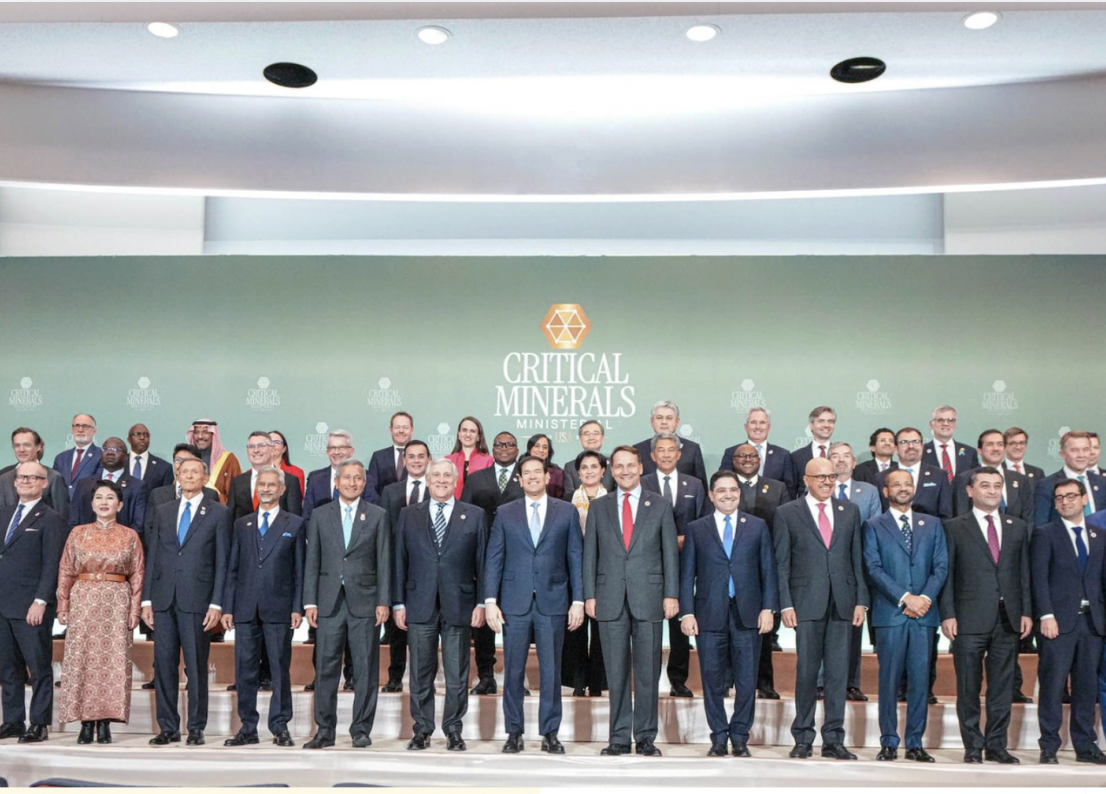
The U.S. is backing its ministerial language with specific transactions. There are named projects, clear tickets and defined mandates across EXIM, DOE, the Office of Strategic Capital, DFC and USTR. For investors, this means that critical minerals policy is no longer just narrative. It is attached to an identifiable set of assets and jurisdictions.
2) The strategy is built on interdependence, not isolation
The geography of the portfolio shows that the U.S. assumes continued interdependence. Supply security is being built through diversified, politically aligned supply and processing, not through full onshoring. That has direct implications for resource countries: being part of this network can mean access to capital and more stable offtakes, but also tighter expectations on governance, traceability and alignment.
3) Midstream and processing are now central
A notable share of the money is going into processing, refining and advanced materials: graphite, synthetic graphite, titanium, rare earths, potash processing, recycling and metal powders. This matches what we argue in Mining Is Dead. Long Live Geopolitical Mining : geology without midstream does not translate into strategic strength. The real chokepoints sit in processing capacity and in the ability to produce inputs for batteries, electronics and defence.
4) Public capital is being used to make projects financeable
The mix of tools (loans, equity, conditional commitments, letters of interest, stockpiles and investment platforms) is designed to address specific barriers that normally block private capital: price volatility, long payback periods, lack of anchor offtakes and technical novelty. Public tickets are not replacing private money; they are being structured to crowd it in and to move projects from interesting but unbankable to financeable under defined conditions.
5) Government backstops may gradually change how some mining equities behave
The emerging U.S. framework introduces new elements that can alter the pattern for a subset of names. Strategic reserves, long-tenor public loans, equity tickets and structured offtake platforms reduce the probability that technically sound projects are abandoned at the bottom of the cycle. They also increase the visibility of long term demand for specific minerals and intermediate products.
Over time, companies and projects that sit clearly under this policy and funding umbrella could start to show a different risk profile:
- less pure spot price beta and fewer forced shutdowns driven only by short term price drops;
- a valuation logic closer to long-duration industrial or infrastructure assets, where policy, contracts and capacity matter as much as the next quarter of price volatility.
This will not apply to the whole sector. Many miners will remain fully exposed to commodity cycles and political shifts. For capital allocators, the signal is to start distinguishing more carefully between critical mineral plays with explicit policy and funding support, and those that remain in a traditional boom and bust commodity dynamic.
Where the Real Risk Now Sits
The funding architecture now being deployed by the U.S. is internally coherent. It covers upstream, midstream, recycling, reserves and investment platforms. The main constraints are no longer conceptual or financial. They are institutional and social.
The key open questions are:
- whether partner countries can move permits, infrastructure and local approvals at a speed that matches this capital;
- whether projects can secure enough national and local legitimacy to build mines, plants and corridors on tighter timelines.
For investors and boards, this is where the core risk now sits. The U.S. side of the structure is increasingly clear. The decisive variable will be how host jurisdictions respond, and whether they can turn this wave of funding into real tonnes, real processing capacity and more resilient (and legitimate) supply chains.

For the full Geopolitical Mining framework behind this article, see our book Mining Is Dead. Long Live Geopolitical Mining .