
Geopolitical Mining · Davos 2026
Third Axis of Analysis. Germany and Ukraine: European Security and State Speed
Authors: Marta Rivera | Eduardo Zamanillo
This piece is part of our Davos 2026 analysis series at Geopolitical Mining. For the full framework behind our reading of these speeches, see “Davos 2026: Coordinates of the New Geopolitical Era” .
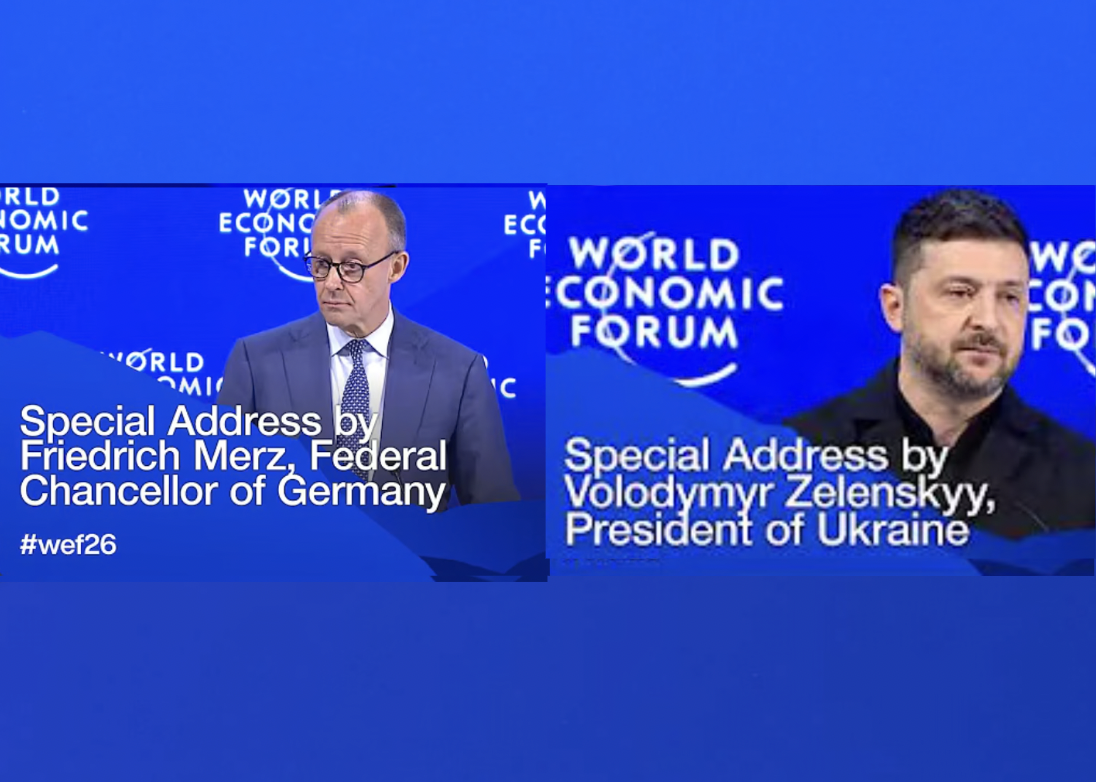
In the speeches by Friedrich Merz and Volodymyr Zelenskyy, Davos 2026 distills a very specific question: how is European security being reorganized, and how quickly can democratic institutions react in an environment that moves faster than they do.
Merz speaks from the centre of the system: Germany and the European Union as an actor that must accept that a “new era of great powers” has begun, invest massively in defence, reform its economy and regain competitiveness. Zelenskyy speaks from the edge: a country at war that has been sounding the same alarm for years, and that sees decisions arrive late while aggression and missiles move faster than sanctions, aid packages or Europe’s internal processes.
This axis looks in detail at how Merz draws the triangle of security – competitiveness – unity for Europe, how Zelenskyy denounces the Groundhog Day of diagnoses without action, and what happens when those two speeches are read together: the tension between design and speed, between strategic architecture and real execution capacity, becomes very clear.
1. Merz: A New Era of Great Powers and the “Security – Competitiveness – Unity” Triangle
Friedrich Merz opens his speech with a strong image: the calm of Davos contrasts with a world whose old order is collapsing at dizzying speed. He says explicitly that “a new era has already begun” and defines it as an age of great powers in which the rules of recent decades are being shaken.
From there, he structures his diagnosis:
The context
Russia, with the war in Ukraine as the most visible expression of this new era. China, an actor that, with strategic foresight, has installed itself firmly among the great powers. The United States, whose global position is being challenged and which is responding by radically reshaping its foreign and security policy.
The conclusion is clear: the imperfect but relatively stable international order of the past 30 years is being replaced by a “hostile” environment built on power, force and coercion.
The response he proposes for Europe
Merz takes a phrase from Carney “we cannot rely only on the power of our values; we must also recognise the value of our power”, and turns it into a roadmap. On that basis, he summarises Europe’s position in a triangle: security, competitiveness and unity.
Security: Europe will invest hundreds of billions of euros in defence. Germany, in particular, commits to raising its spending up to 5% of GDP, with the idea that strengthening military capacity is part of regaining sovereignty.
Competitiveness: he directly links Europe’s ability to exert political influence with the strength of its economy. Competitiveness and geopolitical power are presented as two sides of the same coin.
Unity: he insists that, in this new era, Europe will only be able to act as a relevant actor if it functions as a united European Union, and that Germany assumes a special responsibility in that effort.
In the final part of his speech, he acknowledges that Germany and Europe have “wasted enormous growth potential” by delaying reforms and “unnecessarily and excessively restricting entrepreneurial freedoms and personal responsibility.” He argues that “security and predictability must take precedence over excessive regulation and a misguided quest for perfection.”
He lists concrete steps:
- substantially cutting bureaucracy,
- recovering the original spirit of the single market as a competitive space,
- convening a “special summit on bureaucracy” on 12 February with proposals such as a regulatory emergency brake, legislative discontinuity and a European budget focused on competitiveness,
- accelerating the capital markets union so that European companies are not dependent on foreign stock exchanges and banks,
- mobilising €500 billion to modernise infrastructure,
- investing in AI “gigafactories”, data centres and a high-tech agenda that brings innovation to market.
The underlying idea is that Europe cannot be a great power if it is unable to decide and execute more quickly. Security, industrialisation and the technological transition depend on that speed.
In the strictly geopolitical dimension, Merz places Greenland as a concrete case where security, territory and the transatlantic relationship intersect:
- he acknowledges that the United States takes the Russian threat in the Arctic seriously,
- he states that any attempt to acquire European territory by force would be unacceptable,
- he warns that new tariffs would undermine the foundations of the transatlantic relationship and that, if they are imposed, the European response must be “united, calm, measured and firm.”
With that combination, his speech constructs an image of a Europe that wants to be a strong ally of the US, but not a subordinate: willing to invest massively in its own defence, to reform its economy and to act as “the alliance that offers open markets and rules” in the face of practices it sees as protectionist or arbitrary.
2. Zelenskyy: Europe Between Groundhog Day and the Need to Act in Time
Zelenskyy comes onto the stage with a very different device: he cites the film Groundhog Day to describe the feeling of repeating the same warnings over and over without the European response changing. He says that the previous year he closed his Davos speech stating that “Europe must learn to defend itself” and that, one year later, he finds himself forced to repeat exactly the same line.
His intervention has two layers:
1. Critique of Europe’s slowness and fragmentation
He talks about Russian missiles in Belarus “within range of most European capitals,” and notes that Europe remains in “Greenland mode”: waiting to see what someone else will do, instead of acting. He points out that although sanctions exist, the flow of Russian oil has not stopped and companies that finance the war machine are still operating. He thanks Europe for the pressure applied so far, but states that “Europe must do more” if it wants its sanctions to be as effective as those of the United States.
He describes a Europe that is “beautiful but fragmented,” “a kaleidoscope of small and medium powers” where internal debates, diplomatic silences and constant electoral calculations make strategic decision making difficult. The central sentence is blunt: “you cannot build a new world order with words; only actions create real order.”
2. A call for Europe to become a real power, not just a geography
Zelenskyy maintains that Europe risks degrading itself to a “secondary role” if it is unable to act as a genuine power. He says that, very often, Europe “waits for someone else to say how long we must resist,” that some leaders “are from Europe, but not always for Europe,” and that the continent continues to see itself more as geography, history or tradition than as a coherent political force.
He argues that Europe has the possibility of being “a global force” if it acts united, with courage and “in time.”
In the final part, his speech connects security with the economy in a very precise way. He answers the question of how to support Ukraine by saying that “real support” is to invest now, open offices, create jobs in Ukraine, because that demonstrates confidence that there will be an independent life after the war.
There he connects defence, reconstruction and economic presence: security is not sustained only with weapons and sanctions; it is also sustained with investment, employment and business rooted in the territory.
3. What They Show Together About European Security and State Speed
Placed side by side, the speeches by Merz and Zelenskyy draw the clearest picture of Europe’s transition towards a harsher geopolitics with higher demands on speed.
Merz speaks from within: he recognises that the old order is over, that Europe must invest massively in defence, reform its economy, reduce bureaucracy and act as a faster, more competitive bloc. His security – competitiveness – unity triangle is a proposal for long-term architecture.
Zelenskyy speaks from the system’s edge: he points out that, while that architecture is being built, decisions still arrive late. The Groundhog Day metaphor points to a gap between diagnosis and action; the call for Europe to be “a global force” shows the urgency of closing that gap.
Here, the tension becomes clear between the structural design of European security (what Merz wants to do in terms of spending, reforms, AI, infrastructure, regulatory reduction) and the “sovereignty of speed” that Zelenskyy is demanding: the ability to make decisions in time, to sanction effectively, to cut real flows (oil, components, finance) and to anchor economic presence in territories in conflict or under reconstruction.
This point 3 leaves two relevant ideas already outlined:
- European security is being redesigned as an integrated package: defence, industrial policy, trade, energy and technology are discussed together, not separately. Merz and Zelenskyy both show this from different angles.
- The success of that redesign will depend on the real speed of institutions: how long it takes to approve defence projects, energy infrastructure, digital networks and, by extension, mining and processing projects that feed into all of the above.
Germany and Ukraine are clear examples of this transition. Europe already has the diagnosis and the language; what is at stake is whether it can move its structures at the pace required by the new security landscape.
4. How This Axis Feeds the Overall Framework
The Germany – Ukraine axis helps to anchor, from a European perspective, three key pieces of the framework we propose for the new geopolitics:
It shows that security is also becoming industrial and material. When Merz talks about hundreds of billions in defence, modernising infrastructure, AI gigafactories, data centres and a capital markets union, he is describing a security model that depends on physical capabilities: military industry, energy, networks, applied technology. Zelenskyy, by asking for investment and jobs in Ukraine as “real support,” reinforces the same idea from the ground: security is not sustained only with declarations or sanctions, but with economic presence and infrastructure that remains after the war. This axis reinforces the first insight of the main article: in Europe too, power is being re-anchored in production, infrastructure and matter.
It makes clear that sovereignty of speed is an existential question for European democracies. Merz proposes the security – competitiveness – unity triangle and details reforms to cut bureaucracy, simplify rules and accelerate decisions. Zelenskyy puts his finger on the wound: while all that is being discussed, missiles keep flying, Russian oil continues to finance the war, and decisions arrive late. The tension between what Europe says it must do and what it manages to do “in time” is a very clear version of the second insight: internal and external legitimacy in democracies will depend on whether they are able to take difficult decisions at the speed the environment demands, without losing their principles or breaking their social contract.
It directly connects European security, institutional speed and future resource demand. A Europe that invests more in defence, reconstruction, energy and digitalisation will need more steel, more copper, more rare earths, more critical components. A Ukraine that is rebuilt as a “stress test” for the European system will concentrate infrastructure, energy and mining projects tied to that same effort. This axis therefore points to the third insight: European security, reindustrialization and reconstruction will intersect with mining and supply chains. The question will not only be how much is invested, but where materials are extracted and processed, under what standards, with what permitting speed and with what degree of legitimacy in the eyes of societies already scrutinising every decision.
Taken together, the Germany – Ukraine axis shows a Europe that already has the diagnosis (it knows the old order is over) but is still testing whether it can adjust its institutions to the pace of the new era. That gap between what it sees and what it manages to do “in time” will be one of the central tests of geopolitics in the coming years, and one of the places where the notion of geopolitical mining will become most visible: at the intersection between security, industry, citizens and resources.
This axis connects with the other five we analyse for Davos 2026. To see how they all fit into a single framework, you can read the full article: “Davos 2026: Coordinates of the New Geopolitical Era” .

For the full Geopolitical Mining framework behind this article, see our book Mining Is Dead. Long Live Geopolitical Mining .