
Geopolitical Mining · Article
Conversation with China. What Wang Yi’s Munich Speech Signals for Global Governance
Authors: Marta Rivera | Eduardo Zamanillo
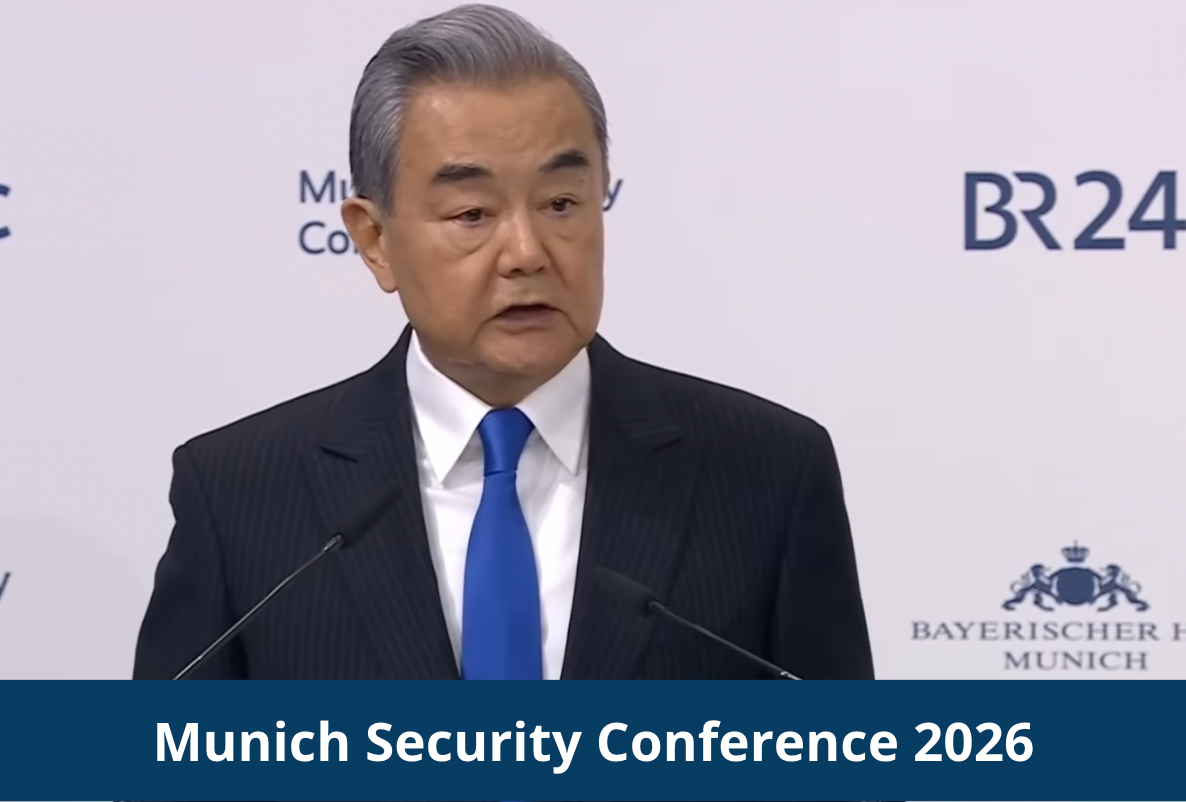
Wang Yi’s appearance at the Munich Security Conference, in the session titled “Conversation with China”, shares almost the same stage and timing as Secretary Rubio’s remarks. If Rubio’s speech offers a compact map of a new Western project, Wang presents a different kind of map: one in which China defines itself as a constructive force in a turbulent world, defends the centrality of the United Nations, and places the Global South at the heart of any reconfiguration of global governance.
Read with a Geopolitical Mining lens, this is not a speech about mines or specific resources. It is a speech about the institutional and narrative framework in which all other discussions will take place, including the re-wiring of critical minerals value chains.
1. Starting point: turbulence, law of the jungle and a historical crossroads
Wang begins with a diagnosis that, on the surface, is not so far from Western speeches: the international landscape is marked by transformation and turbulence; the “law of the jungle” and unilateralism are on the rise; humanity is at a new crossroads for peace and development.
The response, however, is framed very differently. Where Rubio answers with a project of Western renewal anchored in material power (industry, borders, supply chains) Wang responds with a project of global governance. He presents Xi Jinping’s Global Governance Initiative (GGI) as a compass for the giant ship of history, built around sovereign equality, international rule of law, multilateralism, a people centred approach and real actions.
In his narrative, the GGI is not a platform for a single country. It is described as reflecting the largest common ground among the world’s nations and as a new impulse toward a community with a shared future for humanity. The emphasis is not on who leads an industrial project, but on how rules, participation and legitimacy are distributed.
From a Geopolitical Mining perspective, this already shifts the focus: if the next phase of critical minerals is about re-building industrial capacity and re-configuring supply chains, Wang is asking under which governance narrative that will happen, and who gets to sit at the table.
2. The UN as cornerstone: a building to renovate, not to replace
The first concrete pillar of the speech is the United Nations. Wang describes the UN as a core outcome of the victory against fascism, a historic choice after the agonies of war, and the largest collective investment in peace humanity has made so far. He uses an architectural metaphor: the UN is an edifice built jointly by the peoples of the world; everyone has the responsibility to reinforce and renovate it; no one has the right to destroy it or tear it down.
He acknowledges that the UN is not perfect in its current form, but insists on two points: it remains the most universal and authoritative intergovernmental organisation; without it, the world would risk returning to a situation where the strong prey on the weak and where small and medium sized countries lose the multilateral foundation they rely on for survival and development.
For Wang, the priority is not to bypass or downgrade the UN, but to revitalise it: reaffirm its founding mission, strengthen its leading role, improve its effectiveness, and adapt it to 21st-century needs so that it can unleash renewed vitality.
In Rubio’s speech, by contrast, the UN appears primarily as ineffective on Gaza, Ukraine, Iran and Venezuela, with U.S. leadership and coalitions of the willing filling the gaps. The contrast is clear. For Geopolitical Mining, it has direct implications: any Western attempt to redesign critical minerals governance through selective clubs will face a Chinese narrative that repeatedly returns to the UN, to universal participation, and to the need to protect small and medium-sized states within the system.
3. Diversity, cooperation and harmony without uniformity
The second major block of Wang’s speech addresses why global governance is not functioning as well as it should. In his view, the problem does not lie with the UN as an institution, but with the behaviour of certain countries that magnify differences, place themselves above others, stoke bloc confrontation and revive a Cold War mentality. The effect, he argues, is an erosion of trust, a worsening atmosphere for cooperation and an impaired performance of international institutions.
As an answer, he proposes a relatively simple formula: seek common ground, manage differences and preserve cooperation. He emphasises that the world is naturally diverse in systems, histories, cultures, interests and demands. That diversity, in his view, is precisely what makes dialogue and cooperation necessary. He invokes the Confucian idea of harmony without uniformity to suggest that countries do not need to share the same model or ideology in order to respect one another and contribute to each other’s success.
He also points to history: from the anti-fascist war to responses to global financial crises, climate change and terrorism, progress has required countries to work together despite their differences.
This emphasis on diversity and cooperation translates, in geopolitical terms, into a normative defence of plural paths. It provides cover for governments in the Global South that want to work with multiple partners. Countries that seek to keep strategic autonomy rather than locking themselves into one bloc. And resource rich states that wish to negotiate with both China and Western actors on mining, energy and infrastructure.
For Geopolitical Mining, this is not a minor point. It underpins how many producing countries may justify diversified partnerships and resist either/or choices on critical minerals and related infrastructure.
4. Multilateralism, multipolarity and the rise of the Global South
The third axis is multilateralism. Wang argues that monopolisation of power by a few countries is unpopular, that the world is multipolar, and that what is needed is true multilateralism. He translates this into a call for greater democracy in international relations: global affairs should be discussed by all; the future of the world should be decided by all; all countries should be bound by the same set of rules based on the UN Charter.
In this vision: all states should be equal in terms of rights, opportunities and rules; major powers, in particular, should lead by example by advancing cooperation instead of confrontation, observing rules instead of applying double standards, promoting equality rather than imposing their will, and encouraging openness rather than unilateralism.
Crucially, he notes that the Global South is rising collectively, and that the global governance system should evolve accordingly, giving more weight to its voice and representation.
This intersects directly with the politics of critical minerals. In Rubio’s speech, the economies of the Global South appear as key theatres where the West must compete for market share and secure industrial and strategic footholds. In Wang’s speech, the Global South appears as a collective actor whose representation must be upgraded and whose interests must be reflected in institutions.
The perspectives are not mutually exclusive, but they stress different dimensions:
- one looks at markets, supply chains and competition;
- the other at representation, voice and institutional reform.
From a Geopolitical Mining standpoint, that dual framing will matter when Western actors propose critical minerals clubs, supply chain partnerships or selective investment frameworks in Latin America, Africa or Asia. Beijing will likely contrast those with offers and narratives organised around inclusiveness, development and multilateral legitimacy.
5. Conflicts and China as a force for peace, stability and progress
The speech then moves from principles to current conflicts: Gaza, Iran, Ukraine and Venezuela. Wang makes the point that without peace, global governance is meaningless. He refers to Xi’s concept of common, comprehensive, cooperative and sustainable security as a guide for resolving crises.
On Ukraine, he reiterates that China is not a direct party to the conflict; its role, as he presents it, is to promote talks for peace. He notes that channels of dialogue have reopened and expresses the hope that they will lead to a comprehensive, durable and binding peace agreement that tackles root causes and produces lasting stability. He reaffirms the importance of sovereignty and territorial integrity, but also stresses that the legitimate security concerns of all parties need to be addressed.
Taken together, these points build a carefully calibrated self image. China as a force for peace, committed to a path of peaceful development. As a reliable force for stability, upholding fairness and justice in international affairs and proposing distinctly Chinese approaches to hotspot issues. And as a progressive force in history, defending the outcomes of human civilisation and advancing global initiatives under the banner of a shared future.
For Geopolitical Mining, this reinforces how China wants to be perceived as a partner for long term projects: predictable, resistant to unilateral sanctions and emphasising political solutions over coercive ones. That positioning resonates in parts of the Global South where sovereignty, non interference and development space are central to domestic politics, especially in extractive sectors.
6. China-Europe and China-US: multipolarity versus blocs
In the final part of the speech and the Q&A, Wang turns directly to Europe and the United States.
On Europe, his message is that China and Europe are indispensable poles in a multipolar world, with time honoured civilisations and a shared responsibility to prevent fragmentation. He insists that in the journey towards multipolarity and economic globalisation, China and Europe are partners, not rivals, and that the choices they make now will be crucial for the future of the world.
On the United States, he recalls Xi’s three principles for the relationship, mutual respect, peaceful coexistence and win-win cooperation, and explicitly lays out two possible trajectories for China–US ties. One path is based on a more reasonable and objective understanding of China, a pragmatic policy and joint efforts to expand common interests, which would lead to cooperation beneficial for both countries and the world. The other path is based on decoupling, severing supply chains and opposing China in a purely emotional, knee jerk way, building small exclusive circles and trying to split Taiwan from China.
In practical terms, these two paths translate into two scenarios for global value chains, including those related to critical minerals: a scenario of managed interdependence, where supply chains remain complex but relatively stable and there is some room for shared standards and coordinated action; a scenario of deeper bifurcation, with more separated supply chains, competing rule sets and stronger pressure on producing countries to choose sides or play at the margins.
7. What this adds to the Geopolitical Mining picture
Placed alongside Rubio’s speech, Wang Yi’s remarks provide a complementary reference point for the emerging order around critical minerals and industrial strategy.
Rubio speaks from a Western civilisational narrative focused on reindustrialisation, border control and alliances, and calls for a Western critical minerals chain protected from coercion. Wang speaks from a global governance narrative focused on revitalising the UN, democratising international relations and amplifying the voice of the Global South.
Critical minerals are not mentioned explicitly in Wang’s text, but the rules of the game context is. Over the next decade, any Western attempt to rebuild or re-route supply chains, through legislation like the CRMA, friend shoring frameworks, or critical minerals clubs, will operate in an environment where China: insists on UN centrality and universal participation, presents itself as a defender of diverse development paths, and offers partnerships framed around sovereignty, non interference and inclusive multilateralism.
For resource rich countries, this will translate into a double conversation. On one side, they will receive proposals to join Western centred architectures of supply and processing. On the other, they will encounter offers that are embedded in a vocabulary of multipolarity, South-South cooperation and more democratic global governance. For Europe, it means navigating its role inside a Western industrial and security project, of the kind articulated by Rubio, while also managing a relationship with a China that wants to treat it as a partner in multipolarity, not as an automatic rival.
From a Geopolitical Mining standpoint, the practical value of Wang’s speech is not in project lists or mining policy detail. It lies in how clearly it sets out the narrative China will use when it talks about institutions, standards and alliances in a world where critical minerals move from technical annexes to the centre of strategic debate. Like Rubio’s Munich speech, it becomes a point of reference to interpret how the material economy of the 21st century is being rewritten.
Source
Munich Security Conference
China in the World | Main Stage I

For board-level insight and decision support on mining, legitimacy and industrial strategy, visit Geopolitical Mining Advisory .

For the full Geopolitical Mining framework behind this article, see our book Mining Is Dead. Long Live Geopolitical Mining .