
Geopolitical Mining · Article
The Day USA Locked in a Critical Minerals Deal with Argentina, and the Questions It Raises for Chile
By Marta Rivera | Eduardo Zamanillo
Geopolitical Mining
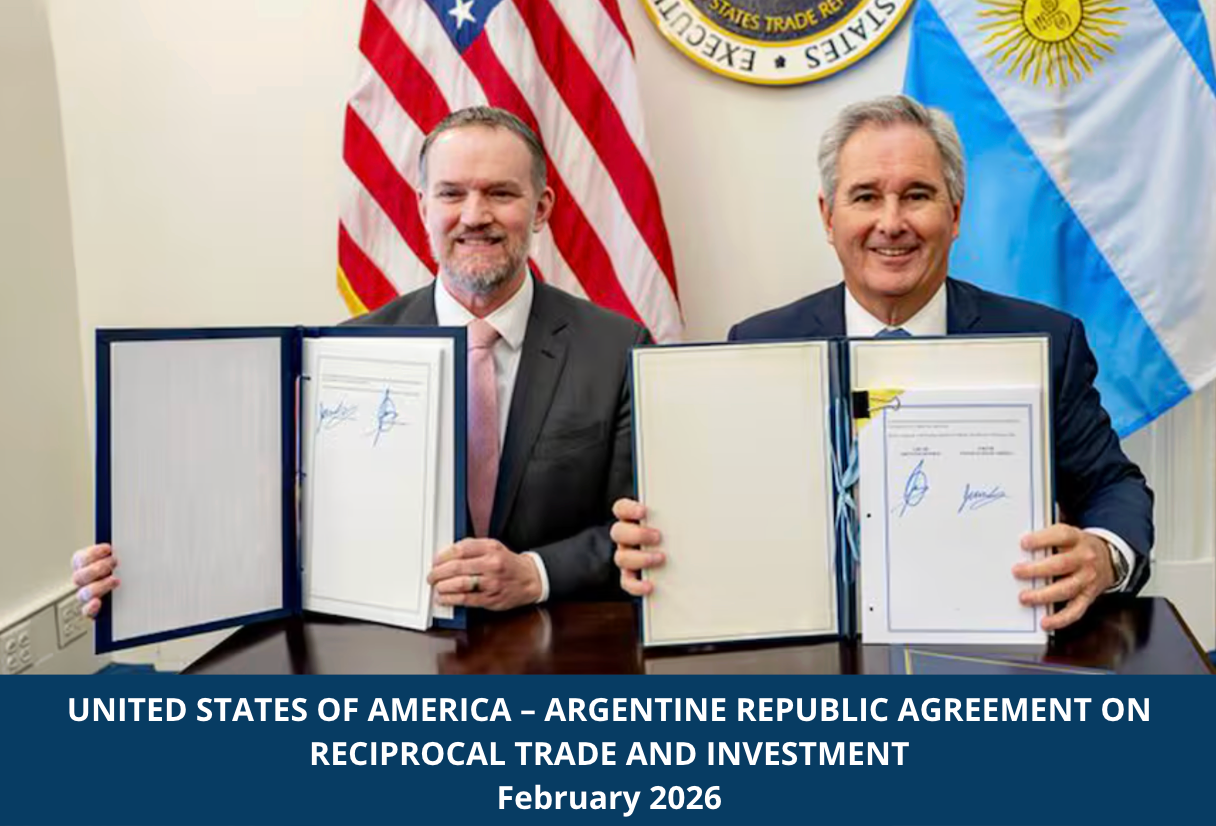
On February 2026, the United States and Argentina signed a package that marks a clear phase shift in the logic of Geopolitical Mining: a Strategic Framework to Strengthen Critical Minerals Supply Chains and the U.S.-Argentina Agreement on Reciprocal Trade and Investment (ARTI). ARTI explicitly opens Argentina’s critical minerals and energy sectors to U.S. capital and ties that access to U.S. financing instruments, including EXIM and DFC.
The signature is public and formal. ARTI was signed in Washington on 5 February 2026 by USTR Ambassador Jamieson Greer and Argentina’s Foreign Minister Pablo Quirno. Its entry into force is procedural: Article 6.7 provides that ARTI enters into force 60 days after both Parties exchange written notifications certifying completion of their applicable legal procedures (or on another date they may agree). In Argentina, the Office of the President stated the agreement will be sent to Congress in line with constitutional procedure.
The content matters. The speed and sequence matter as well. In few months, Washington has moved through a compressed progression:
- integrating economic strength, reindustrialisation, and supply chain control into the 2025 National Security Strategy (https://geopoliticalmining.com/americas-2025-national-security-strategy-when-economic-power-and-critical-minerals-move-to-the-center/);;
- outlining bloc style market architecture at the Critical Minerals Ministerial, including a preferential trade zone, reference prices, and enforceable price floors maintained through adjustable tariffs (https://geopoliticalmining.com/welcome-to-the-era-of-u-s-geopolitical-mining/);
- closing a country specific lane with Argentina and attaching investment access to public finance and security alignment through ARTI.
Argentina’s selection has immediate implications for the Southern Cone. Chile, long treated as the region’s mining benchmark, has just presented a National Critical Minerals Strategy. Yet Chile does not appear in the U.S. government’s public list of delegations at the 2026 Critical Minerals Ministerial, and it is navigating a diplomatic escalation after the U.S. imposed visa restrictions on three Chilean officials, which Chile formally rejected.
We do not know whether Chile declined to attend the ministerial or was not invited. We do know that during the same period Washington chose to bring Argentina into its emerging critical minerals architecture in a highly explicit way. This article looks at what was signed, Argentina’s real mining position today, and the questions this raises for Chile in the era of U.S. Geopolitical Mining.
1. What Washington Actually Signed with Argentina
The anchor document is ARTI: a wide ranging agreement covering tariffs, non tariff barriers, services, digital trade, labour, and environment. ARTI is signed, and its implementation is now a matter of legal procedure: it enters into force 60 days after the Parties exchange written notifications confirming completion of their applicable legal steps. Argentina’s government has stated it will remit the agreement to Congress as part of that domestic process.
The minerals and energy investment clause
ARTI states that Argentina shall allow and facilitate U.S. investment to explore, mine, extract, refine, process, transport, distribute and export critical minerals and energy resources, on terms no less favourable than those accorded to its own investors.
Finance is built into the lane
ARTI states that the United States will work through institutions such as EXIM and DFC (if eligible) to consider supporting investment financing in critical sectors in Argentina, in collaboration with U.S. private-sector partners.
Security alignment is part of the package
Under ARTI’s economic and national security provisions, Argentina commits to cooperate on export controls, to strengthen enforcement around security sensitive technologies and goods, and to ensure Argentine companies do not backfill or undermine U.S. export controls. ARTI also includes a complementary actions clause tied to U.S. border measures adopted on economic or national security grounds.
A revealing clause on illegal mining and precious metals
ARTI includes an Illegal Mining article requiring Argentina to develop and implement a system to track precious metals from extraction through transport, processing, and export, and to strengthen institutions responsible for enforcing mining related laws. For a country whose current export base is still dominated by precious metals, this functions as a signal: provenance and compliance are becoming part of the entry condition into a trusted-supply perimeter.
A preference signal: copper and lithium named explicitly
ARTI includes a commitment to fast track eligible projects through RIGI, and an intent to prioritise the United States as a trade and investment partner for copper, lithium, and other critical minerals, including raw, processed, and finished products, over market manipulating economies or enterprises.
The proportions matter. Illegal mining enforcement is one piece of the architecture. The larger point is that critical minerals and energy are being treated as instruments of industrial power and security alignment, and Argentina has now been written into that system.
2. Why Argentina, and Why So Fast?
Speed is the first signal. The U.S. did not take decades to build this lane. It moved from doctrine to bloc logic to a country specific operating framework with Argentina within roughly twelve months, consistent with a broader NSS framing that ties industrial capacity and supply chain control to national strength and security.
Argentina fits not because it replaces established partners, but because it offers a convergent bundle:
A multi-metal resource stack aligned with the first technological revolution: gold and silver as today’s cash base, lithium as a near term strategic ramp, copper as the 2030s option, and uranium as a quieter layer with strategic density.
A pro-investment policy posture built around RIGI, marketed as long-horizon predictability and incentives, including stability provisions.
A hemispheric logic consistent with the NSS emphasis on the Western Hemisphere as a space where the U.S. seeks to secure supply chains and constrain strategic vulnerabilities.
From this perspective, Argentina is one of the first live test cases for a U.S. model that blends market architecture (price floors and protected lanes) with bilateral frameworks and finance enabled execution.
3. Argentina’s Real Mining Position Today
To assess what this architecture can unlock, it helps to start from the ground: what Argentina already delivers in mining, and what remains prospective.
Gold and silver: the current backbone
Argentina’s mining export report shows total mining exports of USD 6.037 billion in 2025, around 7.0% of Argentina’s total exports. Metallic minerals account for USD 4.948 billion (82%), with gold (USD 4.078B) and silver (USD 777M) as the dominant components.
The silver market report adds two strategic details. It records a fourth consecutive global silver deficit in 2024 and places Argentina as the 10th global silver producer, with 3.0% of global production (Silver Institute). It also reports Argentine silver exports of USD 652 million in 2024, with China as the largest destination (25.6%).
For Geopolitical Mining, this matters for two reasons. Precious metals remain the cash flow anchor. Silver’s industrial role ties it directly to electrification, electronics, and solar demand, material inputs that sit beneath the AI buildout as well.
Lithium: from narrative to pipeline
Argentina’s lithium report frames the market context as oversupplied and price compressed in 2024, while positioning Argentina as a leading producer with large resource and reserve shares and a growing project pipeline. It reports USD 645 million in lithium exports in 2024 and projects potential exports exceeding USD 11 billion by 2035 under a successful pipeline and enabling conditions.
The Lithium Portfolio 2025 consolidates the execution picture: 6 projects in operation, 5 under construction, and an advanced portfolio summarised at USD 8.008B CAPEX, 122 Mt LCE resources, and 562 kt/year LCE in potential production. (This portfolio includes the same third party/disclaimer approach used across the Secretariat’s project portfolios.)
Lithium is the metal where Argentina has moved furthest from narrative to structured pipeline, making it the most plausible near term delivery channel inside a U.S. trusted-supply lane.
Copper: a portfolio for the 2030s
Argentina’s copper market report states 17.2 Mt of copper reserves and describes nine advanced projects with combined CAPEX to initiate operations above USD 28B, projecting potential production above 1.5 Mt/year in 2035 and exports above USD 17B in that horizon.
The Copper Portfolio 2025 summarises the flagship set with an estimated USD 22B CAPEX, 90.42 Mt Cu in identifiable resources, and 1 Mt/year in potential production.
In U.S. strategic terms, copper is the metal nervous system of grids, data centres, industrial equipment, and defence electronics. That makes execution timing the core question: whether policy stability, finance channels, and corporate capacity can move part of this portfolio from slides into production within a window that matters for U.S. industrial planning.
Uranium: a smaller but strategically dense layer
The Uranium Portfolio 2025 lists 34,281 t U₃O₈ in resources and a modest exploration budget, and shows a project set distributed across feasibility, advanced exploration, and early exploration. Uranium will not dominate bilateral trade numbers, yet it adds strategic density in a doctrine that treats energy security and critical infrastructure as core policy objects.
RIGI and the portfolio state
RIGI is being used as the enabling platform for large scale capital mobilisation, marketed as long-horizon predictability and incentives, including stability provisions. In February 2026, Argentina also announced a one time one year extension of the adhesion window, and stated that 10 projects totalling USD 25.479B had been approved since operational regulation.
Alongside this, the Secretariat’s commodity specific portfolios function as a curated interface: projects grouped by metal and stage, with CAPEX, resources, and production estimates compiled from public technical reporting.
This combination, RIGI + portfolios + ARTI’s finance and preference lane, forms Argentina’s institutional signal: readiness to host a share of an emerging critical minerals order, with a map attached.
4. The Federal Map: Where Can This Actually Land?
A structural constraint remains: Argentina is federal, and subsoil resources sit within a provincial governance reality. The project portfolios published by Argentina’s Secretariat of Mining make this explicit and direct readers to provincial authorities for legal, social, and environmental status, precisely because mines can fall under national or provincial jurisdiction depending on location.
ARTI recognises this constraint in operational terms. Under its Critical Minerals article, Argentina commits to work with provincial governments to facilitate U.S. investment in critical mineral projects, and to fast track eligible applications through RIGI. The result is clear: the U.S.-Argentina lane will not land evenly across the country. It will materialise first where project density, local political alignment, permitting execution, infrastructure readiness, and social licence already converge.
In practice, that points to three provincial clusters that are already carrying the weight of Argentina’s mining pipeline:
Northwest lithium provinces (Jujuy/Salta/Catamarca): the advanced lithium system is concentrated in the Puna, with projects explicitly located in Jujuy (e.g., Salar de Caucharí) and Salta (e.g., Mariana), and with some assets spanning the Catamarca-Salta border area. This is also where activity is already in motion: Argentina’s own Mining Project Portfolio lists multiple lithium operations in production and several more under construction.
San Juan as the copper centre of gravity: the Copper Portfolio shows a concentration of flagship copper systems tied to San Juan, including projects at construction and feasibility stages. Josemaría is explicitly presented as a construction stage project, supported by technical sources that situate it in San Juan Province. El Pachón is located in San Juan (Calingasta) near the Chilean border, and Filo del Sol is described as cross border, extending into the adjacent province of San Juan on the Argentine side. The portfolio also places Los Azules in San Juan (Calingasta) near the border.
Santa Cruz for precious metals project density: the national Mining Project Portfolio groups a significant share of gold and silver related project activity under Santa Cruz, reflecting the province’s continuing weight in Argentina’s precious metals footprint.
The key point is that this is not a purely future tense architecture. Argentina’s RIGI update reports 10 projects approved totalling USD 25.479 billion, indicating that investment decisions are already being processed through the regime that ARTI explicitly links to critical minerals acceleration.
So the federal map is not a footnote, it is the implementation filter. ARTI can widen the lane, attach financing pathways, and set a preference logic. The pace of delivery will still be set below the headline: provincial permitting capacity, infrastructure build out, and the local contracts that sustain social legitimacy.
5. And Chile? The Southern Cone Question
Chile remains a global anchor in copper and an important lithium producer. That installed reality has not changed. What has changed is the environment in which that relevance is being priced and translated into partnerships.
Washington is building a critical minerals operating architecture that blends trade rules, market design, public finance, security alignment, and compliance thresholds into a single system. In that system, resource endowment still matters, but the decisive variable increasingly becomes execution: how quickly a partner can align institutions, move projects through permitting and financing pathways, and stay synchronized on security sensitive infrastructure choices.
Chile has moved on its side as well. It presented a National Critical Minerals Strategy designed to consolidate its role in global supply chains, strengthen value chains, and deepen minerals diplomacy as a policy pillar. Yet in the same window, Chile did not appear in the U.S. government’s published delegations list for the 2026 Critical Minerals Ministerial, which convened 54 delegations and the European Commission.
Then came the clearest signal of how tightly Washington is linking minerals and infrastructure security. The U.S. Department of State announced visa restrictions on three Chilean government officials, stating that the individuals had engaged in activities that compromised critical telecommunications infrastructure and undermined regional security. Chile rejected the allegations and requested clarification through diplomatic channels. In Geopolitical Mining terms, this matters because it shows the selection filter in real time: when telecom infrastructure is framed as a national and regional security issue, it can spill into the broader trusted perimeter logic that now surrounds minerals.
This is where Argentina becomes revealing, even beyond its geology. Argentina has moved with unusual speed and administrative clarity: it has pushed an investment regime, curated and segmented its mining pipeline, and worked with the provinces that are already positioned to execute, even if not all jurisdictions are aligned. And Washington has shown flexibility in parallel: it is willing to place early bets on partners that can negotiate diligently and move quickly, even when part of the material payoff is structurally medium term. Copper is the obvious example. Argentina’s copper story is not a this year story; it is a build and permit story measured in years. Yet the U.S. lane with Argentina was still formalised first, with finance and security alignment attached.
That contrast sharpens a Southern Cone question that is easy to miss if we only look at reserves. Chile has world class copper capacity already in production. If resource endowment were the only filter, Chile would look like the natural first lane. The fact that Washington formalised an explicit, finance linked lane with Argentina first suggests that pace, synchrony, and political operational alignment are increasingly shaping who gets integrated early, and how.
This dynamic also exposes a recurring Latin American risk: allowing political colour to become the main variable shaping external negotiation. In a cycle where critical minerals are being folded into security doctrine and market architecture, execution windows do not wait for domestic politics to settle. The cost is not rhetorical; it is time, sequencing, and the ability to shape terms while frameworks are still being designed.
A reset opportunity may still open quickly. Chile’s president elect is José Antonio Kast, who takes office in March, and reporting indicates he accepted an invitation to a Trump hosted summit with Latin American leaders in Miami on 7 March, a first venue to rebuild synchrony and reopen channels at the leadership level.
From a Chilean perspective, the questions are therefore practical and time bound:
- How does Chile want to position itself inside an emerging U.S. led trusted perimeter where critical infrastructure decisions increasingly sit alongside minerals?
- What is Chile’s midstream offer (processing, refining, advanced materials) alongside extraction, and how bankable is that offer under current permitting and investment conditions?
- How will Chile manage China exposure in trade and infrastructure while preserving strategic optionality with the U.S. and Europe?
- What institutional commitments can Chile make that remain durable across political cycles, so that partners can treat execution as predictable?
Chile’s relevance is structural. The variable now is whether Chile can convert that structural position into early inclusion in fast moving architectures, through speed, synchrony, and a negotiation posture that treats this cycle as strategic rather than partisan.
6. Reading This Moment Through a Geopolitical Mining Lens
From the perspective of Geopolitical Mining, the U.S.-Argentina package is not an isolated bilateral episode. It shows how a new order operates when it locks onto a specific country.
Three conclusions follow.
First, the United States has moved from diagnosis to architecture to execution with unusual speed. Minerals, midstream capacity, and industrial capability are being embedded into security doctrine and translated into instruments that shape markets and accelerate projects. Argentina is one of the first places where this becomes a country level lane with finance and preference logic attached.
Second, Argentina is being invited into a structured role in a supply chain map where mining behaves as infrastructure. Gold and silver remain the current export backbone, and traceability becomes part of the compliance threshold. Lithium is the most concrete near term delivery wedge. Copper is the potential step change of the 2030s, conditional on execution. Uranium adds a smaller layer with strategic density. Delivery will depend less on geology than on institutions, provinces, permitting, infrastructure, and social contracts.
Third, the Southern Cone is moving into a more plural and competitive configuration. Chile remains central in copper and lithium. Argentina has now entered Washington’s architecture through an explicit lane at a moment when infrastructure security and alignment signals are clearly being weighted more heavily in U.S. policy.
For investors and decision makers, the priority is understanding that U.S. economic and security strategy is being reorganised around material and industrial capacity, and that countries such as Argentina and Chile are increasingly being asked, explicitly or implicitly, to define how and on what terms they intend to participate in that order.
Sources
-
USTR — United States of America–Argentine Republic Agreement on Reciprocal Trade and Investment (ARTI) (Feb 2026) [PDF]
https://ustr.gov/sites/default/files/files/Press/Releases/2026/US%20Argentina%20ARTI%20English%20Final%20February%202026.pdf -
The White House — 2025 National Security Strategy (Dec 2025) [PDF]
https://www.whitehouse.gov/wp-content/uploads/2025/12/2025-National-Security-Strategy.pdf -
JD Vance — Remarks at the Critical Minerals Ministerial (Transcript) (Feb 4, 2026)
https://rollcall.com/factbase/trump/transcript/donald-trump-remarks-jd-vance-critical-minerals-february-4-2026/ -
EXIM — Project Vault (Announcement) (Feb 2, 2026)
https://exim.gov/news/project-vault -
U.S. Department of State — 2026 Critical Minerals Ministerial (Delegations list) (Feb 4, 2026)
https://www.state.gov/releases/office-of-the-spokesperson/2026/02/2026-critical-minerals-ministerial -
U.S. Department of State — Visa Restrictions on Chilean Nationals Undermining Regional Security (Feb 20, 2026)
https://www.state.gov/releases/office-of-the-spokesperson/2026/02/visa-restrictions-on-chilean-nationals-undermining-regional-security/ -
Ministerio de Relaciones Exteriores de Chile — Gobierno de Chile rechaza la imposición de medidas unilaterales por parte de Estados Unidos (20 Feb 2026)
https://www.minrel.gob.cl/sala-de-prensa/gobierno-de-chile-rechaza-la-imposicion-de-medidas-unilaterales-por-parte -
Gobierno de Chile (Economía) — Gobierno presenta Estrategia Nacional de Minerales Críticos (27 Jan 2026)
https://www.economia.gob.cl/2026/01/27/gobierno-presenta-estrategia-nacional-de-minerales-criticos.htm -
Secretaría de Minería (Argentina) — Mercado de Plata (Dec 2025) [PDF]
https://www.argentina.gob.ar/sites/default/files/plata_2025.pdf -
Secretaría de Minería (Argentina) — Mercado de Oro (Oct 2025) [PDF]
https://www.argentina.gob.ar/sites/default/files/mercado_de_oro_20251510.pdf -
Secretaría de Minería (Argentina) — Portfolio of Advanced Projects: Silver (2025) [PDF]
https://www.argentina.gob.ar/sites/default/files/portfolio_silver_2025.pptx.pdf -
Secretaría de Minería (Argentina) — Portfolio of Advanced Projects: Uranium (2025) [PDF]
https://www.argentina.gob.ar/sites/default/files/portfolio_uranium_2025.pptx.pdf -
Council of the EU — EU–Mercosur: Council greenlights signature of the comprehensive partnership and trade agreement (9 Jan 2026)
https://www.consilium.europa.eu/en/press/press-releases/2026/01/09/eu-mercosur-council-greenlights-signature-of-the-comprehensive-partnership-and-trade-agreement/ -
USTR — Press Release: Ambassador Greer Signs the United States–Argentina Agreement on Reciprocal Trade and Investment (ARTI) (Feb 5, 2026)
https://ustr.gov/about/policy-offices/press-office/press-releases/2026/february/ambassador-greer-signs-the-united-states-argentina-agreement-reciprocal-trade-and-investment -
La Nación — Se firmó el acuerdo comercial entre la Argentina y Estados Unidos (Feb 5, 2026)
https://www.lanacion.com.ar/politica/se-firmo-el-acuerdo-comercial-entre-la-argentina-y-estados-unidos-nid05022026/ -
Argentina.gob.ar — El Gobierno Nacional prorroga por un año el plazo de adhesión al RIGI (19 Feb 2026)
https://www.argentina.gob.ar/noticias/el-gobierno-nacional-prorroga-por-un-ano-el-plazo-de-adhesion-al-rigi -
Secretaría de Minería (Argentina) — Informe mensual: Exportaciones mineras en Argentina (Enero 2026) [PDF]
https://www.argentina.gob.ar/sites/default/files/2026.01_exportaciones_mineras_en_argentina.pdf -
Secretaría de Minería (Argentina) — Mercado de Cobre 2026 [PDF]
https://www.argentina.gob.ar/sites/default/files/mercado_de_cobre_2026.pdf -
Secretaría de Minería (Argentina) — Informe Litio (Junio 2025) [PDF]
https://www.argentina.gob.ar/sites/default/files/informe_litio_junio_2025.pdf -
Secretaría de Minería (Argentina) — Portfolio of Advanced Projects: Lithium (2025) [PDF]
https://www.argentina.gob.ar/sites/default/files/portfolio_lithium_2025ok.pdf -
Argentine Mining Exports Reach Historic Record of US$6.037 Billion in 2025
https://www.panorama-minero.com/en/news/argentine-mining-exports-reach-historic-record-of-us-6-037-billion-in-2025 -
Secretaría de Minería (Argentina) — Portfolio of Advanced Projects: Copper (2025) [PDF]
https://www.argentina.gob.ar/sites/default/files/portfolio_copper_2025.pptx.pdf

For board-level insight and decision support on mining, legitimacy and industrial strategy, visit Geopolitical Mining Advisory .

For the full Geopolitical Mining framework behind this article, see our book Mining Is Dead. Long Live Geopolitical Mining .