
Country & Region Analysis · Europe
Europe Wakes Up: How Merz, von der Leyen, Starmer, and Macron Are Grasping the New Moment
Authors: Marta Rivera | Eduardo Zamanillo
In Munich this year, the main stage offered (almost back to back) three layers of the emerging order.
First, Secretary Rubio laid out a hard power Western agenda: reindustrialisation, a Western critical minerals supply chain, a sharper competition for market share and influence in the Global South. Then Wang Yi responded with China’s map: UN centred multilateralism, true democracy in international relations, a bigger voice for the Global South in global governance.
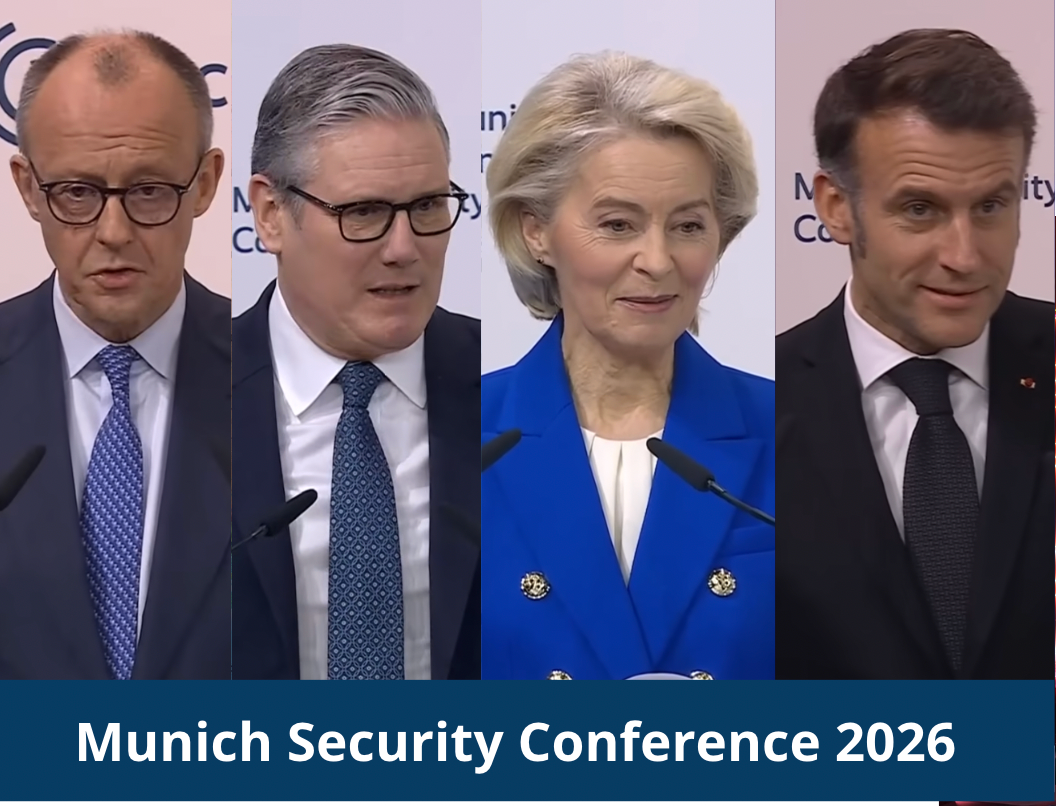
Between those two maps sits Europe. And in Munich four European leaders ,Chancellor Friedrich Merz, Commission President Ursula von der Leyen, Prime Minister Keir Starmer and President Emmanuel Macron, started to define how Europe wants to position itself between Washington and Beijing.
They spoke from different institutions and different capitals, but when you place their speeches side by side, they describe the same underlying reality: Europe is no longer treating security as something separate from its material base. Hard power, industrial capacity, supply chains and raw materials are being pulled into the same frame.
For Geopolitical Mining, this is the moment when Europe stops talking about strategic autonomy in abstraction and begins to define what that means in terms of mines, factories, logistics and alliances.
1. The end of Europe’s holiday from history
All four speeches start from a similar place, even if they use different language to describe it.
Merz takes the conference motto Under Destruction and says flatly that the international order based on rights and rules, so imperfect even in its best days, no longer exists in that form. Europe, he argues, has ended a long holiday from world history and has stepped back into an era openly shaped by power and great power politics.
Von der Leyen speaks of four years of Russian aggression, external efforts to weaken the Union from within, and a return of hostile competition that tests Europe’s way of life, its democratic foundations and the trust of its citizens. Starmer talks about a peace that no longer feels solid under Europe’s feet; war is no longer something that happens far off. The warning signs, he insists, are all there.
Macron starts from a similar assessment but chooses to attack the narrative of European decline more explicitly. He lists the clichés he hears, Europe as an ageing, slow, fragmented construct; as an overregulated economy that chokes innovation; as a society allegedly overwhelmed by migration; even as a continent where free speech is supposedly under threat. Then he deliberately turns that on its head. He describes Europe as a radically original political construction of free, sovereign states that chose, after centuries of rivalry and war, to institutionalise peace through economic interdependence. He points to the Western Balkans and Moldova as candidates that want to join precisely because they understand the value of that model, and he warns that Europeans are becoming too shy about their own achievements.
The common thread across the four is that European leaders no longer treat the post Cold War order as a given. Russia’s war in Ukraine is the sharpest expression of that shift, but not the only one. China’s patient global rise, pressure on alliances, the instrumentalisation of energy, information and technology, all four mention versions of these dynamics.
From this, they draw a similar conclusion: Europe cannot afford to be a consumer of security and a spectator in the material economy. It has to be a producer of power, starting from its own economic and industrial base.
2. Raw materials, technologies and supply chains as instruments of power
For Geopolitical Mining, one of the most important lines comes from Merz. He says that in the new era of great power politics, raw materials, technologies and supply chains become instruments of power in the zero sum game of the big players. It is a concise way of saying that extraction, processing and manufacturing are no longer neutral background conditions; they are levers of coercion, influence and resilience.
Von der Leyen, speaking from the EU side, puts it into a broader independence doctrine. For her, Europe must become more independent in every dimension that affects our security and prosperity: defence and energy, economy and trade, raw materials and digital tech. Raw materials sit on the same line as energy and digital; that is a deliberate choice, and it anchors them inside the security conversation.
Starmer, from the UK side, uses different language but moves in the same direction. He describes hard power as the currency of the age, calls Europe a sleeping giant whose economies dwarf Russia but whose defence capabilities are fragmented, and argues that Europe must move from over dependence to interdependence. His focus is on defence spending, industrial integration and economic alignment with the EU, but underneath lies the same logic: industrial and technological capacity, backed by secure supply chains, is now a strategic asset, not just an economic advantage.
Macron makes the connection most explicit when he moves from Ukraine to the question of European power. After listing the 170 billion euro assistance package, the sanctions and the rapid reduction of dependence on Russian energy, he says that when he speaks of Europe becoming a power, he means a power that can defend itself, project influence and shape the world according to its values without being dependent on others. That requires more than rearming; it requires building a true European defence industry that is integrated, competitive and sovereign, investing massively in innovation, deep technologies, drones, AI for defence and space capabilities, and reducing dependencies in strategic sectors.
And he adds one sentence that brings critical minerals fully into the picture: Europe cannot continue to depend on others for what is essential to its industries, its technologies, its defence; it must secure supply chains, diversify them, invest in recycling, and invest in mining in Europe and with reliable partners. In other words, raw materials and critical minerals are part of becoming independent.
Once you accept, with Merz, that raw materials, technologies and logistics are instruments of power, with von der Leyen that they belong on the same line as defence and digital, and with Macron that mining and recycling are part of independence, it becomes natural to read:
- a mining project as part of a security architecture,
- a refinery as a node in deterrence,
- a battery plant or defence-tech cluster as a piece of geopolitical infrastructure.
That is the mental shift that runs through these speeches.
3. From normative surplus to capacity realism
Another striking convergence is the recognition that, for years, Europe had more normative ambition than material capability.
Merz says it directly: German foreign policy had a normative surplus compared to its means. It criticised violations of international order around the world, admonished and demanded, but did not worry enough about lacking the instruments to correct them. The gap between ambition and capability became too wide; now it has to be closed.
Von der Leyen makes a similar move at EU level. She talks about shock therapy that Europe did not choose but had to endure, and argues that these shocks have forced the Union to move from declarations to implementation. She cites sharply higher defence spending compared to pre-war levels, large EU packages for Ukraine and new programmes like SAFE. She calls this a European awakening, but stresses that it is only the beginning. The deeper change is her call to bring the EU’s mutual defence clause to life and to apply a security lens across all major policy tools.
Starmer, for his part, is explicit that Europe has treated the US security umbrella as a comfort zone that allowed bad habits to develop: fragmentation in platforms, underinvestment in hard capabilities, an assumption that peace was guaranteed. That, he says, must end. The UK, in his framing, is no longer in the Brexit years of turning inward; it must be a central security provider in a more European NATO and in a more integrated European defence industry.
Macron adds a note of self assertion. He rejects narratives of European decline, but does not deny that Europe is challenged. He argues that Europe must move from doubting itself to acting as a power: accelerating in defence, building an integrated defence industry, investing in deep tech, and explicitly reducing dependencies in strategic sectors, including critical minerals, technologies and energy.
The shared move is from saying more than Europe could materially sustain to aligning values and goals with hard instruments: budgets, industrial capacities, regulatory tools, alliances. In the language we have been using, Europe is moving from a politics of norms to a politics of capacity and norms.
For Geopolitical Mining, this means that discourse on sustainability, ESG and transition will increasingly sit alongside discourse on resilience, supply security and industrial feasibility. The era of assuming that markets alone will deliver the materials needed, on time and in any scenario, is ending.
4. Independence, mutual defence and the security perimeter
Each leader also defines independence in a slightly different, but complementary, way.
Von der Leyen’s definition is the most structured. Independence means that Europe can defend its territory, economy, democracy and way of life at all times. It requires an awakening in defence spending, a European backbone in space, intelligence and deep strike, and, crucially, bringing Article 42(7), the EU’s mutual defence clause, to life. Mutual defence, she says, is not optional; it is a treaty obligation: one for all and all for one.
Merz echoes this from a national perspective. In the age of great powers, he argues, European freedom is no longer a given. It is under threat and has to be defended with firmness, willpower and a willingness to change and sacrifice, not someday, but now. For Germany, that is complex because of its history, but he insists that too little state power can undermine freedom as surely as too much. The answer is a European sovereignty that rejects German hegemony but accepts leadership in alliance.
Starmer focuses on NATO and Article 5. He stresses that the UK’s commitment to collective defence is as strong as ever and that Europe must create a more European NATO by increasing spending, integrating industrial and procurement efforts and taking on more responsibility on its own continent. He frames independence not as going it alone, but as standing on our own two feet inside NATO and in partnership with the United States.
Macron adds the language of Europe as a power in its own right: a power able to defend itself, to project influence and to shape its environment according to its values without being dependent on others. For him, that includes a rearticulation of France’s nuclear deterrent in a European perspective, not sharing it, but opening strategic dialogue so that it is more credibly tied to European security as a whole. It also includes economic, technological and energy sovereignty.
Across the four speeches, the security perimeter is clearly broader than the EU-27. The UK is central to this thinking. Von der Leyen explicitly calls for the EU and the UK to come closer together on security, economy and defending democracy. Merz insists that Germany will never go alone again; its freedom will be defended with neighbours and allies. Starmer says there is no British security without Europe and no European security without Britain. Macron includes Western Balkans, Moldova, the UK, Norway and Canada when he describes the European space of cooperation and freedom.
In practice, this implies that the zone within which security and industrial planning are coordinated, and within which critical minerals and supply chains will be managed, is European in the broad sense, not just the EU-27. That matters when you think about where to situate processing capacity, how to structure trade and investment regimes, and who sits at the table when standards and rules are written.
5. Industrial capacity and dual use sectors move to the centre
Perhaps the most important common element for Geopolitical Mining is the explicit centrality of the industrial base.
Von der Leyen states it in the most direct way. Ukraine has shown that strength, deterrence and ultimately lives depend on industrial capacity, on the ability to produce, scale and sustain effort over time. She uses the Ukrainian phrase you change or die to capture the urgency. For her, that requires tearing down the wall between civil and defence sectors. Car manufacturing, aerospace and heavy machinery are not only commercial; they are core to the defence value chain. Dual use technologies (AI, cyber, drones, space) must move quickly from labs to deployment.
She connects this to specific initiatives: a Defence Innovation Office in Kyiv combining European scale with Ukrainian speed; accelerated innovation and production of drones, which account for the bulk of battlefield damage; and the use of AI and software to create interoperability across fragmented weapons systems.
Merz speaks in similar terms when he says that competition policy is security policy and security policy is competition policy. Decisions about markets, mergers, standards and trade now have direct security implications. He emphasises the need to reduce one sided dependencies on raw materials, key products and technologies, and to revive European industry, not just in defence, but across the industrial ecosystem that supports it.
Starmer’s approach is to highlight the UK’s defence industrial base as a continental asset. British companies represent more than a quarter of Europe’s defence industrial base. They employ hundreds of thousands of people and are already engaged in long range missile development, cutting edge drones with Ukraine, Arctic deployments and naval projects with Norway and other partners. He explicitly links this to the idea of building a shared industrial base across the continent that can turbocharge defence production. To support that, he openly talks about moving closer to the EU single market in certain sectors, where it works for both sides.
Macron adds detail on what this industrial agenda should contain: deep technologies, drones, AI for defence, space capabilities and the full construction of a true European defence industry that is integrated, competitive and sovereign. He then places critical minerals and raw materials inside that same project: Europe must secure its supply chains, diversify them, invest in recycling, and invest in mining at home and in cooperation with reliable partners. For him, this is part of what it means to build an independent Europe.
Taken together, these moves signal that Europe and the UK intend to treat:
- mines, smelters and refineries,
- advanced manufacturing plants,
- technology and innovation clusters
as pieces of security infrastructure. Their feedstock, critical minerals and strategic materials, becomes part of the security conversation by definition.
6. The new doctrine, security as a lens on all policy
Another shared thread is the idea that security can no longer be confined to defence ministries.
Von der Leyen is the most explicit, calling for a new European Security Strategy in which every major policy tool (trade, finance, standards, data, critical infrastructure, platforms, information) acquires a clear security dimension. Europe, she says, should be ready and willing to use its strength assertively and proactively to protect its security interests. The aim of the doctrine she sketches is straightforward: to ensure that Europe can defend its territory, its economy, its democracy and its way of life at all times.
Merz uses different language but points in the same direction when he talks about building a Europe that is a world political factor with its own security strategy, not just an economic space, and about closing the gap between aspirations and instruments.
Starmer adds the domestic political dimension. He warns that if leaders fail to explain the scale of the shift to their publics, peddlers of easy answers on the extremes of left and right will fill the vacuum, often with positions that are soft on Russia and weak on NATO. For him, building consent for higher defence effort, industrial integration and economic alignment is part of security policy itself.
In practical terms, this means that policy areas that used to be treated separately (critical raw materials strategies, green industrial policy, digital regulation, trade agreements) will increasingly be integrated under a security logic. The EU’s Critical Raw Materials Act, for example, is unlikely to remain a purely green industrial tool; it will sit alongside defence, industrial and foreign policy decisions.
7. What this European square means for Geopolitical Mining
If we step back and look at these four speeches as a single European voice, several implications emerge for Geopolitical Mining, especially when contrasted with Rubio’s Western project and Wang’s global governance narrative.
First, Europe is explicitly acknowledging that raw materials, technologies and supply chains are levers of power. This is no longer implicit or confined to technical documents; it is said from the main stage in Munich. That gives political cover to treat mining projects, processing facilities and logistics corridors as strategic assets, not just commercial ventures.
Second, Europe is preparing to invest heavily in hard power, dual use technologies and industrial capacity, and to justify that investment not only in security terms but also as a new industrial deal. Demand for certain minerals and materials is likely to be driven simultaneously by green transition technologies and by defence and dual use sectors. This will shape where capital flows, which jurisdictions are prioritised and how project and country risk are priced.
Third, the governance perimeter for these decisions will be European in a broad sense, not just EU-27. The EU, the UK and close partners like Norway, Iceland and Canada are being woven into a more coherent security and industrial network. Producing countries in Latin America, Africa and Asia will increasingly be dealing with a more integrated European-UK block that combines security commitments, industrial instruments and regulatory power.
Fourth, the internal European conversation is shifting from normative rhetoric to capacity realism. This will change how Europe approaches ESG and sustainability in mining and energy. The requirement will be not only to be clean and fair, but also to be credible and scalable in terms of volumes, timelines and resilience.
Finally, in the larger Munich sequence, Europe is positioning itself between the two maps drawn by Rubio and Wang. The United States is pushing for a Western critical minerals and industrial chain; China is pushing for UN-centred, Global South inclusive governance. Europe, through Merz, von der Leyen, Starmer and Macron, is starting to speak as an active architect of the material order, not just as a market that others compete over. How successfully it can translate these speeches into coherent projects, consistent standards and durable partnerships with resource rich countries will shape not only Europe’s role in the new order, but also the structure of the critical minerals landscape in the decade ahead.
Sources – Munich 2026 European Speeches

For board-level insight and decision support on mining, legitimacy and industrial strategy, visit Geopolitical Mining Advisory .

For the full Geopolitical Mining framework behind this article, see our book Mining Is Dead. Long Live Geopolitical Mining .