
Geopolitical Mining · Davos 2026
Fourth Axis of Analysis. Europe (Von der Leyen and Macron) and China: How the New Order Is Being Narrated
Authors: Marta Rivera | Eduardo Zamanillo
This piece is part of our Davos 2026 analysis series at Geopolitical Mining. For the full framework behind our reading of these speeches, see “Davos 2026: Coordinates of the New Geopolitical Era” .
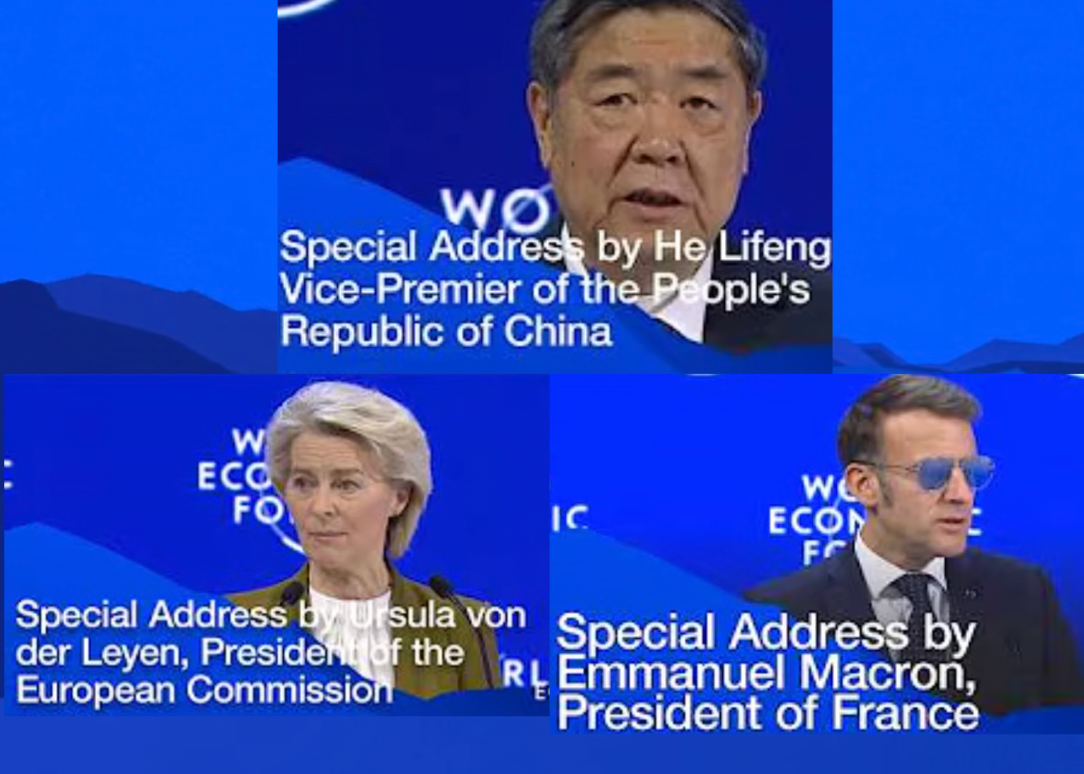
In the speeches by Ursula von der Leyen, Emmanuel Macron and He Lifeng we find the most structural layer of the debate: how the international system should be organised in an era of fragmentation.
From Europe, the conversation is articulated around independence, competitiveness and protection against economic coercion. From China, the emphasis is on defending globalisation and multilateralism as a “large vessel” that should not be broken into blocs, and on positioning China as both factory and market within that order.
This axis captures how von der Leyen speaks about European independence and the reconfiguration of interdependence, how Macron adds the dimension of competitiveness, AI and the use of anti-coercion tools, and how He Lifeng responds by defending globalisation and calling for a more inclusive multilateralism. The goal is to see, in the end, what they are saying together about the architecture of the order and what that implies for the geopolitics of resources.
1. Von der Leyen: European Independence in a Fractured World
Ursula von der Leyen opens her speech with a central idea: the world has changed permanently and the old order is not coming back. She proposes that Europe abandon nostalgia and accept change as the starting point, not as an anomaly.
Her narrative is organised in three layers:
1. Change as a stable condition
She argues that recent geopolitical shocks (war, trade tensions, technological rivalry) are not a passing episode. They are signs of a new stage. If change is permanent, she says, Europe’s response must also be permanent.
2. Independence through how Europe connects with the world
Von der Leyen does not propose closing off, but reconfiguring interdependence. She uses the new EU – Americas trade agreement, signed after decades of negotiation, as an example and presents it as a clear message: a preference for “fair” trade over an escalation of tariffs, strategic partnerships instead of isolation, diversification and de-risking instead of critical dependence on a single supplier or route.
From there she lists other agreements under way (with Mexico, Indonesia, Gulf countries, India, ASEAN), all under the same logic: linking up with the growth centres of the 21st century while reducing vulnerabilities.
3. An internal agenda to sustain that independence: single market, capital and energy
Von der Leyen then brings the concept of independence down to three concrete fields. Regulation and the single market: she recognises that many companies face different rules in each Member State. That turns the 450-million-person market into a mosaic that is difficult to scale. She therefore proposes a “28th Regime” and a kind of “EU Inc.”: a single set of rules that allows companies to operate across the Union and register a company in 48 hours, fully online.
Capital: she notes that Europe needs a genuine savings and investment union to finance innovation, industry and SMEs without depending excessively on external markets.
Energy: she identifies energy as a bottleneck. She proposes an energy union based on interconnections, nuclear and renewables, with the goal of lowering prices and reducing dependence on external sources.
In the final part, von der Leyen links the economy and security. She speaks of a strong increase in defence spending, the rise of European companies in the sector and the Arctic as a space where security, trade and resources intersect. She argues that allies should not enter a spiral of tariffs and announces a European agenda for investment and presence in the region.
Taken together, her speech sketches a Europe that wants to remain open, but with a different architecture: more autonomous capacity, more diversification, and a new relationship between market, energy and defence.
2. Macron: Competitiveness, AI and Firmness Against Coercion
Emmanuel Macron moves within the same family of themes, but places the emphasis on two elements: industrial competitiveness and the response to economic coercion.
On the economic side, he starts from an uncomfortable diagnosis: Europe has had weak growth for too long, and that feeds a sense of decline and political discontent. In response, he proposes an agenda built on three pillars:
1. European preference in strategic sectors
Macron argues that Europe needs to use its own industrial, fiscal and public-procurement tools to sustain European value chains in key areas: clean technologies, defence, artificial intelligence, data, advanced industry. He does not call for closing the market, but for making deliberate decisions about what Europe wants to produce at home, at what scale and with what support.
2. Simplification so companies can move
He reiterates the diagnosis that regulatory and administrative complexity discourages investment and projects. He calls for a simpler and more predictable environment for businesses, in line with what von der Leyen proposes, but with a strong emphasis on turning simplification into part of a competitiveness strategy, not just a technical reform.
3. AI, quantum and “physical AI” as a field where Europe can win
Macron insists that Europe is not condemned to trail in technology if it plays to its strengths: industry, engineering, capital intensive sectors. He speaks of AI applied to robots, machinery and industrial processes (“physical AI”), and of technologies such as quantum and space as areas where the combination of industrial tradition and scientific capabilities can translate into real advantage, if there is political will and capital.
On the geopolitical plane, Macron deepens the discussion on power. He argues that Europe cannot accept a world in which “the strongest” impose costs on their partners through tariffs, extraterritorial sanctions or unilateral commercial pressures.
He supports the use of instruments such as the European anti coercion mechanism when necessary, not as a symbolic gesture, but as a real tool to respond to practices that he sees as abusive. And he maintains that multilateralism and the international rule of law will only be credible if Europe is prepared to use the tools it has when certain lines are crossed.
With this, Macron reinforces the image of a Europe that wants to be a relevant technological and industrial actor, not just a market, and that is willing to combine values, economic instruments and regulatory power to defend that position.
3. He Lifeng: Globalisation as a “Large Vessel” and Defence of Multilateralism
He Lifeng’s speech also starts from the idea that we are living through a transformation “unseen in a century,” marked by unilateralism, protectionism and geopolitical tensions. The difference is that, faced with this description, China does not adopt the language of independence, but of defence of globalisation and multilateralism.
His narrative is structured in three blocks:
1. The “large vessel” metaphor and the rejection of fragmentation
He revisits recurrent images used by Xi Jinping: the idea that trying to force the waters of the ocean back into “lakes and isolated streams” goes against the course of history, or that in the face of global crises countries do not travel in “190 small boats” but in a single large ship.
With that metaphor, he argues that economic globalisation, based on specialisation and cooperation, has been a positive force and that breaking it into blocs is costly and inefficient.
2. Multilateralism with reform, not abandonment of rules
He cites data on how the share of trade covered by most-favoured-nation treatment has fallen, and how fragmentation could reduce global GDP. From there, he criticises trade wars, the political use of preferential agreements and unilateral measures that, in his view, violate WTO rules.
China presents itself as an actor that: respects the multilateral framework, is willing to reform the WTO and the IMF to give more voice to the Global South, and wants rules to be strengthened, not abandoned.
3. China as factory and market within that order
He underlines that China does not want to be only the “factory of the world,” but also the “market of the world.” He insists that domestic consumption is below the level of developed countries, that the expansion of China’s middle class is a priority and that domestic demand has been placed at the top of the economic agenda.
He reaffirms the policy of reform and opening: more market access, more support for innovation, secure and stable supply chains, and alignment with high standard economic rules.
Taken together, his speech proposes an architecture in which globalisation continues, but reformed and more inclusive, with a central role for China as a major producer and major market.
4. What They Show Together About the Architecture of the Order
When von der Leyen, Macron and He Lifeng are read together, a clear dialogue emerges on how to reorganise the international system.
They share the diagnosis that the world has changed permanently
Europe and China both recognise that the previous phase (of relatively stable globalisation, low inflation and trade with few geopolitical constraints) has ended. They do not debate that fact; they debate the response.
Europe is reconfiguring towards independence, competitiveness and protection against coercion
Von der Leyen proposes a Europe that reduces critical dependencies, diversifies partners, strengthens its internal market, its capital union and its energy union. Macron complements that vision with a strong emphasis on industrial policy, European preference in strategic sectors, AI and advanced technologies, and the active use of tools such as the anti-coercion mechanism.
Together they project a Europe that wants to remain a space of rules and multilateralism, but that also wants its own capacity so as not to be trapped between great powers and to be able to respond when certain limits are crossed.
China defends the continuity of globalisation, but with a more representative multilateralism
He Lifeng insists that splitting the system into blocs is harmful and that the right path is to reinforce, not abandon, multilateral institutions. At the same time, he proposes that those institutions better reflect the weight of the Global South and of emerging economies, including China, and argues that the expansion of China’s middle class and its consumption can be a central source of global growth.
Rules become instruments of power and inclusion
In this triangle, rules are no longer a neutral backdrop. For Europe, they serve to protect a model that combines markets, rule of law, energy transition and its own industrial base. For China, they serve to guarantee an environment in which it can continue to integrate its industry and market without being isolated by rival blocs.
Fragmentation is no longer a hypothesis; it is the working scenario. Europe responds by building responsible independence and an agenda of competitiveness and innovation. China responds by defending globalisation and proposing a reformed multilateralism.
In both cases, the conversation always returns to the material: who produces what, who controls which value chains, how those chains are financed and regulated, and with what degree of energy and resource dependence each actor enters this new phase.
This is where mining and strategic minerals stop being a “sectoral topic” and become part of the design of the order: for a Europe that wants de-risking and independence, and for a China that wants to be, at the same time, factory and reference market.
5. How This Axis Feeds the Overall Framework
The Europe – China axis adds a key piece to the overall framework we outline in the main article: rules and agreements cease to be background and become explicit instruments of power and inclusion.
It reinforces the shift from the financial era to the material era, now seen through the architecture of order. Von der Leyen and Macron do not talk only about treaties or institutions in the abstract. They speak about concrete trade agreements (EU–Americas, Mexico, ASEAN, Gulf), about an “EU Inc.” so companies can operate across the 27 as if it were a single market, about an energy union, a capital union, investments in defence, AI, quantum and physical technologies. He Lifeng responds in a different language, but with a similar underpinning: “secure and stable” supply chains, China’s domestic market as a consumption engine, WTO and IMF reform to better reflect the reality of the Global South.
In both cases, the discussion on international order quickly comes down to who produces what, where, with what energy and under which rules. This reinforces the first insight: the order is no longer organised around abstract financial flows, but around material chains.
It shows that rules are being rewritten to protect concrete development models. Europe is reconfiguring itself towards responsible independence: de-risking, diversification of partners, European preference in strategic sectors, anti coercion mechanisms. China defends the continuity of globalisation, but with a multilateralism that recognises its weight and that of the Global South, and with a narrative in which its industrial and consumption expansion is presented as a shared opportunity.
The rules of the game (trade, investment, standards) become the space in which what kind of development is considered legitimate, and which dependencies are tolerated or corrected, is negotiated. This feeds into the second insight: social and political legitimacy is not played out only within each country, but also in whether external rules allow viable social contracts to be sustained.
It directly links order, fragmentation and the struggle over resources and supply chains. When Europe talks about energy independence, gigafactories, physical AI or anti coercion mechanisms, it is thinking about not ending up trapped in critical dependencies on third parties for raw materials, components or technology. When China defends globalisation and its role as the world’s factory and market, it is defending its position in value chains and its access to resources and markets.
This axis grounds the third insight: minerals and supply chains cease to be a “technical topic” and become a central part of the design of the order. The way agreements, rules and coalitions are rewritten will determine who controls which links, how fast the energy and industrial transition can be deployed, and under what environmental and social standards.
That is why the Europe – China axis is more than a discussion of “models” or “values.” It is where we see how the major blocs are trying to secure their material base (energy, industry, technology, resources) with legal and commercial instruments.
And it is also the space where geopolitical mining comes fully into play: from now on, each treaty, each standard and each coalition that is designed will be, at its core, a decision about how and with whom we gain access to the minerals that sustain this new industrial era.
This axis connects with the other five we analyse for Davos 2026. To see how they all fit into a single framework, you can read the full article: “Davos 2026: Coordinates of the New Geopolitical Era” .

For the full Geopolitical Mining framework behind this article, see our book Mining Is Dead. Long Live Geopolitical Mining .