
Geopolitical Mining · Davos 2026
Davos 2026 Second Axis of Analysis. Indonesia and Egypt: Stability, Growth and the Social Contract in the Global South
Authors: Marta Rivera | Eduardo Zamanillo
This piece is part of our Davos 2026 analysis series at Geopolitical Mining. For the full framework behind our reading of these speeches, see “Davos 2026: Coordinates of the New Geopolitical Era” .
If in the United States and China the discussion on growth is articulated around the middle class and domestic consumption, in Indonesia and Egypt another layer appears: how to organize stability, reform and social cohesion in contexts of uneven development and geopolitical pressure.
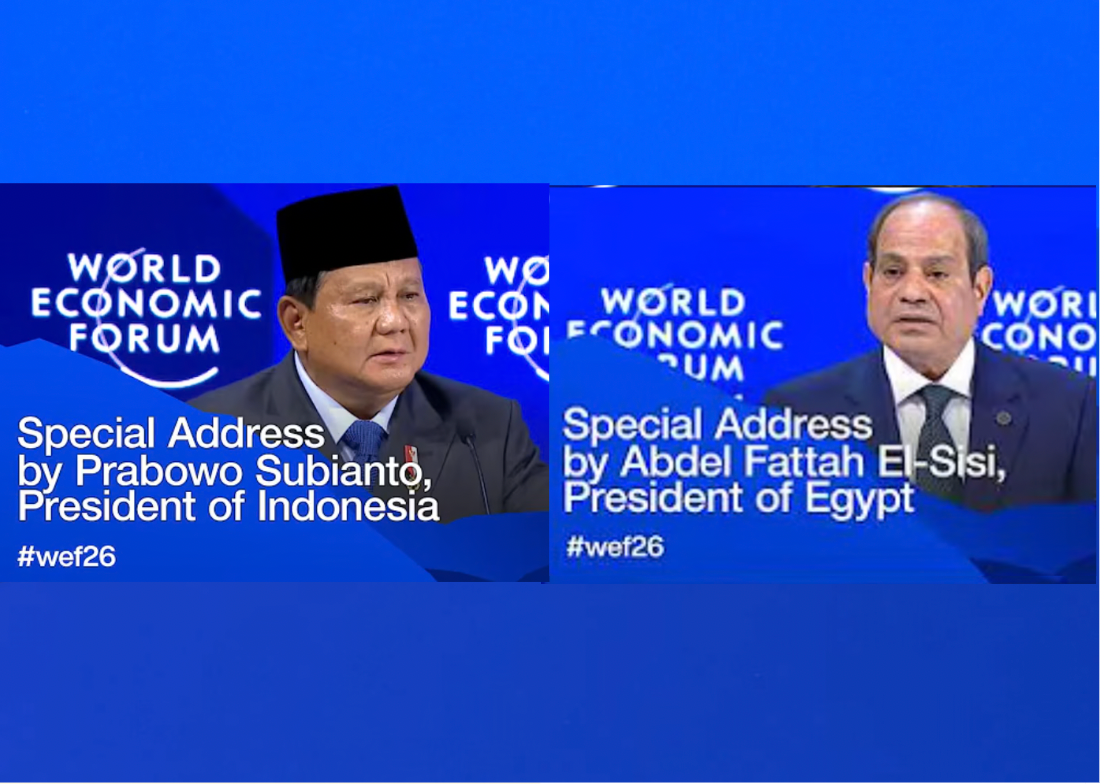
At Davos 2026, both Prabowo Subianto and Abdel Fattah el-Sisi start from a similar diagnosis (a world that is more volatile, more mistrustful and more violent) but they translate it into different strategies:
- Indonesia presents itself as a country that deliberately chooses peace and unity as competitive assets, and that uses social programmes and a sovereign fund to break the chain of poverty and channel investment into infrastructure and future-facing industries.
- Egypt positions itself as an anchor of regional stability in the Middle East and North Africa, while accelerating an internal transition from a producing State to a facilitating State that opens space for the private sector and bets on logistical and industrial corridors linked to the Suez Canal.
This axis looks in detail at those two speeches and, in the end, reads them in parallel to understand what they say about the stability – growth – legitimacy equation in the Global South, and how they connect with the general framework we propose for the new geopolitics.
1. Prabowo: Breaking the Chain of Poverty on a Foundation of Peace and Stability
Prabowo opens his speech with a sentence that orders everything that follows: “peace and stability are our most valuable assets… they are the ultimate prerequisites for growth and prosperity; there will be no prosperity without peace.”
From there, he builds a narrative that combines three elements:
1. A diagnosis of global fragility
He speaks of an era of wars, mistrust between countries and institutions, and of how history shows that chaos can destroy decades of progress. Indonesia, in his view, has deliberately chosen the path of unity and cooperation over confrontation.
2. A social programme as the basis for growth (“Prabowonomics”)
He presents a series of policies already under way: free medical check ups, nutritious meals for mothers, children and the elderly, school building programmes, explicit support for rural areas and the most vulnerable groups.
The stated goal is to break the chain of poverty and raise quality of life as a condition for growth to be sustainable. Social policies are presented as investment in human capital, not just as expenditure.
3. A State that calibrates and coordinates (“our policies have been and will always be well calibrated”)
Prabowo speaks of “Prabowonomics” as a set of calibrated policies: macroeconomic stability, fiscal discipline, a fight against corruption (which he calls “greedonomics”) and the creation of a sovereign fund (“Danantara”) to finance infrastructure and strategic sectors.
The idea he conveys is that of a State that does not withdraw, but rather tries to organize the space where the private sector and international capital can operate in a predictable environment, under the premise that political and social stability is Indonesia’s main competitive advantage.
Taken together, the speech presents Indonesia as a country seeking accelerated growth based on three pillars: internal peace, social programmes that raise basic capabilities and a State that coordinates investment, infrastructure and future sectors (including industry, technology and energy).
2. El-Sisi: Regional Stability, Economic Reform and the Role of the Private Sector
Abdel Fattah el-Sisi’s speech shares the same starting point (an unstable world that demands cooperation) but he articulates it from another context: a country embedded in a region marked by conflict and security tensions.
At Davos, El-Sisi structures his message on three levels:
1. Regional stability and the Palestinian question
He places the “Palestinian question” at the centre of his intervention and states that it remains a priority for Egypt. He reaffirms his support for a two-state solution and his willingness to back the next phase of the ceasefire in Gaza.
From his perspective, regional stability is not only a moral or diplomatic imperative; it is a necessary condition for Egypt and its neighbours to be able to focus on development, investment and modernization.
2. Economic reform: from producer State to facilitator State
On the economic side, El-Sisi presents a clear shift: strengthening the role of the private sector as the main engine of growth, setting a cap on direct State investment, implementing a carefully designed plan for the State’s gradual withdrawal from sectors where private enterprise can operate, and advancing the State ownership policy that defines in which areas the State remains and in which it retreats.
The stated goal is to double the contribution of the private sector and make Egypt a more attractive destination for investment, reducing the perception of a State that competes with business.
3. Betting on frontier industries and strategic corridors
El-Sisi lists the sectors Egypt wants to develop: electric vehicles and components, pharmaceuticals, logistics and port hubs, information technologies, data centres and artificial intelligence, hydrogen and related energy industries.
The Suez Canal Economic Zone appears as a key space: it connects Egypt’s geographic position with its ambition to become a logistical, industrial and energy corridor between continents. There, he tries to anchor his narrative of a safe and stable country that invites long-term investment.
In short, El-Sisi’s message is that Egypt wants to preserve its role as a regional stability anchor while accelerating an internal transition: less direct State role in production, more weight for the private sector, and an explicit focus on industries that combine added value, employment and technology.
3. What They Say Together About Stability, Growth and the Social Contract
Read in parallel, Prabowo and El-Sisi offer a window into how part of the Global South is redefining its social contract around stability and growth.
Stability as a political and economic asset
Indonesia presents stability as the result of choosing unity and cooperation in a fractured global context. Egypt frames it as a condition for managing regional conflicts (especially Gaza) and attracting long-term investment. In both cases, stability ceases to be only a security argument and is offered as a guarantee for capital and for the domestic population.
Growth as legitimacy and protection against disorder
Prabowo links peace, social programmes and the fight against poverty with Indonesia’s ability to be a fairer and more productive country. El-Sisi links reform, the private sector and industrial modernization with the possibility of maintaining cohesion in a highly tense regional environment. In both speeches, growth is not described as a luxury but as a defence against chaos and inequality.
States that reconfigure themselves rather than withdraw
Indonesia presents itself as a State that expands its social role (health, education, food) and uses tools such as the sovereign fund to direct investment, without abandoning fiscal discipline. Egypt presents itself as a State that reduces its direct presence in production, but at the same time sets the course of the economy, defines strategic sectors and uses its geopolitical weight to attract capital. Both are, in practice, variants of a developmental State adapted to the era of fragmented globalization: one more social and coordinating (Indonesia), the other more focused on opening space for the private sector under a security umbrella (Egypt).
The transition towards a more industrial and material logic
Both Prabowo and El-Sisi talk about very concrete policies: infrastructure, future industries, sovereign funds, logistical corridors, attraction of productive investment. The focus is no longer on short term financial flows, but on physical projects that transform the economic base: plants, ports, special economic zones, energy grids. This is the same logic of transition from the financial era to a more industrial phase that we see in the major powers, but here adapted to different institutional realities.
The stability – growth – legitimacy equation is not the preserve of the North. The move towards substance (towards matter, infrastructure and execution capacity) is also happening in countries that start from other income levels and governance conditions.
Indonesia and Egypt are examples of how the agenda of development, security and stability in the Global South will intersect with decisions about where, how and under what standards the resources they need to sustain that social contract are extracted and processed.
4. How This Axis Feeds the Overall Framework
The Indonesia – Egypt axis reinforces and nuances the conclusions of the main article in three very clear ways.
It confirms that the industrial and material turn is not exclusive to the major powers. Prabowo and El-Sisi talk about infrastructure, sovereign funds, special economic zones, logistical corridors, future industries and productive investment. The focus is not on short-term financial flows, but on physical projects that transform the economic base. It is the same logic we see in the United States, China or Europe (returning to matter: energy, industry, ports, grids), adapted to different institutional realities. This axis, therefore, reinforces the first insight: the shift from the financial cycle to a more industrial and material phase is also playing out in the Global South.
It deepens the idea of the social contract and legitimacy as conditions for growth. In Indonesia, “Prabowonomics” combines peace, fiscal discipline and social programmes as a way to break poverty and build consensus. In Egypt, the narrative of regional stability, economic reform and opening to the private sector is presented as the way to maintain cohesion in a conflict-ridden environment. In both cases, growth and political stability are presented as two sides of the same social contract: without peace and a sense of order, investment does not arrive or stay; without tangible improvements in jobs, services and opportunities, stability becomes fragile. This axis adds depth to the second insight: social legitimacy is not an accessory; it is the room for manoeuvre that allows States to advance reforms and investments at the pace the new geopolitics demands.
It anticipates how the development agenda of the Global South will intersect with minerals and sustainability. When Indonesia and Egypt talk about infrastructure, logistics hubs, electric vehicles, hydrogen, information technologies or industrial corridors linked to the Suez Canal, they are not only thinking about GDP. They are describing material systems that require energy, metals, components and operating standards. That connects them directly with the third insight of the general framework: mining, resource supply chains and sustainability will not be abstract debates, but decisions about where, how and under what conditions the resources that sustain these projects of stability and development are extracted and processed.
In other words, this second axis shows that the stability – growth – legitimacy equation that runs through the North is also reshaping the Global South. And that the way Indonesia and Egypt manage (or fail) to align internal peace, productive investment and the protection of their societies and territories will be one more piece of the puzzle we call geopolitical mining: a map where development, security, narrative and resources stop being separate chapters and become parts of a single system.
This axis connects with the other five we analyse for Davos 2026. To see how they all fit into a single framework, you can read the full article: “Davos 2026: Coordinates of the New Geopolitical Era” .

For the full Geopolitical Mining framework behind this article, see our book Mining Is Dead. Long Live Geopolitical Mining .