
Geopolitical Mining · Davos 2026
First Axis of Analysis. United States and China: Middle Class, Domestic Demand and the Industrial Turn
Authors: Marta Rivera | Eduardo Zamanillo
Part of our Davos 2026 analysis series. For the full framework behind our reading of these speeches, see “Davos 2026: Coordinates of the New Geopolitical Era” .
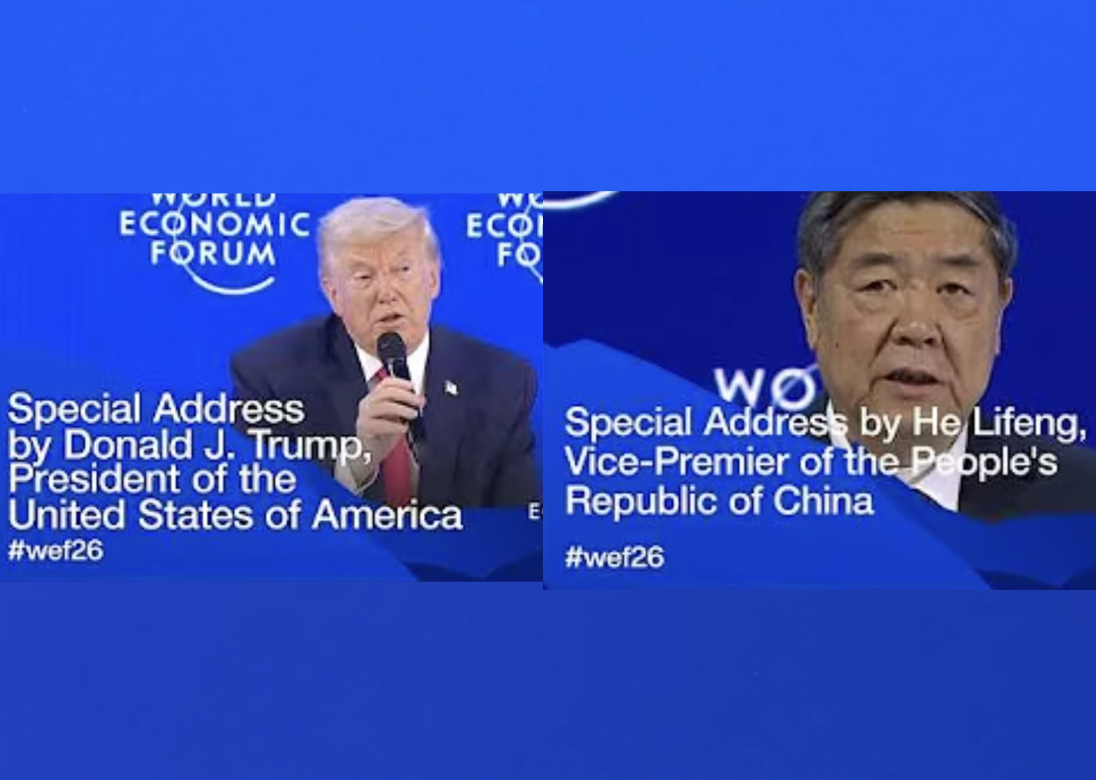
In the speeches by Donald Trump and He Lifeng we see the core of the shift in this new era: the two major powers are organizing their strategies around the material well being of their own populations, and they are doing it from a logic that is increasingly industrial and less purely financial.
At Davos 2026, both use very different data points, promises and images, but they converge on three underlying moves:
- recovering jobs and wages that sustain a broad middle class,
- anchoring growth in production and energy, not only in financial assets,
- and using the State as the architect of the mix between industry, trade and domestic consumption.
This first axis of analysis looks closely at those two speeches. First, Trump’s narrative on reindustrialization and abundant energy for the American middle class. Then, the way He Lifeng presents domestic demand and the expansion of China’s middle class as the next stage of the development project. Finally, we read both together to see what they say (without fully naming it) about the new geopolitics.
1. United States: Reindustrializing to Restore Purchasing Power to the Middle Class
Trump arrives in Davos with a very clear storyline: after a period of stagflation, he presents the United States as an economy in full boom. He talks about growth above expectations, low inflation, stock market records and millions of people leaving assistance programmes such as food stamps.
Beyond the tone, the underlying message is structural:
Reindustrialization as the core of the model
He repeats that plants are being built and reopened, that steel production is returning and that “never seen before” investment commitments have been secured for factories, equipment and new productive capacity. He accompanies this with concrete measures: accelerated depreciation, the possibility of immediately deducting 100% of investment in plants and machinery, and tax cuts aimed at productive investment. The signal to companies is clear: it pays to produce in the United States, not just sell there.
Abundant energy as social policy
The speech links energy and living standards directly. He stresses the expansion of gas and oil, the return to nuclear, the promise of low fuel prices, and presents that combination as the basis for American households to “be doing well again.” Energy ceases to be just a sector and becomes a lever to anchor real wages and domestic consumption.
A State that “creates room” for domestic production
Trump talks about cutting regulations, firing bureaucrats and using tariffs as an instrument to protect industry and jobs. He is not defending a minimal State; he is defending a State that intervenes to tilt the field in favour of domestic production and, with it, of the workers who depend on that industrial base.
Taken together, the speech points to the idea that the path to rebuild legitimacy in the United States runs through restoring purchasing power to the middle class. And for that, the bet is not only financial, it is material: more factories, more industrial jobs, cheaper energy, and a State that adjusts taxes, regulation and trade to sustain that combination.
Even if he does not phrase it in those terms, the shift is clear: moving out of a cycle where the core of the story was driven by financial assets and a services economy, to refocus on production, wages and middle-class consumption.
2. China: Domestic Demand and the Middle Class as the Next Stage of Development
He Lifeng’s speech starts from a different place, but moves toward a similar goal: increasing the spending power of the Chinese population and making that consumption a central motor of growth.
His intervention has two levels: the global order and domestic development. Here we focus on the second:
1. From factory of the world to market of the world
He recalls that globalization has allowed China to become a manufacturing power, but adds something crucial: China does not want to be only an exporter; it also wants to be a major market. He insists that globalization must remain inclusive and “benefit all,” and links this idea to the willingness to share the opportunities from China’s own development with other countries.
2. Domestic demand at the top of the agenda
He explains that global growth has weakened and that inequality and the difficulty of reaching the Sustainable Development Goals are cause for concern. In this context, he argues that “making the pie bigger” also requires domestic demand: raising incomes for urban and rural households, expanding the middle class, improving services such as education, health and social protection, and using the domestic market as a source of innovation and growth.
In his own formulation, China does not seek trade surpluses and, in addition to being a factory, it wants to be a market. He even points out that many times, when China wants to buy, other countries do not want to sell for security reasons, which shows how trade is increasingly crossing over into geopolitics.
Reform and opening as the framework for this new phase
He reaffirms that reform and opening remain State policy. He talks about continuing to open the market, supporting innovation, reinforcing the multilateral trading system and promoting “secure and stable” supply chains. The idea is to leverage China’s scale (production, but also consumption) to project itself as a key driver of global growth in the coming decades.
In short, from the Chinese side, the next stage of development rests on a larger middle class with greater spending capacity, supported by an already consolidated industrial and technological base.
3. What They Reveal Together About the Middle Class and the Industrial Turn
If we place the two speeches side by side, a pattern appears that is key to the framework
Both powers are reorganizing their strategies around domestic material well being
The United States articulates this as reindustrialization, abundant energy and an economic “miracle” so that the middle class can once again have jobs and purchasing power. China articulates it as expanding the middle class, increasing household income and turning the country into “the world’s market” as well as factory, with domestic demand at the centre. The ideological language is very different, but the underlying question is the same: how to sustain political legitimacy by offering greater purchasing power and material security to millions of people.
In both cases, the State acts as architect of the production – energy mix
In the United States, through tax incentives, regulatory easing, selective tariffs and an energy policy that prioritizes volume and price. In China, through plans, reforms, controlled opening, support for innovation and a commitment to multilateralism that allows it to place both its goods and the spending capacity of its domestic market. Neither narrative describes an autonomous market: both assume that the State is the actor that redesigns how industry, energy, trade and consumption are combined.
Both are entering a more industrial and material phase
The US speech constantly invokes images of plants, steel, gas, nuclear, physical investment. The Chinese speech emphasises supply chains, manufacturing, industrial innovation and a huge domestic market that needs to be fed. Legitimacy is no longer sought only in strong financial assets or stock indices; it is sought in operating factories, rising wages, available energy and stable consumption capacity.
From opposite poles of the system, the new geopolitics is being organized around the middle class and domestic demand, sustained by a new wave of industrialization and material deployment. From there, it becomes clear that everything fits into the same logic: the financial era is giving way to an era of substance, where “matter” (energy, industry, infrastructure, minerals) becomes the main terrain on which geopolitics and legitimacy are played out.
4. How This Axis Feeds the Overall Framework
This first axis is not just “one more” in the list. It is the backbone of the conclusions we present in the main article:
- It confirms the structural shift: both the United States and China are moving the focus from financial balances to production, energy, jobs and domestic consumption. That movement is the basis of our first insight: from the financial cycle to a more industrial and material phase.
- It puts the middle class and the social contract at the centre: both speeches, in very different styles, assume that future political stability depends on that segment of the population seeing concrete improvements in their lives. That is the second insight: without social legitimacy, neither reindustrialization nor the energy transition will have enough political time.
- It anticipates the pressure on the material system that we analyse in the third insight: if the two largest economies in the world are betting on more industry, more energy and more domestic consumption, demand for minerals, infrastructure and secure supply chains will not decrease; it will be reorganized and, likely, intensified.
This is why we begin the series of axes with this pair. What Trump and He Lifeng said at Davos 2026 is not only about their countries; it is about the kind of world the international system is moving towards. The other five axes (Latin America, Europe, the Global South, values, technology) are, in essence, variations on this same theme: how power, legitimacy and matter are being reordered around societies that are asking, explicitly or implicitly, for stable and credible material well being.
This axis connects with the other five we analyse for Davos 2026. To see how they all fit into a single framework, you can read the full article: “Davos 2026: Coordinates of the New Geopolitical Era” .

For the full Geopolitical Mining framework behind this article, see our book Mining Is Dead. Long Live Geopolitical Mining .