
Geopolitical Mining · Country & Region Analysis
Brazil: How a Private Company Built a Global Niobium Industry
Araxá, CBMM and the industrial execution behind Brazil’s critical mineral advantage.
By Marta Rivera Muñoz & Eduardo Zamanillo
Geopolitical Mining. June 14, 2026
Brazil, Niobium and the Strategic Meaning of Industrial Depth
In the public conversation on critical minerals, lithium, copper, cobalt, graphite and rare earths usually attract greater attention. They sit visibly inside batteries, electrification, export controls, defense technologies and industrial policy. Niobium occupies a quieter place in that conversation, yet it offers one of the clearest examples of how mineral power is actually built. Brazil converted niobium into a global mineral industrial position.
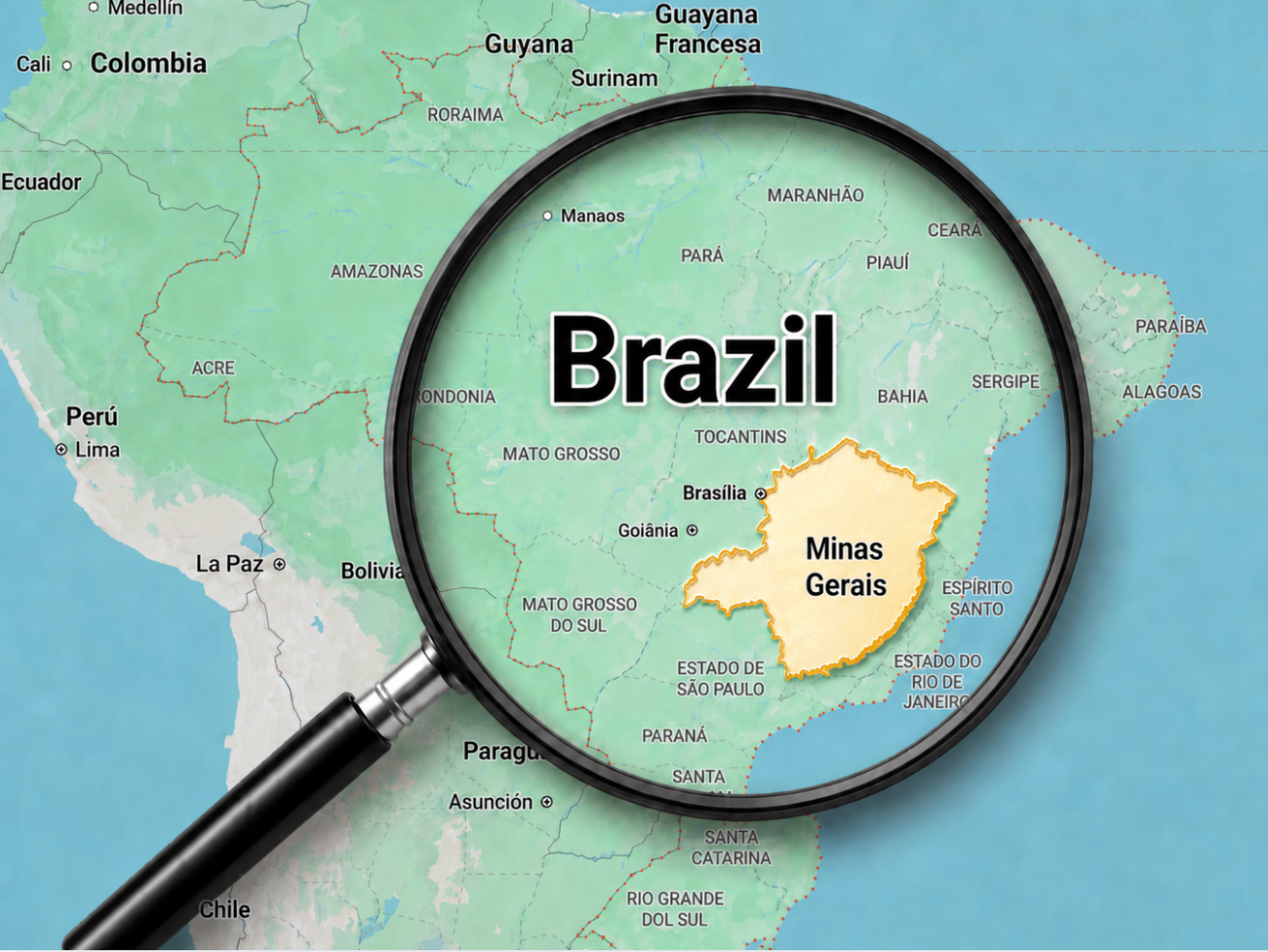
That position emerged through a private industrial actor operating inside a Brazilian geological, territorial and regulatory platform. Araxá a municipality in the state of Minas Gerais, Brazil, provided the geological base. Companhia Brasileira de Metalurgia e Mineração (CBMM) provided the industrial execution. Processing depth, metallurgical knowledge, customer education, international logistics, application development and decades of market creation turned the mineral into a global industry.
The Brazilian niobium case is especially important for Geopolitical Mining because it expands the way mineral power is usually understood. Mineral power often enters policy debates through national strategies, state-owned companies, public financing or geopolitical competition. Brazil’s niobium position followed a different path. A private Brazilian company built the operational, technical and commercial architecture that made niobium useful to the world.
A deposit begins as geological potential. A market emerges through customers, specifications, processing capability, quality assurance, technical trust and industrial adoption. Supply chains develop through repeated delivery, confidence and time. Brazil’s niobium story sits precisely in that movement from resource to capability. The numbers show the scale of Brazil’s position. The United States Geological Survey estimated that Brazil accounted for approximately 93% of global niobium production in 2025, followed by Canada with 5%. Brazil’s estimated mine production was 104,000 metric tons of niobium content, out of a rounded world total of 112,000 metric tons. Its reserves were estimated at 14 million metric tons, out of a world total above 21 million metric tons.
Brazilian official data points in the same direction. In 2024, Brazil represented 94.4% of global production of niobium concentrate, with 144,019 tonnes reported in the national statistical series. Brazilian reserves declared to the Agência Nacional de Mineração (ANM) reached 14.1 million tonnes of contained niobium. ANM also identifies Minas Gerais and Goiás as the main producing states, reflecting the operating geography behind Brazil’s niobium platform.
The USGS and ANM figures refer to different reporting years and statistical series. Read together, they point to the same structural reality: Brazil holds an overwhelming position in both niobium production and reserves. The strategic issue is the conversion of that geological concentration into an industrial system. Brazil’s niobium position now matters for steel, infrastructure, mobility, energy, advanced materials, batteries and global supply security.That is the story.

For the full Geopolitical Mining framework behind this article, see our book Mining Is Dead. Long Live Geopolitical Mining.
Movement I: A Small Market with a Large Industrial Function
Niobium is a relatively small commodity market compared with copper, iron ore or aluminium. Its strategic relevance comes from function, concentration and performance. In mineral strategy, market size can obscure strategic importance. Some minerals matter because they are consumed in enormous volumes. Others matter because small quantities perform a critical role inside much larger industrial systems. Niobium belongs to this second group. Its main use is as a microalloying element in steel. In practical terms, niobium helps steelmakers improve strength, toughness, heat resistance, weldability and weight efficiency. It supports the production of higher performance steels for pipelines, bridges, buildings, vehicle bodies, ships, structural applications and other demanding uses. It also appears in superalloys, aerospace applications, turbines, medical equipment, electronics and advanced battery materials. Niobium often works quietly. A bridge is rarely described as a niobium bridge. A pipeline is rarely described as a niobium pipeline. A vehicle body is rarely marketed as niobium enabled. Yet the material can sit inside the performance logic of all of them.
That makes niobium a useful test case for strategic mineral analysis. The importance of a mineral depends on how it functions inside industrial systems, how concentrated its supply is, how difficult substitution may be and how much technical trust customers require before adoption. USGS data for the United States show this functional profile clearly. In U.S. consumption, niobium was used mostly as ferroniobium by the steel industry and as niobium alloys and metal by the aerospace industry. The major end-use distribution was estimated at about 77% for steels and 23% for superalloys. That distribution is U.S.-specific, but it illustrates the broader industrial logic of the material.
Niobium’s role in steel is particularly important because steel remains the material foundation of infrastructure, construction, pipelines, mobility, energy systems and heavy industry. A mineral that improves steel performance becomes relevant to the quality, durability and efficiency of the built environment. Brazil’s niobium position therefore extends beyond a niche mineral market. It anchors a material input inside larger industrial systems.
Movement II: Criticality Through Concentration and Capability
Niobium’s criticality comes from supply structure, processing capability, market concentration and the industrial difficulty of building alternative systems quickly. The United States Geological Survey states that world resources of niobium are more than adequate to supply projected needs, with most identified resources occurring as pyrochlore in carbonatite deposits. The geological base is substantial. The functioning industry, however, is highly concentrated.
This distinction matters for critical minerals policy. Criticality often emerges through the relationship between resource availability, industrial capability, supply concentration and customer dependence. A mineral can have adequate global resources while still presenting strategic exposure because processing, production and qualified supply are concentrated in a small number of locations. Niobium illustrates that dynamic clearly. Brazil’s dominance provides stability because the Brazilian system is mature, technically credible and commercially reliable. The same concentration also creates exposure because equivalent supply chains require time, capital, processing knowledge, customer qualification and market confidence.
The European Union includes niobium in its critical raw materials framework. Eurostat describes ferro-niobium as an important iron-niobium alloy used mainly in the automotive, construction and steel industries, and identifies it as critical because of supply risk, economic importance and limited substitutability. Niobium’s strategic paradox is therefore straightforward: the resource base is adequate, while the industrial system is highly concentrated. Brazil built the system that customers trust.
Movement III: Araxá as an Industrial Learning System
Brazil’s niobium position is closely associated with Araxá, in Minas Gerais, and with Companhia Brasileira de Metalurgia e Mineração, CBMM.
CBMM was founded in Araxá in 1955. Mining and production operations began in 1961. Ferroniobium production started in 1975. In 1977, the company expanded its international presence through a Niobium Technology Program in the United States. In 1982, it inaugurated a Technology Center in Araxá. Later milestones included expansion into global offices, new research centers, battery related partnerships and an anode production plant focused on niobium solutions for ultra fast charging batteries. This chronology shows how mineral power accumulates over time.
Araxá became an industrial learning system. Geology, metallurgy, processing, technology, customer assistance and application development were accumulated in the same strategic orbit. This is the type of integrated system that gives a mineral position its durability. Deposits, concessions and exploration interest can create opportunity. Integrated technical and commercial systems convert that opportunity into industrial supply.The difference between a deposit and an industrial system is fundamental. A deposit is geological. An industrial system is technical, commercial, institutional and reputational. It includes processing plants, laboratories, engineers, product specifications, logistics, customer relationships, quality controls, long-term contracts, technical assistance and the credibility that allows customers to incorporate the material into their own production systems.
Araxá became the place where those layers came together. Brazil had the geology. The strategic position came from the industrial system built around it: metallurgical capability, product development, market confidence and operational continuity. For Geopolitical Mining, this is the core of the case. A mineral system becomes geopolitically relevant when geology is converted into capability.
Movement IV: The Private Company That Built the Market
The most distinctive part of Brazil’s niobium story is the role of a private Brazilian company as the main market builder. The state still mattered. Geology, mineral rights, regulatory continuity, territorial stability, infrastructure and public institutions are part of every mining system. The operating engine of Brazil’s global niobium industry, however, was CBMM’s long industrial execution. CBMM produced niobium and built the conditions for niobium adoption.
Some minerals enter markets with established demand. Niobium required explanation, testing and customer confidence. Steelmakers needed to understand the performance benefits. Engineers needed to trust the material. Technical specifications needed to evolve. Supply needed to be reliable enough for customers to adapt industrial practice. Pricing needed to support adoption. Logistics needed to work across regions. The benefits of using niobium needed to be demonstrated in real applications. This is a market building story.
CBMM frames its work around the development of niobium technology in Brazil and the expansion of the market. The company describes years of investment in research and development to understand niobium’s effectiveness and demonstrate the benefits that position the material for future applications. This is a deeper form of mineral power. A country that builds processing, products, technical assistance, application knowledge and customer confidence can shape the demand environment itself. Brazil’s niobium position emerged through that model. CBMM describes itself as the world’s leading supplier of niobium products and technology, fully integrated from mine to final products, and providing expert technical assistance to customers around the world. It also says it supplies products and technology to more than 500 customers globally, with regional offices in China, the Netherlands, Singapore, Switzerland and the United States. Those details show the architecture behind Brazil’s position. This is a Brazilian industrial system embedded in global customer networks. A private company transformed a mineral occurrence into a global niobium industry.
Movement V: Processing as the Moat
The niobium case shows how strategic value is created in the movement from ore to product, from product to specification and from specification to customer trust. Ferroniobium is the core example. Brazil’s Agência Nacional de Mineração reported that the country’s external niobium trade in 2024 occurred essentially through ferroniobium, the main product of niobium trade and a product of the mineral transformation industry. Brazil’s niobium products generated a trade surplus of approximately US$2.4 billion in 2024, with China, the Netherlands and Singapore among the leading destinations.
Brazil exports a processed industrial input. This distinction gives Brazil its industrial depth. Processing is where technical knowledge accumulates, quality control is embedded, product consistency is proven and customer specifications are met. Processing also creates the part of mineral power that is hardest to replicate quickly. The product architecture reinforces that position. CBMM’s portfolio goes beyond ferroniobium. Its niobium products include oxides, vacuum grade alloys and metallic niobium. Ferroniobium connects the mineral to steel and infrastructure. Vacuum grade alloys connect it to high temperature applications such as aerospace, aircraft manufacturing, turbines and power generating systems. Niobium oxides and advanced materials open pathways toward batteries and other technology applications.
This is how a mineral becomes an industry. One mine becomes a processing platform. One product becomes a portfolio. One material becomes part of multiple customer systems. Technical assistance, qualification, product reliability and application development become part of the value proposition. That is the moat Brazil built.
Countries can identify niobium deposits, attract exploration and announce critical mineral ambitions. Brazil’s advantage lies in accumulated metallurgical learning, customer qualification, technical assistance and market credibility built over decades. Brazil’s niobium position rests on processing depth as much as geological concentration.
Movement VI: Strategic Customers and the Industrial Logic of Security
The geopolitical relevance of Brazil’s niobium position became visible through the structure of international investment and customer interest. In 2011, a Japanese-Korean consortium acquired a 15% stake in CBMM. The consortium included JFE Steel, Nippon Steel, Sojitz, JOGMEC, POSCO and Korea’s National Pension Service. JOGMEC described niobium as a critical alloying element for high grade steel products and stated that the transaction would support stable supply to Japan and Korea. The agreement also included long-term niobium supply arrangements with CBMM.
Later that same year, a Chinese consortium made up of CITIC Group, Baosteel Group Corporation, Anshan Iron & Steel Group Corporation, Shougang Corporation and Taiyuan Iron & Steel Group acquired a 15% stake in CBMM for US$1.95 billion, according to CITIC. These transactions show how a relatively small mineral market can become strategically relevant for large industrial economies.
Japan, Korea and China secured access to an input that mattered for steel, infrastructure, industrial performance and long term supply security. Their investments reflected an industrial logic: secure the material that improves the performance of systems already central to national manufacturing capacity. This is the practical side of mineral geopolitics. Industrial economies secure the materials that matter to the performance of their industrial systems. Copper, lithium, graphite and rare earths are part of that picture. Niobium occupies a smaller market, but its function inside high performance steel and advanced alloys gives it strategic relevance.
Sojitz’s role illustrates this point. The company describes itself as CBMM’s exclusive distributor in Japan and says it handles more than 90% of the total niobium products brought into Japan. It also maintains domestic inventory for just in time delivery to consumers and is working with CBMM on new applications, including next generation lithium-ion batteries. This is supply chain positioning. The Japanese and Korean investment reflected stable access, long term supply and strategic relationships with the dominant producer. The Chinese investment reflected a similar logic from the perspective of a steel intensive economy seeking secure mineral inputs for industrial growth.
The minority stakes reinforced Brazil’s centrality. Global industrial actors positioned themselves around the Brazilian niobium system because that system had become the reference point for reliable supply. Brazil’s position became internationalized through customer security.
Movement VII: Brazil as a Niobium Platform
CBMM is central to the story, and Brazil’s niobium position also includes a broader production platform. CMOC operates niobium and phosphate assets in Brazil. The company states that its Brazilian niobium business covers exploration, mining, extraction, processing and sales, with ferroniobium as the main product. In 2025, CMOC Brazil reported record niobium production of 10,348 tonnes. Brazil therefore functions as a niobium platform.
Minas Gerais and Goiás together anchor a production base that has attracted Brazilian and international industrial actors, built processing capabilities and connected the country to customers across Asia, Europe and North America. The European Union’s trade exposure illustrates this clearly. In 2024, Eurostat reported that Brazil accounted for 86% of EU ferro-niobium imports, with Canada accounting for the remaining 14%. Europe’s position reflects a familiar critical minerals dilemma: the supplier is reliable, and the structure is concentrated. Stability and exposure sit inside the same supply chain.
That is the strategic character of Brazil’s niobium position. From a customer perspective, Brazil provides reliability. The system is mature. The products are known. The supplier network is established. The industrial relationships are deep. From a diversification perspective, Brazil’s maturity produces dependence. Alternative supply exists, while Brazil’s combination of reserves, processing, market share, customer trust and industrial experience remains difficult to match. This is trusted concentration.
Trusted concentration differs from hostile concentration. It carries a different political risk profile. It still matters because a critical industrial input remains structurally tied to a limited number of supply locations and companies. Reliability and concentration coexist. For Brazil, this creates strategic weight. The country supplies a processed critical material to industrial economies that need performance steels, advanced materials and continuity of supply. That position is much stronger than raw material participation. Many countries want to move up the critical minerals value chain. Brazil already did it in niobium.
Movement VIII: New Applications and the Next Strategic Layer
Niobium’s traditional strength has been connected to steel and superalloys. That foundation continues to anchor the market. A new strategic layer is emerging through advanced materials, batteries and related technologies. The point is one of industrial extension. Brazil’s existing niobium system gives the country a platform from which to participate in future applications. A mineral system with production, processing, research, technical assistance and customer relationships can move into new technological cycles with greater credibility than a system beginning from exploration alone.
CBMM has invested in research and development around new niobium applications, including batteries. ANM noted that in 2024 a niobium-based anode production plant was inaugurated in Araxá and identified CBMM as the main global producer, with approximately R$270 million invested in research and development, including in the battery segment. The battery story has two visible tracks.
One is the Toshiba-Sojitz-CBMM pathway. In 2024, Toshiba, Sojitz and CBMM unveiled an ultra fast charging electric bus prototype using next generation lithium-ion batteries with niobium titanium oxide anodes. The prototype began testing and demonstration operations at CBMM’s industrial plant in Araxá. Toshiba and Sojitz described the technology as using NTO in the anode, with an ultra fast charging time of around ten minutes and high energy density.
The second is the Echion-CBMM pathway. CBMM inaugurated a niobium anode production facility in Araxá dedicated to producing Echion’s XNO active anode material. The plant has been described as the world’s first volume manufacturing facility dedicated to that technology and the largest niobium-based anode production facility in the world, with capacity of 2,000 tons per year of XNO, equivalent to 1 GWh of lithium-ion cells.
These initiatives show the direction of industrial extension. Brazil’s niobium position is anchored in the steel economy and increasingly connected to advanced materials. That is the difference between a producer and a platform. A producer sells today’s material. A platform develops tomorrow’s applications. Brazil has the production, processing and technical base from which to attempt that transition.
Movement IX: What the Niobium Case Teaches Critical Minerals Policy
Brazil’s niobium story offers a clear lesson for critical minerals policy: mineral security requires geological endowment and industrial architecture. Critical minerals policy often begins with lists: which minerals are critical, where deposits are located, who controls production, who controls processing and where vulnerabilities exist. Those lists are useful because they describe exposure. The next stage is capability building.
The niobium case shows the deeper architecture required to turn a mineral into strategic supply. Geology has to be understood and developed. Projects have to be permitted, financed and operated. Ore has to be converted into reliable industrial products. Metallurgical knowledge has to accumulate. Customers have to be educated and qualified. Logistics and commercial reliability have to be maintained over time. The system has to remain credible enough for industrial economies to rely on it. Brazil’s niobium position is powerful because these layers came together over decades.
The case also expands the usual categories of mineral policy. It is a story of private industrial execution using a Brazilian geological advantage to build processing depth, market knowledge and international customer dependence. That combination became national mineral power. This matters for other countries trying to build critical minerals strategies. Having the mineral is only the first step. The harder question is whether the country can build the industrial conditions that make the mineral useful to the world.
Can it process the material? Can it meet customer specifications? Can it provide technical support? Can it maintain supply reliability? Can it build trust over decades? Can it move from raw material to application? Can it become part of the customer’s industrial system? Brazil answered those questions with niobium. That is why the case is so valuable.
Movement X: Private Execution as National Mineral Power
Brazil’s niobium position forces a broader strategic point: private execution can become national mineral power. Analysts often describe mineral power through states: which government controls the resource, which country has the reserves, which ministry sets the policy and which national strategy governs the sector. Those questions matter. Mining power, however, is produced through systems. A private company can become the operating mechanism through which a country’s geological endowment turns into global industrial relevance.
That is what happened with CBMM. The company’s work made Brazilian niobium a technical solution for steelmakers and industrial customers. Its research, technology centers, application development, global offices and technical assistance converted a mineral into a market. Its processing system converted ore into industrial products. Its customer relationships turned Brazilian supply into a trusted part of global production. In geopolitical terms, power sits in capability as much as ownership. The state may own, regulate or frame mineral resources. The operational capacity to process, qualify, market and deliver those resources often sits in companies. When those companies are deeply rooted in a national mineral platform, their industrial success becomes part of the country’s strategic position.
Brazil’s niobium case therefore expands how we should think about national mineral advantage. The question is broader than whether a government has a critical minerals strategy. The deeper question is whether a country has actors capable of executing one, sometimes before the language of critical minerals becomes fashionable. CBMM built the niobium industry before the current critical minerals era. That is exactly why Brazil entered the era with an advantage. Mineral Power Is Built Above Ground
Brazil’s niobium story is one of the strongest examples of mineral power built above ground. The country had the geology. Araxá became an industrial system. CBMM built processing depth, product knowledge, technical assistance and customer trust. International customers embedded Brazilian niobium inside steel, infrastructure and industrial supply chains. New applications may extend that position into the next cycle of advanced materials. Niobium deserves more attention in critical minerals debates because it shows how strategic mineral power is built: by making a material useful, reliable and difficult to replace. Brazil discovered the resource, developed the processing depth, built the customer base and created the market. Through CBMM, Araxá and decades of private industrial execution, Brazil built a global niobium industry. In the new mineral economy, that may be one of the most durable forms of power.
Resources / Sources Used
Brazilian and global niobium data
- U.S. Geological Survey — Niobium, Mineral Commodity Summaries 2026
- Agência Nacional de Mineração — Sumário Mineral Brasileiro 2025, Nióbio
- European Commission — Critical Raw Materials
- Eurostat — International Trade in Critical Raw Materials
CBMM, Araxá and the Brazilian niobium platform
- CBMM — 70 Years of History
- CBMM — Our Story
- CBMM — Leading Niobium Products & Technology Supplier
- CBMM — Global Presence and Customer Network
- CBMM — What Is Niobium?
- CBMM — Niobium Applications
Strategic investors and global industrial customers
- JOGMEC — Japan-Korea Partnership Group to Invest in Brazilian Producer of Niobium
- CITIC Group — Chinese Consortium Takes 15% Stake in CBMM
- Sojitz — Sojitz’s Niobium Business and Stable Supply from Brazil
- Reuters — China Baosteel Group Buys US$1.95 Billion Stake in Brazil CBMM
Brazil beyond Araxá
- CMOC Group — Brazil Niobium and Phosphate Operations
- CMOC Group — Annual Reports and Investor Materials