
Geopolitical Mining · Article
Chile Day Toronto: Chile Wants Investors Back. Mining Needs a Country Level Commitment
A mining viability lens on Chile’s effort to restore investment confidence, institutional durability and project execution.
By Eduardo Zamanillo & Marta Rivera Muñoz
Geopolitical Mining. May 16, 2026
Chile Day Toronto 2026 was more than a pro-investment event. For mining investors, it offered an early view of how Chile’s new administration intends to rebuild the conditions that allow mineral potential to become investable, executable projects. The message was clear: Chile wants capital back. But in mining, capital does not move on intention alone. It moves when investors can see a credible path through permitting, infrastructure, fiscal rules, environmental review, water security, community expectations and political continuity.
Chile remains one of the world’s most relevant mining jurisdictions. Its copper and lithium base, technical capability, mining history and access to global capital give the country a strategic position few jurisdictions can match. Yet mineral endowment is not the same as mining viability. A resource becomes investable only when the system around it allows capital to assess, finance, permit, build and operate a project with confidence over time.
That was the deeper signal from Chile Day Toronto. The government was not simply asking investors to return. It was trying to show that Chile understands why investment slowed down, and that it now wants to restore the conditions that allow capital to move from interest to execution.

For the full Geopolitical Mining framework behind this article, see our book Mining Is Dead. Long Live Geopolitical Mining.
The diagnosis behind the investment message
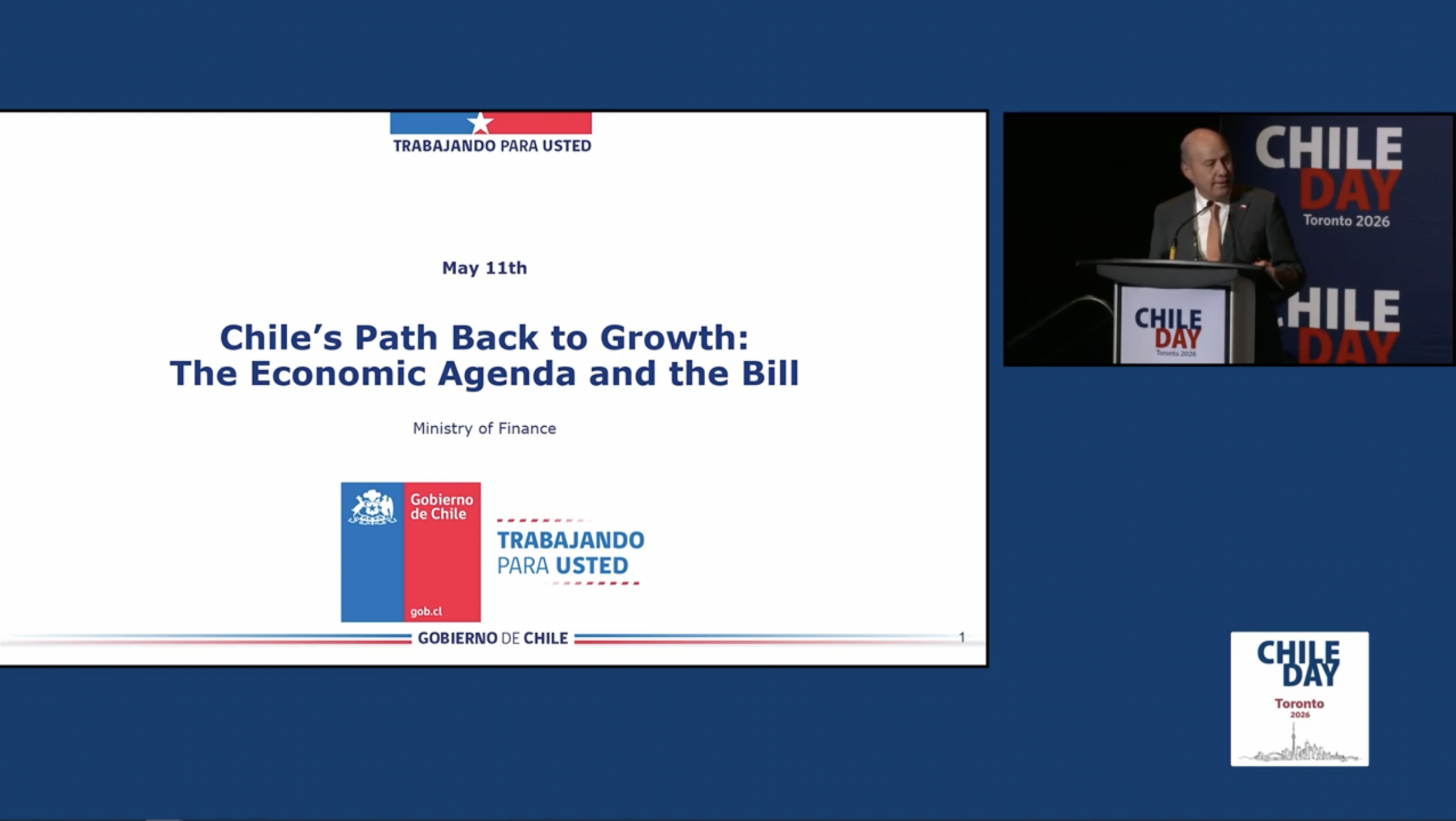
The strongest part of Finance Minister Jorge Quiroz’s presentation was its diagnosis. He did not treat Chile’s investment challenge as a communications problem. He framed it as the result of accumulated frictions: a larger state footprint without equivalent growth, a less competitive tax structure and a regulatory system that has become slower and less predictable. The figures were relevant because they spoke directly to investment confidence. Government expenditure in real terms grew by 4.3% per year over the past decade, while real per capita income grew by only 1%. The corporate tax rate increased from 20% to 27% in 2014, yet revenue from that tax rose only from 3.7% to 4.0% of GDP. Investment growth fell from 8.6% per year in 2000–2013 to 1.7% from 2014 onwards.
For capital, this is the relevant context. Chile is not trying to improve sentiment in isolation. It is trying to reverse a measurable loss of investment momentum. The permitting data was even more important for mining. Quiroz noted that, under broadly similar environmental rules, environmental approval took around 18 months twelve years ago. Today, it can take 37 months or more, with added uncertainty. His point on mining was particularly direct: venture capital belongs in greenfield exploration, not in the development phase of a project that has already passed the geological risk stage. That distinction is central to mining viability. Mining can absorb geological risk. It can absorb commodity cycles. It can absorb technical complexity. It becomes much harder to finance when regulatory uncertainty remains open-ended after years of work.
Management, decrees and laws
One of the most useful frameworks presented at Chile Day was Quiroz’s distinction between three tools of action: management, decrees and laws. For investors, those categories are not equivalent. Management can move quickly. Decrees can adjust implementation within the authority of the executive branch. Laws can change the structural framework, but they require political conversion. They must pass through Congress, survive amendments and then be implemented with enough clarity to matter.
This distinction should shape how investors read Chile today. The direction is constructive, but not every measure carries the same degree of certainty. Some changes are already being pursued administratively. Others remain proposals. The final framework will depend on what is approved, how it is written and whether it can endure beyond the current political cycle. For mining capital, this is not a procedural distinction. It is part of risk pricing.
Permitting as valuation
Chile’s Minister of the Environment, Francisca Toledo, delivered one of the clearest execution signals of Chile Day Toronto. Her message was not centred only on future reform. It emphasized measures already underway: eliminating inefficiencies, unblocking delayed projects, shortening processes and preserving environmental standards.
For mining investors, that framing is material. Environmental review is often discussed as a regulatory process. In project finance, it is also a valuation issue. Time affects NPV. Delays affect CAPEX. Uncertainty affects financing assumptions. A project that cannot estimate its permitting path cannot define its investment path.
Toledo’s statement that economic growth, legal certainty and sustainability belong to the same agenda was therefore not simply a policy line. It challenged the assumption that environmental institutions and investment certainty must move in opposite directions. The relevant test is whether Chile can maintain credible environmental standards while reducing avoidable administrative friction.
The reference to more than US$9 billion in delayed projects resolved through management, together with the target of reducing environmental assessment times by at least 30%, gave that message substance. It suggested that part of the bottleneck can be addressed before every legislative change is complete.
For mining, this is one of the most investable signals. Permitting discipline is not a side issue. It is one of the conditions that determines whether mineral potential becomes a project pipeline.
Tax certainty and capital allocation
The TAX panel was one of the most relevant discussions for foreign investors because it moved the conversation beyond headline rates. Theresa Murakami of Lundin Mining made a useful distinction from the investor’s side: tax becomes decisive after a project has passed the first investability screen. Before that, investors look at permitting timelines, political certainty, legal and litigation risk, infrastructure and commodity prices. Once the project clears that hurdle, tax begins to shape after tax cash flow, NPV, return on investment and comparison across jurisdictions. For projects close to the hurdle rate, a few percentage points can change the economics.
That is the right way to read the proposed reduction of the corporate tax rate from 27% to 23%. It is a competitiveness measure. It is not, by itself, the whole investment case. Nor should it be confused with a structural change to taxes associated with capital repatriation. The one time repatriation mechanism discussed in the broader reform context is a separate question and should be evaluated case by case, including the treatment of foreign tax credits and the actual benefit available to each structure.
The deeper point is fiscal visibility. Astrid Schudeck, tax partner at PwC Chile, noted that treaty country investors face an effective tax rate of around 35%, while non treaty investors can face 45%. The proposed reintegration of the system would seek to place foreign investors under a 35% framework. For mining, the proposed invariability of the royalty is also relevant because royalties can materially affect project economics over the life of a mine.
The panel also surfaced a broader concern: investors need more than statutory rules. They need stable interpretation. Uncertainty around treaty application, changes in administrative criteria and repeated reforms can damage confidence even when the headline tax rate appears competitive. For mining, the fiscal question is therefore not simply “how much tax?” It is whether the framework can be modelled, relied upon and defended across the life of the asset.
Infrastructure as a precedent for continuity
The infrastructure discussion added another layer to the investment case. It showed that Chile has already built one framework capable of surviving political alternation.
Chile’s Undersecretary of Public Works, Nicolás Balmaceda, presented the country as an institutional destination for infrastructure investment, supported by several elements: investment grade status, the UF as an inflation hedging mechanism for long term finance, 37 bilateral tax treaties, and the proposed recovery of tax invariability for foreign investment. He also referred to 70 priority initiatives across the Ministry of Public Works for around US$28 billion, half under a PPP model and half as direct public works.
For mining, infrastructure is never a separate conversation. Roads, ports, power, water systems, logistics corridors and regional infrastructure shape capital intensity, operating costs, construction risk, expansion potential and timelines.
The most important point, however, was not the size of the pipeline. It was continuity. Chile’s concession system has lasted more than three decades, across eight administrations and four political coalitions. That is the type of institutional durability long-cycle capital understands.
Mining needs something comparable. Not the same structure, but the same political depth: a framework that can survive changes in government because the country recognizes the strategic value of the sector.
Mining: from obstacle State to enabling State
Chile’s Undersecretary of Mining, Álvaro González, gave the mining presentation its clearest conceptual frame when he described the need to move from an obstacle State to an enabling State. That language touches the core of the framework we have developed in Mining Is Dead. Long Live Geopolitical Mining: mining viability depends not only on geology, but on the institutional capacity of a country to turn mineral potential into executable projects.
For Chile, this is more than a policy phrase. It is a mining viability question. The country’s stagnation is not explained by the absence of minerals. Chile has copper, lithium, technical capability, mining history and access to global capital. The constraint lies in the system that determines whether those assets can become projects: permits, bureaucracy, legal certainty, fiscal stability, environmental review, infrastructure, water security and institutional coordination.
The government’s proposed direction is aligned with that diagnosis. The mining plan for 2026–2030 places emphasis on investment promotion, legal certainty, regulatory modernization, stronger institutions and project acceleration. It also points to issues that are central for modern mining viability: water management, supplier ecosystems, automation, energy efficiency and the ambition to move beyond raw material extraction toward a more sophisticated mining innovation platform.
Our recommendation to Chile goes one step further. An enabling State is more than a government willing to unblock projects. It is an institutional architecture capable of supporting mining investment across political cycles. It requires permitting discipline, fiscal visibility, technical review, environmental certainty, water and infrastructure coordination, and a political consensus that formal mining is part of the country’s development strategy.
The current administration is moving quickly, and that matters. In only a short time in office, it has placed investment, permitting, taxation, infrastructure and mining development at the center of the agenda. This first signal is constructive. The next test is whether the broader political system (government, opposition, Congress, regulators and institutions) can turn that enabling agenda into a country level framework.
That is the distinction that matters for long cycle capital. A government can accelerate. A country must endure. For Chile, the mining question is whether the shift from obstacle State to enabling State becomes a national commitment rather than the program of one administration.
From pipeline visibility to project delivery
Chile’s challenge is not the absence of projects. Large scale copper, lithium, infrastructure and water related investments continue to attract attention. The question for mining capital is more precise: how many of those projects can move from entry into the system to approval, financing, construction and operation.
A pipeline is a signal of opportunity. Conversion is the test of viability. For investors, the relevant metric is not only the number or value of projects being discussed. It is the state’s ability to move those projects through the system with enough clarity, speed and continuity to justify long cycle capital. A project that enters environmental review but remains trapped in uncertainty is not yet an investable asset. A project that can move through permits, infrastructure, water, fiscal modelling, financing and construction becomes part of a country’s productive capacity.
This is also where Chile Day Toronto could become stronger in future editions. Toronto is one of the world’s leading mining finance centers. Beyond high level policy panels, Chile could add a more project facing layer: juniors, developers and emerging mining companies seeking capital, offtake partners, lenders or strategic investors. High level panels build country confidence. Project facing spaces help translate that confidence into capital formation.
Execution reality check
As this article was being written, Chile’s Second Environmental Court revoked the environmental approval of Collahuasi’s “Desarrollo de Infraestructura y Mejoramiento de Capacidad Productiva” project and ordered the Environmental Assessment Service to partially reopen the evaluation process. The project had originally obtained environmental approval in 2021. According to the company, approximately US$3.2 billion had already been invested and the desalination plant was in its final stage of construction. The Collahuasi case is a useful reminder of why mining viability cannot be measured by project announcements alone. The relevance of the case is not only the size of the investment. It is the nature of the risk. The court’s concern was not centred on conventional environmental pollution or the marine modelling of the desalination infrastructure. The issue was the robustness of the human baseline, the characterization of potentially affected Indigenous communities, and whether further participation or consultation processes were required.
For mining investors, this is precisely where approval becomes different from durability. A project can have capital, engineering, environmental approval and strategic relevance, and still face material uncertainty if the social and territorial foundations of that approval are later questioned.
This point requires precision. The argument is not that projects should be protected from scrutiny. They should not. Environmental review, judicial oversight, community participation and Indigenous consultation are essential to the legitimacy of any serious mining jurisdiction. The issue is institutional sequencing. The material questions that define whether a project is socially, territorially and environmentally viable should be identified, assessed and resolved before approval is granted, not reopened years later, after capital has been committed and construction is already advanced.
For investors, predictability does not mean the absence of challenge. It means that challenge is handled through clear criteria, timely processes and institutions capable of reaching decisions that become durable once the rules have been met. If fundamental questions about communities, consultation or territorial impact remain unresolved after approval, the problem is not only legal uncertainty. It is a weakness in the approval process itself. That is the distinction mining capital will look at. A robust system should front load scrutiny. It should test the project seriously before approval. But once a project has passed that test, the resulting approval needs enough institutional strength to support financing, construction and operation. Without that durability, approval becomes provisional, even when it appears final.
The same logic applies beyond permitting. Recent questions around Codelco’s reported production figures, including scrutiny of approximately 20,000 tonnes of copper and the call for further investigation and external audit, point to a different but related layer of mining viability: governance, internal controls, traceability and operational credibility.
Neither case should be read as a judgment on the current administration. They point to a broader system issue. Chile’s mining challenge is not only to accelerate approvals, but to make those approvals institutionally robust and durable. It is not only to attract investment, but to ensure that projects can move through the full chain: permitting, territorial legitimacy, financing, construction, operation, reporting and governance.
That is why the country level question matters. An enabling State is not only a faster State. It is a State whose institutions can support investment with credibility across the full life of a mining project.

For private decision support on project, jurisdiction or capital questions, Geopolitical Mining Advisory applies a Systemic Mining Viability lens to assess whether a mining opportunity can become credible, legitimate and financeable before full due diligence begins.
The country level test
Chile Day Toronto was constructive because it revealed more than a pro-investment message. It showed a government trying to articulate the conditions of mining viability: diagnosis, permitting discipline, fiscal visibility, infrastructure, water security, institutional capacity and political continuity.
For Geopolitical Mining, that is the relevant frame. Mining is no longer only an extractive activity. It sits inside the material foundation of energy systems, artificial intelligence, infrastructure, defense, industrial policy and national competitiveness. Chile’s copper and lithium give the country strategic relevance, but strategic relevance does not automatically produce investment.
Capital will ask a harder question: can Chile convert that position into projects that can be permitted, financed, built and operated across political cycles? This is why mining cannot be only a government project. It has to become a country level commitment. The proposed reforms may improve Chile’s investment proposition, but many of them still need legislative approval and institutional implementation. Administrative acceleration is already visible in some areas; legislative durability remains the next test. Investors will not underwrite intention alone. They will underwrite execution capacity, fiscal stability, permitting discipline and political continuity.
Chile is asking investors to come back. Mining investors will ask whether the country can stay the course.
Resources
- ChileDay. (2026). Agenda Toronto.
- ChileDay. (2026). Presentation by the Minister of Finance of Chile — Jorge Quiroz.
- ChileDay. (2026). Presentation by the Minister of the Environment of Chile — Francisca Toledo.
- ChileDay. (2026). Presentation by the Undersecretary of Mining of Chile — Álvaro González.
- ChileDay. (2026). Panel Infrastructure: Analysis and Opportunities.
- ChileDay. (2026). Panel: TAX.
- Cámara de Diputadas y Diputados de Chile. (2026). Proyecto de Ley: Para la reconstrucción nacional y el desarrollo económico y social, Boletín 18216-05.
- BioBioChile. (2026). Collahuasi evalúa acciones tras revocación a RCA de proyecto con inversión de más de US$3 mil millones.
- MINING.COM. (2026). Codelco output questioned over 20,000-tonne gap.