
Geopolitical Mining · Country Case
Codelco: A State Operator Under Pressure in the Age of Geopolitical Mining
Authors: Marta Rivera | Eduardo Zamanillo
April 13, 2026
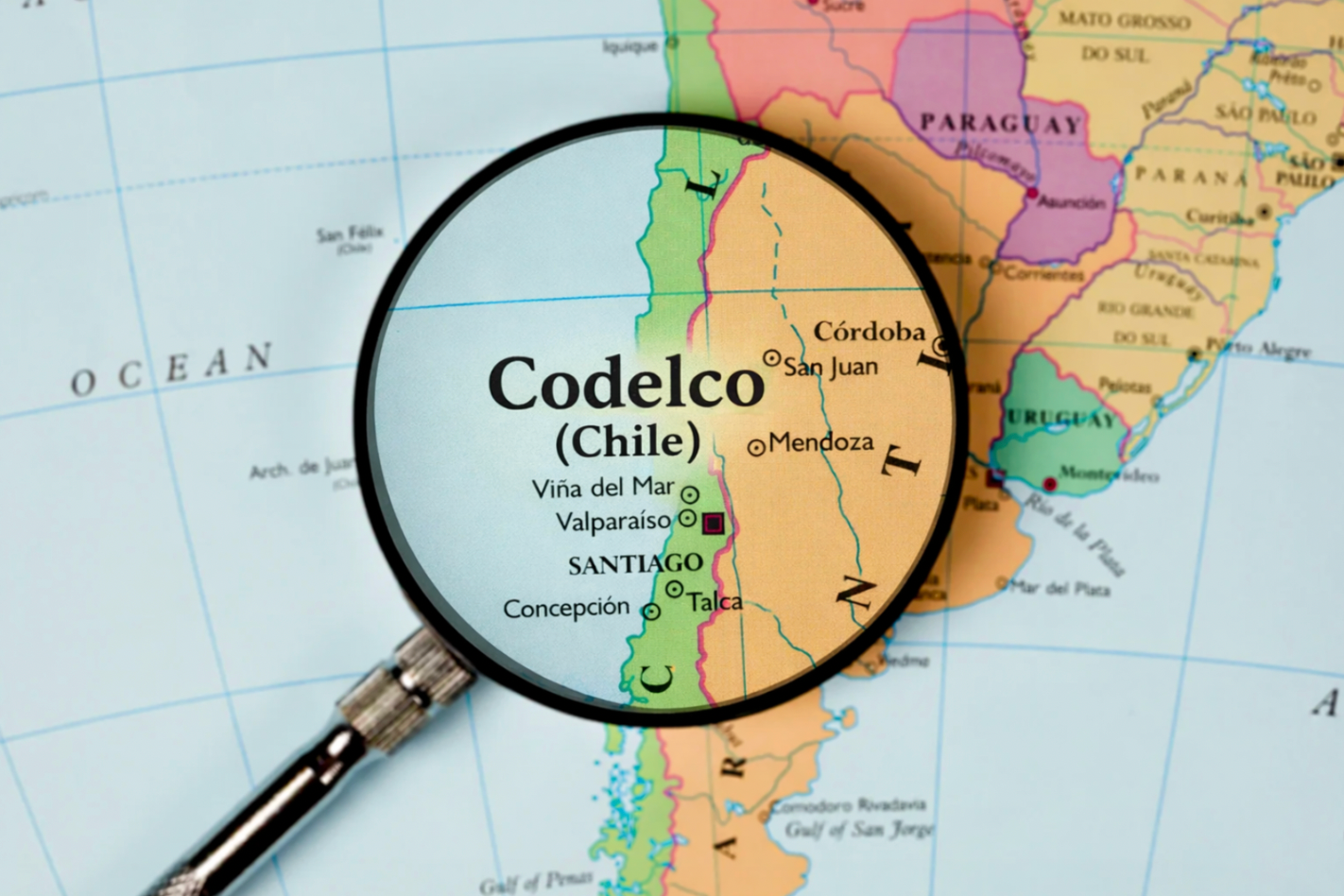
Codelco remains the world’s largest copper producer and stands as one of the clearest contemporary tests of what a state mining operator can achieve in a strategically important commodity. Chile created Codelco to operate mining directly, capture a greater share of rent, and turn mineral wealth into national development. That founding ambition was coherent in its time. The question today is whether Chile has preserved the institutional, technical, and financial conditions required for a state operator to perform well in a far more demanding mining era. Chile nationalized the large copper mines in 1971 and formally established Codelco in 1976 as a state-owned mining, industrial, and commercial corporation.
1. Why Codelco Is Becoming a Case Worth Watching
Codelco has become an especially important case in geopolitical mining because it brings into focus a larger strategic question: what happens when a country chooses to operate a strategic mineral directly through the state rather than simply host mining activity within its borders?
For decades, Codelco stood as a symbol of sovereign control over a strategic resource. It was built to ensure that a greater share of copper rent remained in Chilean hands and could be linked to broader national objectives. That logic retains its force today. Copper is moving closer to the center of the global economy, and Chile remains one of the world’s most important producers. In that context, the Codelco case raises a more demanding question: if minerals are becoming more strategic, can a state operator still deliver the level of performance required to convert that opportunity into lasting national advantage?
That is what gives the case its analytical value. Codelco reveals far more than the condition of a single company. It shows how Chile has managed the relationship between sovereignty, state ownership, technical execution, capital intensity, and long-term mining discipline. The company matters because it sits precisely where those forces converge.
2. The Original Logic: A State Operator Built to Capture National Rent
Codelco emerged as the operational expression of Chile’s decision to nationalize its most strategic copper assets. It embodied a clear state thesis: Chile would do more than tax or regulate copper. It would operate it directly and use that operating capacity to retain a greater share of the value generated by the country’s most important mineral endowment. The company’s own historical account reflects that logic clearly. Following the constitutional reform that nationalized copper in 1971, Codelco was formalized in 1976 as a state-owned corporation that brought the nationalized deposits together within a single mining, industrial, and commercial structure.
That historical mission still carries weight. A successful state operator can achieve forms of alignment that a purely private system struggles to reproduce. It can connect production, investment, and strategic planning to national objectives. It can serve as a fiscal anchor, sustain long-cycle investment where continuity matters to the state, and preserve sovereign influence over a strategic commodity during periods of geopolitical tension.
At the same time, this model rests on demanding conditions. A state operator still has to function as a serious mining company, with technical discipline, sound capital allocation, production continuity, and operational control. Sovereign ownership heightens those requirements rather than easing them. That is precisely what makes the Codelco case so revealing.
3. What the Numbers Show: High Copper Prices, Lower Capture
The recent Codelco story is defined by a widening gap between a favorable market environment and a weaker ability to capture value. The company’s long historical series shows that between 2015 and 2025 total copper production fell from 1.891 million tonnes to 1.440 million tonnes, while own copper sales declined from 1.774 million tonnes to 1.522 million tonnes. Over the same period, average ore grade fell from 0.77% to 0.63%, cash cost rose from 138.7 USc/lb to 208.6 USc/lb, and net financial debt increased from US$13.2 billion to US$25.1 billion.
The significance of that deterioration becomes clearer when set against the copper price environment. In 2015, the copper price in Codelco’s series stood at 249.2 USc/lb. By 2025, it had risen to 450.8 USc/lb, the highest level in that published series. Under those conditions, one would have expected a much stronger level of sovereign capture through the state operator. Yet the fiscal outcome moved in the opposite direction. In 2021, with an LME copper price of 422.6 USc/lb, Codelco contributed US$5.573 billion to the Chilean Treasury. In 2025, despite a higher average copper price, it contributed US$1.778 billion. That divergence sits at the political and strategic center of the case: the recent copper cycle created a major rent opportunity, but Chile converted only part of it into fiscal capture through Codelco.
That does not make 2025 a year of financial collapse. Codelco reported US$6.67 billion in Adjusted EBITDA, up from US$5.44 billion in 2024, while total revenues rose to US$19.6 billion. Those results, however, require careful interpretation. The company itself states that profit before tax was strongly supported by a higher share of income from associates and joint ventures, reflecting the inclusion of the lithium business with SQM, while Adjusted EBITDA explicitly excludes that effect. The improvement in 2025 therefore points to relief, but it does not yet establish a full structural recovery of the copper business.
4. The Real Pressure Point: Cost Inflation and Operational Erosion
Cost provides one of the clearest entry points into the Codelco case. The company’s own series shows that cash cost remained relatively contained between 2016 and 2021, moving within a range of 126.1 to 141.6 USc/lb. The real break begins in 2022. Cash cost rose to 165.4 USc/lb that year, climbed to 203.1 in 2023, eased slightly to 199.1 in 2024, and then rose again to 208.6 in 2025.
Several forces help explain that shift. Part of it is structural. Ore grades have declined, mines have aged, and greater development work is required to sustain the production base. At the same time, the recent increase also reflects a more specific deterioration in operating performance. In its recent reporting, Codelco linked cost pressure to lower production, higher electricity and diesel costs, greater use of inventories, additional maintenance services, equipment rentals used to accelerate mine development, and higher local costs. The 2025 operational report also records US$415.6 million in fixed indirect costs associated with low production levels, including US$162.2 million related to El Teniente after the July 31, 2025 seismic event and the subsequent interruption and recovery process. This matters because it shows that the pressure does not come only from more expensive inputs. It also comes from weaker dilution of fixed costs as operational continuity deteriorates.
At that point, the case moves beyond a narrow discussion of accounting or market timing. Once a state operator begins to lose volume while carrying a heavier cost base, the pressure spreads quickly through the rest of the model. What starts as operational erosion soon becomes a financial problem as well.
5. Debt, Capital Intensity, and the Cost of Being a State Operator
Debt is one of the most revealing parts of the Codelco case because it helps explain a deeper tension at the center of the model. It is easy to treat debt as a secondary financial indicator, but in this case it says something more fundamental about the kind of burden the company is being asked to carry. Chile expects Codelco to remain a major fiscal contributor, preserve sovereign operating capacity in copper, and execute a large portfolio of structural projects at the same time. When those demands converge under weaker production and rising costs, debt becomes one of the principal mechanisms through which that tension is financed. Codelco’s long historical series shows that net financial debt increased from US$13.2 billion in 2015 to US$25.1 billion in 2025.
The company does not present this increase as a sudden anomaly. It reflects a structural financing challenge that has been visible for years. In its 2016 Annual Report, Codelco stated plainly that the resources approved by the State did “not resolve the company’s medium- and long-term financing problem” and that a new arrangement with its owner would be needed to establish a sustainable capitalization framework. That admission matters because it shows that the tension between state ownership, fiscal extraction, and capital-intensive mining renewal did not emerge recently. It was already embedded in the model.
The 2025 results make that tension especially clear. During the year, Codelco generated about US$3.9 billion in operating cash flow while reporting more than US$5.0 billion in capital and exploration expenditure. In other words, the company continued to invest at a level above the cash it generated from operations. That gap does not automatically imply failure. In mining, large long-cycle investments are often necessary to preserve future production. In Codelco’s case, however, it does help explain why debt continued to rise even in a strong copper price environment. The company was financing more than growth. It was financing the effort to sustain its production platform while operating under more difficult geological and operational conditions.
Debt matters here because it shows that part of the value generated by copper is no longer being translated cleanly into sovereign capture. A growing share of the system’s energy is being used to sustain the operator itself. For that reason, debt should be read as more than a sign of financial weakness. It is also a sign of the capital intensity of the state operator model when that operator is asked to do too many hard things at once. Codelco is a state-owned producer expected to preserve national operating capacity, contribute materially to the Treasury, and advance the structural projects required to replace declining ore bodies and aging assets. When production does not recover quickly enough, and when costs rise at the same time, the financing burden becomes heavier and the model becomes more exposed.
That is why debt belongs at the center of the Codelco story. It reveals that the issue goes beyond operational deterioration and beyond governance strain. It also reflects the financial cost of asking a state operator to remain sovereign, productive, and fiscally useful while the technical base of the business becomes more demanding. Seen in that light, Codelco’s debt trajectory is not just a balance-sheet trend. It is one of the clearest expressions of the pressure the model is carrying.
6. Governance, Control, and the Technical Question
The Codelco story became more serious when operational pressure began to intersect with governance concerns. In February 2026, the board of directors publicly stated that an internal audit had identified “inconsistencies and concealment” in the way technical information had been reported to the sectoral authority, together with serious deviations and governance weaknesses in El Teniente and across the corporation more broadly. That public statement matters because it takes the discussion beyond ordinary cost pressure or project delay and places governance and technical control much closer to the center of the case.
This does not in itself prove that Codelco has been overtaken by non-technical decision-making. The executive layer still includes senior professionals with strong mining and engineering backgrounds. At the same time, the public composition of the board raises a legitimate institutional question. The current board includes profiles from business, industrial engineering, law, history, human resources, and psychology, while only one director is publicly identified as a mining engineer. That fact may not be problematic in itself. In a highly complex mining operator facing declining grades, project execution pressure, safety concerns, and rising debt, however, the issue becomes far more acute: does the governance structure preserve sufficient technical gravity at the top of the system?
This is one of the most important lessons of the case. A state operator does not weaken only when prices fall. It can also weaken when the technical logic of the business is no longer adequately protected within the governance structure meant to direct it.

For the full Geopolitical Mining framework behind this article, see our book Mining Is Dead. Long Live Geopolitical Mining.
7. Codelco and the Limits of the State Operator Model
It would be too simplistic to conclude from the Codelco case that the state should not operate mining assets. That argument goes further than the evidence allows. Chile’s decision to nationalize copper and operate through Codelco reflected a coherent sovereign logic. There are also moments in the company’s recent history, including 2021, that show what a state operator can achieve when production, costs, and market conditions move into alignment.
The more valuable conclusion is also the more demanding one. Codelco does not show that the state operator model is inherently flawed. It shows that such a model depends on the state behaving like a serious owner. That means providing timely capitalization, preserving technical discipline, protecting execution quality, and ensuring that governance structures are adequate to the complexity of the business.
This is what makes the Chilean case especially instructive. The strain does not come simply from the fact that Codelco is state-owned. It comes from the accumulation of difficult functions placed on the company at the same time: remaining a major fiscal contributor, financing and executing large structural projects, managing geological deterioration, and sustaining world-class operational performance under political ownership. Once those conditions stop reinforcing one another, the model begins to show visible strain.
8. The State (Codelco): Operator or Facilitator?
At this stage, the case opens a broader policy question. Should the state directly operate strategic mining assets, or does it create greater value by acting primarily as a facilitator, regulator, and coordinator of private investment? This is not only a Chilean question. It is one of the central questions of geopolitical mining.
The answer is unlikely to be binary. In some contexts, direct operation can still make strategic sense. The Codelco case, however, suggests that such a model is far more demanding than political rhetoric usually admits. It requires sustained capital discipline, technical strength, continuity of execution, and governance robust enough to resist institutional drift. Where those conditions weaken, sovereign ownership may remain intact while sovereign capture deteriorates.
That is why the case matters beyond Chile. In a world where minerals are becoming more strategic, ownership alone does not create advantage. The test lies in whether the institutional model around the asset can convert ownership into sustained national benefit.
9. Codelco and the New Logic of Geopolitical Mining
Codelco deserves attention because it reveals a deeper institutional story about the new era of strategic minerals. Its case shows that state ownership alone does not convert mineral wealth into strategic outcomes. Capture depends on execution. Resilience depends on technical discipline. High prices deliver national returns only when the operating system beneath them remains strong.
Seen through the broader framework of geopolitical mining, Codelco brings one of the defining truths of this period into sharper view: mineral sovereignty now depends on far more than ownership of the resource itself. It depends on the capacity to operate, finance, govern, and sustain the chain around that resource with enough seriousness to turn mineral abundance into lasting national leverage.
That is what makes Codelco so important today. The company illustrates the distance between owning a strategic asset and converting that ownership into durable national advantage. In an era shaped by tighter supply chains, heavier capital requirements, rising technical complexity, and growing geopolitical competition, that distance has become one of the most important questions in mining. Codelco therefore matters not only as a Chilean company under pressure, but as a test of whether a state can still translate mineral sovereignty into operational strength, fiscal capture, and long-term strategic credibility.
Resources
- Codelco – Historia
- Ley Chile – Decreto Ley 1.350 (1976), crea la Corporación Nacional del Cobre de Chile
- Codelco – Resultados del ejercicio completo 2025
- Codelco – Resultados de los nueve meses de 2025
- Codelco – Informe Anual 2016
- Codelco – Estados Financieros Consolidados al 31 de marzo de 2025
- Codelco – Estados Financieros Consolidados al 30 de junio de 2025
- Codelco – Declaración pública del Consejo de Administración sobre El Teniente
- Codelco – Junta Directiva

For board level insight and decision support on mining, legitimacy and industrial strategy, visit Geopolitical Mining Advisory.